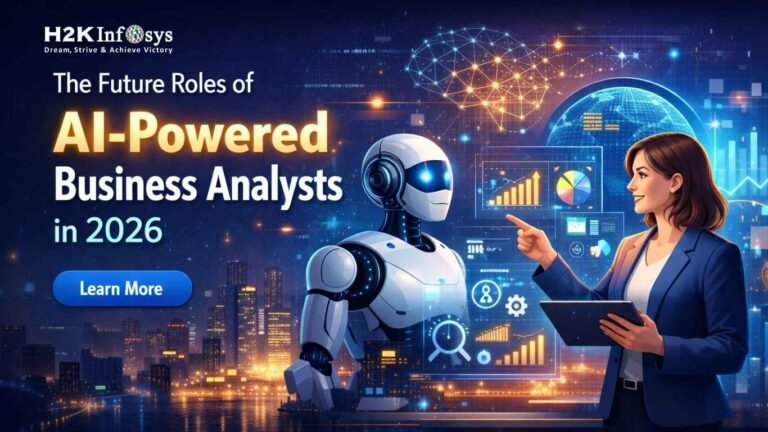
In 2026, H2K Infosys predicts that AI-powered Business Analysts (BAs) will evolve into strategic, AI-augmented partners who move beyond manual data processing to high-level decision-making. These analysts will utilize AI for rapid analysis and predictive modeling, helping businesses optimize strategies. Key roles will include interpreting complex data trends, managing AI agents, and driving hyper-personalized strategies. BAs will shift from merely running reports to refining business strategies alongside AI, using AI-driven tools for accurate forecasting and overseeing autonomous AI agents. These advancements will require BAs to combine advanced data interpretation, soft skills, and technical adaptability for success.
The Growing Importance of AI in Business Analysis
AI-powered Business Analysts who know how to use AI do more than just produce reports and analyze numbers. BAs will have positions in which they use AI technologies to locate important information and make predictions about the future. This is because AI can quickly and accurately examine at large amounts of data. AI isn’t replacing the analyst; it’s making their job easier by helping them make judgments faster and better.
Anyone who wants to receive business analysis training or an online business analyst certification has a bright future ahead of them. Training is being developed to integrate AI technology, which will assist those who want to be BAs in obtaining the skills they need to do well in this fast-changing field. By adding AI to their toolkits, these people will be at the forefront of driving innovation and strategy in businesses.
1. Predictive Analytics and Decision-Making
A BA’s job has always been to analyze the data and create understanding from that data. It’s been taken to an entirely new level with AI. AI-Enabled BAs will predict market trends, customer behaviour, and prospective business opportunities using predictive analytics. And, rather than simply responding to changes, they’ll be proactive in helping organizations not just understand what’s happening now, but also have a better view of what is likely to happen in the future. This tranformation in BA function towards predictive analysis is one of the key characteristics that we would observe in a 2026 BA.
Business analysis training is already incorporating AI integration. Students today are learning how to use AI for predictive analytics an employment advantage. Furthermore, the application of machine learning models and natural language processing (NLP) processed AI-powered tools will refine predictive accuracy and range to discretion.
2. Automation of Repetitive Tasks
Automation is known to be the most drastic form of influence AI will have on the BA practice. BAs have traditionally dedicated a lot of time to collecting and sorting data in the past. Much of this will be automated for AI-driven Business Analysts, allowing them to earn in more strategic issues and business-enablers.
But the rise of AI doesn’t mean BAs are no longer of value. AI is not about replacing the BAs but automating boring tasks so that they can focus on value-added activities. Through the fluency in AI-augmented technology, BAs will additionally have the skills they need to govern automation when it is in place and work well within parameters that support what the business is hoping to achieve.
3. Enhanced Collaboration with AI Systems
By 2026, we may see a more significant focus on teaming business analysis with AI systems. AI Business Analysts will collaborate closely with AI models to interpret results and iterate processes. Rather than being decision makers themselves, BAs will be the liaison between humans and the AI systems that make their output align with a business’s strategic objectives.
In this new role, BAs need to be well-versed in both AI and business strategy. Business analyst certification courses are even now starting to encompass AI, equipping professionals with the skills they need to engage closely with Aaron, not compete their way towards business success.
4. AI-driven Data Visualization and Reporting
Artificial intelligence (AI) is altering the field of data visualization, enabling business analysts to communicate complex data through visually appealing representations that can be understood at a glance. At its best, an AI-driven Business Analyst will use tools that allow them to automatically create real-time reports and collect data from different sources in a cohesive manner. This will decrease the time that is invested in generating reports manually, and organizations can get insights whenever they want.
by 2026, we will see BAs engaging in shit tons of AI-powered dashboard designs, applying AI tools for finding out the most important measures and numbers, and giving those insights to decision makers in a way that would be persona,l digestible, and usable.”
5. New Attention on Innovation and Business Strategy
With less of the technical and data analytics-heavy drudgework to handle, AI-driven Business Analysts are likely going to get more strategic in organizations. They will be providing more than just data analysis and reporting, but rather insight into long-term business strategy and innovation.
Business analysis online training will, in all probably change to be about this, recognizing there will be a ton of real eureka moments realized through a more artistic approach to thinking and resolving issues. As well as mastering AI technology, tomorrow’s BAs will increasingly require great business-savvy and a skill for converting the insights from AI into real actions in their businesses.
6. Ethical Considerations and AI Governance
And as AI capabilities are more deeply integrated into businesses decision making, this will include a focus on ensuring those systems operate ethically. AI has power, but if unchecked, it can create biased or unethical results. BAs will also have to operationalize governance frameworks, so that AI is used responsibly and in a way that’s consistent with industry norms and legal requirements.
This change will necessitate business analyst certification programs adopting training about AI ethics, governance, and compliance so analysts can manage the nuances of AI decision-making.
Conclusion: The Future Looks Bright for AI Business Analysts
AI-based Business Analysts will be key drivers in the business environment of the future. Beyond 2026, not only will these professionals depend upon Artificial Intelligence for data exploration and decision making, but they themselves will serve as the main catalysts for corporate strategy, innovation, and responsible AI within their organisations. Indeed, if you want to pursue a career in business analysis, it’s evident that learning how to use AI tools and applications will be necessary to remain relevant in the constantly changing world of business.
For those seeking to remain relevant during this new age, business analysis training and Placement and business analyst courses with an emphasis on AI are a step in the right direction. The future is bright for AI-based Business Analysts, and you could, with the right training, become a leader in its adoption.