If you’ve ever struggled to turn messy business data into clear decisions, the answer is simple: Salesforce analytics tools help teams predict trends faster, understand customers better, and make smarter decisions without spending hours inside spreadsheets. That’s exactly why so many professionals are learning Salesforce Einstein today. It’s no longer just a “nice-to-have” platform feature it’s becoming a serious competitive advantage for businesses and job seekers alike.
Companies across healthcare, retail, finance, SaaS, and logistics are leaning heavily into AI-powered reporting. And honestly, after seeing how fast organizations are adopting intelligent CRM systems in 2025 and 2026, it’s pretty obvious why demand for people with hands-on analytics skills has exploded.
I’ve spoken with professionals who moved from basic reporting roles into high-paying CRM analyst positions simply because they understood how to work with Salesforce Einstein effectively. Some started with almost no technical background. That’s the interesting part modern analytics platforms are becoming more business-friendly, not less.
And yes, this is also why interest in Salesforce certification courses, Salesforce training certification, and Salesforce certification programs has surged recently.
Why Businesses Are Paying Attention to AI-Driven Analytics
A few years ago, most companies relied on static dashboards. Teams downloaded CSV files, built reports manually, and hoped nobody made a formula mistake at 11:47 PM before the executive meeting.
Now? Decision-making is becoming predictive.
With Salesforce Einstein, businesses can analyze customer behavior, forecast sales performance, identify churn risks, and automate recommendations in real time. That shift changes how teams operate day-to-day.
Think about a retail company during the holiday sales season. Traditional dashboards might show declining sales after the problem has already happened. AI-powered analytics can flag unusual buying patterns before revenue dips become serious. That proactive insight matters.
What makes Salesforce Einstein particularly valuable is that it sits directly inside the CRM environment that many companies already use. Teams don’t need ten disconnected systems anymore. Sales, marketing, service, and operations can work from one ecosystem.
And from a career standpoint, this integration is huge. Employers increasingly prefer candidates who understand both CRM workflows and AI analytics together.
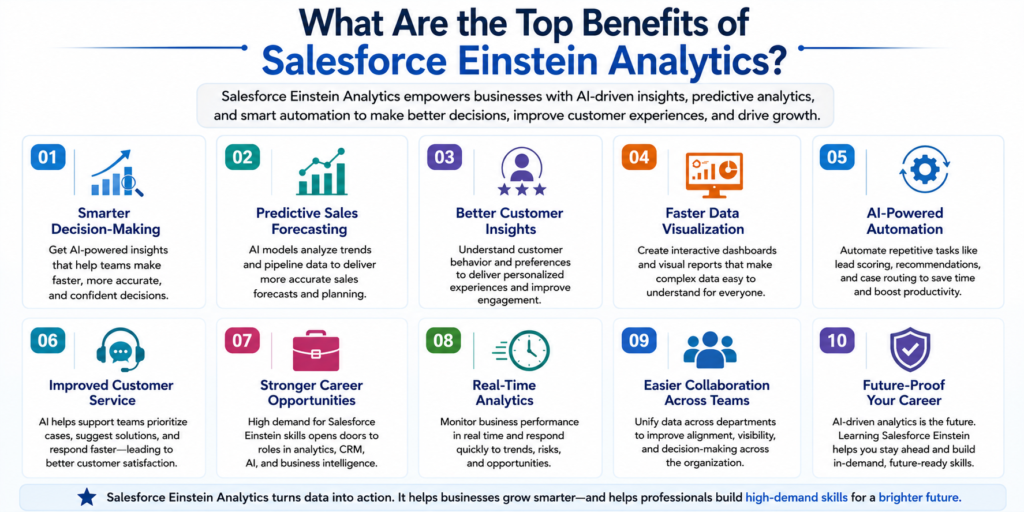
1. Smarter Decision-Making Without Technical Complexity
One of the biggest benefits of Salesforce Einstein is accessibility.
You don’t need to become a hardcore data scientist to gain insights from business data anymore. Managers, sales reps, and marketers can interact with dashboards using natural-language searches and visual reports.
I remember talking with a sales manager who admitted she avoided analytics tools for years because they felt too technical. Once her team adopted Salesforce Einstein, she started using predictive opportunity scoring daily. Her close rates improved because the platform highlighted which leads were actually worth prioritizing.
That’s the practical difference.
Instead of drowning in spreadsheets, teams get focused recommendations.
This is also why many professionals enroll in Salesforce training and placement programs now. Businesses want employees who can bridge the gap between business strategy and intelligent analytics.
2. Predictive Sales Forecasting Actually Saves Time
Forecasting used to be exhausting.
Sales leaders gathered updates from dozens of reps, manually compared numbers, and still ended up with unreliable predictions. AI-based forecasting changes dramatically.
With Salesforce Einstein, historical sales activity, engagement trends, seasonality, and pipeline behavior all feed into forecasting models automatically.
The result? More accurate planning.
A SaaS company, for example, can identify which enterprise deals are likely to stall before quarter-end. That means managers can intervene earlier rather than scrambling during the final week.
And honestly, this matters even more now because businesses are under pressure to make faster decisions with leaner teams.
That’s one reason reputable providers like H2K Infosys are emphasizing real-world analytics scenarios inside their Salesforce certification courses instead of relying only on theoretical lessons.
Recruiters increasingly ask candidates practical questions:
- Can you interpret predictive dashboards?
- Can you optimize CRM workflows?
- Can you explain AI-driven recommendations to stakeholders?
Those skills are becoming extremely valuable.
3. Better Customer Insights and Personalization
Customers expect personalization now. Not “nice personalization.” Real personalization.
People notice when businesses send irrelevant emails or push random offers.
With Salesforce Einstein, organizations can analyze browsing behavior, purchase history, support interactions, and engagement patterns to deliver more relevant experiences.
Streaming platforms already do this brilliantly. Retailers are catching up fast.
For example:
- An eCommerce brand can recommend products based on previous purchases.
- A bank can identify customers likely to need refinancing options.
- A healthcare provider can improve patient engagement through personalized reminders.
The interesting thing is that customers often don’t realize AI is powering these experiences behind the scenes. They just feel like the company gets them.
That subtle improvement builds trust and retention over time.
4. Faster Data Visualization for Non-Technical Teams
This benefit gets overlooked a lot.
Many employees aren’t analysts. They just need answers quickly.
With Salesforce Einstein, users can create visual dashboards that simplify large datasets into charts, trends, and actionable insights. Instead of reading giant tables full of numbers, teams can understand business performance almost instantly.
I’ve seen marketing teams shave hours off weekly reporting simply because visual analytics made campaign performance easier to interpret.
And there’s another important trend happening right now: executives want real-time reporting.
Quarterly reports alone aren’t enough anymore.
Organizations using Salesforce Einstein can monitor operations continuously instead of reacting weeks later. That responsiveness helps businesses adapt much faster during market shifts.
5. AI-Powered Automation Reduces Repetitive Work
This might be my favorite advantage personally.
Nobody enjoys repetitive manual tasks.
Sales reps don’t want to spend half their day updating records. Marketing teams don’t want to manually sort leads. Service teams don’t want to dig endlessly through customer histories.
With Salesforce Einstein, many repetitive workflows become automated:
- Lead scoring
- Opportunity prioritization
- Email recommendations
- Customer sentiment analysis
- Workflow triggers
- Case routing
That automation doesn’t replace employees, it removes low-value busywork.
And honestly, most professionals I talk to welcome that change. They’d rather spend time solving problems than copying data between systems.
This is exactly why employers increasingly favor candidates with Salesforce training certification credentials. Automation knowledge has become highly practical, not just theoretical.
6. Improved Customer Service Experiences
Customer service is evolving at a rapid pace.
End users of omnichannel customer service generally expect fast, accurate, and seamless multi-touchpoint services.
Salesforce Einstein can help enterprise customer support teams implement three types of core business automation operations
A certain domestic Chinese telecommunications enterprise processes thousands of customer inquiries and support requests on a daily basis, and the introduction of artificial intelligence (AI) enables the precise prevention and control of customer complaint risks. One poor experience can push customers toward competitors instantly.
Businesses know this.
That’s partly why CRM and analytics investments continue rising globally despite economic uncertainty.
7. Stronger Career Opportunities for Salesforce Professionals
This part deserves real attention.
The demand for analytics-focused CRM professionals is climbing rapidly.
Companies aren’t just hiring Salesforce admins anymore. They want:
- CRM analysts
- AI consultants
- Business intelligence specialists
- Predictive analytics professionals
- Customer experience strategists
Learning Salesforce Einstein gives professionals an edge because AI-integrated CRM skills are still relatively specialized.
I’ve noticed many hiring managers specifically searching for candidates who completed structured Salesforce certification programs with practical project exposure.
And this is where training quality matters.
Some courses teach theory but skip real-world implementation. Others include hands-on projects, sandbox environments, interview preparation, and placement support.
That difference can seriously impact career outcomes.
Why H2K Infosys Stands Out for Salesforce Training
There are countless online tech courses floating around now. Some are excellent. Some feel rushed and outdated after two modules.
What I’ve consistently heard about H2K Infosys is that their training focuses heavily on practical experience rather than memorization alone.
Their Salesforce Einstein programs include:
- Project exposure in real time
- Sessions led by instructors
- Assignments with hands-on experience
- Advice for career paths
- Help with finding jobs
- Current examples from the industry
That approach is important because employers are more interested in practical experience and not just in certificates.
Flexibility is also important to their learners because many of them juggle classes and work at the same time.
And honestly, the placement support aspect makes a huge difference for career changers entering the Salesforce ecosystem for the first time.
8. Real-Time Analytics for Faster Business Response
Markets move quickly now. Sometimes painfully quickly.
The performance of a business can change due to a viral trend, a supply chain issue, or a user backlash.
Enterprises can leverage Salesforce Einstein to retrieve real-time operational data, thereby seizing core competitive advantages in the market.
Logistics enterprises can use real-time analytics to identify potential distribution bottlenecks and avoid all types of delivery delays.
The AI dashboard can identify traffic peaks, helping online retailers manage potential risks and avoid user boycotts.
All business scenarios are essential elements of core operations.
Currently, the core focus of Salesforce certification courses is AI reporting and intelligent automation.
9. Integration of Multiple Systems for Greater Collaboration
The Core Value of Salesforce Einstein’s Cross-Team Collaboration Is Underrated
Sales, service, marketing, and leadership teams often operate with disconnected data sources. That creates different priorities for each group.
When analytics are contained in a centralized CRM system:
- Sales looks at the customer service history
- Marketing can track campaign impact
- Executives can look at performance indicators
- Support can analyze customer purchase history
This synchronization fosters organizational-wide alignment and is essential for better decisions.
And honestly, smoother collaboration often improves workplace culture too. Fewer arguments over whose data is correct.
I know that sounds simple, but anyone who’s worked in fragmented reporting environments understands how frustrating disconnected systems can become.
10. Future-Proofing Careers in the AI Era
This is probably the biggest long-term reason people are learning these skills right now.
AI adoption isn’t slowing down.
According to recent industry hiring trends, organizations are actively investing in intelligent CRM systems and analytics automation. Businesses want professionals who understand both customer relationship management and AI-powered insights.
Learning Salesforce Einstein positions professionals for that future.
The combination of CRM expertise, analytics interpretation, and automation understanding is becoming incredibly valuable across industries.
And the truth is, companies don’t just want technical people anymore. They want professionals who can explain insights clearly to business teams.
In talent development, communication skills, hands-on projects, and industry exposure are equally as important as passing exams.
Vocational programs that include Salesforce training and job placement services have become widely popular, as learners crave genuine employment pathways rather than the useless online certificates available on LinkedIn.
Final Thoughts
AI-enabled CRM platforms are far from mere industry hype; they have truly developed tangible commercial value and enable enterprises of all types to successfully implement four core business operations.
This is precisely why Salesforce Einstein has become a core tool across all industries.
Workplace professionals who wish to build future-ready skills can learn Einstein through structured Salesforce certification training, opening the door to high-demand positions such as roles in analytics and CRM consulting.
If you pursue practical learning rather than superficial theory, H2K Infosys is an option worth considering. This institution focuses on hands-on practice, real-world projects, and career preparation.
At the end of the day, technology keeps changing. Fast. But people who understand how to turn data into useful business decisions? They stay valuable. That’s the real opportunity behind learning Salesforce Einstein today.