The average salary after completing an Artificial Intelligence Course in the USA depends on different factors such as previous experience, technical capabilities, job function, industry, and location. Through comprehensive Artificial Intelligence Training Program offered by H2K Infosys, learners gain the practical skills and industry knowledge required to pursue rewarding careers in artificial intelligence and machine learning. Entry-level positions usually involve responsibilities such as AI Analyst, Machine Learning Engineer, Data Analyst, or AI Developer, while experienced professionals may progress into Senior AI Engineer, AI Architect, Machine Learning Architect, or Lead Data Scientist roles, earning considerably higher salaries. H2K Infosys helps aspiring AI professionals build in-demand skills through hands-on projects, real-world case studies, and caroused training designed to enhance employability and long-term salary growth in the U.S. technology market
A certification in Artificial Intelligence can help professionals to gain practical skills in machine learning, data science, deep learning, natural language processing (NLP), and AI deployment, which are increasingly relevant across many industries.
What is AI ( Artificial Intelligence ) ?
Artificial intelligence (AI) is a subfield of computer science concerned with the creation of systems capable of performing activities normally requiring human intelligence. These tasks are:
- Learning from the data
- Pattern recognition
- The art of divination
- Language understanding
- “Image Processing”
- Supporting decision making
AI integrates various disciplines such as:
- Machine Learning (ML)
- Deep Learning
- Natural Language Processing (NLP)
- Computer Vision
- Data Science
- Predictive Analytics
Organisations today leverage artificial intelligence to boost operational efficiencies, automate repetitive tasks, analyze massive amounts of data, and enhance consumer experiences.
What is the average salary after an Artificial Intelligence course?
Salary results rely on a number of factors like education, certifications, technical expertise, project experience and geographic region.
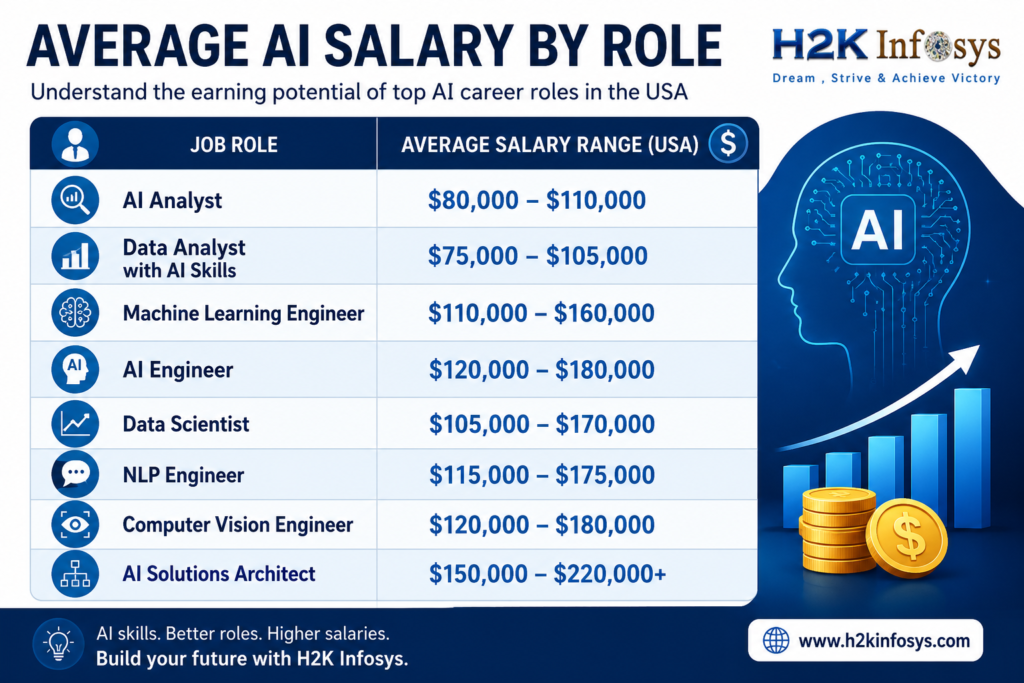
Average AI Salary by Role
| Job Role | Average Salary Range |
|---|---|
| AI Analyst | $80,000 – $110,000 |
| Data Analyst with AI Skills | $75,000 – $105,000 |
| Machine Learning Engineer | $110,000 – $160,000 |
| AI Engineer | $120,000 – $180,000 |
| Data Scientist | $105,000 – $170,000 |
| NLP Engineer | $115,000 – $175,000 |
| Computer Vision Engineer | $120,000 – $180,000 |
| AI Solutions Architect | $150,000 – $220,000+ |
Such values are typical wage ranges found in the U.S. technology sector, and may vary depending on the firm and area.
Factors Influencing AI Salaries
Experience Level
Professionals with a prior background in:
- Data analytics Software development
- Cloud computing .
- Business Intelligence Statistics
often transfer faster into AI professions and can demand larger salaries.
Technical Skill Depth
Generally, the more advanced the abilities the better the compensation:
- Python programming Machine learning algorithms
- Deep Learning Libraries
- MLOps
- cloud-based AI services
- IndustryLarge Language Model(LLM)
Industry
AI professionals work in:
- Healthcare
- Finance
- Retail
- Manufacturing
- Telecommunications
- Cybersecurity
- E-commerce
Industries that have a lot of data generally spend a lot in AI talent.
Place
Major IT hubs usually have higher salaries:
- California
- Washington
- New York
- Texas
- Massachusetts
- Virginia
But the rise of remote work has created prospects for AI jobs all throughout the country.
Why artificial intelligence is important for working professionals?
Many enterprise tech stacks are folding in Artificial Intelligence.
Organisations are increasingly using AI to:
- Automation of processes
- Forecasting
- Fraud detection,
- Automation of customer service
- Recommendation engines
- Business forecasting
For working professionals, knowledge of AI is useful to fill the gap between traditional IT tasks and growing technology demands.
Benefits include:
- More career opportunities
- Potential for more earnings
- More technical versatility
- Better decision making capabilities
- More relevance in data-driven organisations
How does AI work in real-world IT projects?
AI systems look for patterns in past and present data.
A typical AI workflow in the enterprise includes:
Step 1: Collect Data
Potential data sources include:
- APIs for databases
- Enterprise Resource Planning systems
- CRM systems
- IoT gadgets.
- Cloud apps
Step 2: Prepare Data
Teams prepare and convert data by:
- Remove duplicate
- Missing values handling
- Standardising the forms
- Engineering properties
Step 3: Training the model
Machine learning algorithms are taught on prepared datasets.
Common algorithms are as follows:
- Linear Regression
- Random Forest XGBoost Neural Nets Support Vector Machine
Step 4: Test the model
Performance metrics could be:
- Accuracy Precision Recall F1 Score
- ROC AUC
Step 5: Deployment
The models are then deployed into a production environment, where they can consume new data and begin to make predictions.
Step 6: Monitoring and Optimisation
Organisations are always monitoring:
- Model performance
- Drift of data
- Loss of accuracy
- Security threats
This is frequently called MLOps.
How is AI used in the enterprise?
Enterprise AI deployments are focused on solving real-world business problems .
Automating customer service
Organisations adopt:
- Chat bots AI
- Virtual Assistant
- Smart ticket routing
Standard Tools
- OpenAI APIs
- Azure AI by Microsoft
- Google Vertex AI (https://cloud.
Amazon Bedrock Fraud Detection
AI is used by financial firms to identify:
- “Unusual Transactions”
- Account Takeover
- Fraud in payments
Machine learning models look for trends in real-time to identify questionable activity.
Predictive Maintenance
AI is used by manufacturing organisations to:
- Watch Equipment
- Failure prediction
- Minimise downtime
Predictive models are constantly fed data from sensors.
Demand Forecasting
Retail companies utilise AI to predict:
- Future inventory requirements
- Demand for product
- Seasonal buying patterns
This helps optimize supply chain operations.
What Skills Are Needed to Learn Artificial Intelligence Certified Course?
“You don’t need to have advanced research-level skills to get into AI, but some basic skills are helpful.
Technical Skills Programming
Most AI practitioners use:
- Python
- SQL
- R (occasionally)
Python remains the dominant language because of its huge AI ecosystem.
Mathematics & Statistical Sciences
Key topics include:
- Linear algebra
- Probability
- Statistics
- Calculus fundamentals
These concepts help professionals understand how algorithms function.
Data Analysis
AI projects depend heavily on data interpretation.
Key skills include:
- Data cleaning
- Data visualization
- Feature engineering
- Exploratory data analysis
Machine Learning Fundamentals
Professionals should understand:
- Supervised learning
- Unsupervised learning
- Reinforcement learning
- Model evaluation techniques
Soft Skills
Enterprise AI projects also require:
- Problem-solving
- Communication
- Stakeholder collaboration
- Business understanding
- Documentation skills
What Tools Are Usually Offered in an Online Artificial Intelligence Certificate Program?
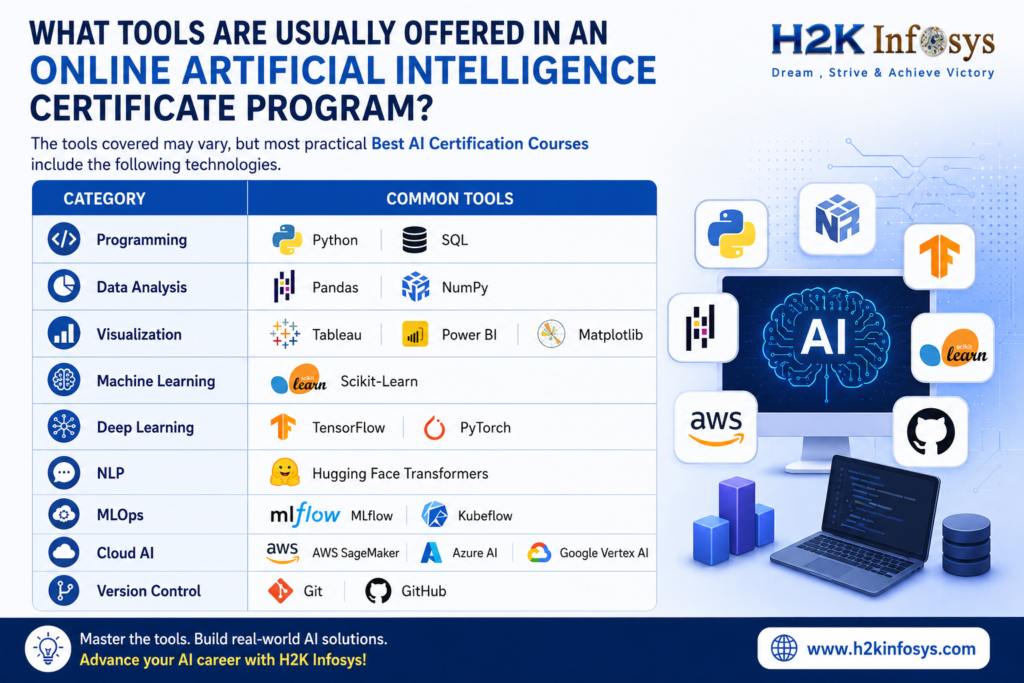
The tools covered may vary, but most practical Best Ai Certification Courses include the following technologies.
| Category | Common Tools |
| Programming | Python, SQL |
| Data Analysis | Pandas, NumPy |
| Visualization | Tableau, Power BI, Matplotlib |
| Machine Learning | Scikit-Learn |
| Deep Learning | TensorFlow, PyTorch |
| NLP | Hugging Face Transformers |
| MLOps | MLflow, Kubeflow |
| Cloud AI | AWS SageMaker, Azure AI, Google Vertex AI |
| Version Control | Git, GitHub |
These tools are frequently used in production AI environments.
What Jobs Use AI Daily?
“AI skills cut across many technical and business functions.
AI Engineer
Responsibilities include the following:
- Building AI systems
- Training models
- Deploying solutions
- Monitoring performance
Machine Learning Engineer
Focus areas include:
- Model development
- Feature engineering
- Performance optimization
- Production deployment
Data Scientist
Data scientists:
- Analyze datasets
- Build predictive models
- Generate business insights
Business Intelligence Professional
BI teams increasingly use AI for:
- Forecasting
- Trend analysis
- Decision support
Cloud Engineer
Cloud professionals support:
- AI infrastructure
- Model hosting
- Automated deployment pipelines
What Are The Career Opportunities After Learning Artificial Intelligence?
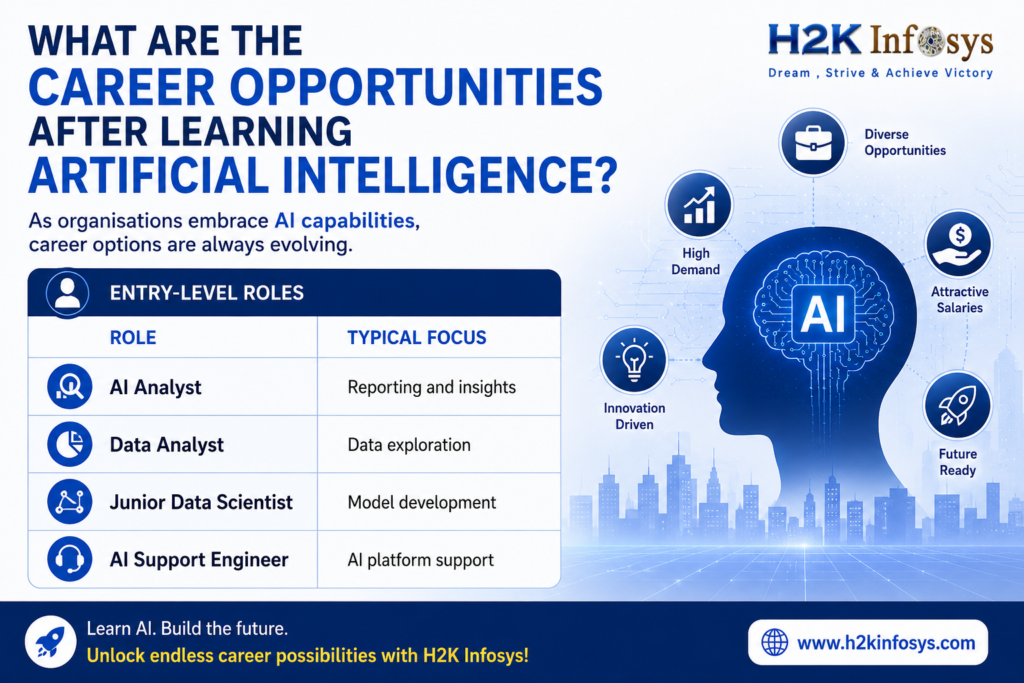
As organisations embrace AI capabilities, career options are always evolving.
Entry-Level Roles
| Role | Typical Focus |
| AI Analyst | Reporting and insights |
| Data Analyst | Data exploration |
| Junior Data Scientist | Model development |
| AI Support Engineer | AI platform support |
Mid-Level Roles
| Role | Typical Focus |
| Machine Learning Engineer | Production models |
| AI Engineer | AI solution development |
| NLP Engineer | Language applications |
| Computer Vision Engineer | Image processing systems |
Senior Roles
| Role | Typical Focus |
| Lead AI Engineer | Technical leadership |
| Principal Data Scientist | Advanced analytics |
| AI Architect | Enterprise AI strategy |
| Director of AI Programs | Organizational implementation |
Learning Path for Professionals Pursuing Artificial Intelligence
A structured learning approach can help professionals build practical competency.
Phase 1: Foundations
Learn:
- Python
- SQL
- Statistics
- Data analysis
Phase 2: Machine Learning
Study:
- Regression
- Classification
- Clustering
- Model evaluation
Phase 3: Deep Learning
Explore:
- Neural networks
- CNNs
- RNNs
- Transformers
Phase 4: Enterprise AI
Focus on:
- MLOps
- Cloud deployment
- Security
- Scalability
Phase 5: Portfolio Projects
Build projects such as:
- Customer churn prediction
- Sales forecasting
- Document classification
- Recommendation systems
- Sentiment analysis
Employers often value demonstrated project experience alongside certifications.
Common Challenges AI Professionals Face in Enterprise Projects
Understanding real-world challenges is important for career readiness.
Data Quality Issues
Organizations frequently encounter:
- Missing data
- Duplicate records
- Inconsistent formats
Poor data quality often impacts model performance more than algorithm selection.
Model Explainability
Many industries require transparency.
Teams may need to explain:
- Why predictions were made
- Which variables influenced outcomes
- How risks are managed
Security and Compliance
AI projects must address:
- Data privacy
- Regulatory compliance
- Access controls
- Model governance
Scalability
Models that perform well in testing may face challenges when processing millions of records in production.
Enterprise teams must design systems capable of handling growth.
How Can an Online Certificate Program in Artificial Intelligence Help Advance Your Career?
A structured learning path can help professionals:
- Get a handle on the basics of AI
- Get hands-on project experience
- Learn business tools
- Build technological portfolios.
- Get ready for interviews
The value typically comes from combining:
- Practical exercises
- Real life projects
- Mentoring
- Steady skill improvement
instead of just certification.
Frequently Asked Questions FAQ
Is artificial intelligence a decent career in USA?
AI continues to be a major focus of investment across many industries. There is a need for experts who can responsibly and successfully create, deploy, and manage AI Solutions.
What is the typical pay after finishing an artificial intelligence course?
Many professionals start off with salaries ranging from about $80,000 to $180,000 per year, depending on experience, technical skills, location and job duties.
Do I need programming experience to learn AI?
Some basic programming skills is beneficial. Python is frequently recommended as the initial programming language for AI students.
Which industries hire AI professionals?
Common industries include:
- Manufacturing Insurance Retail Healthcare Finance
- Telecommunication
- Technology services
Is an Artificial Intelligence certificate online sufficient to get a job?
A certificate can demonstrate structured learning, but employers typically also evaluate:
- Technical skills
- Project experience
- Problem-solving ability
- Portfolio quality
What tools should I learn for AI careers?
Widely used tools include:
- Python
- SQL
- Scikit-Learn
- TensorFlow
- PyTorch
- Git
- AWS
- Azure AI
- Google Vertex AI
How long does it take to learn AI?
Learning timelines vary. Many professionals spend several months developing foundational knowledge and additional time building practical project experience.
Conclusion
Artificial Intelligence Course in the USA continues to impact how organisations analyse data, automate processes and support decision-making. With an Artificial Intelligence certification course and practical skills in machine learning, data science, cloud AI and corporate deployment, professionals can build a plethora of technical and analytical job paths.
Key Takeaways
- Average AI-related wages in the USA are $80,000 – $180,000+ depending on function & expertise.
- Healthcare, banking, retail, manufacturing, and technology all leverage AI skills.
- Good grounding in Python, SQL, machine learning and data analysis are key for career progression.
- For enterprise AI initiatives, the key areas to focus on are scalability, security, governance, and model performance.
- Practical project experience is generally considered equal to credentials.
Explore H2K Infosys Artificial Intelligence Course in the USA programs to build hands-on skills through guided projects and structured learning paths.
Learn industry-relevant AI technologies that can support long-term career growth in data-driven enterprise environments.