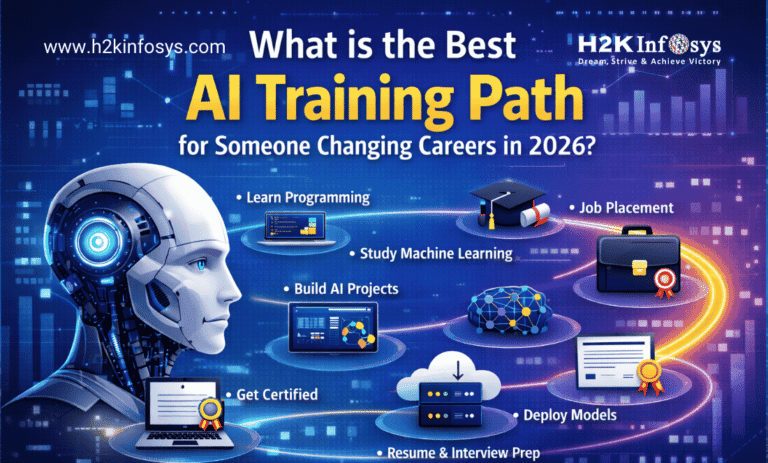
The Best H2K Infosys Artificial Intelligence training programs and structured learning paths help career changers build the technical and practical skills required to transition into AI roles in 2026 through hands-on projects, real-world workflows, and Artificial intelligence certification online validation. The best AI training path for career changers in 2026 involves structured learning in programming, data handling, machine learning fundamentals, real world projects, and Artificial intelligence Certification Online to validate skills. Most professionals begin with Python and data analysis, progress to machine learning and deep learning, and then specialize in enterprise tools and deployment workflows. AI and machine learning courses designed for career switchers emphasize practical implementation, portfolio development, and job-ready skills aligned with industry requirements.
Artificial intelligence is now integrated into enterprise systems for automation, analytics, cybersecurity, quality assurance, and business decision-making. As a result, career changers from QA, business analysis, IT support, finance, and non-technical roles are transitioning into AI-related positions through structured training paths.
Why Is AI a Practical Career Path for Career Switchers in 2026?
Artificial intelligence is commonly used across industries to automate repetitive tasks, improve efficiency, and enable predictive insights. Organizations need professionals who understand both technical concepts and business workflows.
Career switchers benefit from AI training because:
- AI roles exist at multiple skill levels
- Entry-level roles focus on implementation, not research
- Many AI workflows overlap with existing IT and data roles
- AI integrates with enterprise tools already used in organizations
Common industries hiring AI professionals include:
- Healthcare analytics
- Financial risk analysis
- Software testing automation
- E-commerce recommendation systems
- Cybersecurity threat detection
- Supply chain optimization
Career changers often transition into roles such as AI analyst, junior machine learning engineer, automation specialist, or AI data associate.
What Is the Recommended Learning Path in AI and Machine Learning Courses?
AI training follows a structured progression. Career changers do not start with advanced deep learning immediately. Instead, they build foundational skills step by step.
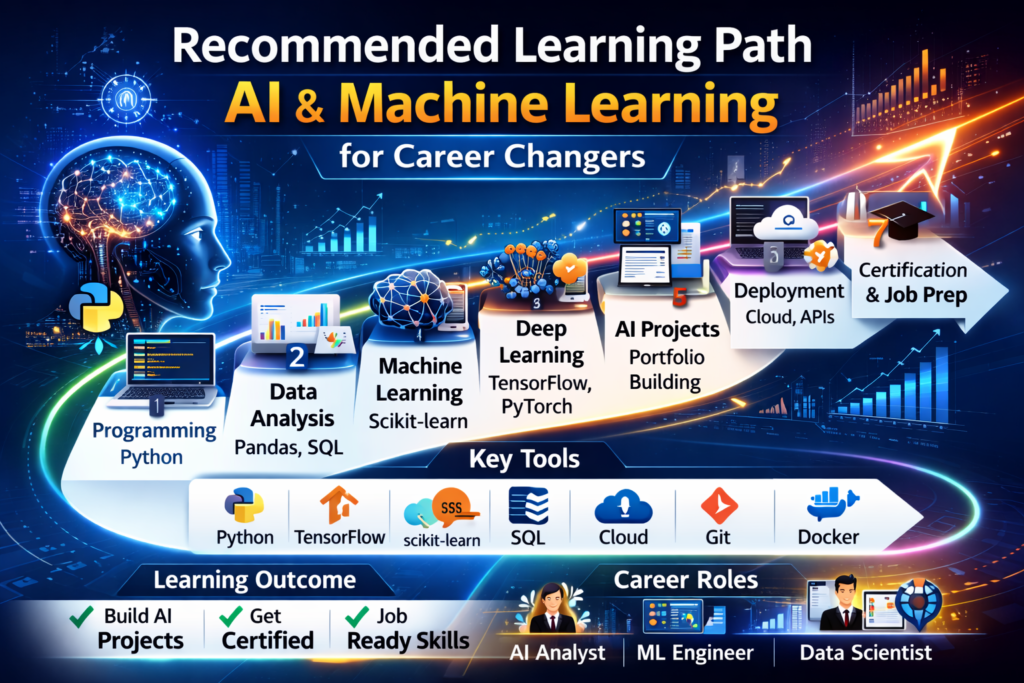
Recommended AI Training Path Overview
| Stage | Focus Area | Key Skills | Typical Tools |
|---|---|---|---|
| Stage 1 | Programming Foundations | Python, logic, scripting | Python, VS Code |
| Stage 2 | Data Analysis | Data cleaning, visualization | Pandas, NumPy, Excel |
| Stage 3 | Machine Learning | Supervised and unsupervised learning | Scikit-learn |
| Stage 4 | Deep Learning Basics | Neural networks | TensorFlow, PyTorch |
| Stage 5 | Real Projects | Model development and evaluation | Jupyter Notebook |
| Stage 6 | Deployment | Integrating models into applications | Flask, FastAPI |
| Stage 7 | Certification | Skill validation | Artificial intelligence certification online |
Each stage builds practical competence required for real-world enterprise AI roles.
What Skills Are Required to Start AI Training?
Career switchers often assume advanced mathematics is required initially. However, most AI and machine learning Courses begin with practical programming and data handling.
Core Skills Required
1. Programming with Python
Python is the primary programming language used in AI because of its simplicity and extensive libraries.
Example tasks in enterprise environments:
- Automating data processing
- Writing scripts to clean datasets
- Developing machine learning models
Example code snippet:
import pandas as pddata = pd.read_csv("customer_data.csv")
cleaned_data = data.dropna()
print(cleaned_data.head())
This type of script is commonly used in real data preparation workflows.
2. Data Analysis and Preparation
AI systems depend on structured and clean data.
Key tasks include:
- Removing duplicate records
- Handling missing values
- Normalizing datasets
- Preparing training and testing datasets
Tools used:
- Pandas
- Excel
- SQL
- Jupyter Notebook
3. Machine Learning Fundamentals
Machine learning enables systems to learn from data patterns.
Common algorithms used in enterprise environments:
- Linear regression
- Logistic regression
- Decision trees
- Random forest
- Clustering algorithms
Example enterprise scenario:
Predicting customer churn based on usage patterns.
4. Basic Statistics and Probability
Statistics helps evaluate model performance.
Common concepts include:
- Mean, median, standard deviation
- Probability distributions
- Model accuracy and error measurement
These concepts are applied when validating model predictions.
How Does AI Work in Real-World IT Projects?
AI workflows follow structured steps similar to software development lifecycles.
Typical AI Project Workflow
| Step | Description |
|---|---|
| Data Collection | Gather raw enterprise data |
| Data Cleaning | Remove errors and inconsistencies |
| Feature Engineering | Select useful data variables |
| Model Training | Train machine learning model |
| Model Testing | Evaluate accuracy |
| Model Deployment | Integrate into production systems |
| Monitoring | Track performance and update models |
Example Enterprise Use Case: Fraud Detection
Step-by-step workflow:
- Collect transaction data
- Clean and normalize data
- Train classification model
- Deploy model in application
- Flag suspicious transactions
Tools used:
- Python
- Scikit-learn
- SQL
- Cloud platforms
What Tools Are Used in Artificial Intelligence Certification Online Programs?
Professional AI training programs use industry-standard tools.
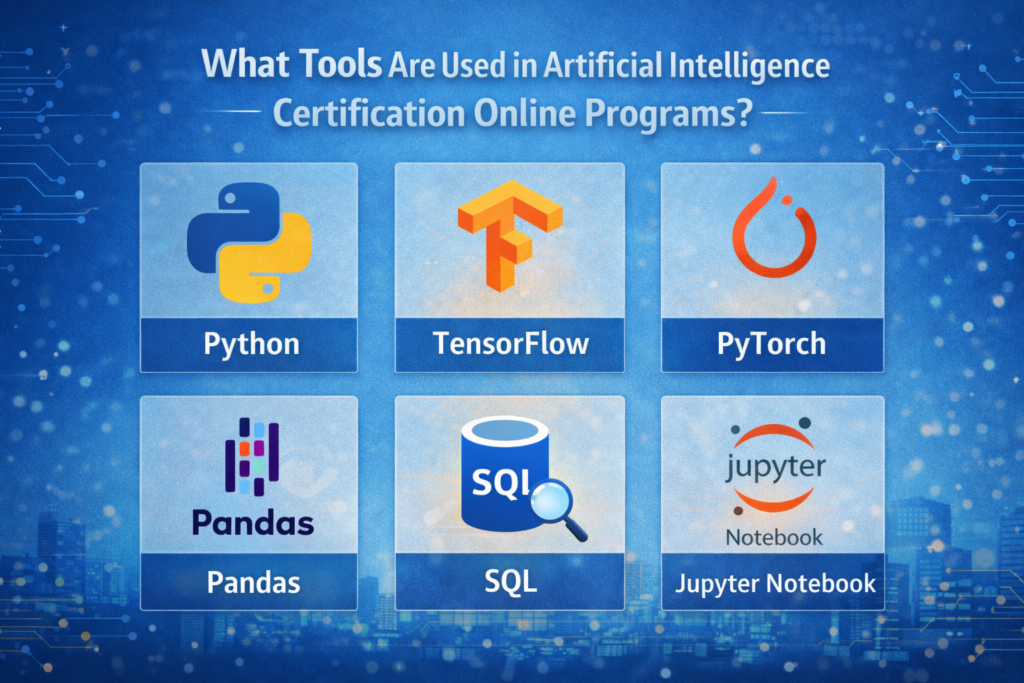
Common AI Tools and Their Uses
| Tool | Purpose |
|---|---|
| Python | Programming language |
| Jupyter Notebook | Model development |
| Pandas | Data manipulation |
| NumPy | Mathematical operations |
| Scikit-learn | Machine learning |
| TensorFlow | Deep learning |
| PyTorch | Neural networks |
| SQL | Data retrieval |
| Git | Version control |
| Docker | Model deployment |
These tools are commonly used in enterprise AI workflows.
How Long Does It Take to Transition into an AI Career?
Transition timelines vary based on prior technical experience.
Typical Timeline for Career Switchers
| Experience Level | Estimated Time |
|---|---|
| Non-technical background | 6–12 months |
| IT background | 4–8 months |
| Software or QA background | 3–6 months |
The timeline depends on:
- Learning pace
- Practice frequency
- Project experience
Hands-on practice significantly accelerates skill development.
How Are AI and Machine Learning Courses Structured for Career Switchers?
Most structured programs follow progressive modules.
Typical Course Modules
- Python programming
- Data analysis
- Machine learning fundamentals
- Deep learning basics
- AI project development
- Model deployment
- Resume and interview preparation
Projects may include:
- Customer prediction models
- Recommendation systems
- Automation tools
- Chatbot development
These projects demonstrate real-world implementation capability.
What Real-World Projects Should Career Switchers Build?
Portfolio projects demonstrate practical competence to employers.
Common AI Projects for Career Switchers
Customer Churn Prediction
Predict customers likely to leave a service.
Skills demonstrated:
- Data analysis
- Machine learning
- Model evaluation
Spam Email Classification
Identify spam messages using classification models.
Skills demonstrated:
- Text processing
- Model training
- Accuracy evaluation
Recommendation System
Recommend products or content based on user behavior.
Skills demonstrated:
- Collaborative filtering
- Data analysis
- Machine learning
Predictive Analytics Dashboard
Visualize predictions using dashboards.
Tools used:
- Python
- Power BI
- Tableau
How Is AI Used in Enterprise Environments?
AI is integrated into production systems for automation and decision-making.
Common Enterprise AI Applications
| Industry | AI Use Case |
|---|---|
| Banking | Fraud detection |
| Healthcare | Disease prediction |
| Software Testing | Test automation |
| Retail | Product recommendations |
| Cybersecurity | Threat detection |
| Manufacturing | Predictive maintenance |
AI models operate within larger enterprise systems and workflows.
What Job Roles Are Available After Completing AI Training?
Career switchers typically enter entry-level or mid-level AI roles.
Common AI Job Roles
| Role | Responsibilities |
|---|---|
| AI Analyst | Analyze data and generate insights |
| Machine Learning Engineer | Build and deploy models |
| Data Analyst | Analyze datasets |
| AI Support Engineer | Maintain AI systems |
| Automation Engineer | Implement automation solutions |
These roles require practical skills rather than research-level expertise.
What Certifications Help Validate AI Skills?
Artificial intelligence certification online helps demonstrate competency.
Certification benefits include:
- Skill validation
- Resume credibility
- Industry recognition
- Structured learning completion
Certifications typically assess:
- Programming knowledge
- Machine learning concepts
- Project implementation
Certification supports job readiness but must be combined with project experience.
What Challenges Do Career Switchers Face When Learning AI?
Career switchers commonly encounter practical challenges.
Common Challenges
Information Overload
AI includes multiple domains.
Solution:
- Follow structured learning path
Lack of Hands-On Experience
Employers prioritize practical skills.
Solution:
- Build portfolio projects
Understanding Real-World Applications
Theory alone is insufficient.
Solution:
- Practice real enterprise use cases
Deployment Knowledge Gap
Many learners do not understand production environments.
Solution:
- Learn model deployment tools
How Should Career Switchers Practice AI Skills?
Practical implementation is essential.
Recommended Practice Approach
- Learn concept
- Implement project
- Test model performance
- Improve accuracy
- Deploy simple application
This mirrors enterprise workflows.
What Is the Ideal Weekly Learning Plan?
Sample Weekly Learning Schedule
| Week | Focus |
|---|---|
| Week 1–4 | Python programming |
| Week 5–8 | Data analysis |
| Week 9–12 | Machine learning |
| Week 13–16 | Projects |
| Week 17–20 | Deployment |
| Week 21–24 | Certification preparation |
Consistent practice produces measurable progress.
FAQ: AI Training Path for Career Switchers
Is AI difficult for career changers to learn?
AI can be learned gradually through structured training. Beginners start with programming and data analysis before progressing to machine learning.
Do I need a computer science degree to learn AI?
No. Many professionals transition into AI through structured AI and machine learning courses and practical project experience.
How important is Artificial intelligence certification online?
Certification validates skills and helps demonstrate structured learning completion. Employers also evaluate project experience and practical implementation ability.
Can QA, Business Analysts, or IT professionals transition into AI?
Yes. Many AI roles involve data analysis, automation, and workflow optimization, which overlap with existing IT roles.
How important are projects when learning AI?
Projects demonstrate practical competence and are often reviewed during job interviews.
What programming language should career switchers learn first?
Python is the primary programming language used in AI.
Conclusion
Key Takeaways
- AI training paths begin with programming, data analysis, and machine learning fundamentals
- Artificial intelligence certification online helps validate skills and improve credibility
- Enterprise AI workflows include data preparation, model training, deployment, and monitoring
- Practical projects are essential for demonstrating job readiness
- Career switchers can transition into roles such as AI analyst, machine learning engineer, and automation specialist
- Structured AI and machine learning courses help build practical, real-world implementation skills
H2K Infosys offers structured AI training with real-world projects and hands-on practice aligned with industry workflows.
Explore H2K Infosys AI courses to build practical skills and support your career transition into artificial intelligence