Introduction
If you’re looking into a Data Analytics Certification Courses or thinking about joining a data analytics bootcamp online, the simple answer is this: these courses teach you how to work with real business data and turn it into decisions companies can actually use. That includes learning tools like SQL, Excel, Python, Tableau, and Power BI but honestly, the bigger skill is learning how to think like an analyst.
A lot of people assume Data Analytics Certification Courses are mostly about charts and dashboards. I used to think that too, years ago. Then you see how businesses actually use analytics day to day, and you realize the job is way more practical than people expect. Analysts help companies understand why sales dropped, why customers leave, what products are trending, or where money is wasted. It’s not just “working with numbers.” There’s a business side to it that good courses try to teach early.
And lately, with AI tools becoming part of everyday workflows, analytics training has changed again. Companies want people who can work with automation tools, not people who panic every time a dashboard updates itself automatically.
The Core Skills You Learn in Data Analytics Certification Courses
1. Data Cleaning and Preparation
Nobody talks about this part enough.
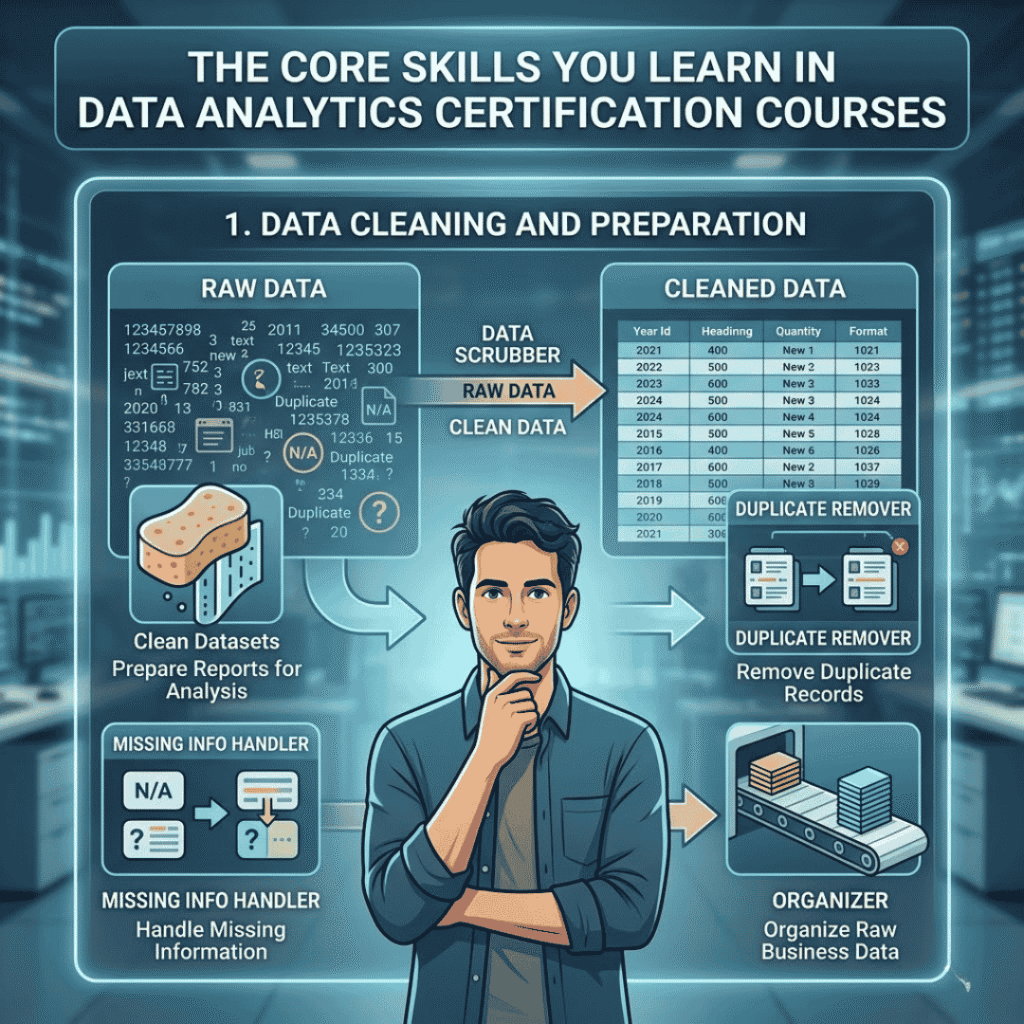
Most raw business data is messy. Really messy sometimes. Missing values, duplicate entries, random formatting problems, incomplete customer records, you name it. Before analysis even starts, someone has to fix all of that.
That’s why a solid Data Analytics Certification Courses usually spends a lot of time teaching students how to:
- Clean datasets
- Remove duplicate records
- Handle missing information
- Organize raw business data
- Prepare reports for analysis
At first, beginners sometimes wonder why this step matters so much. Then they work on an actual dataset and realize half the work is just making the information usable.
One instructor I listened to recently joked that “analytics is basically detective work with spreadsheets.” Weirdly accurate.
SQL Is Still One of the Biggest Skills Employers Want
Even with all the AI tools coming out, SQL hasn’t disappeared. Not even close.
Most businesses store information inside databases, so analysts need a way to pull data quickly. That’s where SQL comes in.
Nearly all Data Analytics Certification Courses cover things like:
- SELECT queries
- JOIN operations
- GROUP BY statements
- Filtering and sorting data
- Aggregations
- Subqueries
At first glance SQL looks technical, but once you start practicing, it feels surprisingly straightforward. You’re basically asking the database questions.
Stuff like:
- Which products sold best this month?
- Which customers haven’t purchased again?
- Which marketing campaigns made money?
That’s the kind of work analysts actually do.
And honestly, recruiters still ask SQL questions constantly during interviews. Anybody saying SQL is outdated probably hasn’t looked at analytics job postings lately.
Dashboard Building and Data Visualization
This is usually the section people enjoy most because it finally feels visual.
Tools like:
- Tableau
- Power BI
- Looker Studio
- Excel dashboards
help turn complicated datasets into something teams can understand quickly.
A good data analytics bootcamp online teaches students how to:
- Create dashboards
- Build KPIs
- Design business reports
- Present trends visually
- Explain insights clearly
That last point matters a lot more than beginners realize.
You can technically build a dashboard filled with charts and still completely confuse executives. I’ve seen reports with fifteen different graphs where nobody could tell what the actual takeaway was supposed to be.
Good analysts simplify things.
That’s honestly one of the hardest skills to learn.
Python for Modern Data Analytics
Python has become a much bigger part of analytics training over the last few years.
Not every analyst role needs advanced programming, but companies increasingly like candidates who can automate repetitive tasks or work with larger datasets without relying entirely on spreadsheets.
Most modern Data Analytics Certification Courses now include:
- Python basics
- Pandas
- NumPy
- Data visualization libraries
- Simple automation scripts
Some programs even introduce beginner-level machine learning concepts now because businesses are moving toward predictive analytics faster than expected.
One practical example?
Instead of manually updating the same weekly report every Friday afternoon, analysts can automate it using Python scripts. Companies love that because it saves hours of repetitive work.
Once you automate your first report, it becomes painfully obvious how much time gets wasted manually doing things.
Excel Is Still Everywhere
People love acting like Excel is outdated. Then you join a company and realize half the business still runs on spreadsheets.
That hasn’t changed in 2026.
A strong Data Analytics Certification Coursesstill teaches:
- Pivot tables
- Lookup formulas
- Forecasting tools
- Conditional formatting
- Reporting workflows
- Data validation
Some hiring managers still test Excel before they test anything else.
It’s not flashy, but it’s real-world relevant.
Statistics and Analytical Thinking
This is where analytics becomes more than just learning software.
Strong courses teach students how to interpret information not just display numbers on a screen.
You’ll usually learn topics like:
- Trend analysis
- Forecasting
- A/B testing
- Correlation vs causation
- Basic probability
- Performance metrics
Because companies don’t hire analysts simply to make charts look pretty.
They want answers.
Questions like:
- Why are customers leaving?
- Which products are underperforming?
- Why did conversions suddenly drop?
- Which business process is slowing revenue growth?
That’s the real job.
And honestly, analytical thinking takes practice. There’s no shortcut for it.
AI and Automation Are Now Part of Analytics Training
This is probably the biggest change happening right now.
Modern analytics teams increasingly use:
- AI-assisted reporting
- Predictive analytics platforms
- Automated dashboards
- Natural-language data querying tools
Some newer Data Analytics Certification Courses programs now teach students how to work alongside these tools instead of treating AI like some threat to analytics careers.
That’s important because businesses still need humans who understand the context behind the numbers.
AI can generate reports. But it still takes people to explain why something matters.
At least for now.
Real Projects Matter More Than Most Certificates
This part honestly deserves more attention.
Employers care a lot about practical experience. Sometimes even more than the certification itself.
That’s why better programs include hands-on projects like:
- Sales reporting dashboards
- Customer churn analysis
- Marketing performance tracking
- Financial reporting
- Healthcare analytics case studies
A portfolio gives recruiters proof that you can actually work with data instead of just watching tutorials online.
That’s one reason training providers like H2K Infosys focus heavily on project-based learning. It helps students move from “learning concepts” to handling realistic business scenarios.
And honestly, that transition is where many self-learners get stuck.
What Jobs Can You Get After Completing Data Analytics Certification Courses?
Career opportunities are still growing across multiple industries.
Some common job roles include:
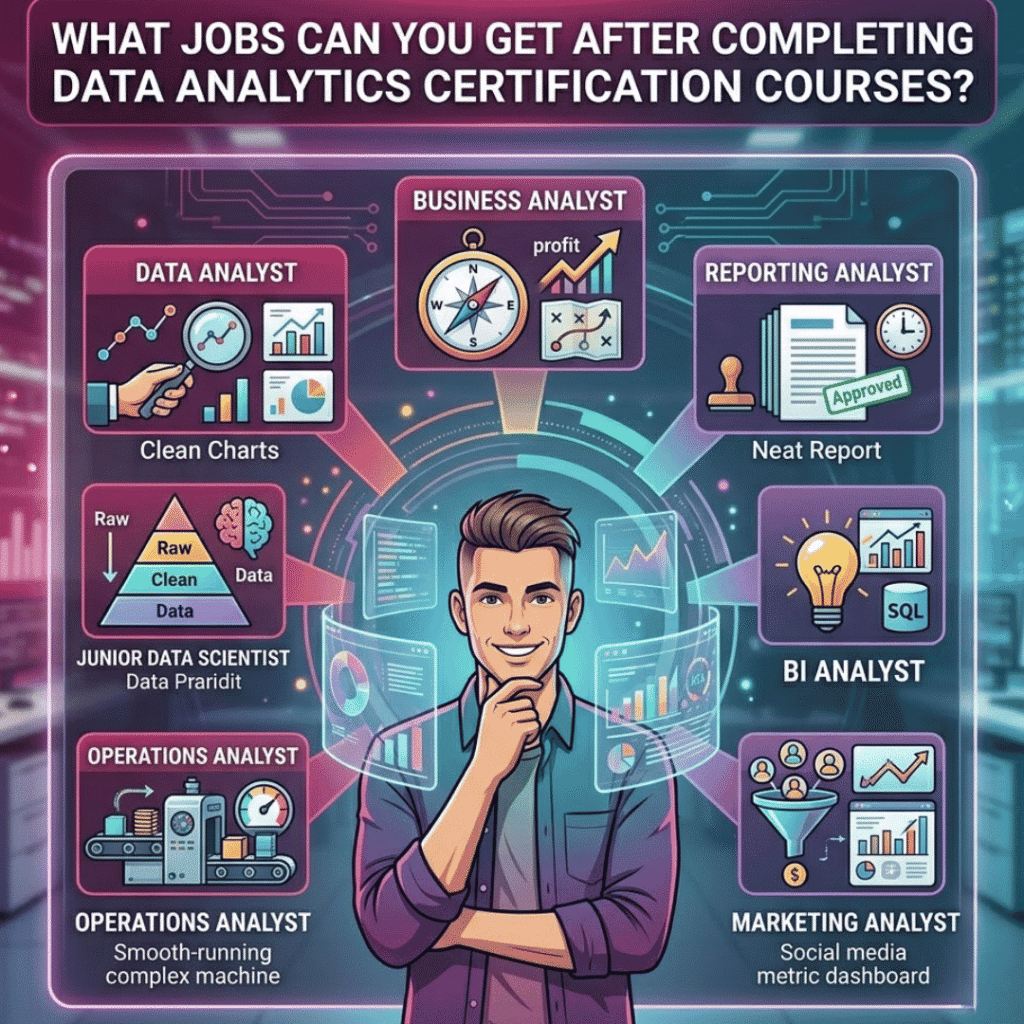
- Data Analyst
- Business Analyst
- Reporting Analyst
- BI Analyst
- Marketing Analyst
- Operations Analyst
- Junior Data Scientist
Industries hiring analytics professionals include:
- Healthcare
- Retail
- Banking
- Logistics
- SaaS companies
- E-commerce
A lot of companies now prioritize practical skills over traditional academic backgrounds, especially for entry-level analyst roles.
That’s why many learners choose a Data Analytics Certification Courses with live projects, internship exposure, and job support instead of purely theoretical learning.
Common Mistakes Beginners Make
A few patterns show up constantly.
Learning Too Many Tools at Once
Beginners often jump between Python, Tableau, machine learning, cloud tools, and AI platforms all at once. It usually creates confusion.
Start with fundamentals first.
Ignoring SQL
This still happens surprisingly often. Some learners focus only on visualization tools and skip database skills entirely.
Big mistake.
Building No Portfolio Projects
Recruiters want proof of practical work. Even small projects help more than people think.
Memorizing Instead of Practicing
Watching videos isn’t enough in analytics. You need hands-on repetition.
There’s really no way around that.
Why Structured Training Helps So Many Beginners
Self-learning works for some people, absolutely.
But analytics can feel overwhelming because there’s so much conflicting advice online. One person says learn Python first. Another says Excel matters more. Then somebody else says AI will replace analysts completely.
It gets noisy fast.
That’s where structured programs help.
A well-organized Data Analytics Certification Courses typically gives students:
- Step-by-step learning paths
- Real-world projects
- Mentor guidance
- Resume preparation
- Mock interviews
- Practical assignments
- Exposure to business scenarios
If you’re serious about entering analytics, structured training can save a lot of wasted time.
Programs from H2K Infosys, for example, focus on practical analytics workflows and career-oriented training rather than only theory, which tends to help beginners feel more job-ready.
Related Topics You Can Also Explore
To build stronger analytics knowledge, you can also explore topics like:
- Business Intelligence vs Data Analytics
- SQL Interview Questions for Beginners
- How to Become a Data Analyst Without a Technical Background
These topics connect naturally and help create a stronger learning foundation.
FAQs
Are Data Analytics Certification Courses worth it in 2026?
Yes, especially programs focused on hands-on learning and real business projects. Employers care more about practical skills now than generic certificates alone.
Can beginners learn data analytics online?
Definitely. Many professionals transition into analytics from non-technical backgrounds through a structured Data analysis course online.
Which skill is most important for a data analyst?
SQL remains one of the most valuable technical skills, along with Excel, dashboards, and analytical thinking.
How long does it take to become job-ready?
For most learners, it takes around 4–8 months of consistent practice and project work, depending on previous experience.
Do employers value online bootcamps?
Yes, especially when the bootcamp includes projects, mentorship, interview prep, and practical analytics training.
Final Thoughts
The best Data Analytics Certification Courses teach far more than software tools.
They teach how businesses use data to make decisions.
That’s the part that actually matters in real jobs.
Learning SQL or Power BI is useful, obviously. But understanding how to analyze patterns, explain findings clearly, and support business decisions that’s what makes someone valuable in analytics roles today.
And despite all the talk around AI replacing jobs, companies still need analysts who understand business context, customer behavior, and operational decision-making.
If you’re planning to enter this field, focus on practical skills, real projects, and consistent hands-on work instead of trying to learn every trending tool at once.
A structured program like the training offered by H2K Infosys can help simplify that process, especially for beginners trying to move into a real analytics career with confidence.