Professionals often ask, “Which Artificial Intelligence Course Is Best?” Generally, the ideal artificial intelligence course for working professionals in the United States in 2026 is one that covers machine learning fundamentals, generative AI, large language models (LLMs), cloud-based AI deployment, and practical enterprise applications. Programs offered by H2K Infosys follow this approach by combining industry-relevant skills with hands-on training. The best curriculum should balance theoretical knowledge with practical implementation while offering flexible online learning options for professionals managing full-time jobs.
When looking for online AI courses, practitioners should consider the breadth of curriculum, industry relevance, project focus, cloud platform exposure, and the latest developments in AI use in enterprises. The top Artificial intelligence course for Beginners also teach learners how organisations install, govern, and scale AI solutions in production environments not just how AI models function.
What is AI?
Artificial Intelligence (AI) is the term used to describe computer systems that can do tasks that normally need human intelligence. Such tasks can include:
- Pattern recognition Decision making
- Language comprehension
- Image processing
- Prediction and forecasting
- Automation of processes
Modern AI is a cross-section of many fields including:
| Discipline | Purpose |
|---|---|
| Machine Learning | Learning patterns from data |
| Deep Learning | Neural-network-based prediction |
| Natural Language Processing (NLP) | Understanding human language |
| Computer Vision | Processing images and video |
| Generative AI | Creating text, images, code, and content |
| Reinforcement Learning | Learning through feedback and rewards |
AI is also integrated into commercial applications, customer service platforms, cybersecurity systems, healthcare solutions, financial services, and cloud infrastructure for enterprise environments.
Significance of Artificial Intelligence for Working Professionals
AI is becoming an underlying technology across businesses. More and more, people who work in software development, data analysis, cloud computing, project management, cybersecurity, and business operations are getting involved with AI-powered systems.
The leading reasons professionals are looking for AI training include:
- Automating repetitious processes
- Improved business decision making
- Greater productivity with AI assistance
- Demand for AI-related expertise is increasing
- Incorporating AI into existing enterprise applications
- Expansion in generative AI technologies
Many organisations are pursuing AI projects to increase their operational efficiency, customer experience, and data-driven decision-making.
Professionals are more likely to grasp AI concepts and can be more involved in digital transformation projects and AI adoption activities.
What to look for in the best online AI courses for working professionals?
Not all Artificial Intelligence Course are meant for experts already working in IT or business settings.
A good AI training program should include:
Technical Foundations
Learners should note that:
- Python programming
- Statistics Basics
- Data analysis
- ML ideas –
- Model evaluation method
Contemporary AI Technologies
The curriculum should cover:
- Generative AI Large Language Models (LLMs)
- Retrieval-Augmented Generation (RAG) Prompting
- AI agents
- Databases Vector
Cloud-Based AI Platforms
Enterprise AI solutions frequently run on cloud platforms such as:
- Amazon Web Services (AWS)
- Microsoft Azure
- Google Cloud Platform (GCP)
Professionals need to understand how AI services interact into cloud systems.
Hands-On Projects
Theory alone is not enough.
Practical projects allow learners to understand:
- Preparing the data
- Deployment workflows Model training
- Tracking & Optimisation
What Skills Do You Need to Learn Artificial Intelligence?
Many working professionals think AI requires sophisticated maths or research-level skill.
Deeper AI specialisations will need advanced expertise, but most industry-focused programs start with approachable principles.
Core Skills
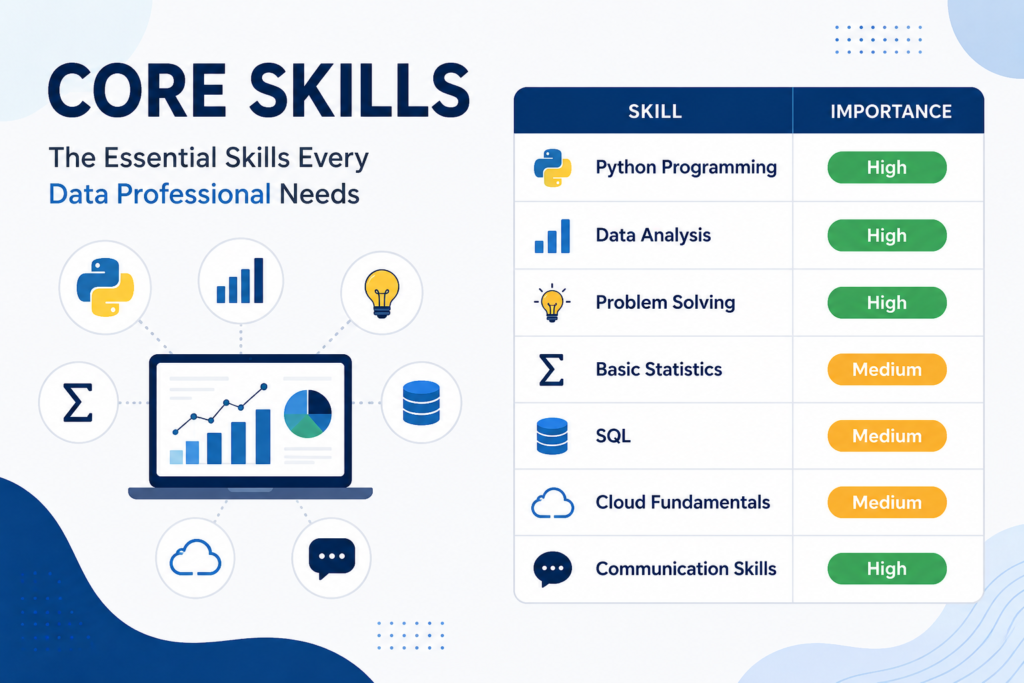
| Skill | Importance |
| Python Programming | High |
| Data Analysis | High |
| Problem Solving | High |
| Basic Statistics | Medium |
| SQL | Medium |
| Cloud Fundamentals | Medium |
| Communication Skills | High |
Helpful Backgrounds
The following fields generally provide a successful basis for a career transfer into AI:
- Software Development
- Data Analytics
- Business Intelligence
- Cloud Engineering
- DevOps
- Cybersecurity
- IT Support
- Project Management
Many Artificial Intelligence Course are targeted primarily at learners with little or no previous AI knowledge.
How Artificial Intelligence Works in Real-World IT Projects?
Enterprise AI projects usually have a defined lifespan.
Step 1: Identify the business problem
Organisations have reported a problem as:
- Predicting customer churn
- Fraud detection /
- Document Handling
- Demand forecast 2.
- IT incident categorisation
Step 2: Data Collection
Teams gather data from:
- Databases APIs
- CRM systems
- ERP systems
- Application logs
Step 3: Data Preparation
Data engineers and analysts:
- Cleaned data
- Duplicates Remove
- Missing Value Handling
Convert datasets
Step 4: Model Development
Data scientists train models using frameworks such as:
- Data Scientists build models from frameworks such as:
- Keras PyTorch Scikit-learn
Step 5: Model Evaluation
Performance metrics may include:
- Performance metrics could be:
- Accuracy Precision Recall F1 Score
- ROC AUC
Step 6: Deployment
Models are deployed through:
- Docker Containers Kubernetes
- Azure AI Service
- Amazon SageMaker
- Google’s Vertex AI
Step 7: Monitoring
Teams continuously monitor:
- Bias in performance decline
- security problems
- Resource consumption
Using Artificial Intelligence in Enterprise Environments
The emphasis of AI adoption is often on solving quantifiable business problems.
Customer Service
Organizations use AI for:
- Chatbots
- Virtual assistants
- Automated ticket routing
- Sentiment analysis
Common Tools
- OpenAI APIs
- Microsoft Copilot
- Google Gemini
- ServiceNow AI
Software Development
Developers use AI-powered coding assistants to:
- Generate code snippets
- Debug applications
- Create documentation
- Improve productivity
Common Tools
- GitHub Copilot
- Amazon CodeWhisperer
- Cursor
- JetBrains AI Assistant
Healthcare
AI supports:
- Medical image analysis
- Clinical documentation
- Risk prediction
- Patient engagement systems
Healthcare implementations often require strict compliance with regulatory standards such as HIPAA.
Finance
Financial institutions apply AI to:
- Fraud detection
- Credit scoring
- Risk analysis
- Algorithmic trading
Security, explainability, and compliance remain major priorities.
Cybersecurity
Security teams use AI for:
- Threat detection
- Log analysis
- Malware classification
- Security automation
AI systems help identify patterns that may be difficult for humans to detect at scale.
What Will the Best Online AI Courses Cover in 2026?
A comprehensive curriculum should address both traditional AI and emerging technologies.
| Topic | Importance in 2026 |
| Python for AI | Essential |
| Machine Learning | Essential |
| Deep Learning | Essential |
| NLP | Essential |
| Generative AI | Essential |
| LLMs | Essential |
| Prompt Engineering | Essential |
| AI Agents | High |
| RAG Architecture | High |
| Vector Databases | High |
| MLOps | High |
| AI Governance | High |
| Cloud AI Services | Essential |
Professionals should prioritize programs that teach implementation rather than focusing solely on theory.
What Job Roles Use Artificial Intelligence on a Daily Basis?
AI skills support a broad range of technical and business careers.
Technical Roles
- AI Engineer
- Machine Learning Engineer
- Data Scientist
- Data Engineer
- MLOps Engineer
- Software Developer
- Cloud Engineer
Business-Focused Roles
- Business Analyst
- Product Manager
- Digital Transformation Consultant
- Operations Manager
- Project Manager
Many organizations now expect professionals in non-AI roles to understand AI-assisted workflows.
What Are the Jobs You Can Get After Learning Artificial Intelligence?
Career opportunities vary depending on prior experience and specialization.
Career Progression Examples
| Current Role | Potential AI-Oriented Path |
| Software Developer | AI Engineer |
| Data Analyst | Data Scientist |
| System Administrator | AI Infrastructure Engineer |
| Business Analyst | AI Business Analyst |
| Cloud Engineer | Machine Learning Engineer |
| Project Manager | AI Program Manager |
The most successful transitions often combine existing domain expertise with newly acquired AI skills.
How Do Online AI Classes Compare to Traditional Classroom Training?
Many professionals prefer online learning because of scheduling flexibility.
| Feature | Online AI Classes | Traditional Training |
| Flexible Schedule | Yes | Limited |
| Self-Paced Learning | Often | Rare |
| Recorded Sessions | Common | Limited |
| Global Instructor Access | Yes | Limited |
| Cost Efficiency | Often Better | Often Higher |
| Hands-On Cloud Labs | Common | Varies |
Working professionals typically benefit from programs offering instructor support alongside self-paced content.
What Challenges Do Professionals Face When Learning AI?
AI learning involves both technical and practical challenges.
Common Challenges
Information Overload
The AI ecosystem evolves rapidly.
Professionals often encounter:
- New frameworks
- New models
- Frequent platform updates
Lack of Practical Experience
Understanding concepts differs from deploying solutions.
Hands-on projects help bridge this gap.
Data Quality Issues
Real-world data is often:
- Incomplete
- Inconsistent
- Unstructured
Learning to manage data quality is a critical skill.
Model Governance
Enterprise environments require:
- Security controls
- Compliance standards
- Ethical AI practices
- Auditability
These considerations are increasingly included in advanced AI curricula.
What Does an Enterprise AI Workflow Look Like?
The following workflow reflects a common enterprise implementation process:
| Stage | Activities |
| Problem Definition | Business objective identification |
| Data Collection | Gathering structured and unstructured data |
| Data Preparation | Cleaning and transformation |
| Feature Engineering | Creating predictive variables |
| Model Training | Building machine learning models |
| Validation | Testing and evaluation |
| Deployment | Production implementation |
| Monitoring | Continuous optimization |
| Governance | Security, compliance, auditing |
Professionals who understand the entire lifecycle are often more effective contributors to AI initiatives.
Frequently Asked Questions (FAQ)
Which artificial intelligence course is best for working professionals in 2026?
The Artificial Intelligence Course online typically combines machine learning, generative AI, cloud deployment, MLOps, and hands-on projects while offering flexible online learning suitable for full-time professionals.
Are online AI classes effective for beginners?
Yes. Many programs begin with Python, statistics, and machine learning fundamentals before progressing to advanced AI topics.
Do I need a programming background to learn AI?
Basic programming knowledge is helpful, especially Python, but many beginner-friendly courses provide introductory programming support.
What is the most important programming language for AI?
Python remains the dominant language because of its extensive AI ecosystem and framework support.
How long does it take to learn AI?
Most working professionals spend several months building foundational skills and additional time gaining practical project experience.
Are generative AI skills important in 2026?
Yes. Generative AI, LLMs, prompt engineering, AI agents, and Retrieval-Augmented Generation are increasingly common in enterprise AI projects.
What industries hire AI professionals?
Industries commonly using AI include:
- Healthcare
- Finance
- Retail
- Manufacturing
- Telecommunications
- Government
- Technology Services
Is cloud knowledge important for AI careers?
Yes. Many enterprise AI systems run on AWS, Azure, or Google Cloud, making cloud familiarity valuable.
Conclusion
Artificial intelligence has grown from a niche research area to a working corporate technology that’s being used in software development, analytics, cloud computing, cybersecurity, healthcare and enterprise operations. In 2026, the finest AI Online Courses for working professionals will offer a blend of core machine learning concepts with contemporary subjects like generative AI, LLMs, MLOps, AI governance, and cloud deployment.
Key Takeaways
- Technical and business professions are rapidly finding applications for AI expertise.
- Top AI Courses Online Mix Theory, Hands-on Labs & Real-world Projects
- Python, machine learning, generative AI and cloud platforms are still important skills.
- Enterprise AI needs knowledge in implementation, monitoring, security and governance.
- AI career options go beyond data science to software, cloud, business and operational professions.
- Real-world project experience is critical to using AI successfully in corporate settings.
Get hands-on exposure with cutting-edge AI technology and enterprise operations with H2K Infosys artificial intelligence training classes.
Join H2K Infosys courses to learn practical skills for professional progression and real-time implementation projects on AI.