If you’re completely new to artificial intelligence, the best Online AI courses for beginners are the ones that start with the fundamentals, give you plenty of hands-on practice, and connect learning with real career skills. For learners who want structured training plus career guidance, H2K Infosys’ Artificial Intelligence Online Training is a strong option to consider because it combines live instruction, projects, cloud-based practice, mock interviews, resume support, and job assistance.
And there’s a good reason this matters in 2026. AI is no longer something only machine-learning engineers need to understand. The World Economic Forum lists AI and big data among the fastest-growing skill areas through 2030, while AI and machine-learning specialists are among the fastest-growing job categories.
The tricky part? There are thousands of AI courses online now. Picking one can feel harder than actually learning AI.
So, let’s make the decision a little easier.
What Should a Beginner Look for in an AI Course?
Before choosing a course, forget the flashy promises for a moment.
Ask a much simpler question:
“After completing this course, what will I actually be able to do?”
A good beginner program should gradually take you through:
- AI fundamentals
- Python basics
- Statistics and data concepts
- Machine learning
- Neural networks and deep learning
- Natural language processing
- Generative AI and LLM concepts
- Practical projects
- AI tools used in real-world scenarios
- Resume and interview preparation
That progression is important.
Imagine someone who has never written Python being dropped straight into a lesson about transformers and vector databases. They might understand the words individually, but the bigger picture gets lost pretty quickly.
A beginner-friendly course should build that picture one piece at a time.
Why AI Skills Matter More in 2026
There has been a noticeable shift in what employers expect from newcomers.
Knowing how to use ChatGPT or another AI tool is useful, sure. But employers increasingly want people who can apply AI to an actual business problem.
For example, consider a customer-support team receiving thousands of questions every week.
A beginner learning AI could eventually work on a system that:
- receives customer questions,
- identifies the topic,
- searches relevant company information,
- generates an answer,
- and routes complicated cases to a human.
That’s very different from simply knowing a few clever prompts.
The broader employment trend supports this shift. The WEF’s Future of Jobs Report 2025 found that AI and big data are expected to be the fastest-growing skills, while analytical thinking, creativity, resilience, and technological literacy remain important alongside technical skills.
India is also expanding AI-focused skilling. In 2026, the Ministry of Skill Development and Entrepreneurship reported that the Skill India Digital Hub had expanded its AI-related offerings, including qualifications covering AI for jobs, workplace productivity, and sector-specific applications.
So, yes, learning AI makes sense.
But learning AI with no practical direction isn’t enough.
Best Online AI Courses for Beginners: What Are the Main Options?
There isn’t one perfect course for every person. Your choice depends on what you want to do with AI.
Here are the main paths.
1. AI Fundamentals Courses
These are ideal if you’re starting from zero.
You typically learn:
- What AI actually is
- Machine learning basics
- Types of AI
- Data fundamentals
- Basic AI applications
- Ethics and responsible AI
They’re a good starting point if words like neural network, model training, and NLP currently sound like another language.
2. Machine Learning Courses
These go deeper into how machines learn from data.
You’ll usually encounter:
- Regression
- Classification
- Clustering
- Feature engineering
- Model evaluation
- Python libraries
- Machine learning projects
This route is particularly useful if you eventually want to work toward machine learning or data-focused roles.
3. Generative AI Courses
This is the area getting a lot of attention in 2026.
Beginner-focused GenAI courses may cover:
- Large language models
- Prompt engineering
- Generative AI applications
- APIs
- LLM-powered applications
- Retrieval-Augmented Generation
- Vector databases
- AI assistants and automation
For example, H2K Infosys’ current Generative AI certification program covers fundamentals of AI, ML, NLP and LLMs before moving into prompting, APIs, LangChain, LlamaIndex and RAG systems.
That makes it more useful for someone who wants to go beyond simply using AI tools.
Why H2K Infosys Is Worth Considering for Beginners
If your goal is specifically to find ai courses online for beginners with a career-oriented structure, H2K Infosys deserves a closer look.
Its current Artificial Intelligence Online Training program is listed as a 75-hour course, with live virtual classes, lifetime access to recorded training, cloud test-lab access and hands-on projects.
The curriculum includes areas such as:
- Statistics fundamentals
- Python programming
- Machine learning
- Deep learning
- Advanced deep learning
- Test analytics
There are also projects such as RoboTaxi Explorer and Defect Detection, giving learners something more concrete to discuss than “I completed an online course.”
That distinction matters.
When you’re applying for your first AI-related position, being able to explain what you built, why you built it, what data you used, and what problems you encountered can make your learning much easier to demonstrate.
H2K Infosys and Job Support: What Does It Actually Mean?
This is where prospective students should read the fine print with any training provider.
“Job support” shouldn’t automatically be interpreted as “guaranteed job.”
Instead, look for the actual career services included.
H2K Infosys says its AI program includes:
- Resume-building assistance
- Mock interviews
- Project experience
- Career guidance
- Job-placement assistance
- HR support after course completion
Its course page describes the training as job-oriented and says its HR team assists learners with job placement after completion.
So if you’re specifically searching for ai courses online with job support, this is one of the areas where H2K’s model is different from simply buying a self-paced video course.
You’re not just asking, “Did I finish the videos?”
You’re asking, “Can I turn what I learned into something I can explain to an interviewer?”
That’s a much better question.
A Simple Example: How a Beginner Can Learn AI
Let’s say you’re a QA professional.
You don’t necessarily need to throw away your existing career and start from scratch.
You could build an AI-focused project around software testing.
For example:
Problem: A company has hundreds of bug reports.
AI solution: Build a model that categorizes bug reports by severity or issue type.
Now your existing QA experience becomes useful.
You’re not just saying:
“I learned machine learning.”
You’re saying:
“I used machine learning to solve a problem related to software quality.”
That combination of domain knowledge + AI skills can be far more compelling.
The same idea works for business analysts, developers, data analysts and other professionals.
And this is one reason I wouldn’t recommend choosing a course solely because it promises to teach the largest number of AI tools.
Relevance beats quantity.
Who Should Consider H2K Infosys AI Training?
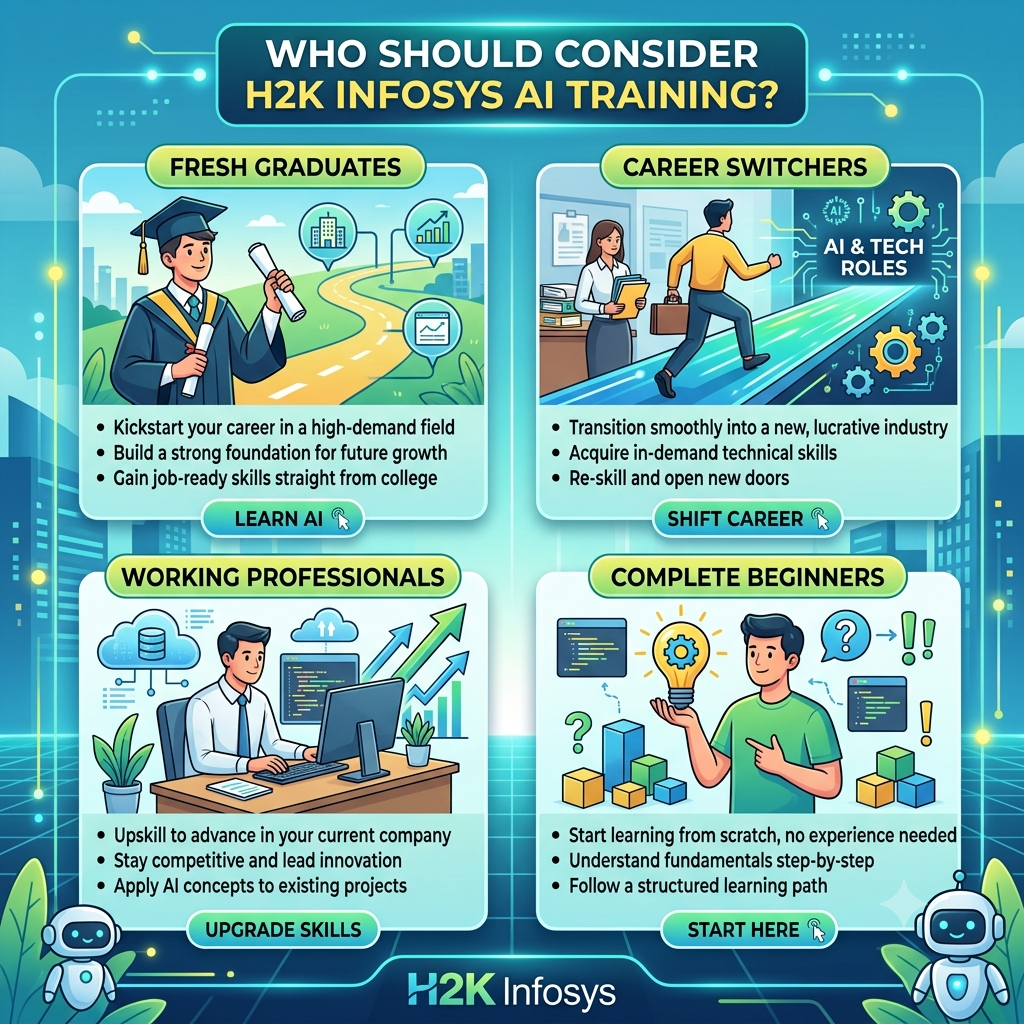
H2K’s current program is aimed at a fairly broad audience, including people coming from software development, data science, engineering and other backgrounds, as well as learners looking to transition toward AI-focused careers.
It can make particular sense for:
Fresh graduates
If you’ve learned some programming or quantitative subjects but don’t know how to turn that knowledge into an AI career, structured training can give you a clearer path.
Career switchers
Someone working in QA, business analysis, software development or data-related work may be able to build on existing experience rather than starting completely from zero.
Working professionals
Live online learning can be useful when leaving your current job isn’t an option.
Complete beginners
You don’t necessarily need to understand advanced AI before starting. A properly sequenced course can introduce the concepts gradually.
That said, “beginner-friendly” doesn’t mean “effort-free.”
You’ll still need to practice.
A lot.
What Makes an Online AI Course Actually Good?
Here’s my practical checklist.
Before paying for any program, check whether it offers these six things.
1. A logical curriculum
AI should be taught in an order that makes sense.
Python → statistics → ML → deep learning → GenAI is much easier to follow than jumping randomly between buzzwords.
2. Live instructor interaction
Recorded videos are convenient, but sometimes you need to ask:
“Why did this model fail?”
That’s difficult to solve by watching another 20-minute video.
3. Real projects
Projects give you an opportunity to make mistakes which is actually part of learning.
4. Current technologies
AI changes quickly. A course shouldn’t be stuck teaching only older machine-learning concepts while ignoring modern LLM and GenAI workflows.
5. Interview preparation
Knowing AI and explaining AI during an interview are two different skills.
Mock interviews can help bridge that gap.
6. Career support
Resume guidance, interview preparation and job-search assistance can be valuable, particularly for someone entering the field for the first time.
H2K Infosys currently highlights all six areas across its AI training and career-support offering.
Free AI Courses vs Paid AI Training
This is an interesting one.
You absolutely can start learning AI for free.
Government-backed initiatives in India, for instance, now include online AI and GenAI learning options through platforms such as Skill India Digital Hub. The Ministry reported more than 120 AI-related digital courses on the platform in March 2026, including courses specifically focused on Generative AI.
So why pay for training?
The answer is structure.
A free course may teach you what machine learning is.
A structured career program may help answer:
- What should I learn next?
- What project should I build?
- How do I explain that project?
- How should my resume present these skills?
- How do I prepare for interviews?
- Where do I start looking for AI-related roles?
If you’re disciplined enough to design your own curriculum, free resources can be excellent.
If you keep jumping between YouTube videos, tutorials and random courses without finishing anything well, that’s a different story. Most beginners don’t need more information. They need a learning path.
Are AI Certifications Enough to Get a Job?
No.
And I’d be suspicious of any course claiming otherwise.
A certificate can demonstrate that you completed training. It doesn’t automatically demonstrate that you can solve an employer’s problem.
Think of the certificate as the cover of the book.
Your projects, technical understanding, communication skills and interview performance are the actual chapters.
This is particularly important because AI is changing entry-level work itself. Recent reporting has highlighted concerns that automation may reduce some traditional entry-level tasks while increasing the value of skills involving judgment, domain knowledge and problem-solving.
So don’t build your learning strategy around collecting certificates.
Build it around becoming useful.
How Long Does It Take to Become Job-Ready in AI?
There’s no honest one-size-fits-all answer.
Someone with Python and data experience might move considerably faster than someone starting from scratch.
H2K Infosys estimates that becoming job-ready can take roughly 3 to 12+ months depending on starting point and study intensity, while its structured programs commonly run around 3–6 months.
I’d treat that as a planning range rather than a promise.
A better way to measure progress is:
Can I build something?
Then:
Can I explain what I built?
Then:
Can I troubleshoot it when it doesn’t work?
And finally:
Can I explain its business value to an interviewer?
Those milestones tell you much more than the number of weeks you’ve been enrolled.
H2K Infosys vs a Typical Self-Paced AI Course
The key takeaway isn’t that every self-paced course is bad. Far from it.
If you already have strong fundamentals and excellent self-discipline, a self-paced course can be fantastic.
But if you’re starting from scratch and want training + projects + career preparation, a structured program like H2K Infosys can make the journey less fragmented.
Frequently Asked Questions
Which AI course is best for an absolute beginner?
Look for a course that starts with AI and programming fundamentals before progressing into machine learning, deep learning and Generative AI. H2K Infosys’ AI training follows this type of progression and includes practical projects and career support.
Can I learn AI online without a computer science degree?
Yes. Your starting point matters more than the title of your degree. You may need to spend additional time learning Python, statistics and basic programming concepts, but online AI education is accessible to learners from different professional backgrounds.
Which are the best AI courses for beginners with job support?
Prioritize courses that combine technical training with projects, resume assistance, mock interviews and job-search support. H2K Infosys currently offers these career-support components as part of its AI training.
Is Generative AI a good starting point?
It can be, especially if you want to understand today’s AI applications. However, learning only prompting without understanding basic AI, data and programming concepts can leave gaps later. A foundation-first approach is safer for a long-term AI career.
Does H2K Infosys offer a free demo?
Yes. H2K Infosys currently advertises a free demo session for its Artificial Intelligence training, allowing prospective learners to get a feel for the course before enrolling.
Final Verdict: Which Online AI Course Should a Beginner Choose?
If you’re searching for ai courses online for beginners, don’t choose based on the longest curriculum or the biggest list of buzzwords.
Choose based on what happens after you finish learning the theory.
Can you build projects?
Can you work with real tools?
Can you explain your work?
Can someone help you prepare for interviews?
And do you have a realistic path from training to employment?
For learners who want that combination, H2K Infosys’ Artificial Intelligence Online Training is a strong option to explore in 2026, particularly because its current program combines foundational AI concepts, Python, machine learning, deep learning, practical projects, live instruction and career assistance.
The bigger point is this: AI isn’t becoming important because everyone needs to become an AI engineer. It’s becoming important because almost every kind of professional work is being touched by AI.
So start where you are.
Learn the fundamentals. Build something useful. Get comfortable explaining your work.
And don’t wait until you feel “ready” to start doing practical work. That’s usually when the real learning begins.
If you’d like to explore H2K Infosys’ current AI curriculum and free demo, check the official course page: H2K Infosys Artificial Intelligence Online Training