An AI Certification Course Offers Placement Assistance from H2K Infosys typically combines technical AI training, hands-on projects, interview preparation, and career support services. The Best Online Courses Artificial Intelligence are designed to help working professionals build practical skills in machine learning, generative AI, automation, and enterprise AI workflows while improving job readiness through mentoring, resume support, interview coaching, and placement guidance.
Programs focused on practical AI implementation often include industry-relevant tools, project-based learning, resume preparation, mock interviews, and support for transitioning into AI-related job roles. Courses such as the IAI program are commonly structured to support learners from beginner to intermediate technical backgrounds.
What is an Artificial Intelligence Certificate Online Program?
An AI Certification Course Offers Placement Assistance is a structured training course designed to teach AI concepts, tools, frameworks, and implementation practices through remote learning platforms. These programs usually cover:
- Machine learning fundamentals
- Neural networks
- Natural language processing (NLP)
- Generative AI
- Data handling and preprocessing
- AI model deployment
- Python programming for AI
- Enterprise AI workflows
Unlike purely academic AI programs, professional certification courses focus heavily on applied learning and industry use cases.
Common Components of AI Certification Programs
| Component | Purpose |
|---|---|
| Live Instructor Sessions | Real-time learning and interaction |
| Recorded Modules | Flexible self-paced revision |
| Hands-On Labs | Practical implementation |
| Capstone Projects | Enterprise-style problem solving |
| Career Support | Resume and interview preparation |
| Placement Assistance | Job search guidance and referrals |
Many working professionals choose AI Certification Course Offers Placement Assistance because they can continue full-time employment while upgrading technical skills.
Why Do Professionals Look for AI Courses With Placement Assistance?
Placement assistance is important because learning AI concepts alone is often insufficient for transitioning into AI-related job roles. Employers generally expect candidates to demonstrate:
- Practical implementation experience
- Familiarity with enterprise AI tools
- Problem-solving ability
- Understanding of production workflows
- Knowledge of data governance and model deployment
Placement-oriented AI programs attempt to bridge the gap between theoretical learning and job readiness.
Typical Placement Assistance Services
Resume and LinkedIn Optimization
Learners receive guidance on:
- Highlighting AI projects
- Presenting transferable technical skills
- Structuring AI-focused resumes
Mock Technical Interviews
Programs often simulate:
- Python coding interviews
- Machine learning discussions
- AI system design questions
- Scenario-based problem solving
Project Portfolio Preparation
Candidates build demonstrable projects such as:
- Chatbots
- Recommendation systems
- Predictive analytics pipelines
- AI-powered automation tools
Career Mentorship
Mentors may help learners:
- Understand AI career paths
- Identify skill gaps
- Prepare for enterprise environments
What Makes IAI Relevant for Working Professionals?
IAI-focused training programs generally emphasize practical artificial intelligence implementation rather than purely research-oriented AI theory.
For working professionals, this approach is useful because enterprise organizations commonly prioritize:
- AI integration into business workflows
- Automation efficiency
- Scalable AI systems
- Responsible AI practices
- Deployment and monitoring
Core Areas Usually Covered in IAI Programs
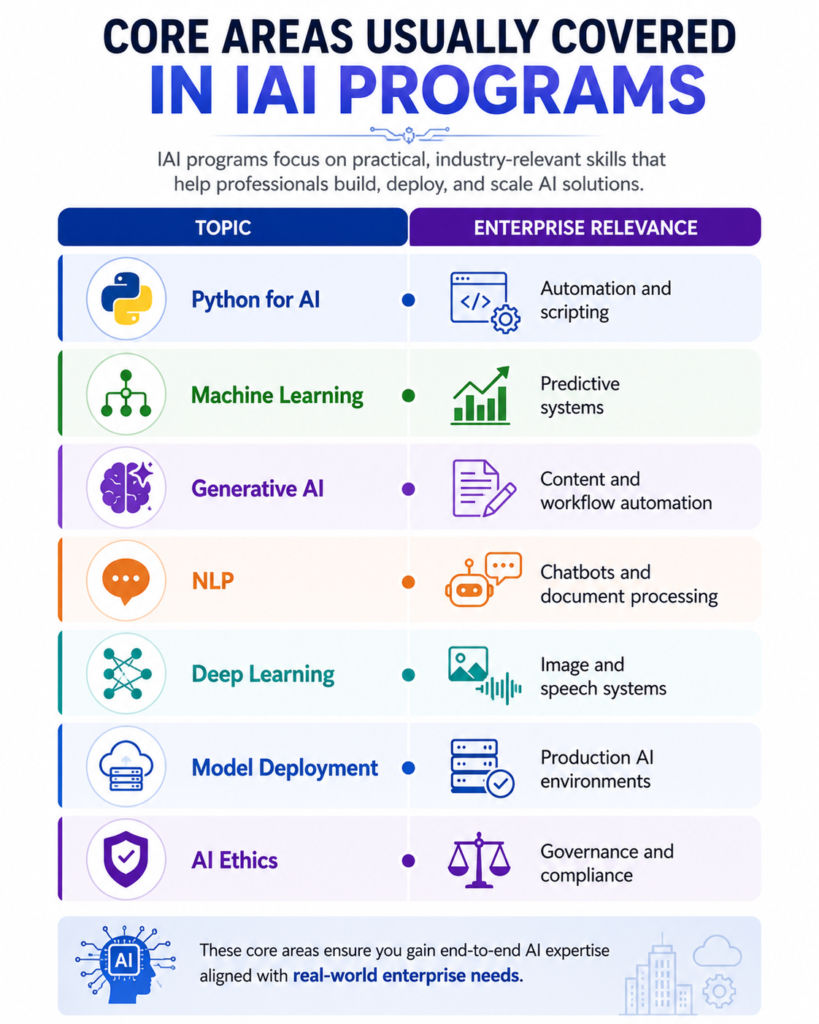
| Topic | Enterprise Relevance |
|---|---|
| Python for AI | Automation and scripting |
| Machine Learning | Predictive systems |
| Generative AI | Content and workflow automation |
| NLP | Chatbots and document processing |
| Deep Learning | Image and speech systems |
| Model Deployment | Production AI environments |
| AI Ethics | Governance and compliance |
These topics align with common enterprise AI implementation requirements.
How Does Artificial Intelligence Work in Real-World IT Projects?
Artificial intelligence systems typically process data, identify patterns, make predictions, and automate decision-making tasks.
In enterprise IT projects, AI is rarely implemented as an isolated technology. Instead, it is integrated into:
- Cloud platforms
- Enterprise applications
- Business intelligence systems
- Customer support tools
- Security operations
- DevOps pipelines
Typical AI Workflow in Enterprise Environments
| Stage | Description |
|---|---|
| Data Collection | Gather structured or unstructured data |
| Data Cleaning | Remove inconsistencies and duplicates |
| Feature Engineering | Prepare data for training |
| Model Training | Train machine learning algorithms |
| Validation | Evaluate model accuracy |
| Deployment | Integrate into production systems |
| Monitoring | Track model performance |
Example: AI in Customer Support Automation
An enterprise support platform may use:
- NLP models for ticket classification
- Sentiment analysis for prioritization
- Generative AI for response drafting
- Predictive analytics for escalation risk
In this scenario, AI engineers collaborate with:
- Cloud teams
- DevOps engineers
- Data analysts
- Security administrators
This demonstrates why enterprise AI training must include cross-functional workflows.
Why is AI Certification Important for Working Professionals?
AI certification programs help professionals validate practical skills in a rapidly evolving technical domain.
For experienced IT professionals, AI training can support transitions from roles such as:
- Software development
- Data analysis
- QA automation
- Cloud administration
- Business intelligence
- DevOps engineering
Benefits of AI Certification
Structured Learning Path
Professionals can learn AI concepts systematically instead of relying on fragmented tutorials.
Exposure to Enterprise Tools
Courses often include:
- Python
- TensorFlow
- PyTorch
- Scikit-learn
- OpenAI APIs
- LangChain
- Vector databases
Practical Project Experience
Hands-on labs help learners understand:
- Model training
- Deployment challenges
- API integration
- Performance optimization
Career Transition Support
Placement assistance helps professionals navigate:
- AI-focused resumes
- Technical interviews
- Portfolio development
What Skills Are Required to Learn IAI?
Most AI Certification Courses are designed for beginner-to-intermediate technical learners.
Recommended Prerequisites
| Skill | Importance |
|---|---|
| Basic Programming | Essential |
| Logical Thinking | Essential |
| Python Fundamentals | Highly Recommended |
| Statistics Basics | Helpful |
| SQL Knowledge | Useful |
| Cloud Fundamentals | Useful |
Technical Skills Commonly Learned
Programming Skills
- Python scripting
- API integration
- Data manipulation
Machine Learning Concepts
- Supervised learning
- Unsupervised learning
- Classification and regression
Data Processing
- Data cleaning
- Feature engineering
- Dataset management
AI Framework Usage
- TensorFlow
- PyTorch
- Hugging Face
- LangChain
Deployment Skills
- Docker basics
- REST API integration
- Cloud deployment concepts
How is AI Used in Enterprise Environments?
Enterprise AI adoption usually focuses on operational efficiency, automation, analytics, and customer experience improvement.
Common Enterprise AI Use Cases
| Industry | AI Application |
|---|---|
| Healthcare | Diagnostic assistance |
| Finance | Fraud detection |
| Retail | Recommendation systems |
| Manufacturing | Predictive maintenance |
| IT Operations | Automated monitoring |
| Customer Service | AI chatbots |
Enterprise Constraints AI Teams Must Handle
Security and Compliance
Organizations must protect:
- Sensitive data
- Customer records
- Intellectual property
Scalability
AI systems must support:
- High transaction volumes
- Real-time processing
- Distributed architectures
Model Governance
Teams monitor:
- Bias detection
- Accuracy drift
- Regulatory compliance
Infrastructure Optimization
Production AI systems require:
- GPU management
- Efficient storage
- Monitoring pipelines
These realities make practical AI Certification Course Offers Placement Assistance significantly more valuable than theory-only learning.
What Job Roles Use Artificial Intelligence Daily?
AI skills are now integrated into multiple technical and business roles.
Common AI-Related Job Roles
| Role | Responsibilities |
|---|---|
| AI Engineer | Build and deploy AI systems |
| Machine Learning Engineer | Train predictive models |
| Data Scientist | Analyze data and generate insights |
| NLP Engineer | Develop language processing systems |
| AI Solutions Architect | Design enterprise AI solutions |
| Generative AI Developer | Build AI-powered applications |
| Automation Engineer | Integrate AI into workflows |
Hybrid Roles Emerging in Enterprise IT
Many organizations now expect AI familiarity in:
- DevOps roles
- QA automation
- Cloud engineering
- Cybersecurity analysis
- Business intelligence
This is one reason AI Certification Course Offers Placement Assistance have become increasingly relevant for experienced IT professionals.
What Careers Are Possible After Learning IAI?
Career opportunities depend on:
- Prior technical background
- Project experience
- Practical implementation skills
- Understanding of enterprise workflows
Potential Career Paths
| Background | Possible AI Transition |
|---|---|
| Software Developer | AI Engineer |
| Data Analyst | Machine Learning Analyst |
| QA Engineer | AI Test Automation Specialist |
| Cloud Engineer | AI Infrastructure Engineer |
| Business Analyst | AI Product Analyst |
Entry-Level AI Responsibilities
Professionals entering AI-related roles may work on:
- Dataset preparation
- AI model testing
- Workflow automation
- Prompt engineering
- AI integration support
More advanced responsibilities generally require:
- Production deployment experience
- Distributed systems knowledge
- Model optimization expertise
What Should You Evaluate Before Choosing an Online AI Certification Course?
Not all AI Certification Course Offers Placement Assistance programs provide the same level of practical training or placement support.
Important Evaluation Criteria
Curriculum Depth
Look for programs covering:
- AI fundamentals
- Machine learning
- Generative AI
- Deployment practices
Hands-On Projects
Projects should simulate realistic enterprise workflows.
Instructor Experience
Programs led by industry practitioners often provide better production-level insights.
Placement Support
Evaluate whether the program includes:
- Resume preparation
- Mock interviews
- Mentorship
- Job referrals
Enterprise Tool Exposure
The curriculum should include commonly used frameworks and platforms.
Comparing Different Types of AI Learning Paths
| Learning Option | Advantages | Limitations |
|---|---|---|
| Self-Paced Videos | Flexible schedule | Limited mentorship |
| Academic Degrees | Strong theory | Longer duration |
| Bootcamps | Intensive practical training | Fast-paced |
| AI Certification Courses | Balanced practical learning | Quality varies by provider |
For working professionals, certification programs with structured mentorship are often more manageable than full academic programs.
How Do AI Professionals Work on Real Projects?
AI implementation usually involves collaboration between multiple technical teams.
Example Enterprise AI Workflow
Step 1: Business Requirement Definition
A company identifies a need such as:
- Customer ticket automation
- Fraud detection
- Forecasting
Step 2: Data Preparation
Teams collect and clean datasets.
Step 3: Model Selection
Engineers evaluate:
- Classification models
- Neural networks
- Transformer models
Step 4: Training and Validation
The AI system is trained and tested.
Step 5: Deployment
The model is integrated into production applications.
Step 6: Monitoring
Teams track:
- Accuracy
- Latency
- Resource usage
- Security issues
Common Challenges in Production AI
| Challenge | Description |
|---|---|
| Data Quality | Incomplete or inconsistent data |
| Model Drift | Reduced accuracy over time |
| Security Risks | Sensitive data exposure |
| Infrastructure Costs | GPU and cloud expenses |
| Integration Complexity | Legacy system compatibility |
Practical AI Certification Course Offers Placement Assistance should expose learners to these operational realities.
Best Practices for Learning Artificial Intelligence Effectively
Focus on Practical Implementation
Build projects instead of only studying theory.
Learn Python Thoroughly
Python remains the dominant programming language for AI development.
Understand Data Fundamentals
Many AI project failures originate from poor data quality.
Practice Model Deployment
Deployment knowledge is important for enterprise readiness.
Study Enterprise Workflows
Understand how AI integrates with:
- APIs
- Cloud platforms
- Databases
- Monitoring systems
Frequently Asked Questions (FAQ)
What is the best online course for artificial intelligence with placement assistance?
The AI Certification Course Offers Placement Assistance typically combine hands-on projects, enterprise-focused curriculum, mentoring, and career support. Programs offering practical implementation experience are generally more valuable for working professionals.
Is an artificial intelligence certificate online useful for career transitions?
Yes. AI Certification Course Offers Placement Assistance can help professionals transition from software, analytics, cloud, QA, or support roles into AI-related positions if they also build practical project experience.
Do AI certification courses require coding experience?
Basic programming knowledge is helpful, especially Python fundamentals. However, many programs are structured for beginner-to-intermediate learners.
What tools are commonly taught in AI courses?
Common tools include:
Python
TensorFlow
PyTorch
Scikit-learn
OpenAI APIs
Hugging Face
LangChain
Are online AI certification programs suitable for working professionals?
Yes. Many online programs are specifically designed for professionals who need flexible schedules alongside full-time employment.
How long does it take to learn AI?
The timeline depends on prior technical experience. Foundational AI skills may take several months of consistent study and project work.
What industries hire AI professionals?
AI professionals work across:
Healthcare
Banking
Retail
Manufacturing
Cybersecurity
Software development
Cloud services
Are online AI certification programs suitable for working professionals?
Yes. Many online programs are specifically designed for professionals who need flexible schedules alongside full-time employment.
How long does it take to learn AI?
The timeline depends on prior technical experience. Foundational AI skills may take several months of consistent study and project work.
Do placement assistance programs guarantee jobs?
Placement assistance generally includes mentorship, interview preparation, and job guidance. Employment outcomes still depend on technical skills, experience, and market conditions.
Key Takeaways
- An AI Certification Course Offers Placement Assistance program helps professionals build practical AI implementation skills.
- The best online courses for artificial intelligence usually include projects, mentorship, and enterprise tool exposure.
- Placement assistance focuses on job readiness through resumes, mock interviews, and portfolio development.
- Enterprise AI projects require understanding workflows, deployment, governance, and scalability.
- AI career opportunities span engineering, analytics, automation, cloud, and business intelligence roles.
Explore H2K Infosys AI Certification Course Offers Placement Assistance to gain hands-on experience with enterprise AI tools and practical workflows.
Learn industry-relevant AI skills through structured online training designed for working professionals and career growth.