An AI online course with resume and interview preparation usually combines technical artificial intelligence training with career support services such as mock interviews, project assistance, resume optimisation, and job-oriented coaching. These programs help learners develop practical skills in machine learning, deep learning, natural language processing, and other AI technologies while preparing for careers as AI engineers, machine learning engineers, data analysts, or AI solutions professionals.
And many Online AI Training Programs these days also include job preparedness elements, as companies want to know how well candidates can articulate real-world project experience during interviews not just their technical chops.
What is an Online AI Course with Resume and Interview Prep?
Which Online AI Course Includes Resume is a full-featured online training program that teaches ai principles and includes resume writing and interview skills training.
Typically these courses cover:
- Basics of AI and machine learning
- Projects (hands-on)
- Tools and frameworks in the industry
- Tips for Building a Resume
- Technical interview prep
- Practice interview sessions
- Portfolio Creation
- Career coaching
Professional online AI programs, unlike self-paced and video-only platforms, tend to emphasise applied learning and enterprise use cases.
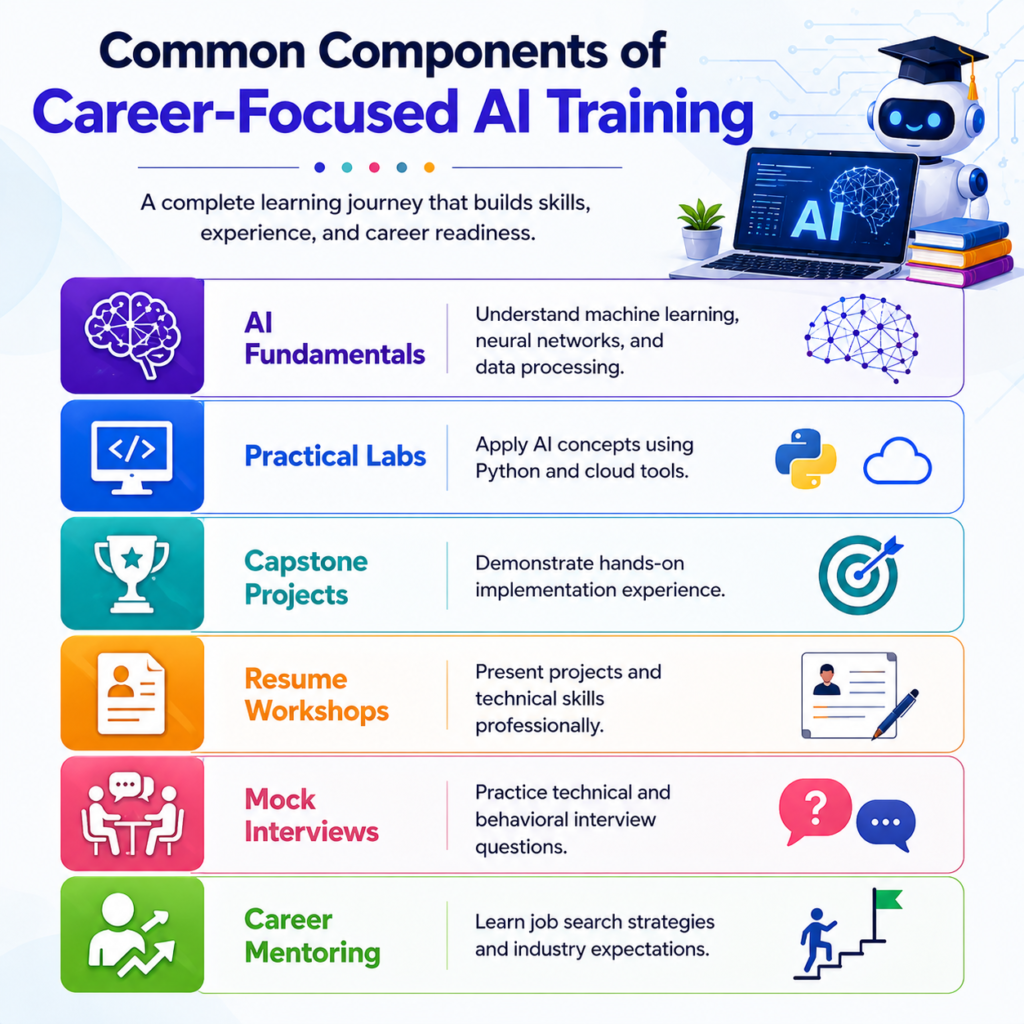
Common Components of Career-Focused AI Training
| Component | Purpose |
|---|---|
| AI Fundamentals | Understand machine learning, neural networks, and data processing |
| Practical Labs | Apply AI concepts using Python and cloud tools |
| Capstone Projects | Demonstrate hands-on implementation experience |
| Resume Workshops | Present projects and technical skills professionally |
| Mock Interviews | Practice technical and behavioral interview questions |
| Career Mentoring | Learn job search strategies and industry expectations |
Why Working Professionals Should Consider AI Training Online?
There’s continued acceptance of AI in healthcare, banking, retail, cybersecurity, logistics and software engineering. AI literacy is becoming increasingly important for working individuals in technical and business-focused IT professions to remain competitive.
The online learning allows professionals to:
- Learn while you work
- Experiment with cloud-based AI tools
- Gradually build project portfolios
- Flexible schedule
- Attend live mentoring sessions virtually.
Which Online AI Course Includes Resume Includes Resume are often leveraged by professionals shifting to AI-enabled tasks such as software development, QA testing, business analysis, data analytics, and infrastructure.
Why Professionals Are Taking AI Courses
- Transitioning into AI-related careers
- Upskilling for automation initiatives
- Understanding AI processes in an enterprise
- Better data-driven decision making
- Preparing for AI-infused cloud environments
- How does AI operate in real IT projects?
Artificial intelligence systems analyse data, find patterns, and make predictions or choices based on algorithms and statistical models.
Common AI workflows in the enterprise include:
Career transition into AI-related roles Upskilling for automation-focused projects Understanding enterprise AI workflows Improving data-driven decision making Preparing for AI-integrated cloud environments
A customer-service AI system could include:
- Natural language processing (NLP)
- Chatbot frameworks
- Sentiment analysis
- Ticket categorisation models
In production contexts, engineers must also solve for:
- Data protection
- Model latency (response time)
- Integrations API
- Scalability
- Security adherence
These operational considerations are commonly covered in advanced online AI training programs.
What skills do you need to learn about AI?
Most beginning to intermediate Ai Certified Courses assume that learners will gradually acquire foundational technical abilities.
Core Skills for Learning AI
| Skill Area | Importance |
|---|---|
| Python Programming | Widely used for AI and ML development |
| Statistics | Required for model evaluation and probability |
| Data Handling | Essential for preprocessing and analysis |
| SQL | Used for querying enterprise datasets |
| Machine Learning Concepts | Core understanding of predictive modeling |
| Cloud Platforms | Important for deployment and scalability |
Tools Frequently Used in AI Learning
| Tool | Purpose |
|---|---|
| Python | Primary AI programming language |
| Jupyter Notebook | Interactive development environment |
| TensorFlow | Deep learning framework |
| PyTorch | Neural network development |
| Scikit-learn | Machine learning library |
| Pandas | Data manipulation |
| NumPy | Numerical computation |
| Git | Version control |
| Docker | Containerization |
| AWS / Azure | Cloud deployment |
There are many online AI programs that teach these concepts via guided labs and project assignments.
What are some examples of AI in enterprise?
Enterprise AI solutions are more likely to be integrated into broader IT ecosystems than they are stand-alone apps.
Enterprise AI common use cases
Forecasting Analytics
Organisations are forecasting with machine learning models:
- Customers behaviour
- Sales trends
- Mechanical failures
- Risks of Surgery
Fraud Detection:
Financial organisations often deploy AI algorithms to detect anomalous transaction trends.
Smart Automation
Artificial intelligence (AI) is a technology that helps with robotic process automation (RPA) by allowing computers to:
- Read documents
- Extract information
- Handle Emails
- Automate route workflows
- Recommendation Systems.
Retail and streaming services leverage AI to tailor suggestions.
Cyber Security Monitoring
AI algorithms learn from network behaviour to spot abnormalities and suspicious activity.
Enterprise Challenges AI Teams Face
| Challenge | Description |
|---|---|
| Data Quality | Incomplete or inconsistent datasets |
| Scalability | Managing large-volume model inference |
| Security | Protecting sensitive information |
| Explainability | Understanding model decisions |
| Governance | Meeting compliance requirements |
| Infrastructure Costs | Optimizing cloud resource usage |
These practical operational realities are commonly introduced in professional courses in AI.
What Job Positions Use AI Daily?
AI skills are becoming relevant in many IT and commercial areas.
| Role | Responsibilities |
|---|---|
| AI Engineer | Build and deploy AI systems |
| Machine Learning Engineer | Develop predictive models |
| Data Scientist | Analyze data and train algorithms |
| Data Analyst | Generate insights using AI-assisted tools |
| NLP Engineer | Build language-processing applications |
| AI Product Manager | Coordinate AI-based product development |
| Business Intelligence Developer | Integrate analytics and reporting |
| Cloud AI Specialist | Deploy AI workloads on cloud platforms |
A lot of organizations are looking for people who have AI skills and domain expertise, such as:
DevOps + AI
QA Automation + AI
Cybersecurity and AI
AI + Cloud Engineering
AI + Business Analytics
This has led to the emergence of online, hands-on Which Online AI Course Includes Resume for experienced IT professionals.
What Should an Online AI Program Consist of?
Not all AI courses are equal in depth or practical preparation.
Here are the components that an ideal career-oriented AI course should have in place.
Technical Learning Modules
- Fundamentals of Machine Learning
- Deep learning 101:
- Language processing
- Generative AI Ideas
- Data pre-processing
- Deploying the model
- Hands-on Project Experience
Projects can include:
- Customer Attrition Prediction
- Recommendation systems
- Models for resume screening
- Workflows for Fraud Detection
Developing a Chatbot
| Feature | Why It Matters |
|---|
| Resume Guidance | Helps present technical projects effectively |
| Mock Interviews | Simulates real technical interviews |
| LinkedIn Optimization | Improves professional visibility |
| Project Reviews | Validates implementation quality |
| Portfolio Assistance | Demonstrates practical experience |
More than just technical knowledge is needed to apply for a job.
Many candidates deal with:
- Well-defined AI projects
- Measuring contributions
- Explain the tools used
- Show business worth
Resume building workshops allow students to present their experience in a professional way.
Example Resume Enhancements
Before that
- Worked on machine learning project.
Then
“Built a customer churn prediction model with Python, Scikit-learn and logistic regression, enhanced classification accuracy through feature engineering and hyperparameter tuning.”
This kind of specificity allows recruiters and hiring managers to evaluate practical competency.
What is involved in preparing for an AI interview?
Interview preparation usually includes a mix of technical and behavioural tests.
Common AI Interview Areas
| Area | Topics Covered |
|---|---|
| Python | Data structures, functions, libraries |
| Machine Learning | Algorithms, overfitting, evaluation |
| Statistics | Probability, distributions, regression |
| SQL | Joins, aggregations, optimization |
| Projects | Architecture and implementation discussion |
| System Design | Model deployment workflows |
Mock interviews are a great way for experts to practise formal technical explanations.
Why Do Real World AI Projects Help Learning?
Practical implementation is one of the most significant parts of AI education.
- Advantages of Project-Based Learning
- Theoretical concepts reinforced
- Develop debugging skills
- Increases comfort with the tool
- Gains knowledge of workflow
- Delivers portfolio-ready artefacts
- Normal Project Process
- Define business issue
- Get data set
- Clean and preprocess data
- Base model training
- Assess indicators
- Better performance
- Solution deployment or demo
It mimics real-world company development procedures.
What’s the Difference Between Self-Paced and Instructor-Led Online AI Courses?
Self-paced learning
Benefits:
- Flexible working time
- Reduced cost
- Independent study
Limitations:
- Limited Mentoring
- Limited review of project
- Less broad accountability
- Instructor-led Courses
Benefits:
- Programme with structure
- Live Q&As
- Feedback on project
- Mentoring in careers
- Working with peers
Limitations:
- scheduled meetings
- Need more time
Working professionals tend to favour hybrid models where live education is mixed with recorded resources.
How Long Does It Take to Learn AI?
How long it takes to learn depends on your technical experience.
Estimated Learning Duration
| Background | Approximate Learning Time |
|---|---|
| Non-Technical Beginner | 9–12 months |
| IT Professional | 4–8 months |
| Developer or Data Analyst | 3–6 months |
Progress is influenced by factors such as:
- Knowledge of programming
- Mathematical background
- Hours of practice/week
- Complexity of the project
- Exposure to real data sets
“It’s not the length of the course that matters, it’s the consistent hands-on practice.
What Jobs Can You Get After Learning AI?
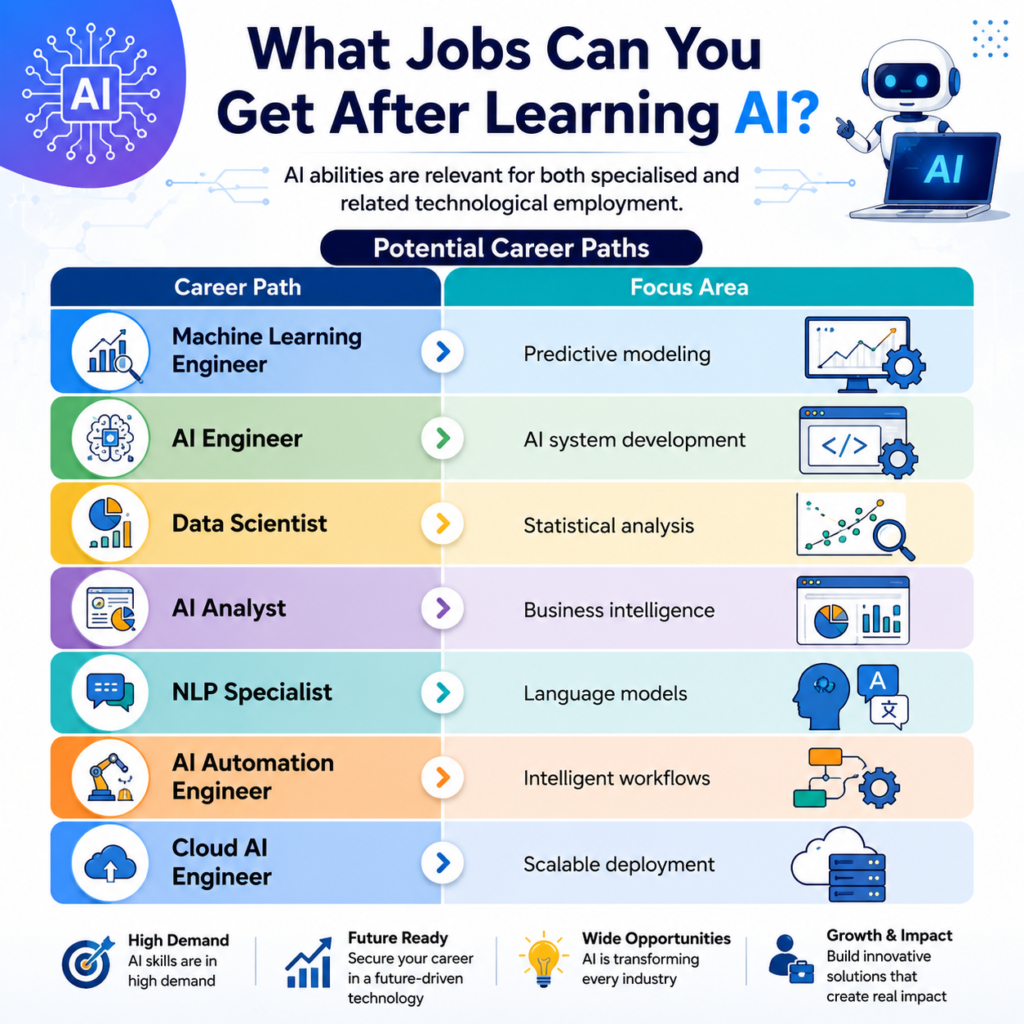
AI abilities are relevant for both specialised and related technological employment.
Potential Career Paths
| Career Path | Focus Area |
|---|---|
| Machine Learning Engineer | Predictive modeling |
| AI Engineer | AI system development |
| Data Scientist | Statistical analysis |
| AI Analyst | Business intelligence |
| NLP Specialist | Language models |
| AI Automation Engineer | Intelligent workflows |
| Cloud AI Engineer | Scalable deployment |
Many organisations nowadays are adding AI capabilities to their existing enterprise software systems.
What to Expect from AI Training Online for Working Professionals?
For the online AI programs, they must be judged on both technical depth and job preparation.
Evaluation Checklist
| Consideration | Why It Matters |
|---|---|
| Live Project Work | Demonstrates practical experience |
| Instructor Expertise | Ensures accurate technical guidance |
| Industry-Relevant Tools | Aligns learning with enterprise usage |
| Career Support | Helps with transition into AI roles |
| Mock Interviews | Improves technical communication |
| Flexible Schedule | Supports working professionals |
FAQ – Frequently Asked Questions
What is the fastest way to learn AI online?
Usually, beginners start with basics of Python, statistics and machine learning and then go to deep learning and deployment principles later.
Practical projects in online AI programs?
Many professional AI courses involve supervised projects in predictive analytics, NLP, recommendation systems, or automation workflows.
Does one have to learn programming for AI?
Having basic knowledge of programming is a huge plus. Python is often used for AI creation and is frequently included in applications designed for beginners.
Part-time AI for working professionals?
Yes. Many online AI training programs are aimed at working professionals that need to fit around a work schedule and organised learning in evenings or weekends.
Here are some of the popular AI interview topics:
Common themes include Python, machine learning algorithms, SQL, statistics, conversations about projects, model evaluation, and concepts of deployment in a system.
Why is it vital to prepare a CV for AI learning?
AI resumes should explicitly detail projects, tools, methods, datasets, and measurable results. Resume seminars assist candidates in showcasing their technical experience.
Which industries use AI the most?
AI solutions are deeply integrated into company operations in finance, healthcare, cybersecurity, retail, logistics, and cloud technology.
Are cloud platforms significant in the AI career?
Yes. Many AI workloads are deployed in cloud infrastructures like AWS , Azure or Google Cloud , for scalability and operational administration .
Summary
Online AI programs for Which Online AI Course Includes Resume prep mix technical knowledge with career readiness. Successful programs often have realistic projects, business-oriented workflows, industry-standard tools and guided coaching.
Professionals looking for Which Online AI Course Includes Resume should look for hands-on learning, project-based implementation, interview preparation, and practical exposure to real-world AI situations.
Key Learning
AI courses are more and more including career prep components
“Hands-on projects are important for skill development.
Resume and interview preparation make you more ready for a job
Enterprise AI brings scalability, security and deployment considerations
Typical python, machine learning, SQL and cloud skills required
Flexible online AI programs for working professionals
Join H2K Infosys Which Online AI Course Includes Resume to learn AI practically with hands-on projects, resume preparation and interview orientated learning.
Get career-ready experience and industry-relevant processes knowledge through structured online training programs.