Online AI training courses from H2K Infosys that help candidates get hired in the USA in 2026 typically focus on applied machine learning, data engineering integration, and real-world project experience using tools such as Python, TensorFlow, PyTorch, and cloud platforms. The most effective programs combine theoretical foundations with hands-on labs, portfolio projects, and exposure to enterprise workflows. Courses aligned with job roles such as Machine Learning Engineer, Data Scientist, or AI Engineer are more likely to lead to employment outcomes than purely academic or conceptual programs.
What Is an Online AI Course and What Makes It Job-Relevant?
An AI Training Course is a structured program designed to teach concepts such as machine learning, deep learning, natural language processing (NLP), and data modeling. However, not all courses translate into employable skills.
Job-Relevant AI Courses Typically Include:
- Programming with Python for AI workflows
- Practical use of libraries like:
- TensorFlow
- PyTorch
- Scikit-learn
- Data preprocessing and feature engineering
- Model training, validation, and deployment
- Exposure to cloud AI services (AWS, Azure, GCP)
- Real-world datasets and business use cases
Less Effective Courses Often:
- Focus heavily on theory without implementation
- Lack real-world datasets or projects
- Do not cover deployment or MLOps practices
Why Is Choosing the Best Artificial Intelligence Course Online Important?
For working professionals, time and ROI are critical. The Best Artificial Intelligence Course Online should align with industry expectations rather than academic exploration.
Key Reasons:
- Hiring managers prioritize demonstrable skills over certifications
- Portfolio projects are often required during interviews
- AI roles require cross-functional knowledge (data + engineering + domain context)
- Employers expect familiarity with production environments
How Does AI Work in Real-World IT Projects?
AI in enterprise environments follows a structured lifecycle rather than isolated experimentation.
Typical AI Workflow in Production
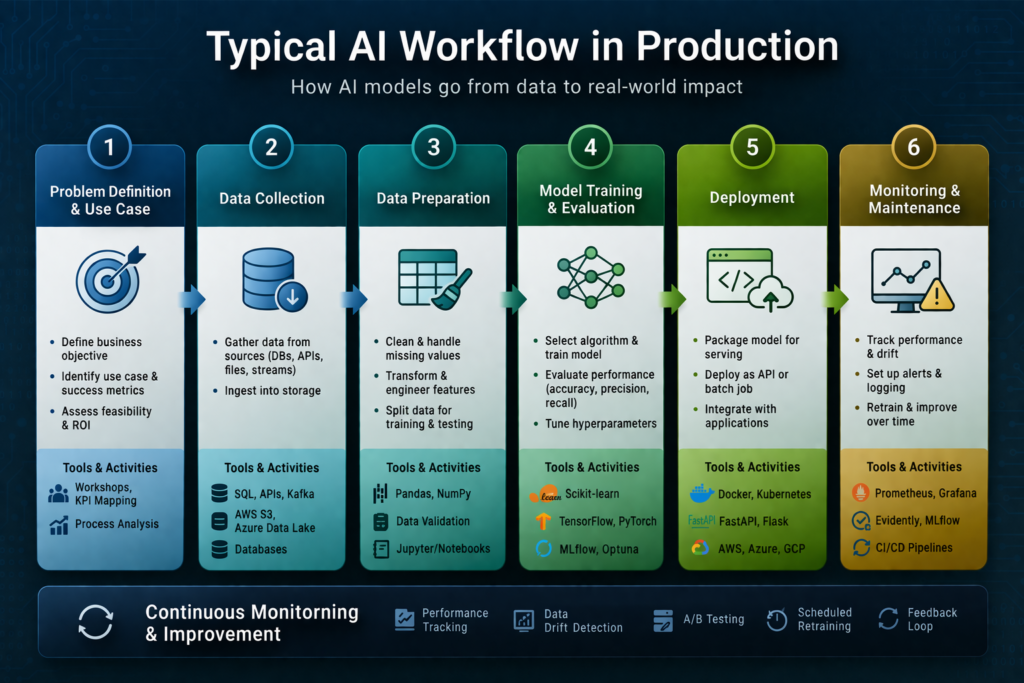
- Problem Definition
- Example: Predict customer churn in a telecom system
- Data Collection
- Sources: CRM systems, transaction logs, APIs
- Data Preprocessing
- Cleaning missing values
- Encoding categorical variables
- Model Selection
- Logistic regression, random forest, neural networks
- Model Training & Evaluation
- Train/test split
- Metrics: accuracy, precision, recall
- Deployment
- REST APIs using Flask/FastAPI
- Integration with enterprise systems
- Monitoring & Maintenance
- Model drift detection
- Performance tracking
How Is AI Used in Enterprise Environments?
AI is commonly integrated into business processes rather than used as standalone systems.
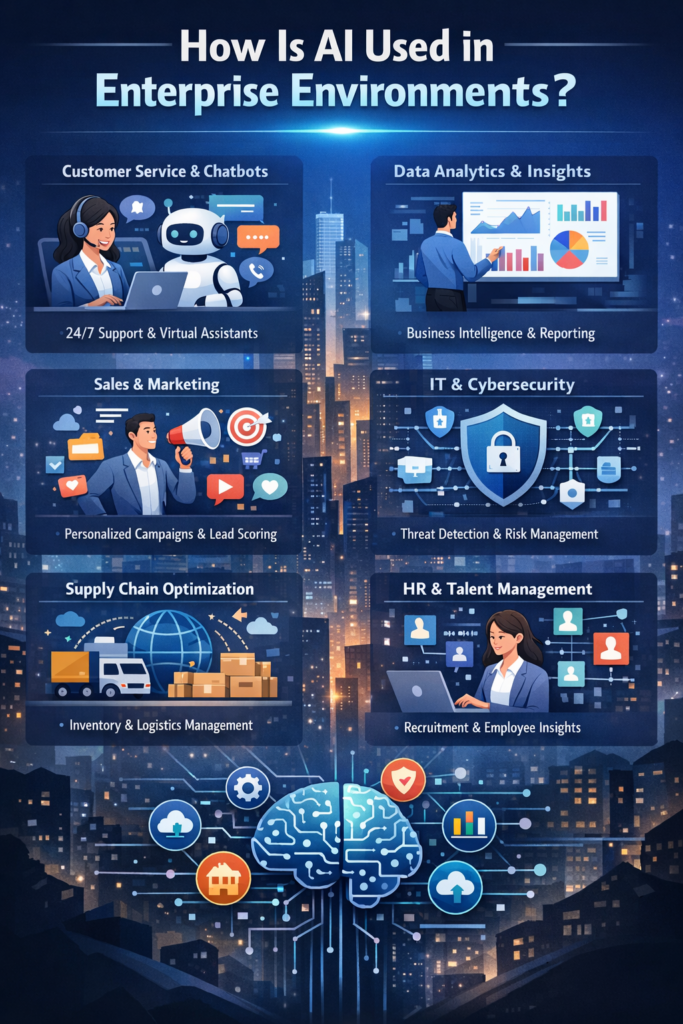
Common Enterprise Use Cases
| Industry | AI Application | Tools Used |
|---|---|---|
| Banking | Fraud detection | Python, Scikit-learn |
| Healthcare | Medical image analysis | TensorFlow, CNNs |
| Retail | Recommendation systems | Collaborative filtering |
| Telecom | Customer churn prediction | XGBoost, ML pipelines |
| Finance | Risk modeling | Statistical ML models |
Enterprise Considerations:
- Data security and compliance (HIPAA, GDPR)
- Scalability using cloud infrastructure
- Integration with legacy systems
- Explainability of AI models
Which AI Training Courses Are Most Relevant for USA Jobs in 2026?
The following types of AI training courses are commonly aligned with hiring requirements:
1. Machine Learning Engineer-Focused Courses
- Emphasis on algorithms, pipelines, deployment
- Tools: Python, Scikit-learn, TensorFlow
2. Data Science + AI Hybrid Courses
- Combines statistics, visualization, ML
- Tools: Pandas, NumPy, Matplotlib
3. Deep Learning Specialization Courses
- Focus on neural networks, NLP, computer vision
- Tools: PyTorch, Keras
4. AI + Cloud Integration Courses
- Covers AWS SageMaker, Azure ML, GCP Vertex AI
- Important for enterprise deployment
5. MLOps and Production AI Courses
- CI/CD for models
- Docker, Kubernetes
- Model monitoring
What Skills Are Required to Learn AI Effectively?
Core Technical Skills
- Python programming
- Linear algebra and basic statistics
- Data handling with Pandas
- Machine learning algorithms
- Model evaluation techniques
Supporting Skills
- SQL for data querying
- Cloud platform basics
- Version control (Git)
- API development
Soft Skills
- Problem-solving
- Data interpretation
- Communication with stakeholders
What Tools Are Commonly Taught in the Best Artificial Intelligence Course Online?
AI Tool Stack Overview
| Category | Tools | Purpose |
|---|---|---|
| Programming | Python | Core language |
| ML Libraries | Scikit-learn | Traditional ML |
| Deep Learning | TensorFlow, PyTorch | Neural networks |
| Data Processing | Pandas, NumPy | Data manipulation |
| Visualization | Matplotlib, Seaborn | Data insights |
| Deployment | Flask, FastAPI | Model APIs |
| Cloud | AWS, Azure, GCP | Scalable AI systems |
| MLOps | Docker, Kubernetes | Production workflows |
How Do AI Courses Translate Into Real Job Roles?
Role vs Skill Mapping
| Job Role | Key Skills | Tools Used |
|---|---|---|
| Machine Learning Engineer | Model building, deployment | TensorFlow, Docker |
| Data Scientist | Data analysis, ML models | Python, Pandas |
| AI Engineer | End-to-end AI systems | PyTorch, APIs |
| NLP Engineer | Text processing | Transformers, NLP libraries |
| Computer Vision Engineer | Image processing | OpenCV, CNNs |
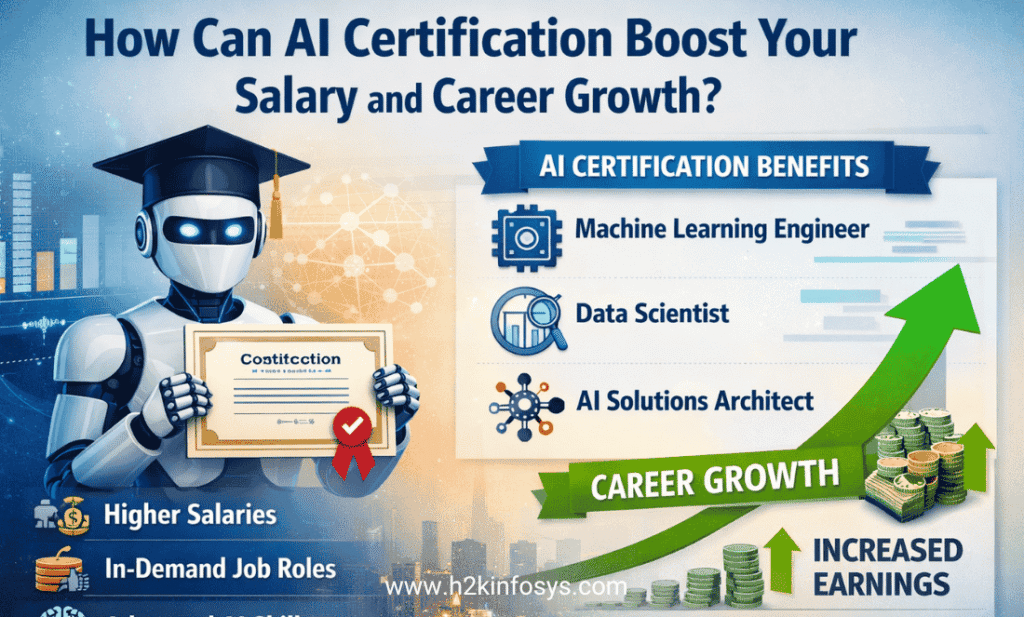
What Careers Are Possible After Learning AI?
AI training courses can lead to multiple career paths depending on specialization.
Common Career Options
- Machine Learning Engineer
- Data Scientist
- AI Engineer
- Business Intelligence Analyst
- NLP Engineer
- Computer Vision Specialist
Entry-Level vs Advanced Roles
| Level | Typical Roles |
|---|---|
| Entry-Level | Data Analyst, Junior ML Engineer |
| Mid-Level | Data Scientist, ML Engineer |
| Advanced | AI Architect, Lead Data Scientist |
What Do Employers in the USA Look for in AI Candidates in 2026?
Key Hiring Criteria
- Hands-on project experience
- Understanding of ML lifecycle
- Ability to work with real datasets
- Experience with cloud platforms
- Knowledge of deployment workflows
Common Interview Expectations
- Explain model selection decisions
- Walk through a project pipeline
- Write Python code for data processing
- Discuss trade-offs (accuracy vs performance)
How Should You Evaluate an AI Training Course Before Enrolling?
Evaluation Checklist
- Does it include real-world projects?
- Are industry tools covered?
- Is deployment or MLOps included?
- Are datasets realistic (not toy examples)?
- Does it simulate enterprise workflows?
Red Flags
- Only theoretical lectures
- No coding exercises
- Outdated tools or frameworks
- No portfolio development
What Is a Practical Learning Path for AI in 2026?
Step-by-Step Learning Roadmap
- Foundations
- Python, statistics, linear algebra
- Data Handling
- Pandas, NumPy, SQL
- Machine Learning
- Supervised and unsupervised learning
- Deep Learning
- Neural networks, CNNs, RNNs
- Projects
- Real datasets (e.g., Kaggle, enterprise-style data)
- Deployment
- APIs, Docker, cloud platforms
- MLOps
- CI/CD pipelines, monitoring
FAQ: AI Training Courses and Careers
Which AI course is best for beginners?
Courses that start with Python and basic machine learning concepts, followed by hands-on projects, are most suitable.
Do AI courses guarantee jobs in the USA?
No course guarantees employment. However, courses with practical projects and industry tools improve employability.
How long does it take to become job-ready in AI?
Typically 6–12 months with consistent learning and project work.
Is certification important for AI jobs?
Certifications help but are secondary to practical experience and portfolio projects.
Can working professionals learn AI part-time?
Yes, many online AI training courses are designed for flexible learning schedules.
Key Takeaways
- AI training courses that emphasize hands-on projects and deployment are most effective
- The best artificial intelligence course online aligns with real job roles and enterprise workflows
- Employers prioritize practical experience, tools, and problem-solving ability
- Skills in Python, ML, cloud platforms, and MLOps are essential
- A structured learning path improves readiness for AI roles in the USA