
If you’re someone who enjoys finding solutions, talking with people, and understanding how a business works behind the scenes, a Business Analyst Career may be worth exploring. It is good to know what a Business Analyst does, what skills companies are looking for, and how the right learning path can help you get started before you get into this field. Beginners can get practical knowledge, understand real-world business scenarios, and prepare for a Business Analyst Career in this growing field through programs such as H2K Infosys Business Analyst Training.
Many beginners think Business Analyst is only writing reports or attending meetings. But that’s not the whole story. A BA considers business problems, understands customer needs and works with teams to deliver better solutions.
The role is a bridge between business and technology and this is why all kinds of companies continue to recruit talented Business Analysts.
5 Things To Know Before Starting A Business Analyst Career
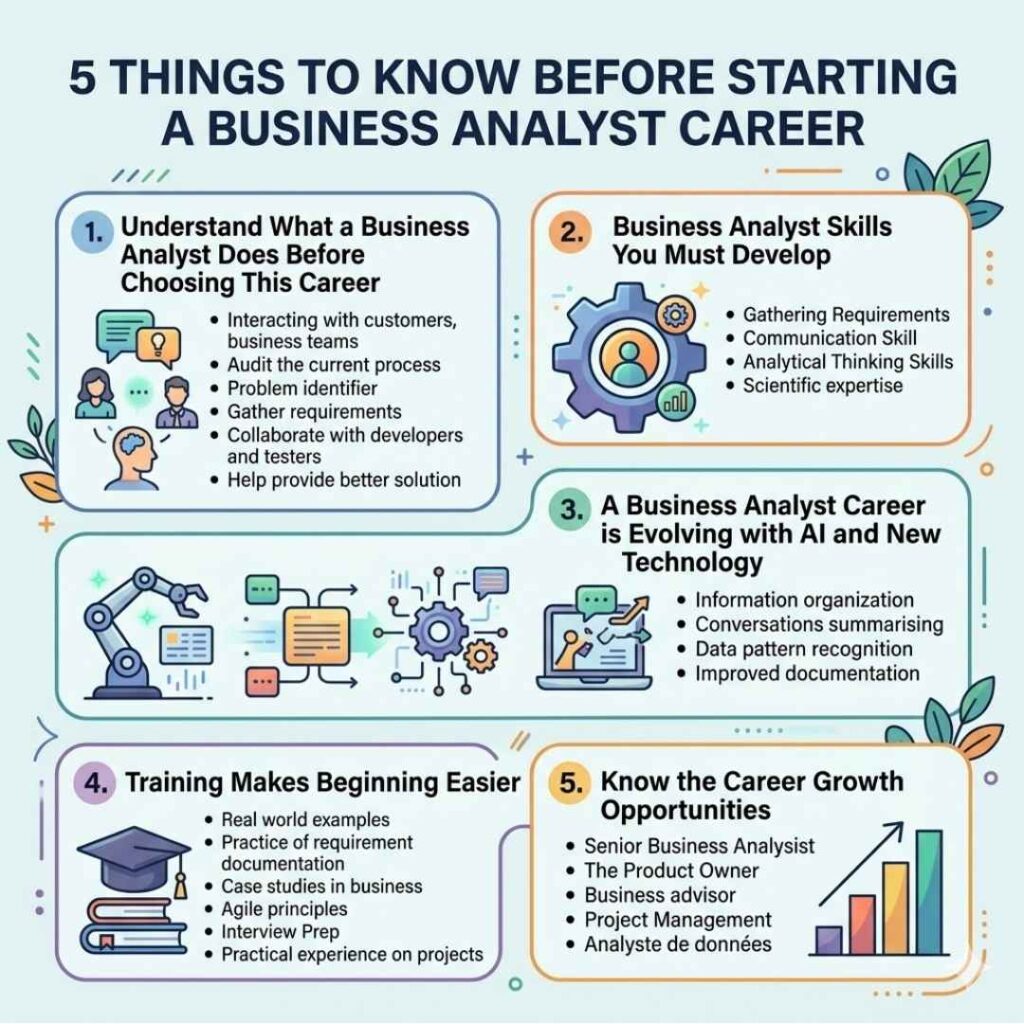
Before you can start your Business Analyst Career, it’s worthwhile to understand what the role is actually about. Giving yourself some time to understand the responsibilities, skills, and expectations can make your learning journey much easier. Whether you are planning to join a training program or looking for your first opportunity, having the right idea about the field helps you to move in the right direction.
1. Understand What a Business Analyst Career Does Before Choosing This
A Business Analyst helps companies to improve the way they work.
For example, an online shopping compan. may see that customers are abandoning the site before completing their checkout process. The company might need someone to figure out why this is happening.
A Business Analyst may:
- Interacting with customers, business teams
- Audit the current process
- Problem identifier
- Gather requirements
- Collaborate with developers and testers
- Help provide better solution
A BA generally handles a project from the beginning until the final solution is delivered.
The interesting part is every project can be different. You may spend one month working on a banking app and the next month helping a healthcare company improve an internal process.
2. Business Analyst Skills You Must Develop
Business knowledge alone isn’t enough to be a successful BA Analyst. The role requires a combination of technical and soft skills.
Some of the key skills are:
Gathering Requirements
A BA should be able to ask the right questions and be able to understand what the stakeholders actually need.
Sometimes people explain what they want, but not the problem they’re trying to solve. A good BA learns to tell the difference.
Communication Skill
Business Analysts work with a number of teams, so clear communication is really important.
You may need to explain a business need to a developer or a technical constraint to a business manager. The ability to simplify information is a useful skill.
Analytical Thinking Skills
A BA needs to analyse information, identify patterns, and suggest improvements.
For instance, if a company’s sales process is sluggish, a BA looks at each step and identifies where the delays are happening.
Scientific expertise
“You don’t have to be a developer but knowledge of technology helps.
If you have experience with SQL, databases, Agile methodologies, software development processes and analytics tools, you can be more confident in the role.
This is why most beginners choose a structured Business Analyst Career rather than learning everything without any direction.
3. A Business Analyst Career is Evolving with AI and New Technology
The Business Analyst Career role is changing.
Today companies are taking advantage of artificial intelligence, automation, cloud platforms and data analytics to enhance their operations. Therefore BAs are expected to know both business goals and technology possibilities.
AI tools can help you with things such as:
- Information organization
- Conversations summarising
- Data pattern recognition
- Improved documentation
But companies still need people who understand people, ask the right questions and make business decisions.
Technologies may change but the need for people who can connect business problems and practical solutions remains as strong.
4. Training Makes Beginning Easier
One of the biggest struggles for a beginner is where to start from.
There are hundreds of videos and articles on the internet but learning randomly leads to confusion. A good training plan provides a roadmap.
Good Business Analyst Career Training should cover:
- Real world examples
- Practice of requirement documentation
- Case studies in business
- Agile principles
- Interview Prep
- Practical experience on projects
Business Analysis is a practical career, we learn by doing and that makes a big difference.
Training programs such as Business Analyst training with placement at H2K Infosys are structured to provide practical exposure to learners and help them develop job-ready skills. It seeks to make students understand how Business Analyst Career work in real companies and not just in theory.
5. Know the Career Growth Opportunities
The Business Analyst Career role can grow in many directions.
After gaining experience, professionals can transition into roles like:
- Senior Business Analysist
- The Product Owner
- Business advisor
- Project Management
- Analyste de données
The career path is based on your interests.
Some people like to work closely with customers and business strategy, whereas others go more towards data and technology roles.
That flexibility is one of the reasons many see a Business Analyst Career as a long-term career choice.
Is Business Analysis a Good Career for Freshers?
Yes, a Business Analyst Career can be a good choice for freshers who are willing to learn and enhance their skills.
Though a fresher may not have years of experience, he/she can get confidence by practicing:
- Criteria for writing
- Process flow creation
- Business problem understanding
- Sample projects and working on them
The key is to get your hands dirty and be able to articulate your thought process in interviews.
How Can You Start Your Business Analyst Journey?
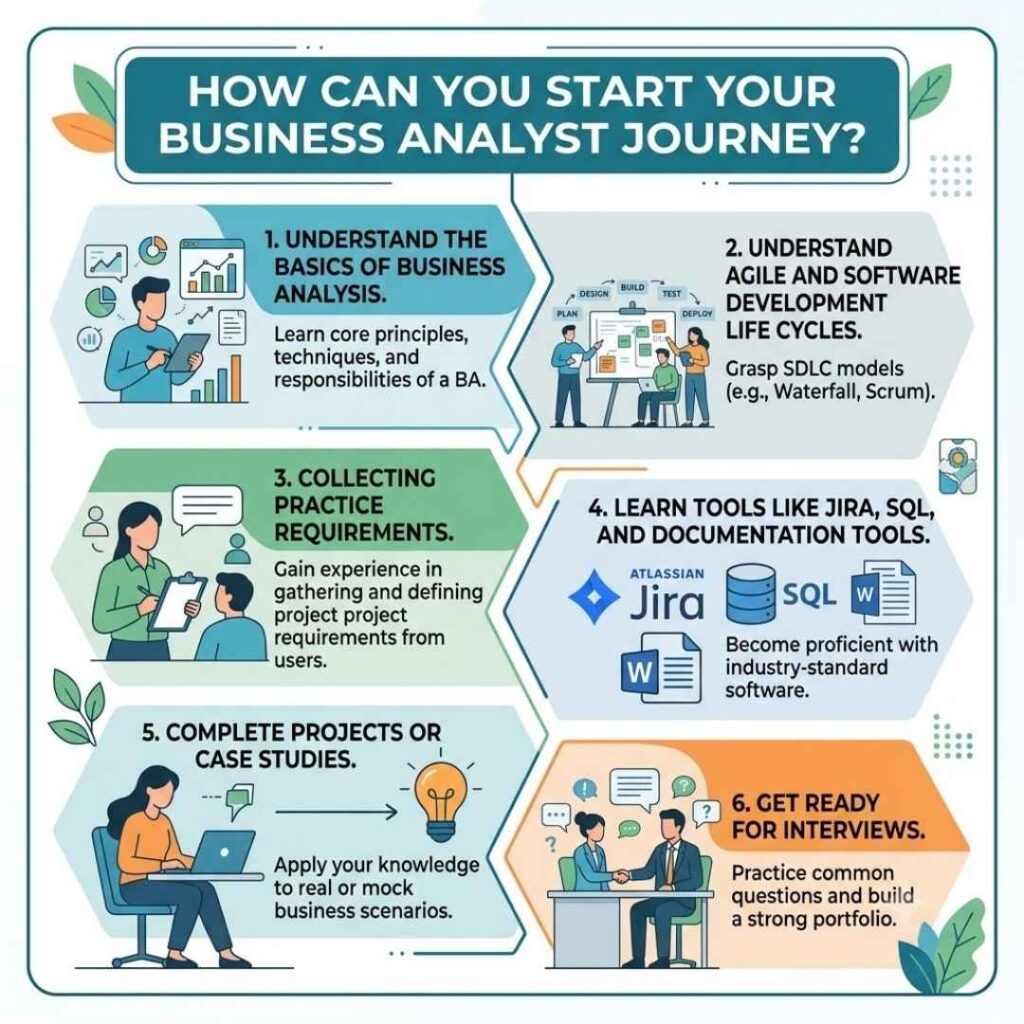
A simple roadmap might look like this:
- Understand the basics of Business Analysis
- Understand Agile and software development life cycles
- Collecting Practice Requirements
- Learn tools like Jira, SQL and documentation tools
- Complete projects or case studies
- Get ready for interviews
A guided Business Analyst Career can make this journey more structured and help you avoid common beginner mistakes.
Common Mistakes Beginners Make
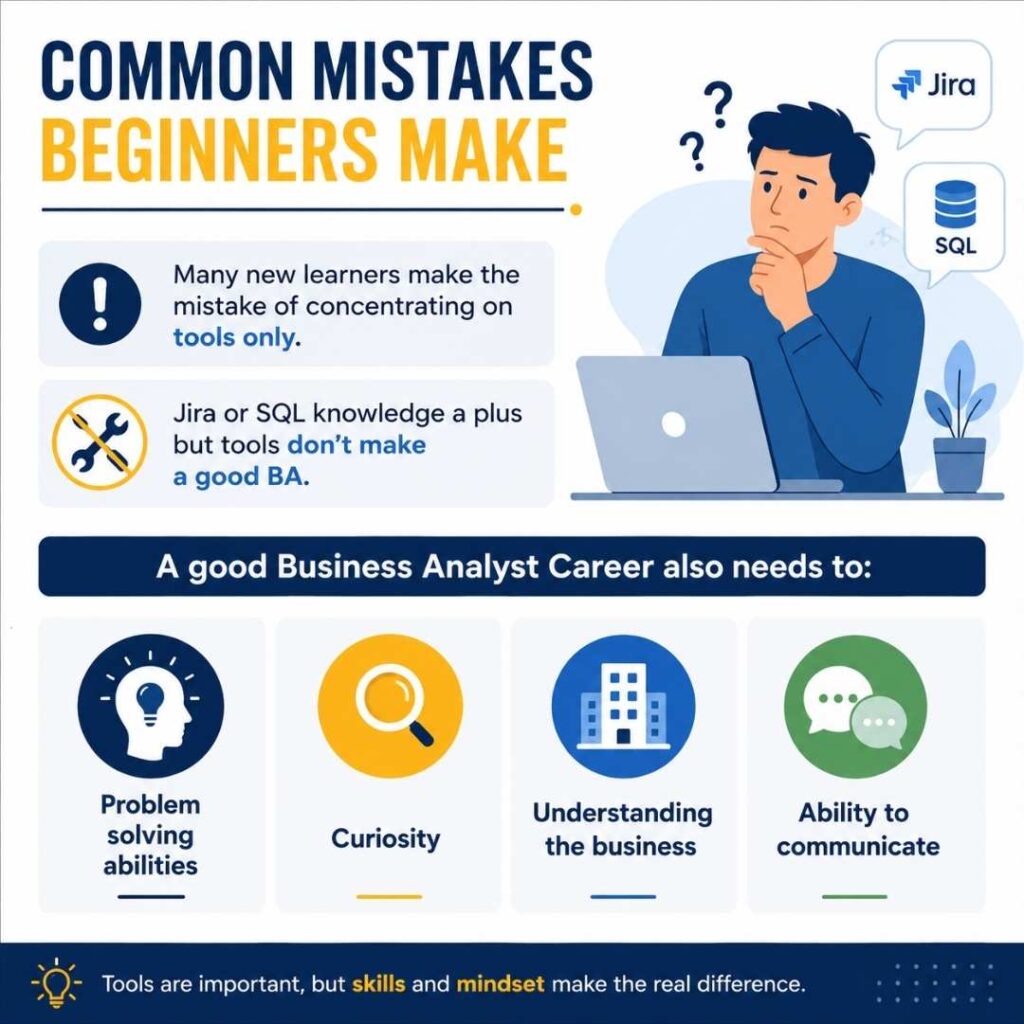
Many new learners make the mistake of concentrating on tools only.
Jira or SQL knowledge a plus but tools don’t make a good BA.
A good Business Analyst Career also needs to:
- Problem solving abilities
- Curiosity
- Understanding the business
- Ability to communicate
Another error is expecting a job without practicing real scenarios. Most employers want people who can figure things out, not just regurgitate definitions.
Why H2K Infosys Can Be a Helpful Choice for Beginners?
You can avoid much time and confusion by choosing the right training provider.
H2K Infosys is focused on practical learning, so the learners understand what is expected in the industry, project scenarios, and skills needed for Business Analyst Career positions.
For beginners, if you are looking for structured guidance, H2K Infosys Business Analyst Career training can provide you the learning path with concepts, practice and career preparation.
Final Words
A Business Analyst career is not just sitting in meetings all day and reading documents. It’s about understanding problems, connecting people and helping businesses make better decisions.
If you like to analyse situations and come up with solutions this could be a great career choice.
Getting the right Business Analyst Career and experience will help you be confident and work towards your career goals.
FAQs:
1. What does a Business Analyst do?
Business Analyst understands the needs of the business, gathers requirements, analyses problems and works with technical teams to develop effective solutions.
2. Do we require coding to be a Business Analyst?
No, usually advanced coding is not necessary. But basic tech knowledge like SQL, databases and software development concepts can help.
3. How long does it take to be a Business Analyst?
It depends on your background and how you learn how long it takes. Basic skills can be acquired by many beginners after a few months of consistent practice and correct training.
4. Is it possible for a non-technical person to be a Business Analyst?
Yes. There are many Business Analysts who come from non-technical backgrounds. Strong communication, analytical thinking and willingness to learn are important.
5. What tools should a beginner Business Analyst learn?
Beginners should consider learning tools such as Microsoft Excel, SQL, Jira, Confluence, Power BI, Tableau, and documentation tools used for creating business requirements.