The scope of data science with Python includes data analysis, artificial intelligence, machine learning, predictive analytics, automation, data engineering and business intelligence. Python helps professionals collect, clean, visualize and analyze data, build machine learning models and develop AI-powered applications. Popular career options include data analyst, data scientist, data engineer, machine learning engineer, business intelligence analyst and AI engineer.
Organizations in healthcare, banking, retail, manufacturing, education, government and technology use data science to make better decisions, predict future outcomes and automate complex processes. As businesses continue to generate large volumes of digital information, professionals with Python, SQL, statistics and machine learning skills can explore several career opportunities.
What Is Data Science?
Data science is an interdisciplinary field that combines mathematics, statistics, programming and business knowledge. Its main objective is to transform raw data into meaningful information that can support decision-making.
Businesses collect data from websites, mobile applications, customer transactions, social media, connected devices and internal software systems. This information may be available in structured or unstructured formats.
Structured data is usually organized in spreadsheets, tables and databases. Unstructured data includes documents, images, videos, audio recordings, emails and social media content.
A typical data science process includes:
- Understanding the business problem
- Collecting relevant data
- Cleaning and organizing the data
- Exploring patterns and relationships
- Building statistical or machine learning models
- Evaluating the results
- Presenting the findings
- Deploying and monitoring the solution
Data science is not limited to writing code or building algorithms. Data professionals must also understand business requirements and communicate their findings to technical and non-technical stakeholders.
Why Is Python Used in Data Science?
Python is one of the most widely used programming languages for data science. Its simple syntax makes it accessible to beginners, while its extensive ecosystem allows experienced professionals to develop advanced analytics and artificial intelligence solutions.
Python can be used throughout the data science lifecycle, including data collection, preparation, visualization, modelling, deployment and automation.
Popular Python libraries for Scope of Data Science with Python include:
- NumPy: Used for numerical calculations and array operations
- pandas: Used for data cleaning, transformation and analysis
- Matplotlib: Used for charts, graphs and data visualization
- scikit-learn: Used for machine learning and model evaluation
- TensorFlow: Used for deep learning and artificial intelligence
- PyTorch: Used for neural networks and AI research
- Beautiful Soup and Scrapy: Used for collecting website data
- PySpark: Used for large-scale data processing
- Flask and FastAPI: Used for deploying data and machine learning applications
Python can also connect with databases, cloud platforms, reporting tools and enterprise applications. These capabilities contribute significantly to the growing scope of Data Science with Python.
Scope of Data Science with Python in Different Areas
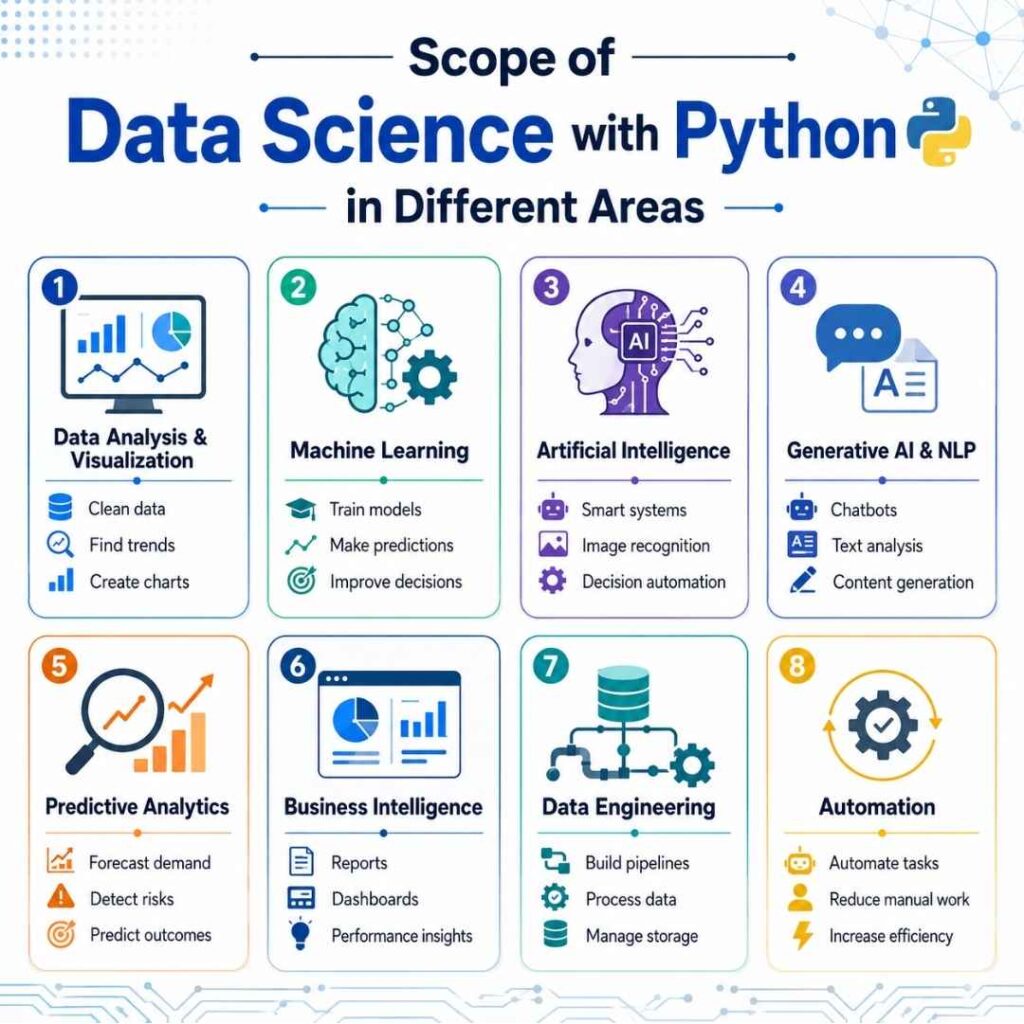
The Scope of Data Science with the adoption of artificial intelligence, cloud computing and automated decision-making has expanded the role of data science. Python is now used across several technical and business functions.
1. Data Analysis and Visualization
Data analysts use Python to examine datasets, identify trends and prepare visual reports. Python can process data from spreadsheets, databases, websites and business applications.
Libraries such as pandas and Matplotlib allow analysts to clean information and communicate findings through charts and graphs. These insights help organizations monitor performance, identify problems and make evidence-based decisions.
2. Machine Learning
Machine learning allows computer systems to identify patterns in historical information and make predictions.
Python is used to develop machine learning applications such as:
- Customer-churn prediction
- Product recommendation systems
- Demand forecasting
- Fraud detection
- Credit-risk assessment
- Predictive maintenance
- Customer-behaviour analysis
- Medical-image classification
Professionals can use Python to prepare training data, select algorithms, train models, evaluate performance and integrate predictions into business applications.
3. Artificial Intelligence
Artificial intelligence is an important part of the scope of Data Science with Python. Python supports the development of systems that can recognize images, process language, generate content and automate decisions.
AI applications developed with Python include virtual assistants, intelligent search systems, image-recognition tools, document-processing applications and automated customer-support solutions.
4. Generative AI and Natural Language Processing
Natural language processing enables computers to understand and generate human language. It is used in chatbots, translation systems, sentiment analysis, document classification and text summarization.
Generative AI has expanded these capabilities. Businesses now use AI systems to answer questions, analyze documents, create content and retrieve information from internal knowledge sources.
Python is commonly used to connect applications with large language models, build information-retrieval systems and evaluate AI-generated responses.
5. Predictive Analytics
Predictive analytics uses historical data to estimate future events.
Retail companies can forecast product demand, banks can assess financial risks and healthcare organizations can identify patients who may require additional care. Manufacturers can use sensor data to predict equipment failures before production is affected.
Python supports data preparation, statistical analysis, model development, testing and deployment.
6. Business Intelligence
Business intelligence involves converting operational data into reports, dashboards and performance indicators.
Python can automate reports, combine information from multiple systems and conduct analyses that may be difficult to perform using spreadsheets alone.
Professionals frequently combine Python with SQL and visualization platforms to create business intelligence solutions.
7. Data Engineering
Data scientists require accurate and accessible information. Data engineers build and maintain the systems that collect, transform, store and deliver this data.
Python is used to create data pipelines, automate processing tasks and connect cloud services. Professionals with Python, SQL, database and cloud-computing skills can pursue opportunities in both data science and data engineering.
8. Business Process Automation
Python can automate many repetitive data-related activities.
Examples include:
- Generating reports
- Cleaning spreadsheet data
- Processing documents
- Collecting information from websites
- Sending automated notifications
- Updating databases
- Monitoring machine learning models
Scope of Data Science with Python, Automation helps organizations reduce manual effort, improve consistency and process larger volumes of information.
Industries Using Data Science with Python
The scope of Data Science with Python is not restricted to technology companies. Organizations across different industries use data analytics and machine learning.
Healthcare
Healthcare organizations use data science for patient-risk analysis, medical research, disease prediction, resource planning and image analysis.
Banking and Finance
Banks and financial institutions use Python-based data science solutions for fraud detection, credit scoring, customer segmentation, risk management and financial forecasting.
Retail and E-commerce
Retail businesses analyze customer and transaction data to improve recommendations, pricing, inventory management, marketing personalization and demand forecasting.
Manufacturing
Manufacturers use operational and sensor data to monitor product quality, predict equipment failures and improve production efficiency.
Education
Educational institutions can analyze student performance, identify learning difficulties and improve academic planning.
Government
Government departments use data analytics for public planning, transportation management, resource allocation, fraud detection and policy evaluation.
Career Opportunities in Data Science with Python
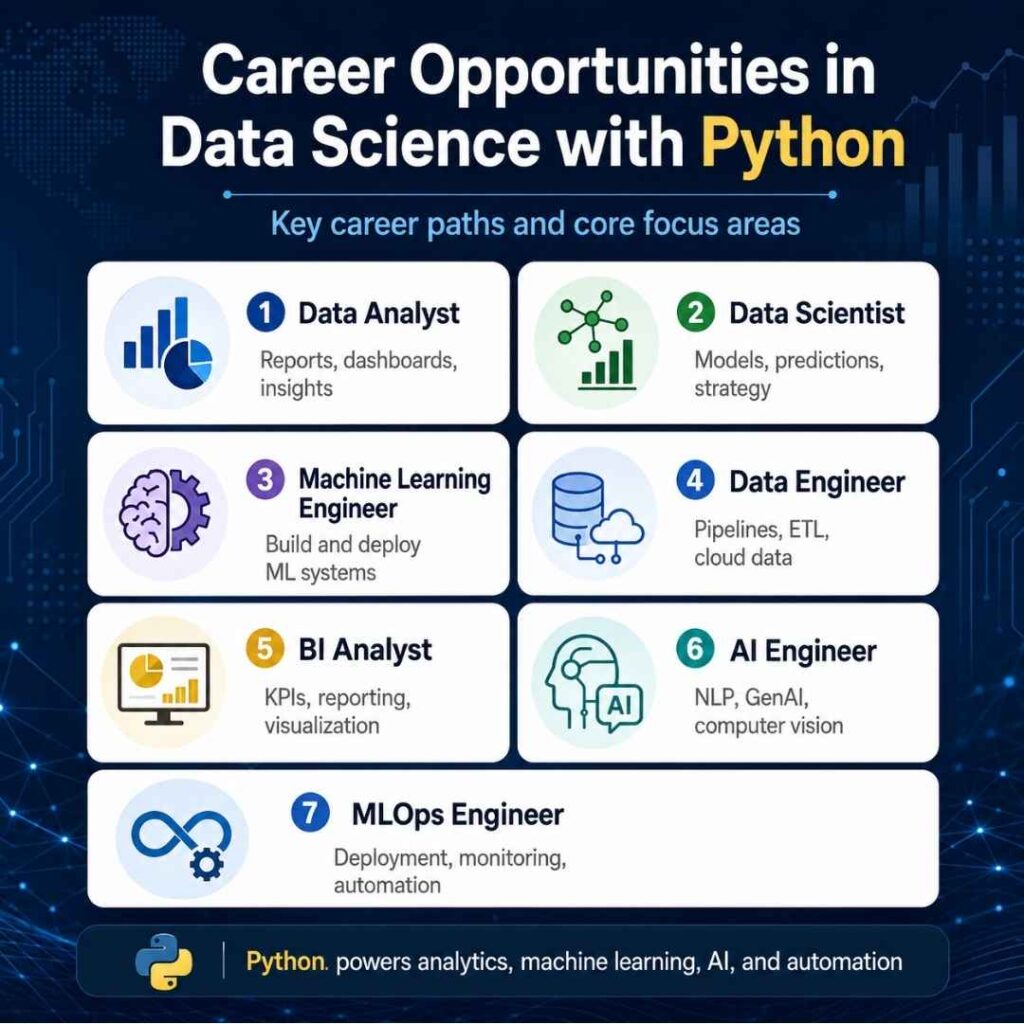
Learning Python and data science can support several career paths Scope of Data Science with Python.
Data Analyst
A data analyst cleans information, creates reports, develops dashboards and identifies business trends. Commonly required skills include Python, SQL, spreadsheets and data visualization.
Data Scientist
A data scientist combines programming, statistics and business knowledge to solve complex problems and develop predictive models.
Machine Learning Engineer
A machine learning engineer converts experimental models into reliable production systems. The role requires knowledge of machine learning, Python and software engineering.
Data Engineer
A data engineer designs and maintains databases, data pipelines and processing systems.
Business Intelligence Analyst
A business intelligence analyst creates dashboards, reports and performance indicators that help organizations make informed decisions.
AI Engineer
An AI engineer develops applications involving machine learning, generative AI, natural language processing and computer vision.
MLOps Engineer
An MLOps engineer manages the deployment, monitoring, maintenance and version control of machine learning models.
Skills Required for a Data Science Career
Python is an important skill, but it is not the only requirement for a successful data science career.
Learners should develop knowledge of:
- Python programming
- SQL and database concepts
- Mathematics and statistics
- Data cleaning and visualization
- Machine learning fundamentals
- Model evaluation
- Cloud-computing basics
- Git and software-development practices
- Business communication
- Analytical problem-solving
Practical experience is also essential. Learners should build projects that demonstrate their ability to clean data, conduct analysis, create visualizations and develop machine learning models.
Is Data Science with Python a Good Career Choice?
Data science with Python can be a suitable career choice for people interested in technology, mathematics, analytics and business problem-solving.
However, learning Python or completing a training course alone does not guarantee employment. Candidates should combine technical knowledge with practical projects, communication skills and industry understanding.
Data science is also becoming more specialized. Depending on their interests, learners can focus on data analytics, machine learning, data engineering, business intelligence, artificial intelligence or MLOps.
Conclusion
The scope of Data Science with Python extends from basic data analysis and visualization to advanced machine learning, artificial intelligence and automated decision-making systems.
Python’s readable syntax, powerful libraries and integration capabilities make it suitable for beginners and experienced professionals. By developing skills in Python, SQL, statistics, data visualization and machine learning, learners can prepare for opportunities in several data-related careers.
Scope of Data Science with Python, H2K Infosys offers instructor-led online training in Python and data science. Explore our online data science courses to gain practical knowledge through live classes, industry-oriented exercises and project-based learning.
FAQs: about scope of Data Science with Python
1. What is the scope of Data Science with Python?
The scope of Data Science with Python includes data analysis, machine learning, artificial intelligence, predictive analytics, business intelligence, automation and data engineering. Python can be used to collect, clean, visualize and analyze data, as well as build and deploy machine learning models.
2. Why is Python popular in data science?
Python is popular in data science because it has simple syntax, a large developer community and powerful libraries. Tools such as pandas, NumPy, Matplotlib, scikit-learn, TensorFlow and PyTorch support data analysis, visualization, machine learning and artificial intelligence.
3. Is Data Science with Python a good career choice?
Data Science with Python can be a strong career choice for people interested in programming, statistics, analytics and business problem-solving. Career opportunities are available in areas such as data analysis, machine learning, data engineering, business intelligence and artificial intelligence.
4. Is Python enough to become a data scientist?
Python alone is not enough to become a data scientist. Learners should also develop skills in SQL, statistics, mathematics, data visualization, machine learning, databases and business communication. Practical project experience is also important.
5. Which Python libraries are used in data science?
Common Python libraries used in data science include NumPy, pandas, Matplotlib, scikit-learn, TensorFlow, PyTorch and PySpark. Flask and FastAPI can also be used to deploy data science and machine learning applications.