Introduction
If you’re looking to advance your career with Salesforce, the good news is that there’s a clear path to success. Salesforce offers a wide range of learning resources and certifications to help you get started and advance in your career. With organizations increasingly turning to Salesforce for customer relationship management, Salesforce training is a highly valuable skill that can open doors to numerous career opportunities in tech and business.
In this guide, we’ll explore the key steps to get started with Salesforce Training Step-by-Step, including the certifications you can pursue, the skills you’ll learn, and how to apply your knowledge to real-world business situations.
How to Get Started with Salesforce Training Step-by-Step: Guide
Step 1: Understand the Importance of Salesforce Training
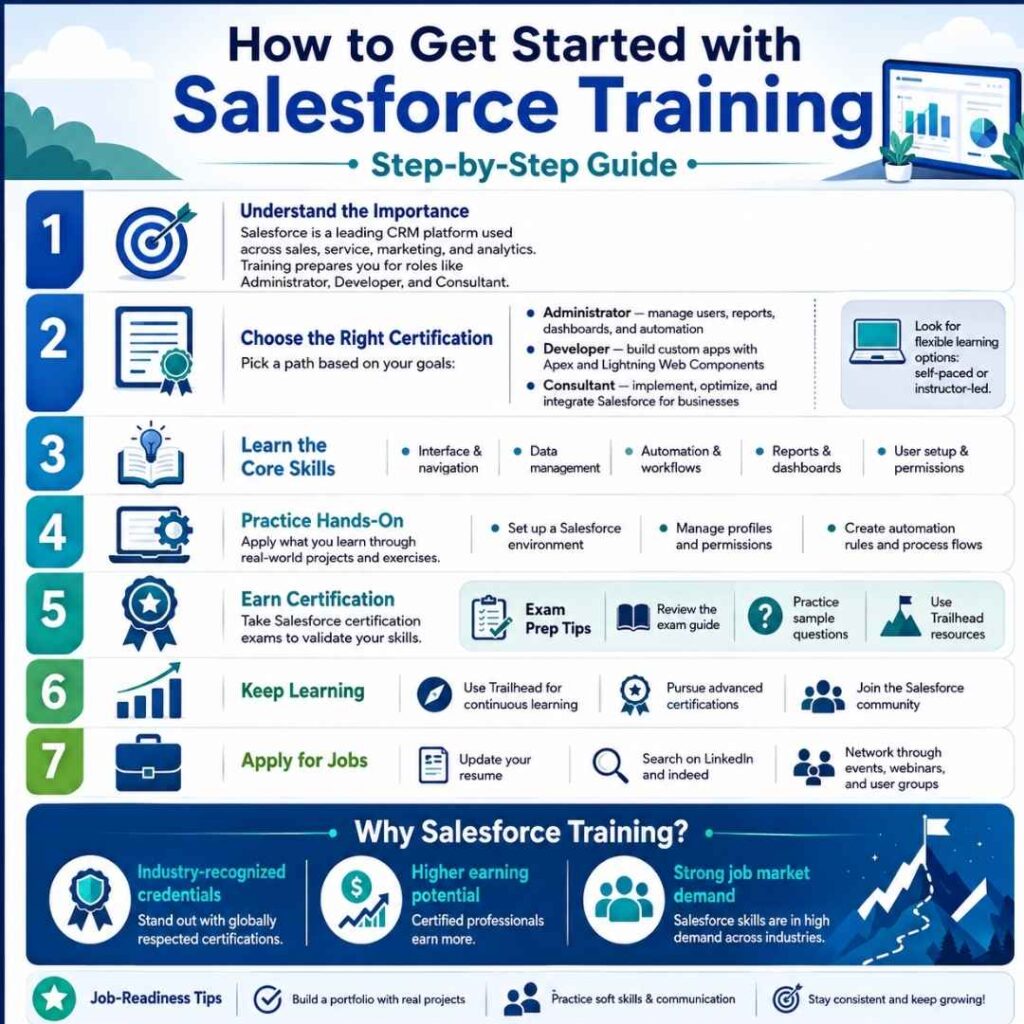
Salesforce is more than just a CRM tool it’s a comprehensive platform that integrates multiple business functions such as sales, service, marketing, and analytics. Salesforce Training helps individuals become proficient in using these tools, preparing them for a wide array of roles including Salesforce Administrator, Developer, and Consultant. By enrolling in Salesforce certification courses, you’ll gain hands-on knowledge of how to configure Salesforce systems, implement automation, and ensure user adoption, among other tasks.
With over 150,000 companies using Salesforce worldwide, the demand for Salesforce-certified professionals continues to grow. Research by Salesforce shows that individuals with Salesforce certifications earn, on average, 25% more than their non-certified counterparts. This makes Salesforce Training a highly beneficial investment in your career.
Step 2: Identify the Right Salesforce Certification Training Program
The first step to getting started with Salesforce Training Step-by-Step is to choose the right program. Salesforce offers a variety of training options, depending on your career goals. The most common certifications include:
Salesforce Administrator Certification
The Salesforce Administrator certification is ideal for individuals who are looking to manage and customize Salesforce for business users. This certification focuses on configuring Salesforce, creating reports and dashboards, and automating processes to improve business efficiency.
Salesforce Developer Certification
For those who wish to dive deeper into customization, the Salesforce Developer certification is a great option. This certification focuses on developing custom applications on the Salesforce platform, including Apex programming and Lightning Web Components (LWC).
Salesforce Consultant Certification
A Salesforce Consultant is responsible for implementing and optimizing Salesforce for businesses. This certification focuses on advanced customization, integration, and business processes, making it ideal for those looking to help companies maximize the value of Salesforce.
Training for Salesforce is Flexible
When choosing a Salesforce certification training course, it’s important to look for a program that offers flexible learning options. At H2KInfosys, we offer online Salesforce certification training that can be tailored to your specific needs. Whether you prefer self-paced learning or instructor-led classes, we have a program that works for you.
Step 3: Start with the Basics: Learn Key Salesforce Skills
Regardless of which certification you pursue, the fundamentals of Salesforce remain the same. As part of your Salesforce Training Step-by-Step, you will learn several key skills that will form the foundation for your career in Salesforce:
1. Salesforce Interface and Navigation
- Learn how to navigate Salesforce’s user interface (UI) to access records, set up dashboards, and use its powerful reporting tools.
2. Data Management
- Understand how to manage data in Salesforce, including importing, exporting, and updating records, as well as data security and sharing rules.
3. Automation and Workflow Rules
- Learn how to set up automation within Salesforce, including workflow rules, process builders, and approval processes, to increase business efficiency.
4. Reports and Dashboards
- Master creating reports and dashboards to visualize key metrics and help decision-makers analyze data in Salesforce.
5. User Setup and Management
- Learn how to manage user profiles, permissions, and access controls to ensure your Salesforce environment is set up securely.
Step 4: Hands-On Practice and RFeal-World Application
While theoretical knowledge is crucial, practical experience is where the true value of Salesforce Training lies. At H2KInfosys, our training programs emphasize hands-on learning through real-world scenarios and Salesforce projects. By applying your knowledge in practical exercises, you’ll gain the confidence to handle real business challenges.
For example, in our Salesforce admin training program, you will:
- Set up a Salesforce environment from scratch
- Configure and manage user profiles and permissions
- Create automation rules and process flows to streamline operations
The more you practice, the more proficient you’ll become in using Salesforce to solve complex business problems.
Step 5: Take Salesforce Certification Exams
Once you’ve completed your Salesforce training, it’s time to take the certification exams. Salesforce offers a series of exams to validate your skills and knowledge, including exams for administrators, developers, consultants, and other roles.
Key Benefits of Salesforce Certifications:
- Industry Recognition: A Salesforce certification is widely recognized by employers and demonstrates your expertise in using the platform.
- Higher Earning Potential: Certified professionals often earn higher salaries and have more opportunities for career advancement.
- Job Market Demand: With the increasing adoption of Salesforce by businesses worldwide, Salesforce-certified professionals are in high demand.
Tips for Exam Preparation:
- Review the Exam Guide: Salesforce provides detailed exam guides for each certification, including a list of topics covered and recommended study resources.
- Practice with Sample Questions: Before taking the exam, practice with sample questions and mock exams to familiarize yourself with the format and timing.
- Use Salesforce Resources: Leverage the Salesforce Trailhead platform for interactive, self-paced learning that complements your formal training.
Step 6: Continuous Learning and Skill Enhancement
Salesforce is a continuously evolving platform, with new features and updates being released regularly. To stay competitive in the job market, it’s important to continue learning and improving your Salesforce skills. This can be achieved through Salesforce Training Step-by-Step:
- Salesforce Trailhead: This free learning platform offers a wide range of modules and trails for ongoing learning. Whether you’re learning about new features or brushing up on best practices, Trailhead is a great resource.
- Advanced Certifications: After earning your initial certification, you can pursue more advanced certifications to specialize in specific Salesforce areas such as marketing, service cloud, or sales cloud.
- Community Engagement: Join the Salesforce community, attend user group meetups, and participate in forums to stay connected with other professionals and learn from their experiences.
Step 7: Apply for Salesforce Jobs
With your Salesforce certification in hand and hands-on experience gained through Salesforce Training, you’re now ready to begin applying for Salesforce-related jobs. Here’s how to get started Salesforce Training Step-by-Step:
- Update Your Resume: Highlight your Salesforce certification and practical experience to showcase your skills to potential employers.
- Leverage Job Platforms: Use platforms like LinkedIn and Indeed to search for Salesforce administrator, developer, or consultant positions.
- Network: Attend Salesforce events, webinars, and user groups to connect with recruiters and other Salesforce professionals in the field.
Conclusion
Salesforce Training Step-by-Step is a powerful tool for anyone looking to enter the world of CRM and customer relationship management. By following this step-by-step guide, you’ll not only learn the basics of Salesforce but also gain the confidence to apply your skills in real-world scenarios. With industry-recognized certifications and practical, hands-on experience, you’ll be well on your way to landing a rewarding career in Salesforce.
Key Takeaways: Salesforce Training Step-by-Step
- Understand the Basics: Start by learning the key features and functionalities of Salesforce.
- Hands-On Practice: Engage in practical exercises to solidify your knowledge.
- Get Certified: Obtain Salesforce certification to stand out in the job market.
- Stay Updated: Continue learning and improving your skills with advanced certifications and community engagement.
By enrolling in Salesforce Training Step-by-Step at H2KInfosys, you can take the first step toward becoming a Salesforce expert. Get hands-on experience, pass your certification exams, and build a rewarding career in the growing Salesforce ecosystem. Don’t wait join today!
FAQs: Salesforce Training Step-by-Step
Do I need coding experience to learn Salesforce?
No. You can start Salesforce training without coding knowledge, especially if you’re pursuing the Salesforce Administrator role. Development roles may require programming skills later.
Which Salesforce certification should beginners choose?
The Salesforce Certified Administrator certification is generally the best starting point because it validates core platform knowledge and is widely recognized by employers.
What skills will I learn in Salesforce training?
A quality Salesforce training program typically covers CRM concepts, object management, security, automation, reports, dashboards, workflows, Flow Builder, data import/export, and basic administration.
Does Salesforce training include hands-on projects?
Many comprehensive Salesforce training programs include real-world projects, case studies, and practical exercises to help learners gain job-ready experience.
Is Salesforce training suitable for beginners?
Yes. Most Salesforce training programs are designed for beginners and cover CRM fundamentals, navigation, data management, reports, dashboards, and basic automation before moving to advanced topics.