At H2K Infosys, people from non-technical backgrounds can learn AI if they build foundational skills in basic mathematics, logical thinking, data understanding, and beginner level programming concepts. What Most modern AI Training Online pathways and curricula are designed to start from fundamentals and gradually introduce advanced AI topics. Technical experience is helpful but not mandatory when structured learning and guided practice are available.
Artificial Intelligence learning today is more skills-based than degree based. Many working professionals transition into AI by learning core concepts step by step, supported by hands-on labs, real datasets, and project-based learning environments.
What Is Artificial Intelligence (AI)?
Artificial Intelligence is the field of computer science focused on building systems that can simulate human intelligence. These systems can analyze data, recognize patterns, make predictions, automate tasks, and support decision-making.
Core Areas Inside AI
- Machine Learning (ML)
- Deep Learning
- Natural Language Processing (NLP)
- Computer Vision
- Generative AI
- Predictive Analytics
In enterprise environments, AI is typically used to:
- Automate repetitive business workflows
- Detect anomalies or fraud
- Predict customer behavior
- Improve operational efficiency
- Support decision intelligence
For beginners, AI is usually introduced through data analysis and basic machine learning models before moving to advanced neural networks or deep learning frameworks.
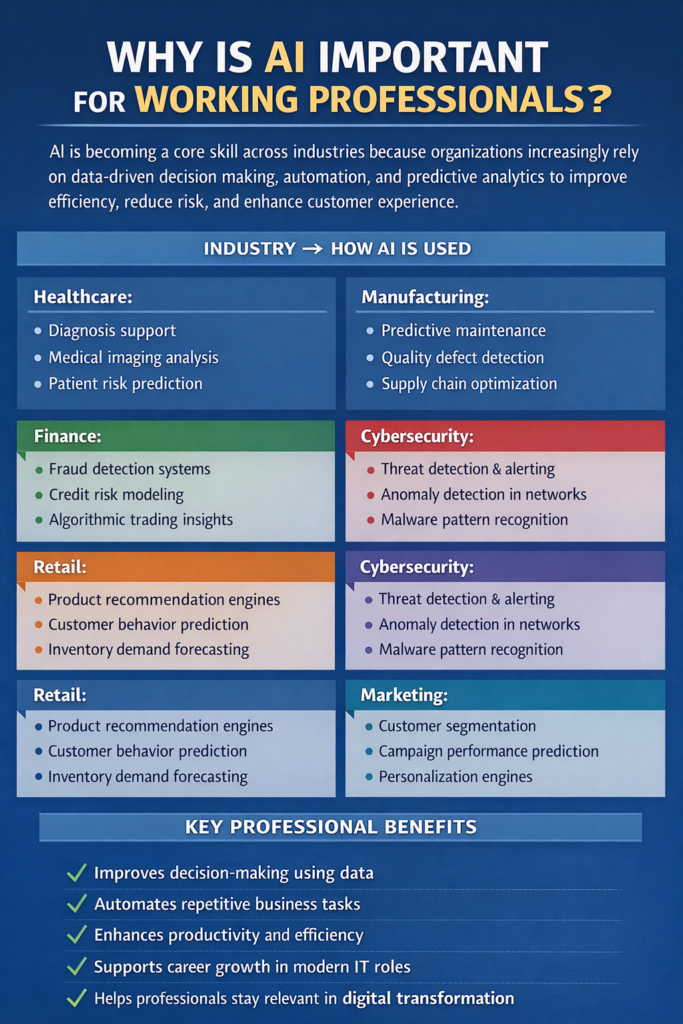
Why Is AI Important for Working Professionals?
AI is increasingly integrated into everyday enterprise systems, not just specialized research teams.
Common Enterprise Use Cases
| Industry | AI Usage |
|---|---|
| Healthcare | Diagnosis support, medical imaging |
| Finance | Fraud detection, risk modeling |
| Retail | Recommendation engines |
| Manufacturing | Predictive maintenance |
| Cybersecurity | Threat detection |
| Marketing | Customer segmentation |
For professionals in QA, Business Analysis, or Data Analytics (like many career switchers and IT upskilling learners), AI literacy is becoming a complementary skill rather than a niche specialty.
What Skills Are Required Before Joining an AI Course?
Basic Computer Literacy
You should be comfortable with:
- File management
- Excel basics
- Browser-based tools
- Basic software installation
Logical Thinking and Problem Solving
AI learning requires:
- Understanding cause-effect relationships
- Interpreting patterns
- Breaking problems into smaller tasks
Basic Mathematics (Beginner Level)
You do NOT need advanced math initially.
Focus areas:
- Percentages
- Basic algebra
- Graph interpretation
- Probability basics
Basic Programming Awareness
Many Artificial Intelligence Training Program programs teach programming from scratch.
Beginner exposure helps:
- Variables
- Loops
- Conditions
- Functions
Python is the most common entry language.
Do I Need Coding Experience to Start an Artificial Intelligence Training Program?
No. Many structured Artificial intelligence program paths start with zero coding assumptions.
Typical Learning Progression
- Data understanding
- Python basics
- Data analysis using libraries
- Machine learning models
- Model deployment basics
Low-code AI tools are also increasingly used in enterprises.
How Does AI Work in Real-World IT Projects?
AI rarely works alone. It is integrated into business workflows.
Typical Enterprise AI Workflow
| Step | Activity |
|---|---|
| Data Collection | Pull data from databases, APIs |
| Data Cleaning | Remove errors, missing values |
| Feature Engineering | Prepare input variables |
| Model Training | Train ML model |
| Validation | Test model accuracy |
| Deployment | Integrate into business system |
| Monitoring | Track performance |
What Tools Are Commonly Used in AI Learning and Enterprise Projects?
Beginner-Level Tools
| Tool | Purpose |
|---|---|
| Excel | Data basics |
| Python | Core programming |
| Jupyter Notebook | Experiment environment |
| Google Colab | Cloud-based coding |
Intermediate Tools
| Tool | Purpose |
|---|---|
| Pandas | Data manipulation |
| NumPy | Numerical computing |
| Matplotlib | Visualization |
| Scikit-learn | Machine learning models |
Advanced Tools
| Tool | Purpose |
|---|---|
| TensorFlow | Deep learning |
| PyTorch | Deep learning research |
| Hugging Face | NLP models |
| OpenAI APIs | Generative AI |
What Learning Path Is Recommended for Non-Technical Beginners?
Phase 1: Foundations (Weeks 1–4)
- Data basics
- Python fundamentals
- Basic statistics
- Data visualization
Phase 2: Core AI Concepts (Weeks 5–8)
- Machine learning fundamentals
- Supervised vs unsupervised learning
- Model evaluation
Phase 3: Applied AI (Weeks 9–12)
- NLP basics
- Image recognition basics
- Model deployment overview
How Is AI Used in Enterprise Environments?
AI is integrated into production systems through APIs and cloud platforms.
Example Enterprise AI Architecture
- Data stored in cloud data warehouse
- ML model hosted in cloud container
- Business app calls model via API
- Results stored back into database
Common Enterprise Platforms
- AWS AI Services
- Azure AI Services
- Google Cloud AI
What Challenges Do Beginners From Non-Technical Backgrounds Face?
Common Challenges
- Fear of coding
- Math anxiety
- Information overload
- Tool confusion
Practical Solutions
- Start with data visualization first
- Use guided labs
- Focus on use-case learning
- Practice with real datasets
What Job Roles Use AI Skills Daily?
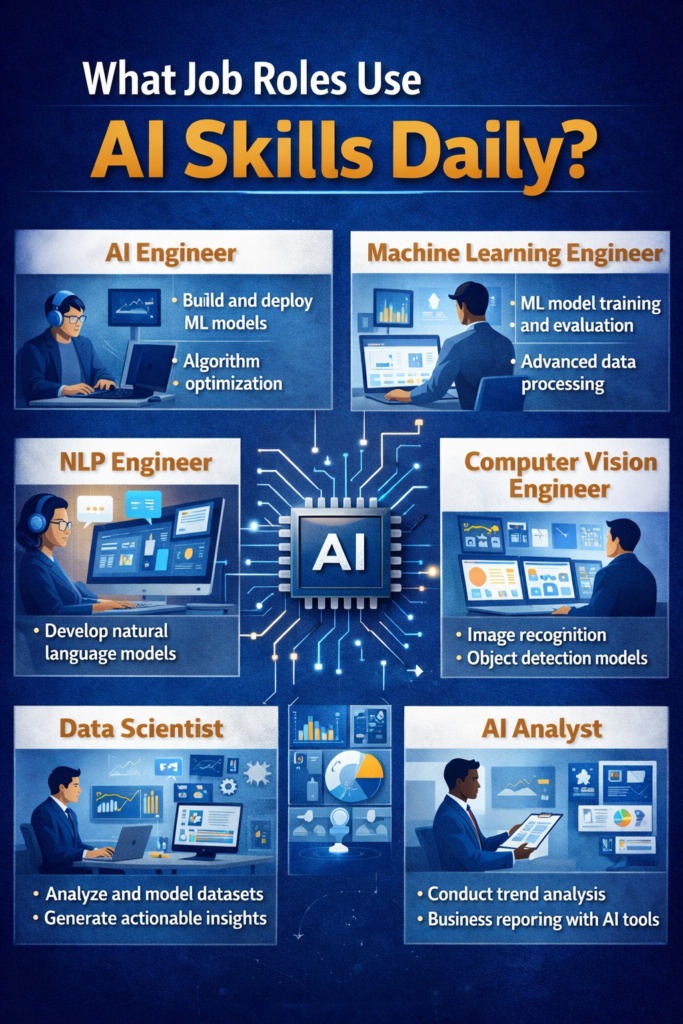
Many modern IT roles use AI skills daily, including AI Engineers, Data Scientists, Machine Learning Engineers, and AI Analysts, where professionals build models, analyze data patterns, and automate decision-making processes.
AI is also widely used in roles like NLP Engineer and Computer Vision Engineer to develop intelligent applications such as chatbots, recommendation systems, and image recognition solutions used in enterprise environments.
Entry-Level Roles
| Role | AI Usage |
|---|---|
| Data Analyst | Predictive models |
| QA Automation Tester | Test optimization |
| Business Analyst | Forecasting insights |
| SOC Analyst | Threat detection |
Mid-Level Roles
| Role | AI Usage |
|---|---|
| Machine Learning Engineer | Model building |
| Data Scientist | Advanced analytics |
| AI Product Analyst | AI solution design |
What Careers Are Possible After Learning AI?
Technical Career Paths
- AI Engineer
- Machine Learning Engineer
- Data Scientist
- NLP Engineer
Hybrid Career Paths
- AI Business Analyst
- AI QA Specialist
- AI Automation Consultant
How Professionals Apply AI Skills in Real Projects
Example: Customer Churn Prediction
Step 1: Collect customer behavior data
Step 2: Clean missing values
Step 3: Train classification model
Step 4: Deploy model to CRM system
Step 5: Generate churn risk scores
Role vs Skill Mapping Table
| Role | Required Skills |
|---|---|
| Data Analyst | Python, SQL, Visualization |
| ML Engineer | Python, ML Algorithms |
| AI Product Analyst | Data interpretation, Business domain |
| QA AI Tester | Automation + ML validation |
How Non-Technical Professionals Can Prepare Before Joining AI Training
Recommended Self-Preparation Plan (30 Days)
Week 1
- Excel basics
- Data charts
Week 2
- Python introduction
- Simple scripts
Week 3
- Statistics basics
- Probability basics
Week 4
- Intro to ML concepts
Best Practices Followed in Enterprise AI Development
- Data security compliance
- Model explainability
- Bias monitoring
- Performance tracking
- Version control for models
FAQ: AI Course Prerequisites for Non-Technical Learners
Q1: Can I learn AI without IT experience?
Yes. Many structured ai training online programs are designed for beginners.
Q2: Do I need advanced mathematics?
No. Basic statistics and algebra are usually enough initially.
Q3: Is Python mandatory?
Most AI learning paths use Python, but it is usually taught from beginner level.
Q4: How long does it take to become job ready?
Varies, but many professionals build foundational skills in 3–6 months.
Q5: Can QA or Business Analysts move into AI?
Yes. Many professionals transition into AI analytics or AI automation roles.
Q6: Is AI only for programmers?
No. AI is now used by analysts, testers, and operations teams.
Key Takeaways
- Non-technical professionals can learn AI with structured learning paths
- Basic math, logic, and beginner programming awareness are sufficient to start
- Enterprise AI focuses on solving business problems using data
- Hands-on projects and workflow understanding are more important than theory
- AI skills are increasingly useful across IT and business roles