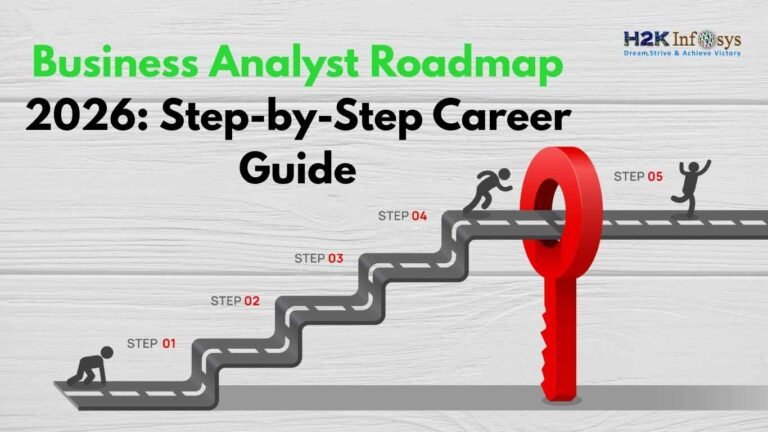
If you want to become a Business Analyst in 2026, the shortest honest answer is this: build real problem-solving skills, learn business + data fundamentals, practice on real projects, and validate your expertise with the right BA certification and hands-on experience. That’s the core of the modern Business Analyst Roadmap.
I’ve worked with professionals who transitioned from support roles, QA, finance, even non-IT backgrounds. The pattern is clear. Those who followed a structured Business Analyst Roadmap with practical exposure moved faster and felt more confident in interviews.
Let’s break it down step by step.
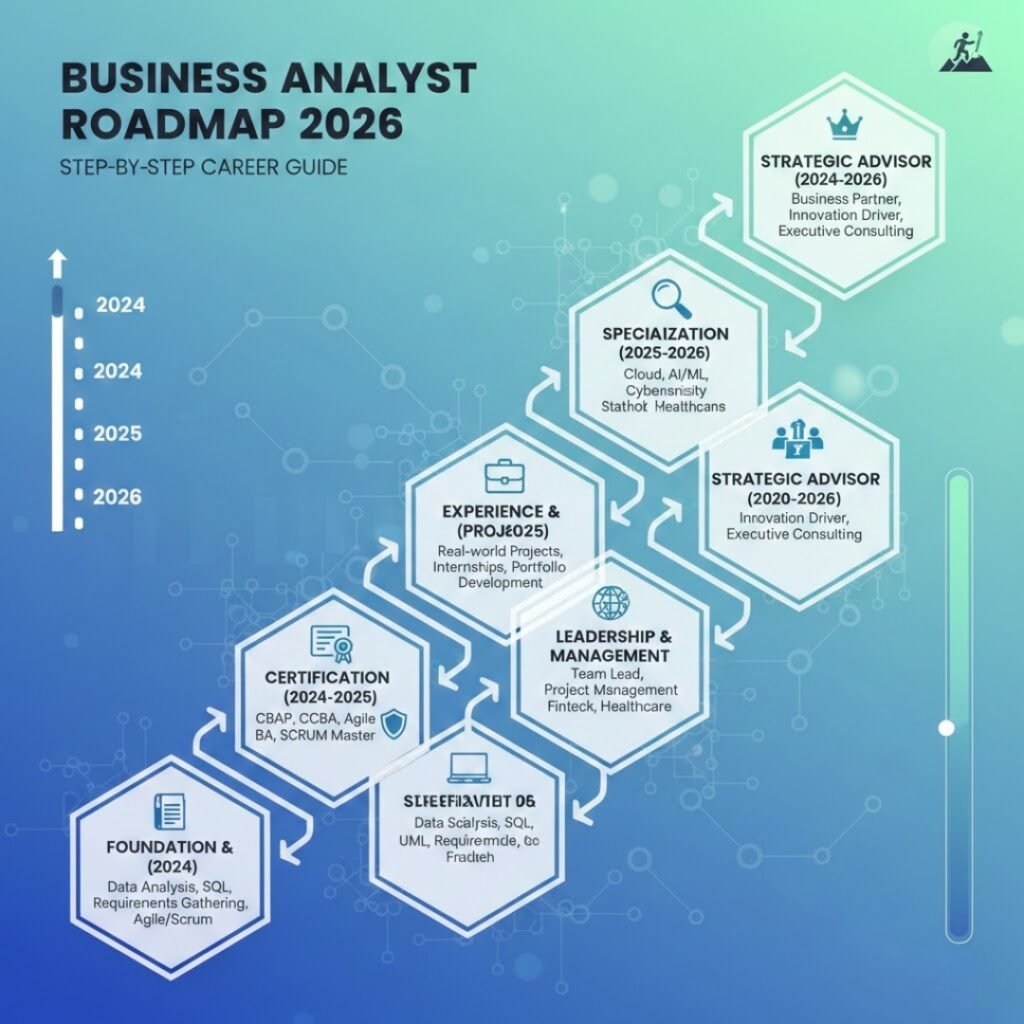
Step 1: Learn what a business analyst does in 2026.
You need to be clear before you start your training.
A Business Analyst in 2026 does more than just produce paperwork. Companies today want:
- Good communication with stakeholders
- Support for making decisions based on data
- A basic understanding of SQL and analytics
- Knowledge of Agile frameworks
- Getting to know AI-assisted reporting tools
For instance, at financial firms, BAs engage with product managers to make sense of AI-powered user behaviour dashboards. In healthcare technology, they are looking at patient data systems and sketching out compliance routines.
The current Business Analyst Roadmap has changed because of this. It’s not just about theory anymore. It’s about making a difference.
Step 2: Get the basics down by taking business analysis training
Structured learning is the second step on the Business Analyst Roadmap.
Usually, good business analysis training includes:
- Ways to collect requirements
- Finding the gaps
- Modelling processes (UML, BPMN)
- User stories and Agile frameworks
- Managing stakeholders
- Basic SQL and understanding data
I always encourage students not to rush this step. When you go to business analyst classes, attempt to act like you’re in a real meeting. Write BRDs and FRDs as if you were giving them to a genuine customer.
A lot of professionals now like online business analysis training because it is more flexible. Especially people who work full-time and have other occupations. The good thing? Most of today’s business analyst courses now contain simulations of real projects.
That layer of usefulness is what makes the difference.
Step 3: Find out what tools the market really uses
Tools should be a part of a realistic Business Analyst Roadmap.
Some common tools in 2026 are:
- JIRA for keeping track of Agile
- Confluence for writing down things
- Dashboards with Tableau or Power BI
- SQL for asking questions
- MS Visio or Lucidchart for mapping out processes
You don’t have to learn everything all at once. But you should be able to get around them easily.
For instance, one of my mentees had trouble with interviews because she knew how to use JIRA workflow but couldn’t show it. Her confidence went up a lot when she practiced with structured BA training and placement programmes that involved using tools.
Tools are now required.
Step 4: Work on Real Projects (This Is Non-Negotiable)
This is where most people skip steps in the Business Analyst Roadmap and regret it later.
Hiring managers want to see:
- A real project case study
- Process improvement documentation
- Stakeholder communication examples
- Data-backed recommendations
You can create simulated case studies:
Example:
- Analyse an e-commerce checkout flow
- Identify drop-off pain points
- Suggest UX improvements
- Create a mock dashboard showing conversion trends
When candidates discuss these in interviews, it shows applied thinking.
This is why good business analyst certification online programs now integrate live project work. Without that, your resume feels incomplete.
Step 5: Pick the Right BA Certification
Validation is next.
A recognised ba accreditation can help you build trust. But make a good choice.
Think about this:
- Are you trying to get entry-level BA jobs?
- Do you want to become a Product Owner?
- Are you aiming for business settings?
In 2026, businesses will reward certificates that indicate you know how to use BABOK ideas and Agile frameworks in an organised way.
People often don’t give this segment enough credit.
A solid online business analyst qualification and experience with projects show that you are serious. Alone? It’s only a line on your CV.
The smarter Business Analyst Roadmap combines certification with real-world experience.
Step 6: Make a resume and portfolio that will help you get a job
Instead of saying:
“Finished the business analyst course”
Write:
“Led workshops with stakeholders to gather requirements for a simulated fintech application, made a BRD, designed process flow diagrams, and gave a gap analysis to a cross-functional team.”
Do you see the difference?
A more polished Business Analyst Roadmap involves aligning resumes.
Your resume should show off:
- Outcomes that can be measured
- Things that were utilised
- Effect on business
- Knowledge of the field
A lot of formal BA training and placement programmes offer aid with resume evaluations and practice interviews. That help can cut down on the time it takes to get a job by a lot.
Step 7: Learn about trends in your field in 2026.
Let’s be real.
- The BA job is changing because of
- Analytics with the help of AI
- Platforms with little code
- Automating reports
- Projects for digital transformation
BAs and data teams now work together closely. Some people even grasp the basics of prompt engineering so they can get information from AI dashboards.
You will quickly feel out of date if your Business Analyst Roadmap doesn’t include digital transformation knowledge.
Keep being curious. Keep up with new product launches. See how AI technologies are changing the way requirements are written down.
It does matter.
Step 8: Network Strategically
Career growth isn’t just about skills.
Join:
- LinkedIn BA communities
- Agile discussion forums
- Business analysis groups
I’ve seen professionals land interviews simply because they actively discussed use cases and process improvement ideas online.
A smart Business Analyst Roadmap includes visibility.
Step 9: Gain Entry-Level Experience
You might start as:
- Junior Business Analyst
- Business Systems Analyst
- Product Analyst
- Functional Consultant
That’s normal.
In the beginning, your focus should be learning how businesses make decisions. Over time, you’ll specialize.
Many professionals use structured business analyst courses and business analyst classes to pivot from QA or support roles into BA roles. It’s very possible in 2026.
Step 10: Start to specialize
After 2–3 years of experience, your Business Analyst Roadmap can change into:
- Analyst of Data
- Owner of the product
- Business Architect
- AI Business Analyst
- BA with a focus on a specific field (healthcare, banking, SaaS)
Specializing raises both pay and impact.
Things that business analysts often do wrong
Let’s be honest.
Some blunders I’ve seen a lot are:
- Getting credentials without doing any work
- Practicing not interacting with stakeholders
- Not paying attention to SQL
- Thinking about Agile as just a hypothesis
- Not doing practice interviews
The candidates that do the best take their time and work through their Business Analyst Roadmap step by step.
How Long Does It Take to Become a Business Analyst in 2026?
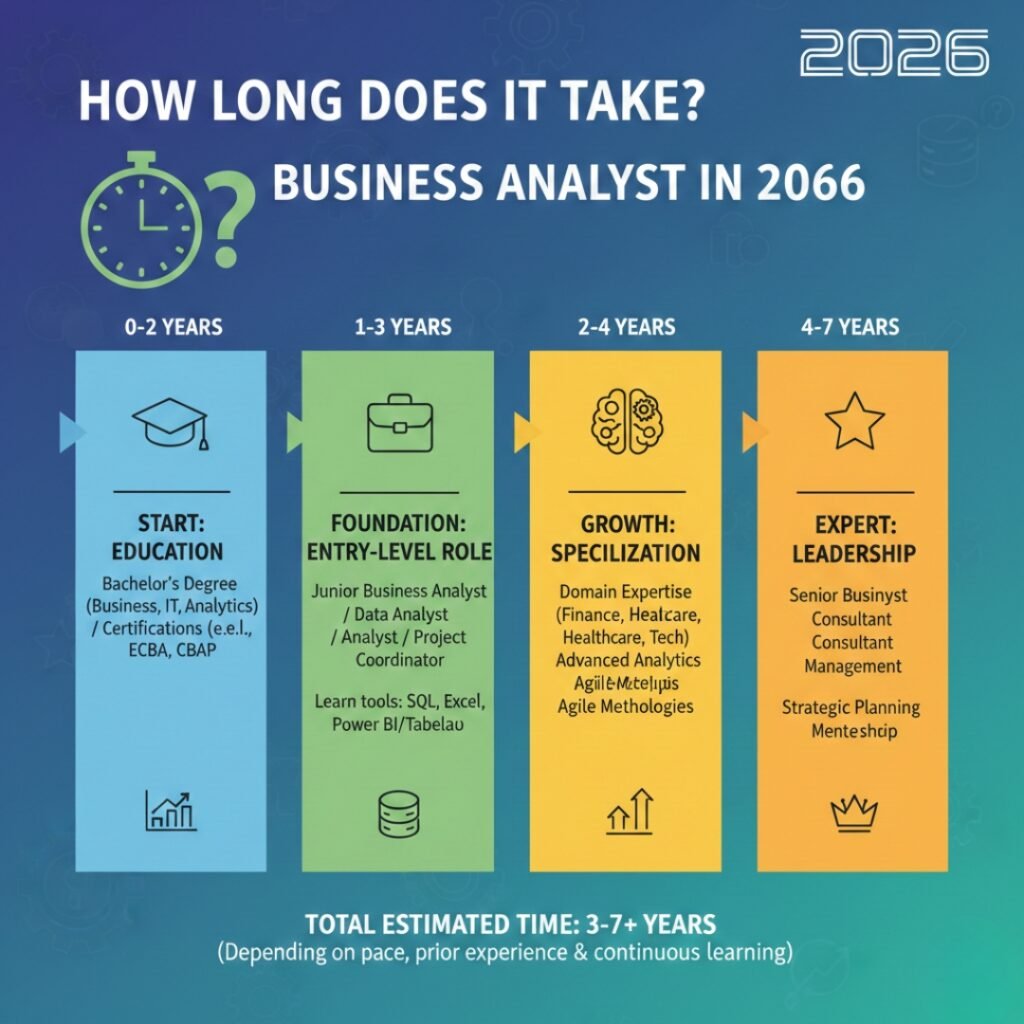
Realistically:
- 3–6 months with intensive business analysis online training
- 6–9 months with project work and certification
- Faster if you’re already in IT
The timeline depends on dedication and consistency.
Conclusion
It is not about remembering frameworks in the current Business Analyst Roadmap. It’s about knowing how businesses work and how data may help you make decisions.
Begin with structured BA Training, gain experience working on real projects, get a BA certification that is relevant to your field, and keep learning new things.
This structured Business Analyst Roadmap will not only help you become ready for a job, but it will also help you get ready for business.
And to be honest, that’s what businesses are truly looking for in 2026.
The best thing is This career path is still on the rise. The process of digital change isn’t slowing down. If anything, it’s speeding up.
So today is the day to start your Business Analyst Roadmap. Just be smart, patient, and practical about it.