In 2026, cloud testing will definitely be a skill that is in high demand. As more businesses shift their apps to cloud platforms like AWS, Azure, and Google Cloud, testers who know how to test cloud-based systems are becoming more and more important.
I’ve seen this change happen faster than most people thought it would. A few years ago, testing largely meant evaluating the software that was already on computers and servers in the office. Cloud computing powers practically everything these days, from banking apps to healthcare platforms to AI tools. That alters the way testing works in every way.
Let’s break this down in a way that makes sense so you can see why cloud testing is so popular and what it implies for your job.
Why Cloud Testing Is All of a Sudden Popular
The basic truth is that corporations don’t make traditional software anymore. They are making apps that work in the cloud.
Think about the apps you use every day:
- Gmail
- Netflix
- Amazon
- ChatGPT
None of them runs on a single server. They work across many regions, distributed cloud environments, and infrastructure that can grow.
You need to test these systems in a different way.
For instance, I worked on a financial product that had a huge increase of visitors on payday. The system operated perfectly throughout normal testing, but when it was put on the cloud, it failed because of scaling problems that weren’t predicted. Only cloud-specific testing scenarios like load testing with auto-scaling, helped pinpoint the real problem.
This is why firms now hunt for testers who know how to work with cloud settings.
What is Cloud Testing, Exactly?
Cloud testing is when you test apps that run on cloud infrastructure instead of local PCs or servers that are on the same premises.
Testing stuff like this is part of it:
- Scalability: Can the system manage sudden increases in traffic?
- How well it works under real-world load
- How safe is data stored in the cloud?
- Combining different cloud services
- Available in different areas
Cloud testing is different from traditional testing since it focuses on environments that change and resources that scale automatically.
And that’s where demand is going through the roof.
Why the Need for Cloud Testing Is Growing So Quickly in 2026
1. Most businesses are moving to the cloud.
Recent statistics from the industry say that more than 90% of businesses currently use cloud services in some way. Even the infrastructure of government systems, healthcare platforms, and insurance businesses is changing.
This move causes a huge need for testers that know how to:
- Testing environments in AWS
- Workflows for testing on the Azure cloud
- Validation of cloud deployment
If you don’t test them properly, cloud systems can break in strange ways.
2. Cloud infrastructure is where AI apps run.
AI tools don’t work on their own. They run in the cloud.
This is where the OnlineQA software tester comes in very handy. AI systems depend on cloud infrastructure for:
- Putting the model into use
- Testing APIs
- Inference in real time
- Processing that can grow
When you test AI systems, you also test cloud systems.
That’s why there is a significant demand for testers who know both cloud computing and AI testing.
3. Cloud testing is important for both remote work and SaaS products.
SaaS products are now the most popular type of software on the market.
Some examples are:
- Salesforce
- Zoom
- Slack
- Shopify
These platforms need to perform well for millions of people all around the world.
Cloud testers make sure:
- Stability at peak traffic
- Quick performance
- Safe handling of data
SaaS products would fail all the time if they didn’t have cloud testing.
Real-World Example: How Cloud Testing Prevents Major Failures
A big retail corporation previously added a new shopping function just before a big sale. In the stage, everything went perfectly. But when it was put into production in the cloud, the auto-scaling arrangement didn’t work.
What happened?
The system went down when many people were using it. Millions of dollars in missed sales. After that, the company spent a lot of money on cloud testing and hired testers who were specifically educated to work in cloud systems.
This happens a lot. It happens more often than people realize.
Why People Who Are New to the Field Are Choosing Cloud Testing as a Career
I’ve seen that a lot of beginners are getting into cloud testing through structured learning programs, including Ai testing courses online for beginners .
Why?
Because cloud testing gives you:
- A lot of room for high pay
- Easy to get in through QA jobs
- Chance to go up to DevOps or AI testing
- Job security is strong
A lot of people who are new to the field start out doing basic testing and then move on to cloud testing jobs. This is not just some theoretical job advice; it’s an actual journey.
How Cloud Testing Fits into Today’s QA Jobs
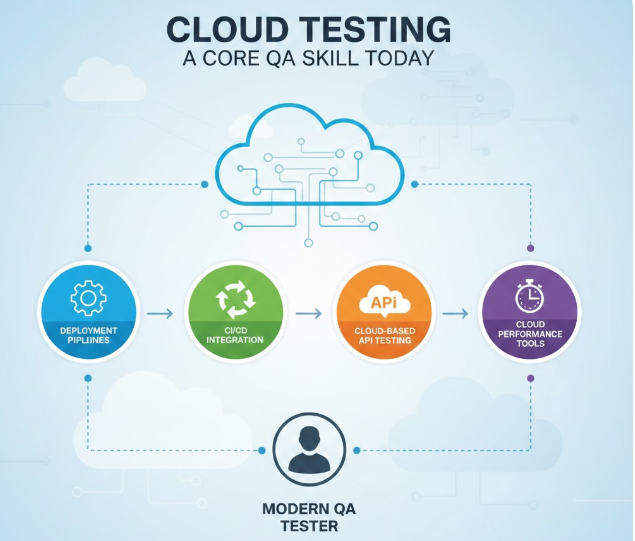
There is no unique job for cloud testing. It’s becoming a normal aspect of QA jobs.
Testers today should know:
- Pipelines for deploying to the cloud
- Integration of CI/CD
- Cloud-based API testing
- Using cloud tools for performance testing
This is why a lot of professionals are taking QA online training courses to improve their abilities, especially ones that let them work in real cloud environments.
You can’t just know how to do traditional tests anymore.
Tools That Are Often Used for Cloud Testing
Here are some tools that real cloud testers use on real projects:
Cloud platforms:
- AWS
- Microsoft Azure
- Google Cloud Platform
- Selenium is a testing tool.
- Postman, JMeter, and Playwright
Cloud testing services include AWS Device Farm. BrowserStack and LambdaTest .Testers who learn how to use these technologies are much more likely to get jobs.
The Possible Salary for Cloud Testers in 2026
Based on how things are going with hiring right now:
Cloud tester at the entry level:
- India: 4–8 LPA
- USA: $70,000–$95,000
for a mid-level cloud tester
- India: ₹10–18 LPA
- USA: $100,000–$130,000
Senior Cloud Tester:
- India: ₹20+ LPA
- USA: $140,000+
Cloud testing expertise can lead to far higher salaries than traditional testing jobs.
The main difference between cloud testing and traditional testing is
Testing that is done the old-fashioned way focuses on systems that don’t change.
Cloud testing is all about environments that can change and grow.
For instance:Standard testing checks to see if a login works.Cloud testing checks to see if 10, 1,000, or 100,000 people can log in at the same time. This discrepancy is rather big.
Why Cloud Testing Will Last
People are still using the cloud. It’s speeding up.
- New technologies, such as AI platforms,
- The architecture of microservices
- Pipelines for DevOps
- Apps that work in real time
It all depends on cloud infrastructure.This suggests that the need for cloud testing will keep expanding for a long time.
Who Should Know How to Test in the Cloud?
Cloud testing is great for:
- Manual testers improving their skills
- Automation testers learning more skills
- New people getting into QA
- Professionals who are heading into AI testing
Structured study and practice can help even beginners learn how to test in the cloud.
Getting Ahead in Your Career After Learning Cloud Testing
Cloud testing can lead to several different jobs:
- Cloud QA Engineer
- Automation Tester
- AI Testing Engineer
- DevOps Engineer
- Site Reliability Engineer
Reliability Engineer are all jobs that you can do.A lot of people start out in QA and go up to jobs that pay more.
My Honest Opinion After Seeing This Change
Five years ago, if you had asked me if cloud testing would be as significant, I would have answered, “It’s useful but not necessary.” It’s not optional anymore. Cloud infrastructure is used by all serious software companies. Testing is also necessary for every cloud system.
I’ve seen testers get twice as many job offers after learning how to test on the cloud.Right now, it’s one of the best upgrades you can make.
Last Thoughts: Should You Learn Cloud Testing in 2026?
Yes. Cloud testing is not only in high demand, but it is also becoming a basic competence for modern QA experts. Companies are moving toward cloud-based systems and AI-driven platforms. Testers who know how to test in the cloud will have greater job prospects, higher pay, and more stable careers. Cloud testing is one of the most useful and future-proof skills you can master right now ,whether you want to get into QA or go forward in your testing career.