Introduction
AI data analytics blends traditional data analysis with machine learning to generate faster, deeper business insights. Its significance lies in helping organizations move from reactive reporting to predictive and automated decision-making. For professionals, it creates opportunities to move beyond basic dashboards into high-impact analytical roles aligned with today’s AI-driven business environment.
The Evolution of AI Data Analytics: Past, Present, and Future
Let’s rewind for a second.
Analytics used to mean spreadsheets and monthly reports. You looked at what happened last quarter and tried to explain it. That was enough.
Then predictive analytics entered the scene. Suddenly, businesses wanted to know what would happen next.
Now? We’re living in the AI layer of analytics.
By 2026, organizations will be embedding AI models into reporting systems. AI is even enabling retailers to forecast demand. It is used by health care providers to identify risk patterns and systems of compromise early. Fintech companies use anomaly detection algorithms to block fraud before a customer even realizes what has happened.
And here’s the interesting part: analysts are still very much needed. But their role has evolved. Rather than number-crunching themselves, they are checking the outputs of AI systems, improving models, and linking insights to strategy.
The future? Analysts who can think critically about AI results will be far more valuable than those who just generate reports.
Key Benefits of Integrating AI Data Analytics in Business Strategy
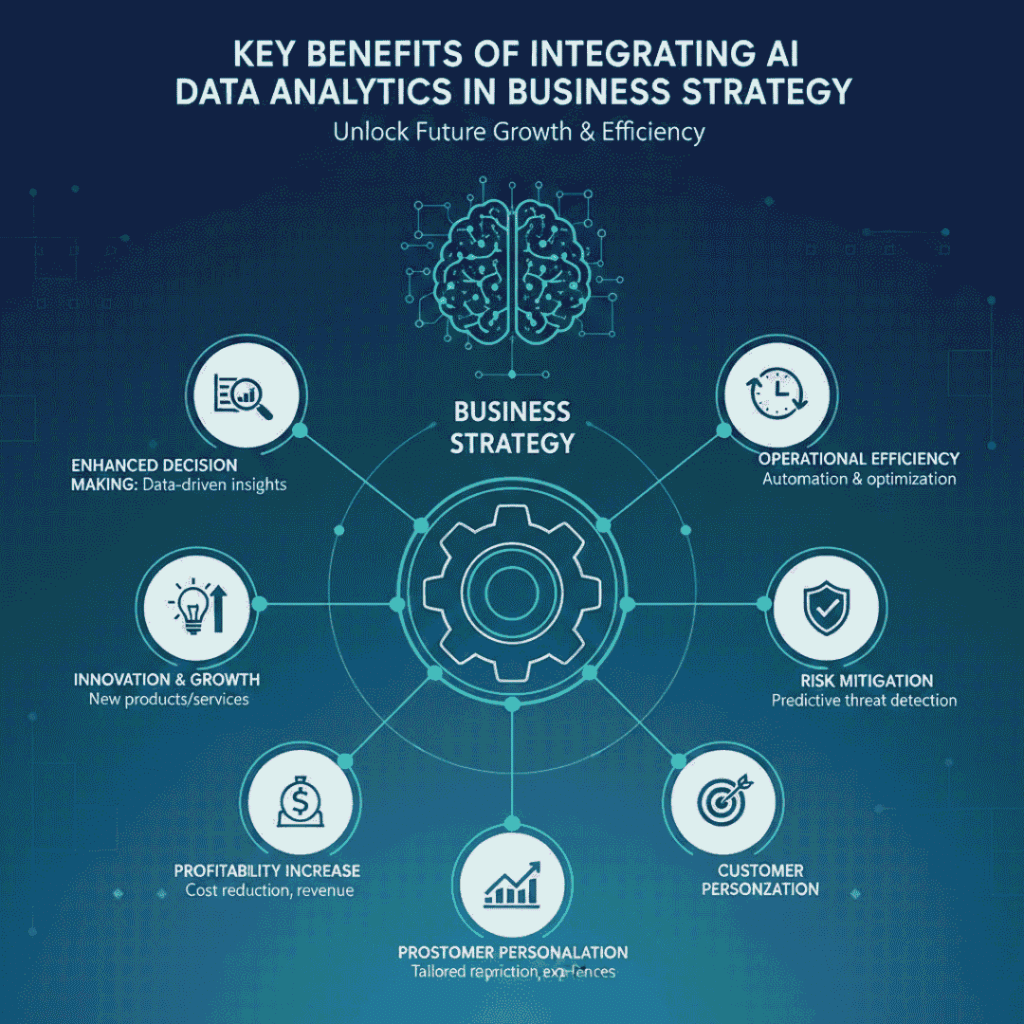
Businesses adopt AI data analytics for one reason: measurable improvement.
I’ve seen companies reduce operational costs simply by predicting supply chain bottlenecks early. Marketing teams now adjust campaigns in real time based on AI-driven behavior analysis. That wasn’t realistic a decade ago.
- The big advantages include
- Faster, data-backed decision-making
- Anticipatory information rather than after-the-fact reporting
- Automation of repetitive analysis tasks
- Improved customer personalization
If you are dabbling in an online analytics course, this is the setting. It’s not about taking tools for their own sake. It is about realizing how AI-driven insights influence revenue, efficiency, and growth.
That is what hiring managers are focusing on now.
Key Tools and Tech for Strong AI Data Analytics
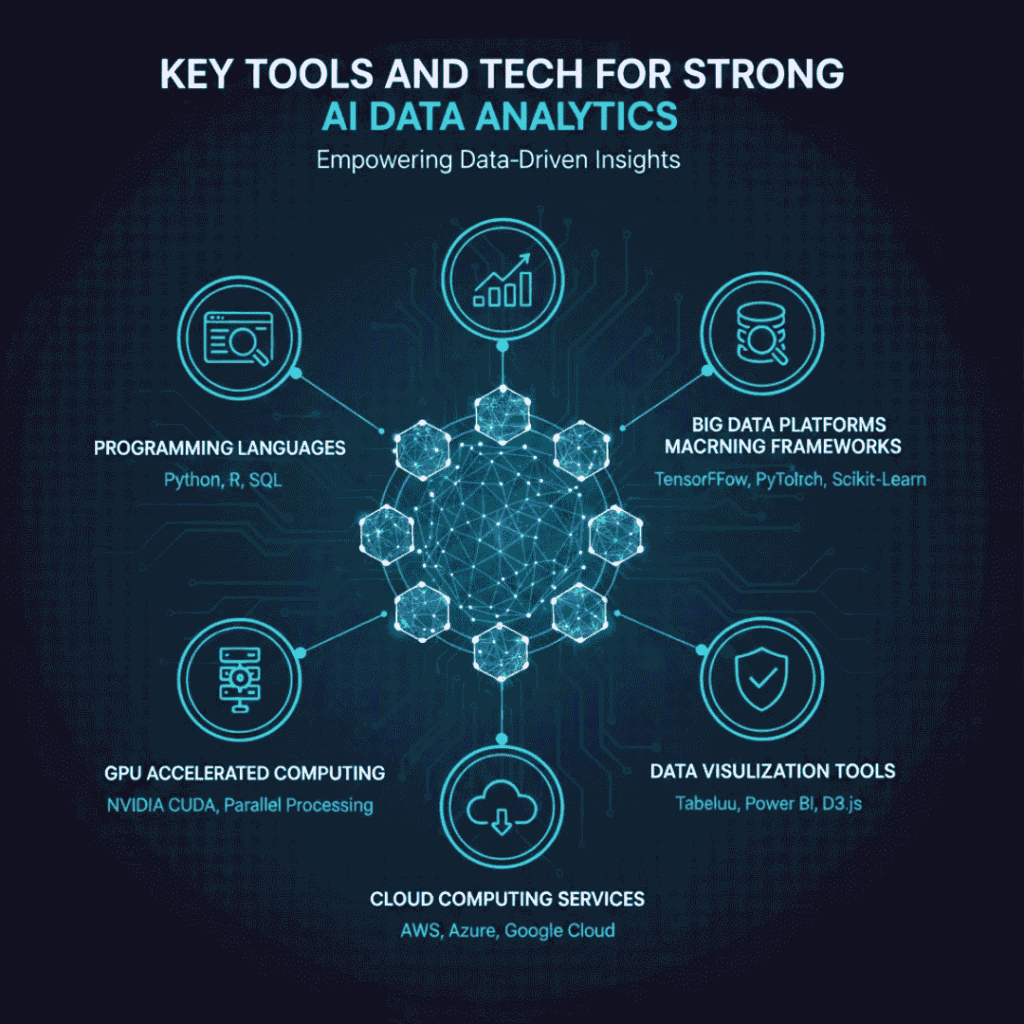
Skills let’s talk about them because that is where career growth really occurs.
Below are most of the requirements for AI data analytics positions, as follows:
- Strong Python knowledge
- SQL proficiency
- Data visualization products (Power BI, Tableau)
- Machine learning fundamentals
- Cloud platform exposure
Once again, a good Python for data analysis course shouldn’t be just about syntax. It’s meant to teach you how to clean up messy datasets, create simple models, and validate your outputs correctly.
One of the things I’ve found interviewing people is that those who “get” why a model behaves like that seem to be way ahead of someone who just knows how to run code.
If you are considering enrolling in an AI data analytics program, look for a program that combines technical depth and business understanding. That combination is
Overcoming Common Challenges in AI Data Analytics Implementation
Now, here’s the part people don’t talk about enough.
AI data analytics sounds impressive, but implementation can get messy.
Common roadblocks include:
- Inconsistent data quality
- Teams that trust AI outputs blindly
- Lack of interaction between the analysts and deciders
- Over-engineered models and a lack of business clarity
I’ve watched companies throw millions at AI tools only to discover that the underlying data was not trustworthy. That would be like constructing a smart house out of weak concrete.
The trick is not just to work with AI. It’s just knowing when to question it.
That perspective, critical thinking over blind automation, is something good analytics courses online are beginning to stress more in 2026.
Case Study: How Amazon Overhauled Its Operations with AI Data Analytics
Consider Amazon as a real-world case.
Reading your mind, Amazon Personalize, powered by AI and its machine learning algorithms, is the service that makes Amazon’s recommendation engine more artificial. It studies a shopper’s browsing history and purchase patterns, among other behavioral signals, to anticipate what they might buy next.
But recommendations aside, AI assists Amazon in optimizing inventory management and delivery routes. That lowers costs and speeds things up two monstrous competitive advantages.
Behind the systems are data teams, which translate performance metrics into decisions and recalibrate models to deliver accurate predictions to the business.
That blend of automation and human insight is exactly where career opportunities are growing.
FAQs: Frequently Asked Questions.
What is AI in data analysis?
AI analytics is essentially the use of artificial intelligence to analyze and interpret data. It applies machine learning, natural language processing, and data mining to interpret data and make predictions or recommendations.
What do AI data analysts do?
What sets the AI analyst apart is that, unlike traditional data analysts who rely on past trends and patterns to make inferences about what might happen next, they employ the latest technology, including machine learning algorithms and neural networks, to analyze big data on the fly. They typically do the following: Synthesize data from different sources. Leveraging predictive analytics and generative AI models to predict trends.
What’s the best AI tool for data analysis?
The “best” AI data analysis tool is specific to your needs, but popular ones you want to consider include Tableau and Microsoft Power BI for visualization/BI, DataRobot and H2O.ai for automated machine learning (AutoML), and up-and-coming platforms including Julius AI and Powerdrill Bloom for easy, code-free natural language analysis and instant insights to Databricks, where you have a complete data lakehouse on top of which to build advanced AI/ML.
What are the 7 steps in data analysis?
7 Steps of Data Analysis Process | Data analysis, Data.
Data Analysis: The 7 steps of data analysis lead to creating actionable insights by turning data into information, usually consisting of asking, collecting, cleaning, exploring/analyzing patterns, interpreting the results, visualizing/presenting, and taking action.
What are the top 3 skills a data analyst (including machine learning) should have?
Three essential skills for a data analyst are SQL/programming (Python/R) for getting and cleaning your data, statistical analysis to interpret the data, and data visualization/communication to communicate insights, plus problem-solving skills and general business acumen. The actual three necessary skills will differ from position to position.
Conclusion
If you’re serious about advancing to the next level in your career, begin with powerful basics. Learn data analysis properly. Just stack AI abilities on top of that.
Go through the recommended Analytics courses online, get trained by an expert as a hands-on analytics professional, and select an AI Data Analytics Program with project collaboration.
Don’t rush the process. Build depth.
The professionals who are succeeding in 2026 aren’t “AI users,” period. They are analytical thinkers who know where and how AI is on a collision course with business strategy.