An Artificial Intelligence Online Training program typically covers the foundations of AI, machine learning, data handling, neural networks, real-world applications, and practical project work that prepares learners for industry roles through an AI course certification. In simple terms, you learn how machines “think”, how models learn from data, and how AI systems are actually built and deployed in real business environments.
If you’ve ever wondered what really happens inside AI and machine learning courses, the answer is a lot more practical learning than most people expect. Modern AI courses aren’t just theory anymore-they’re closer to guided lab experiences where you build things that resemble real products.
Let’s walk through what you’ll usually learn, step by step.
1. Foundations of Artificial Intelligence
Every good AI journey starts with understanding why AI works before jumping into tools.
You’ll typically begin with:
- What AI actually means (beyond the buzzwords)
- Types of AI: Narrow AI vs General AI
- How machines make decisions
- Problem-solving using algorithms
- Real-world AI use cases across industries
Many learners say this part feels surprisingly eye-opening. Things like Netflix recommendations or Google Maps traffic predictions suddenly make sense once you see the logic behind them.
Courses today also discuss ethical AI, especially important after global conversations around generative AI safety and responsible automation that accelerated through 2024–2026.
2. Mathematics and Statistics (Yes, But Practical)
This section sounds intimidating, but modern Artificial Intelligence Online Training programs focus on applied math rather than academic theory.
You’ll usually learn:
- Linear algebra basics
- Probability concepts
- Statistics for data analysis
- Optimization techniques
Instead of solving abstract equations endlessly, instructors often show how math directly improves model accuracy. For example, understanding probability helps explain why a spam filter sometimes makes weird mistakes.
3. Programming for AI (Mostly Python)
Almost every AI course certification includes programming training, usually centered on Python because it dominates AI development today.
Core topics include:
- Python fundamentals
- Data structures
- Working with libraries like NumPy and Pandas
- Data visualization tools
A typical beginner project might involve analyzing customer purchase data or predicting housing prices. Small wins like these build confidence quickly.
4. Machine Learning — The Core of AI
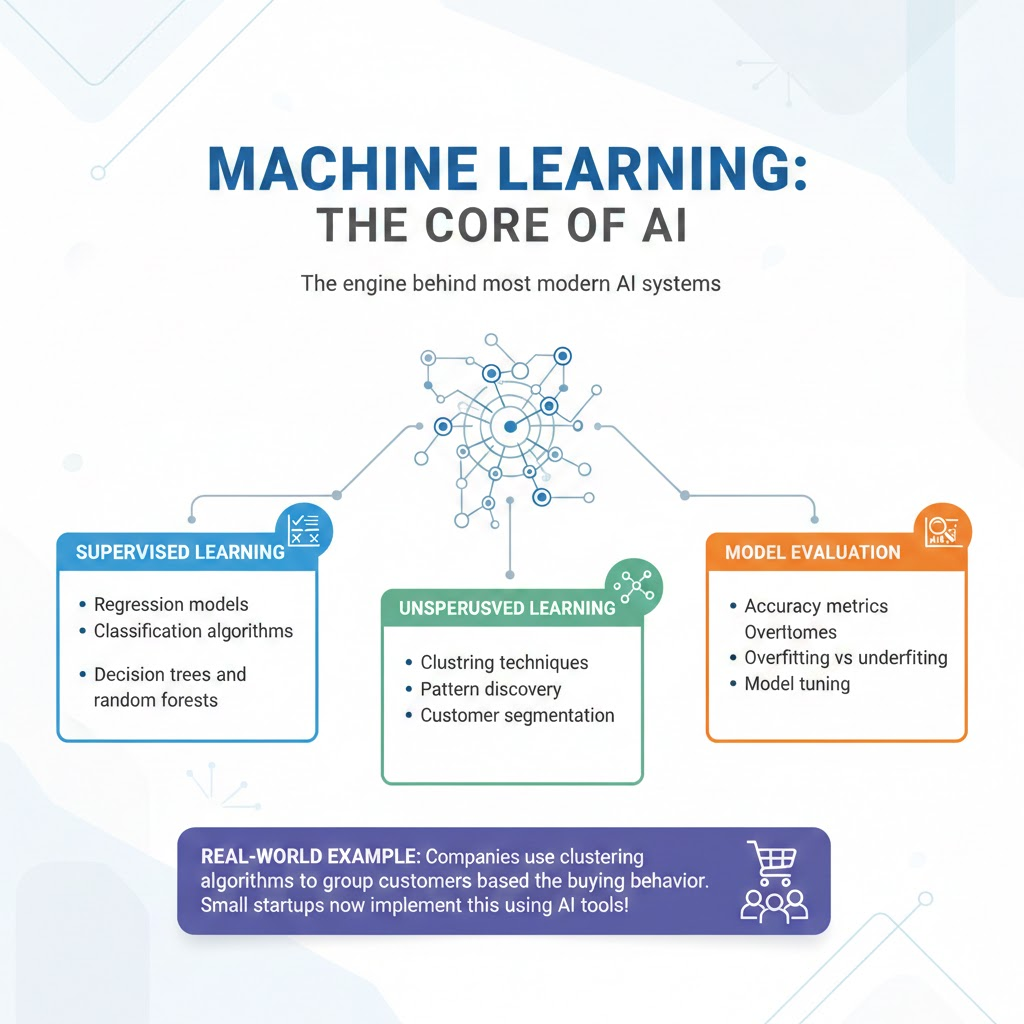
This is where things get exciting. Machine learning is the engine behind most modern AI systems.
Inside AI and machine learning courses, you’ll explore:
Supervised Learning
- Regression models
- Classification algorithms
- Decision trees and random forests
Unsupervised Learning
- Clustering techniques
- Pattern discovery
- Customer segmentation
Model Evaluation
- Accuracy metrics
- Overfitting vs underfitting
- Model tuning
A real-world example: companies use clustering algorithms to group customers based on buying behavior ,something even small startups now implement using AI tools.
5. Deep Learning and Neural Networks
Thanks to the rise of generative AI tools like ChatGPT, Gemini, and AI copilots integrated into workplaces, deep learning has become a major focus in recent curricula.
Topics often include:
- Artificial neural networks
- Convolutional Neural Networks (CNNs) for images
- Recurrent Neural Networks (RNNs) for sequences
- Transformers and large language models (LLMs)
Many courses now include mini projects such as image recognition systems or chatbot prototypes skills directly aligned with current hiring trends.
6. Natural Language Processing (NLP)
NLP teaches machines to understand human language,the technology behind chatbots, voice assistants, and AI writing tools.
You’ll learn:
- Text preprocessing
- Sentiment analysis
- Language modeling
- Chatbot development basics
A practical scenario: analyzing thousands of customer reviews automatically to detect satisfaction trends. Businesses rely heavily on this now, especially in e-commerce and fintech sectors.
7. Computer Vision
Computer vision focuses on helping machines interpret images and videos.
Common lessons include:
- Image classification
- Object detection
- Facial recognition basics
- Real-time visual analysis
Think self-checkout systems in stores or medical imaging tools assisting doctors—these examples make the learning feel tangible rather than theoretical.
8. Data Engineering and Model Deployment
Here’s something many beginners don’t expect: building a model is only half the job. Deploying it is where industry skills really matter.
Modern AI and machine learning courses teach:
- Data preprocessing pipelines
- Model deployment basics
- APIs and cloud platforms
- Monitoring AI performance
With companies increasingly moving AI workflows to cloud platforms like AWS, Azure, and Google Cloud, deployment knowledge has become a key hiring differentiator.
9. Generative AI and Modern Industry Trends
Courses updated for 2025–2026 now include generative AI modules because businesses are actively integrating AI assistants into daily workflows.
You may explore:
- Prompt engineering
- AI copilots
- LLM applications
- Responsible AI usage
Interestingly, many professionals enrolling today aren’t switching careers—they’re upgrading existing roles (marketing analysts, testers, finance professionals) with AI skills.
10. Hands-On Projects and Capstone Work
This is often the most valuable part of an AI course certification.
Typical capstone projects:
- Recommendation systems
- Fraud detection models
- AI chatbots
- Predictive analytics dashboards
Recruiters increasingly care less about certificates alone and more about demonstrated projects. A solid portfolio often matters more than perfect grades.
11. Career Preparation and Industry Exposure
Good Artificial Intelligence Online Training programs now include:
- Resume and portfolio building
- Mock interviews
- Real business datasets
- Case-study learning
This shift happened because companies want job-ready AI practitioners, not just theoretical learners.
So, What Do You Actually Walk Away With?
By the end of a well-structured AI program, most learners gain three things:
- Technical understanding — how AI models work behind the scenes
- Practical skills — building and deploying real solutions
- Career readiness — confidence to apply AI in real jobs
And honestly, that last part matters the most. AI feels overwhelming at first, but once you’ve trained a model yourself—even a small one—the whole field stops feeling mysterious.
Final Thought
An artificial intelligence course today is less about memorizing algorithms and more about learning how to solve problems with data. The best AI and machine learning courses blend theory, experimentation, and real-world application, helping learners move from curiosity to capability—one project at a time.
If you’re exploring an AI course certification, look for programs that emphasize hands-on learning, updated generative AI topics, and practical deployment skills. That combination reflects where the industry is heading right now—not where it was five years ago.