Introduction
If you’re just starting out, the simplest way to learn the Data Analytics Course is to build your foundations using Excel and statistics, enroll in a structured Data Analytics Course, and begin practicing with real-world projects from day one. That’s it. No fancy roadmap. Just consistent, hands-on learning.
Now, let me break that down in a way I wish someone had explained it to me when I started.
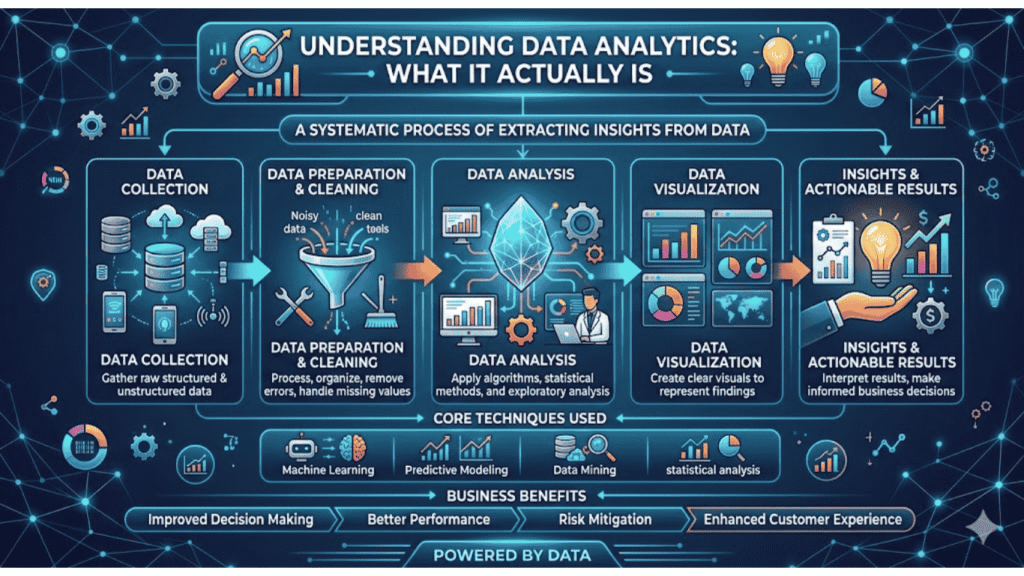
First, Understand What Data Analytics Actually Is (Without the Buzzwords)
Before jumping into a data analyst course online, you need to know what you’re signing up for.
The Data Analytics Course is basically answering real business questions using data.
Not “doing math.”
Not “coding all day.”
Not building robots.
It’s more like
- Why are customers leaving?
- Could you please let us know which marketing campaign is proving to
- Why did sales drop in Q2?
- What should we forecast for next quarter?
I’ve worked with early-stage startups where one simple dashboard changed hiring decisions. And I’ve seen enterprise teams waste months building reports nobody used. The difference? The difference lies in asking clear questions and developing practical skills.
That’s what you’re learning.
Step 1: Begin with the very basics (no ego allowed)
Don’t rush into Python or complex AI tools if you’re just starting off.
Start here:
1. Excel or Google Sheets
Excel and Google Sheets remain highly relevant even in 2026. Don’t let anyone tell you otherwise. Most companies still live inside spreadsheets.
Learn:
- Pivot tables
- VLOOKUP / XLOOKUP
- Basic formulas
- Data cleaning
This builds your logic muscle.
2. Basic Statistics (The Friendly Version)
You don’t need to become a mathematician. You just need to understand:
- Mean, median, standard deviation
- Correlation vs causation
- Probability basics
If you skip this, everything later feels confusing.
Step 2: Take a Structured Course (So You Don’t Get Lost)
Trying to learn randomly from YouTube can feel productive… until you realize you’ve been watching tutorials for 3 months and built nothing.
This is where a proper data analytics course helps.
One of the most beginner-friendly programs right now is the Google Data Analytics Course Professional Certificate. It’s often referred to as the Data Analytics course , and honestly, it’s popular for a reason.
Why it works for beginners:
- No prior experience required
- Teaches Excel, SQL, R, and visualization
- Includes hands-on case studies
- Recognized by employers
And because it’s hosted on , you can learn at your pace.
Is it perfect? No course is. But it gives you structure. And structure is valuable when you’re new.
If you prefer alternatives, there are other strong options, like IBM’s Data Analytics Course program or Meta’s analytics certifications, but Google remains one of the most employer-recognized entry-level paths in 2026.
Step 3: Learn SQL (This Is Non-Negotiable)
If Excel serves as the foundation, SQL serves as the gateway to real analyst jobs.
Most entry-level job postings right now list SQL as mandatory. Even more than Python.
Pay attention to:
- SELECT statements
- WHERE things are
- GROUP BY
- JOINs
It was scary for me to learn SQL at first. Then I learned that all it involves is asking questions in English in a way that makes sense.
For example:
“Show me the total sales by country where the revenue is over $10,000.”
That’s what analytics does.
“Show me total sales by country where revenue is above $10,000.”
That’s analytics in action.
Step 4: Add One Visualization Tool
Once you can analyze data, you need to present it.
The most common tools:
- Tableau
- Power BI
Companies increasingly prefer Power BI because of Microsoft ecosystem integration, but Tableau is still widely respected.
Pick one. Don’t learn both at once.
Hiring managers care more about whether you can tell a clear story with the Data Analytics Course than which tool you used.
Step 5: Build Real Projects (Even If No One Is Paying You)
This is where beginners hesitate.
You don’t have to work to gain experience.
Use:
- Public datasets (Kaggle is an excellent place to find them)
- Open data portals for the government* Sample datasets for e-commerce
Make projects like this:
- Analysis of the sales dashboard
- Basic approach of predicting customer churn
- A breakdown of marketing performance
Then put them on GitHub or make a modest portfolio site.
Recruiters want proof of work in 2026. A certificate and projects are better than just a certificate.
Step 6: Get a Realistic View of the Job Market
People don’t mention this enough:
There are more companies competing for entry-level data jobs now than there were five years ago.
AI tools like ChatGPT and programs that create reports on their own have changed the game. But here’s the twist: they’ve made thinking like a business much more helpful.
Companies don’t just want someone who can pull numbers.
They want someone who can interpret them.
If you can explain:
- Why something happened
- What it means
- What decision should be made?
You’re ahead.
That’s why modern data analyst course online programs are increasingly including storytelling and stakeholder communication modules. Technical skills alone aren’t enough anymore.
How Long Does It Take to Learn?
Realistically:
- 3 months: Basics (Excel + SQL + intro stats)
- 6 months: Job-ready with projects
- 9–12 months: Confident and interview-ready
That’s with consistent practice, not binge-learning one weekend and disappearing for two weeks.
Do You Need a Degree?
Short answer: No.
Long answer: It depends on the company, but skills and portfolio matter far more now.
Many entry-level analysts in tech startups come from:
- Marketing backgrounds
- Finance
- Engineering
- Even completely unrelated fields
What they share isn’t a degree. It’s proof they can solve problems using data.
A Simple Roadmap for Beginners (If You’re Feeling Overwhelmed)
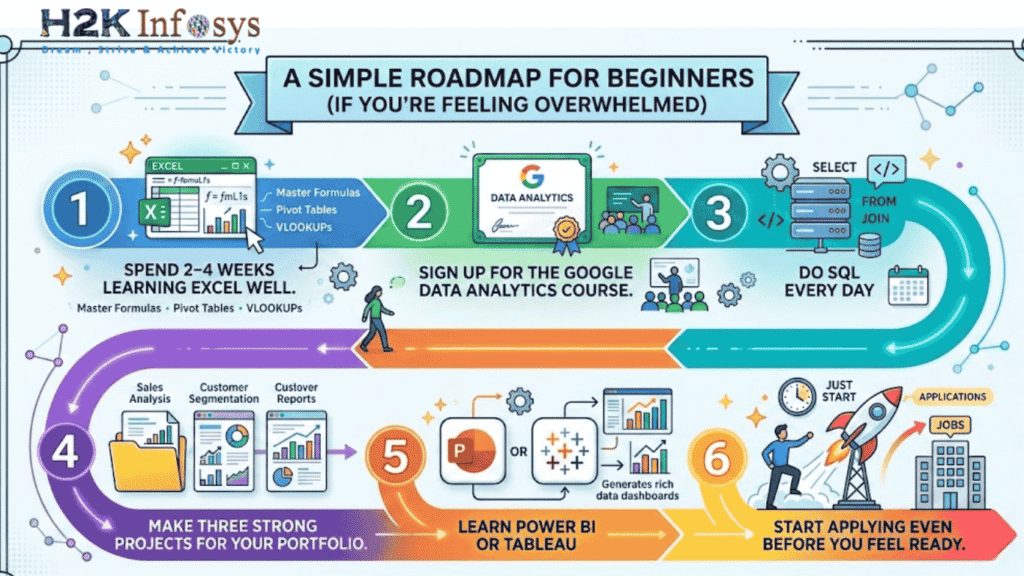
If I had to start again today, this is what I would do:
- Spend 2–4 weeks learning Excel well.
- Sign up for the Google data analytics course.
- Do SQL every day
- Make three strong projects for your portfolio.
- Learn Power BI or Tableau
- Start applying even before you feel ready.
You’ll never feel fully ready, by the way. That’s normal.
Final Thoughts
The Data Analytics Course isn’t about becoming a tech genius.
It’s about becoming curious.
If you enjoy asking:
- Why did this happen?
- What does this number actually mean?
- How can this business improve?
You’ll do well.
And if you commit to one solid data analytics course, practice consistently, and build real projects, you absolutely can break into this field even as a complete beginner.
Just don’t overthink it.
Start messy. Learn consistently. Improve publicly.
That’s how most of us did it.