Yes, H2K Infosys does include real-time AI projects as part of its AI training program and that’s actually one of the main reasons many learners choose it over purely theory-based AI training courses.
What “Real-Time AI Projects”Actually Mean
In many AI training programs, students build toy projects.
You know the type , predicting house prices from a Kaggle dataset or building a basic spam classifier. Useful? Yes. Job-ready? Not always.
What makes H2K Infosys different, based on how their structure works, is that their projects are designed to simulate real production environments. That includes:
- Working with messy, imperfect datasets
- Building end-to-end pipelines (data cleaning → model training → deployment simulation)
- Using cloud environments
- Creating documentation like you would in an actual company
- Participating in mock Agile sprint setups
That last part matters more than people think.
Because in real AI roles today, especially in 2025 and moving into 2026, employers aren’t just hiring “model builders”. They want professionals who understand collaboration, version control, MLOps basics, and stakeholder communication.
Why Real-Time Projects Matter in 2026
Let’s be honest. AI has exploded. After the release of tools like ChatGPT, generative AI adoption skyrocketed across industries. Companies now expect entry-level AI professionals to:
- Understand LLM workflows
- Work with real cloud datasets
- Build scalable solutions
- Integrate AI into business systems
So when evaluating AI training courses, the big question isn’t “Do they teach Python?”
It’s: Do they prepare you for how companies actually use AI right now?
Real-time AI projects bridge that gap.
From what students typically report, H2K Infosys includes:
- Predictive analytics case studies
- NLP-based applications
- AI-driven automation use cases
- Cloud-integrated machine learning models
And importantly projects aligned with job market expectations.
AI Training and Job Placement: The Missing Link Most Programs Ignore
Here’s something I’ve personally noticed working with professionals transitioning into AI roles:
A strong portfolio beats certificates.
Many AI training programs teach theory. A few teach projects. But very few connect projects to interview preparation and job placement support.
H2K Infosys positions itself as offering both AI training and job placement assistance. That combination is what career-switchers often need.
Because let’s face it:
If you’re moving from QA, Business Analysis, or even a non-IT background, you don’t just need coding skills. You need:
- Resume guidance tailored to AI roles
- Mock interviews
- Real project explanations you can confidently discuss
- Understanding of real business use cases
And this is where real-time projects become gold. During interviews, instead of saying:
“I built a classifier as part of my course.”
You can say:
“I worked on a simulated client-based predictive maintenance solution using real-world industrial data and implemented model validation in a cloud setup.”
That’s a completely different level of credibility.
What Makes a Real AI Training Program Stand Out?
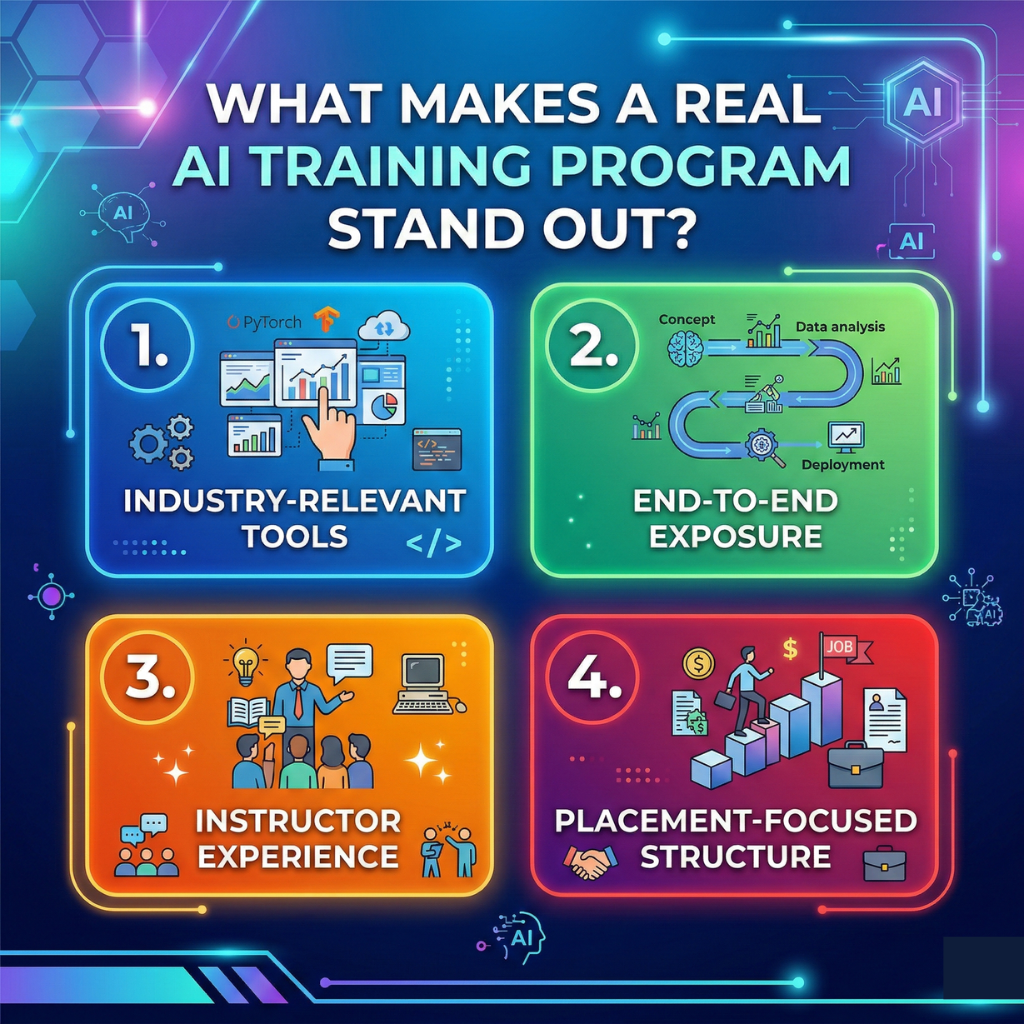
When evaluating any AI training program (including H2K Infosys), here’s what I tell people to look for:
1. Industry-Relevant Tools
Are they teaching tools companies actually use in 2026?
Think: Python, cloud platforms, ML frameworks, deployment concepts, prompt engineering basics.
2. End-to-End Exposure
Does the project cover:
- Problem definition
- Data preprocessing
- Model selection
- Evaluation
- Deployment simulation
- Business impact explanation
If yes , that’s real-world.
3. Instructor Experience
Programs led by instructors who’ve worked on enterprise AI systems tend to teach differently. They explain what goes wrong in real production environments. That insight is invaluable.
4. Placement-Focused Structure
AI training and job placement shouldn’t be separate phases. They should be integrated from day one.
A Practical Example of How This Helps in Interviews
Let’s say a student works on an NLP project analyzing customer support tickets.
In a typical course, you’d stop at sentiment analysis accuracy.
In a more real-time structured AI training program, you might also:
- Build a dashboard for insights
- Discuss business KPIs
- Simulate deployment
- Prepare a stakeholder presentation
That changes how recruiters see you.
Companies hiring AI professionals today want business-aware technologists not just coders.
Is H2K Infosys a Good Fit for Everyone?
Honestly? No program is.
If you’re looking for purely academic AI theory or deep research-focused machine learning math, a university route might be better.
But if your goal is:
- Practical AI skills
- Real-time project experience
- Structured AI training courses
- Support with transitioning into AI roles
Then a job-oriented AI training program like H2K Infosys can make sense.
Especially for:
- Career switchers
- IT professionals upskilling
- Professionals targeting AI roles in US job markets
Final Thoughts from a Practical Lens
The AI job market in 2026 is competitive but still full of opportunity. What separates successful candidates isn’t just knowledge. It’s applied experience. Based on how their structure is designed, H2K Infosys does provide real-time AI projects within its AI training program, and that practical component plays a key role in preparing learners for interviews and workplace expectations.