Project-based AI training at H2K Infosys is effective because it teaches artificial intelligence concepts through practical implementation rather than theory alone. Learners work on structured projects that simulate real enterprise environments, allowing them to apply machine learning algorithms, data pipelines, and AI frameworks to solve realistic business problems. This approach improves technical understanding, strengthens problem-solving skills, and prepares professionals for real world IT workflows.
Unlike purely theoretical AI Training Programs, project-based learning integrates tools, coding practices, and industry workflows that are commonly used in production environments. As a result, learners not only understand how AI algorithms work but also learn how to implement, test, deploy, and maintain AI solutions.
What Is Project-Based AI Training?
Project-based AI training is a learning methodology where students build complete AI solutions through guided projects rather than studying concepts in isolation. Instead of focusing only on lectures or quizzes, learners work on real datasets, develop machine learning models, and implement workflows similar to those used by data science and AI teams.
In many AI Training Online programs, theoretical learning may include topics like supervised learning, neural networks, or natural language processing. Project-based training extends this learning by asking students to implement these concepts in practical scenarios.
Typical project-based AI learning activities include:
- Building predictive models using Python
- Cleaning and preparing datasets
- Implementing machine learning algorithms
- Training and evaluating models
- Deploying models using APIs or cloud services
- Visualizing results for business interpretation
This methodology aligns with how AI solutions are developed in enterprise environments.
Key Characteristics of Project-Based Learning in AI
| Feature | Description |
|---|---|
| Real datasets | Projects use structured and unstructured data similar to industry data |
| Tool-based learning | Learners work with tools such as Python, TensorFlow, and Scikit-learn |
| End-to-end workflow | Covers data ingestion, modeling, evaluation, and deployment |
| Problem-solving focus | Projects simulate business or operational challenges |
| Collaborative development | Some programs include team-based problem solving |
The primary goal is to build technical competence through repeated implementation.
How Does Artificial Intelligence Work in Real-World IT Projects?
Artificial intelligence in enterprise IT environments involves several stages that transform raw data into automated decision-making systems.
Typical AI Workflow in Enterprise Projects
- Data Collection
- Data Preprocessing
- Feature Engineering
- Model Training
- Model Evaluation
- Deployment
- Monitoring and Optimization
Each stage requires specific tools, technical skills, and validation processes.
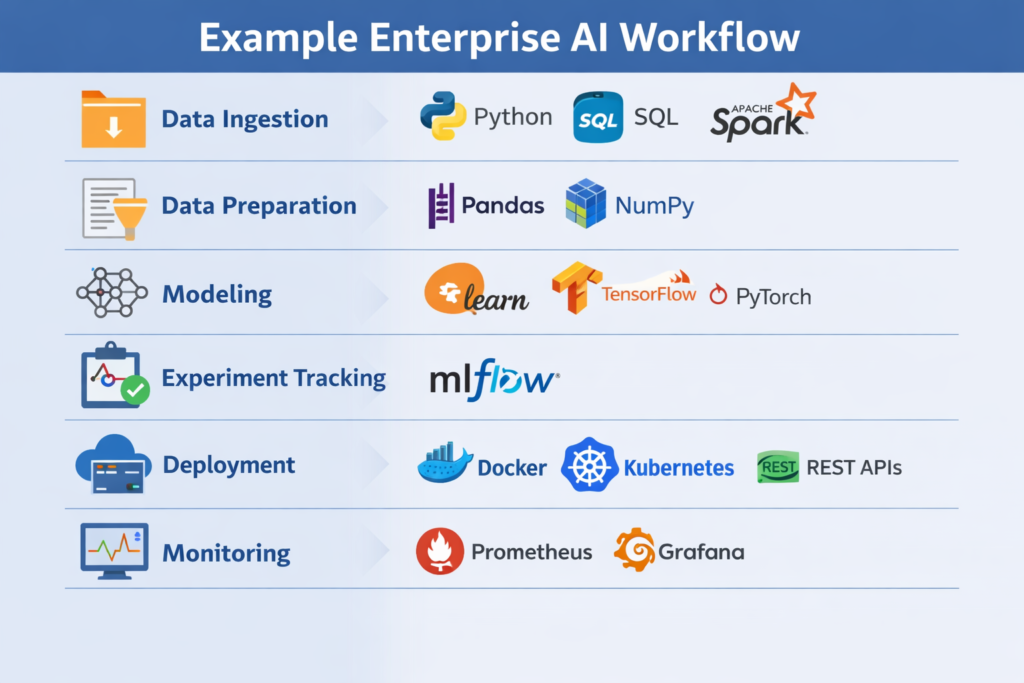
Example Enterprise AI Workflow
| Stage | Tools Commonly Used |
|---|---|
| Data ingestion | Python, SQL, Apache Spark |
| Data preparation | Pandas, NumPy |
| Modeling | Scikit-learn, TensorFlow, PyTorch |
| Experiment tracking | MLflow |
| Deployment | Docker, Kubernetes, REST APIs |
| Monitoring | Prometheus, Grafana |
Project-based AI training programs often replicate this lifecycle so learners understand how each step contributes to production systems.
Real-World Example Scenario
An enterprise retail company may want to predict product demand.
A simplified project workflow might involve:
- Collecting historical sales data
- Cleaning missing values
- Creating features such as seasonal trends
- Training regression or time-series models
- Evaluating accuracy using metrics like RMSE
- Deploying predictions into dashboards
Through projects like these, learners gain experience that closely reflects industry practices.
Why Is Project-Based AI Training Important for Working Professionals?
Working professionals often need practical technical skills rather than purely academic knowledge. Project-based AI learning provides a structured path for applying theoretical concepts to operational problems.
Several factors make this approach particularly valuable.
1. Bridges the Gap Between Theory and Implementation
Many AI concepts such as gradient descent, decision trees, or neural networks can be understood conceptually but require coding and experimentation to fully grasp.
Projects allow learners to:
- Write code for algorithms
- Tune model parameters
- Evaluate model performance
This hands-on process reinforces theoretical understanding.
2. Reflects Enterprise Development Practices
Enterprise AI development involves collaborative workflows, code repositories, testing, and deployment processes.
Project-based learning often includes:
- Version control using Git
- Model testing and validation
- Documentation of results
- Reproducible pipelines
These skills are critical in real IT teams.
3. Improves Problem-Solving Ability
In real environments, AI engineers frequently encounter issues such as:
- Incomplete data
- Model overfitting
- Feature selection challenges
- Performance bottlenecks
Projects help learners develop systematic troubleshooting methods.
4. Builds a Demonstrable Portfolio
Professionals transitioning into AI roles often need evidence of technical capabilities.
Projects provide:
- GitHub repositories
- documented notebooks
- model evaluation reports
These artifacts demonstrate applied skills during job interviews.
5. Encourages Active Learning
Research in professional education shows that active learning methods improve retention and comprehension.
Instead of passively watching lectures, learners actively:
- implement algorithms
- debug models
- interpret results
This process strengthens long-term technical proficiency.
What Skills Are Required to Learn AI?
Artificial intelligence combines multiple technical disciplines including programming, statistics, and data engineering.
Professionals entering AI training online programs typically develop several core skill areas.
Core Technical Skills
| Skill Area | Description |
|---|---|
| Programming | Python is the most commonly used language |
| Mathematics | Linear algebra, probability, statistics |
| Data manipulation | Using libraries such as Pandas |
| Machine learning algorithms | Regression, classification, clustering |
| Data visualization | Tools like Matplotlib and Seaborn |
| Model evaluation | Accuracy, precision, recall, F1 score |
Supporting Technical Skills
In enterprise environments, AI professionals also work with:
- SQL for querying databases
- Cloud platforms such as AWS or Azure
- Version control systems like Git
- Containerization tools such as Docker
Project-based AI training programs integrate many of these skills through structured exercises.
How Is Artificial Intelligence Used in Enterprise Environments?
Artificial intelligence has become an important component of modern enterprise technology systems. Organizations deploy AI models to automate decision-making, improve operational efficiency, and analyze large volumes of data.
Common Enterprise AI Applications
| Industry | AI Use Case |
|---|---|
| Healthcare | Medical image analysis |
| Finance | Fraud detection |
| Retail | Demand forecasting |
| Manufacturing | Predictive maintenance |
| Telecommunications | Network anomaly detection |
Each use case requires a combination of machine learning algorithms, data pipelines, and monitoring systems.
Example: Fraud Detection System
A financial institution might use AI to detect fraudulent transactions.
Typical workflow:
- Collect transaction history
- Label known fraud cases
- Train classification models
- Evaluate model performance
- Deploy real-time scoring APIs
Project-based training programs frequently include simplified versions of these use cases so learners can practice implementation.
What Tools Are Commonly Used in AI Training Programs?
AI development involves an ecosystem of programming libraries, frameworks, and infrastructure tools.
Common AI Development Tools
| Category | Tools |
|---|---|
| Programming | Python |
| Machine learning libraries | Scikit-learn |
| Deep learning frameworks | TensorFlow, PyTorch |
| Data processing | Pandas, NumPy |
| Visualization | Matplotlib, Seaborn |
| Experiment tracking | MLflow |
| Model deployment | Flask, FastAPI |
| Containerization | Docker |
In project-based AI training online environments, learners typically work with these tools to complete assignments and projects.
How Do AI Training Programs Simulate Real IT Projects?
Structured AI training environments often attempt to mirror enterprise workflows so learners become familiar with production development processes.
Typical Learning Project Workflow
- Problem Definition
Example: Predict customer churn.
- Data Exploration
Use Python notebooks to analyze:
- missing values
- data distribution
- correlations
- Data Preparation
Tasks include:
- removing duplicates
- handling missing data
- encoding categorical variables
Possible algorithms:
- Logistic regression
- Random forest
- Gradient boosting
- Evaluation
Models are compared using metrics such as:
- precision
- recall
- ROC-AUC
- Deployment
Model predictions may be exposed via an API endpoint.
Example pseudo-code:
@app.route('/predict', methods=['POST'])
def predict():
    input_data = preprocess(request.json)
    prediction = model.predict(input_data)
    return prediction
- Monitoring
Deployed models must be monitored for performance drift.
Common monitoring checks include:
- accuracy decline
- data distribution changes
- system latency
What Job Roles Use Artificial Intelligence Daily?
Artificial intelligence skills are used across several technical roles in modern IT organizations.
Common AI-Related Roles
| Role | Primary Responsibilities |
|---|---|
| Data Scientist | Develop predictive models and analytics |
| Machine Learning Engineer | Build scalable ML pipelines |
| AI Engineer | Integrate AI models into applications |
| Data Engineer | Build data infrastructure |
| MLOps Engineer | Manage deployment and monitoring |
Project-based AI training programs help learners understand how these roles collaborate during model development.
What Careers Are Possible After Learning AI?
AI skills can lead to a range of technology roles across industries.
AI Career Pathways
| Entry Role | Mid-Level Role | Advanced Role |
|---|---|---|
| Data Analyst | Data Scientist | Principal Data Scientist |
| Junior ML Engineer | ML Engineer | AI Architect |
| Software Developer | AI Engineer | AI Platform Lead |
However, career outcomes depend on:
- prior technical experience
- portfolio projects
- knowledge of AI frameworks
- understanding of data engineering practices
What Challenges Do AI Teams Face in Real Projects?
Understanding real-world constraints is an important part of AI training.
Common challenges include:
Data Quality Issues
Many enterprise datasets contain:
- missing values
- inconsistent formats
- duplicate records
Data cleaning often consumes a large portion of project time.
Model Overfitting
Models may perform well on training data but poorly on unseen data.
Common mitigation techniques include:
- cross-validation
- regularization
- feature selection
Deployment Complexity
Moving models from experimentation environments to production systems requires:
- containerization
- scalable APIs
- monitoring infrastructure
Project-based training helps learners experience these challenges in controlled environments.
Frequently Asked Questions (FAQ)
What is the difference between theoretical AI learning and project-based AI learning?
Theoretical learning focuses on understanding algorithms and mathematical foundations. Project-based learning emphasizes implementing these algorithms using real datasets and development tools.
Are project-based AI training programs suitable for beginners?
Yes, many programs are structured to introduce fundamental programming and machine learning concepts before progressing to larger projects.
What programming language is most commonly used in AI training?
Python is widely used because of its extensive ecosystem of machine learning libraries such as Scikit-learn, TensorFlow, and PyTorch.
How long does it take to learn AI through project-based training?
Learning timelines vary depending on the depth of the curriculum and the learner’s prior programming experience. Many structured programs range from several weeks to several months.
Do AI professionals need knowledge of cloud platforms?
Yes. Many AI systems are deployed on cloud infrastructure such as AWS, Azure, or Google Cloud for scalability and resource management.
What datasets are typically used in AI projects?
Training environments may use:
- public datasets such as Kaggle datasets
- synthetic datasets for learning
- domain-specific datasets depending on the project.
Key Takeaways
- Project-based AI training emphasizes hands-on implementation rather than theoretical instruction alone.
- Real-world projects replicate enterprise workflows such as data preprocessing, model training, deployment, and monitoring.
- AI professionals use tools such as Python, TensorFlow, PyTorch, and Scikit-learn to build production-ready solutions.
- Project experience helps learners develop problem-solving skills and technical portfolios.
- Practical AI training prepares professionals for roles such as data scientist, AI engineer, and machine learning engineer.
H2K Infosys AI training programs to gain hands-on project experience and practical AI skills.
Enroll in structured AI training online to learn real-world tools and workflows used in enterprise AI development