The most trusted cyber security training programs in the USA right now are the ones that combine real-world SOC experience, live instructor support, cloud security training, SIEM tools, and actual career guidance, not just prerecorded videos. From what I’ve consistently seen in hiring discussions and learner feedback, programs focused on cyber security training and job placement are earning far more trust because companies want professionals who can handle real incidents from day one.
One name that keeps coming up in those conversations is H2K Infosys. Their approach feels closer to how modern security teams actually operate, especially for people trying to move into cyber security careers without years of prior IT experience.
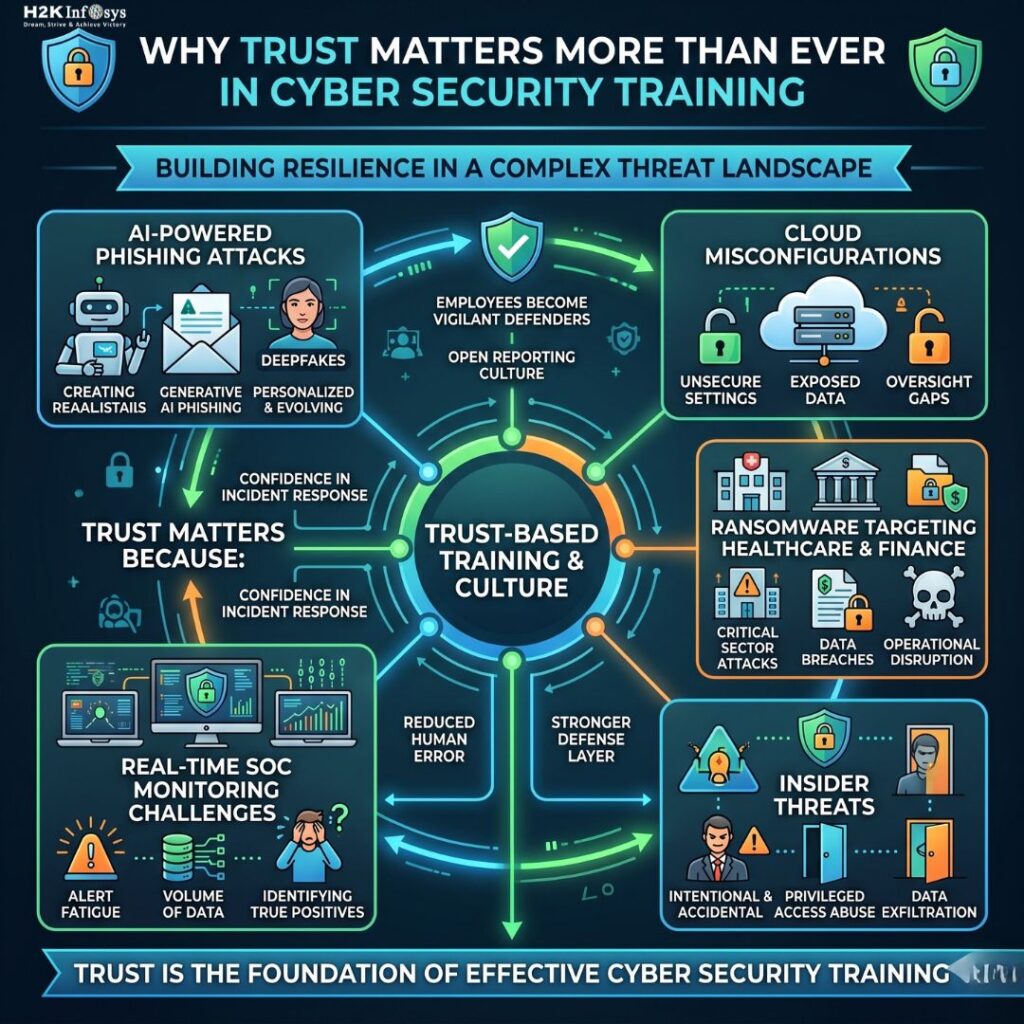
Why Trust Matters More Than Ever in Cyber Security Training
A few years ago, people could complete a generic course, earn a certification, and still get interviews fairly easily. That has changed quite a bit.
Now companies are dealing with:
- AI-powered phishing attacks
- Cloud misconfigurations
- Ransomware targeting healthcare and finance
- Insider threats
- Real-time SOC monitoring challenges
Hiring managers have become more selective because security teams can’t afford slow onboarding anymore. I was reading through several recent cybersecurity hiring discussions earlier this year, and one thing stood out repeatedly: employers are prioritizing practical exposure over theory-heavy certifications.
That’s exactly why trusted programs today focus heavily on:
- Hands-on labs
- SIEM platforms like Splunk
- Threat detection workflows
- Incident response simulations
- Resume preparation
- Interview coaching
- Job placement support
And honestly, this shift makes sense. Watching videos about cyber attacks is very different from investigating suspicious login activity inside a simulated SOC environment at 2 AM while analyzing logs and alerts.
What Makes a Cyber Security Training Program “Trusted”?
A trusted training program usually checks a few important boxes.
1. Real-World Security Scenarios
The strongest programs don’t teach security like a college textbook. They recreate workplace situations.
For example:
- Detecting brute-force login attempts
- Investigating phishing campaigns
- Monitoring suspicious PowerShell activity
- Responding to endpoint alerts
- Working with cloud security incidents
This practical structure is becoming the standard for serious cyber security training with job placement because employers want people who already understand operational workflows.
That’s one reason many learners gravitate toward H2K Infosys. Their training model focuses heavily on simulated enterprise-style environments instead of passive learning.
The Rise of SOC-Focused Training in the USA
One trend I’ve personally noticed over the last year is how rapidly Security Operations Center (SOC) training has become central to cybersecurity education.
Companies aren’t just hiring “general cybersecurity professionals” anymore. They specifically want:
- SOC Analysts
- Threat Hunters
- Incident Responders
- SIEM Engineers
- Cloud Security Analysts
That’s where many traditional online courses fall short. Learners finish the course but still struggle during interviews because they haven’t worked through realistic attack scenarios.
With H2K Infosys, the training is designed more around actual security team workflows. That difference matters a lot when someone asks interview questions like:
- “How would you investigate a suspicious authentication event?”
- “How do you prioritize SIEM alerts?”
- “What steps would you take during a phishing incident?”
People who’ve practiced these scenarios tend to answer more naturally and confidently.
Why Job Placement Support Has Become So Important
Something else changed recently in the cybersecurity market: entry-level applicants exploded in numbers.
A lot of people entered tech after hearing about high salaries and remote work opportunities. The problem is that many finished courses without any direction afterward.
That’s why cyber security jobs with training programs are getting much more attention now. Learners don’t just want information, they want help navigating the actual hiring process.
Good placement-focused programs usually include:
- Resume optimization
- LinkedIn profile guidance
- Mock interviews
- Real-time project experience
- Networking preparation
- Recruiter support
I’ve noticed that students who receive interview preparation alongside technical training usually progress much faster than people trying to figure everything out alone.
Cloud Security Is Now a Major Requirement
Another thing that’s impossible to ignore in 2026: cloud security skills are no longer optional.
Most companies operate partly or entirely in cloud environments now. Because of that, trusted cybersecurity programs increasingly include:
- AWS security basics
- IAM configuration
- Cloud logging
- Threat monitoring
- Compliance practices
- Identity security concepts
Programs that ignore cloud environments already feel outdated, honestly.
H2K Infosys has gained attention partly because the training aligns more closely with modern enterprise infrastructure instead of older on-premise-only approaches.
The Human Side of Cyber Security Training
One thing people rarely talk about enough is confidence.
A lot of learners come from non-technical backgrounds:
- Healthcare
- Banking
- Customer support
- Retail
- Teaching
- Administration
The technical concepts can feel overwhelming at first. I’ve seen many students initially panic when they see log analysis dashboards or SIEM alerts for the first time.
What helps is guided repetition in a realistic environment.
That’s another reason live mentoring matters in cyber security training and job placement programs. Being able to ask questions during labs or discuss attack scenarios with instructors makes the learning process much more practical and less intimidating.
Why Employers Prefer Practical Learners
Employers can usually tell pretty quickly whether someone learned from memorization or from hands-on experience.
For example, during interviews:
- Theory-only candidates often recite definitions
- Practical learners explain investigation processes naturally
That distinction becomes obvious fast.
A candidate who has practiced:
- Threat analysis
- Alert triage
- Splunk searches
- Incident escalation
- Security documentation
usually sounds far more prepared than someone who only studied exam questions.
That’s where trusted programs stand apart. They train learners to think operationally, not just academically.
The Growing Influence of AI on Cyber Security Careers
AI is changing cybersecurity rapidly right now, and training programs are adapting because of it.
Security teams are increasingly using:
- AI-assisted threat detection
- Automated incident response
- Behavioral analytics
- Machine learning anomaly detection
At the same time, attackers are using AI for:
- Smarter phishing campaigns
- Faster malware adaptation
- Automated reconnaissance
So modern cybersecurity professionals need both technical fundamentals and adaptability.
The better training programs now teach learners how to interpret alerts, validate threats, and understand automated systems rather than relying purely on manual monitoring.
What Learners Usually Appreciate Most
From conversations across cybersecurity communities and career forums, learners often value:
- Hands-on labs more than lectures
- Mentorship more than recorded videos
- Interview preparation more than certifications alone
- Real projects more than quizzes
That’s probably why programs like H2K Infosys continue getting attention among people searching for cyber security training with job placement opportunities in the USA.
The structure feels more career-focused rather than just educational.
Final Thoughts
The most trusted cyber security training programs in the USA today are the ones that prepare people for actual security operations, not just certification exams. Employers increasingly expect practical SOC exposure, cloud security awareness, incident-response thinking, and hands-on familiarity with enterprise tools.
That’s why programs centered around cyber security jobs with training support are standing out much more in 2026.
From everything I’ve observed recently, especially around hiring trends, interview expectations, and employer feedback, H2K Infosys continues to stand out because the training feels aligned with real workplace environments instead of outdated theory-heavy learning.
And honestly, that practical difference is exactly what many learners need right now.