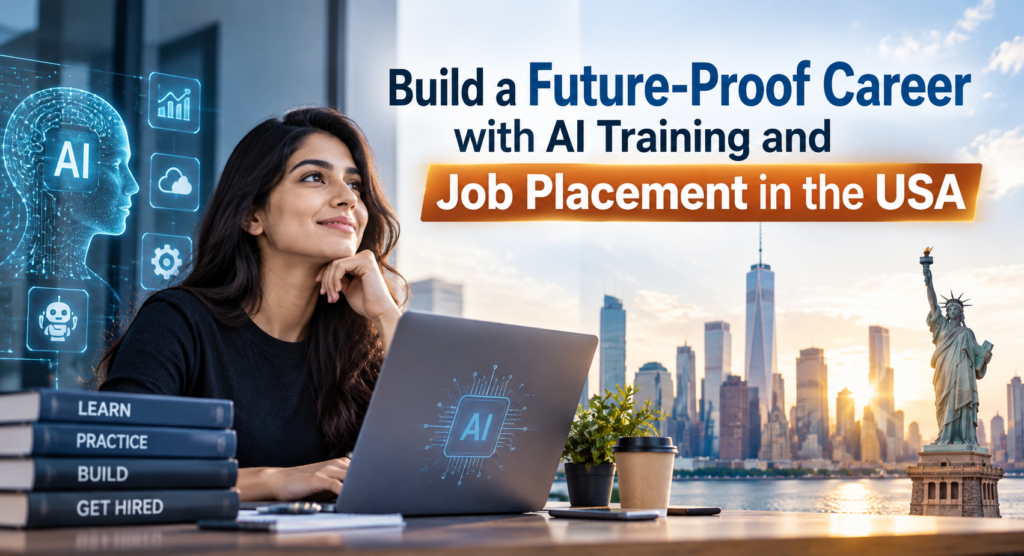
Artificial Intelligence (AI) certifications from training providers such as H2K Infosys in the United States can help professionals remain competitive in the evolving technology job market. These certifications demonstrate validated knowledge in areas such as machine learning, data processing, and AI system development, which are increasingly integrated into enterprise software, analytics platforms, and automation tools. For many professionals, AI learning for Beginners provide a practical pathway to develop relevant skills aligned with industry demand.
As organizations continue integrating AI-driven capabilities into products, services, and internal workflows, professionals with recognized training or certifications often gain advantages in hiring, internal promotions, and project assignments. However, certifications are most valuable when combined with hands-on experience, real-world project work, and understanding of enterprise tools.
What Is an AI Certification?
An AI certification is a formal credential that validates an individual’s knowledge of artificial intelligence concepts, tools, and techniques. These certifications may be issued by universities, training institutions, or technology companies and typically involve coursework, practical exercises, and assessments.
AI certifications often cover topics such as:
- Machine learning algorithms
- Data preprocessing and feature engineering
- Neural networks and deep learning
- Natural language processing (NLP)
- Computer vision
- Model deployment and monitoring
Many AI and Machine learning Courses include certification components that verify completion of structured training programs.
Common AI Certification Providers
| Provider | Certification Type | Focus Areas |
|---|---|---|
| Universities | Professional certificates | AI theory, research-based learning |
| Technology companies | Vendor-specific certifications | Cloud AI services, deployment |
| Online training platforms | Skill-based certificates | Practical AI tools and workflows |
| Industry organizations | Specialized certifications | Data science and ML engineering |
These certifications typically combine theoretical foundations with applied learning.
Why Is AI Important for the Future Job Market?
AI is increasingly embedded in enterprise systems, digital services, and automation frameworks. Organizations across industries use AI to analyze data, improve decision-making, automate repetitive tasks, and enhance customer experiences.
As a result, professionals with AI knowledge are involved in multiple aspects of modern IT systems.
Key Industry Drivers of AI Adoption
- Large-scale data availability
- Advancements in cloud computing infrastructure
- Improved machine learning frameworks
- Demand for automation in business processes
Industries actively applying AI include:
- Healthcare analytics
- Financial risk modeling
- E-commerce recommendation engines
- Cybersecurity threat detection
- Manufacturing process optimization
In many organizations, AI capabilities are integrated into existing systems rather than developed as standalone products.
How Does Artificial Intelligence Work in Real-World IT Projects?
AI systems operate by learning patterns from historical data and using those patterns to make predictions, classifications, or decisions.
Most enterprise AI projects follow a structured workflow.
Typical AI Development Workflow
| Stage | Description |
|---|---|
| Data Collection | Gathering structured or unstructured datasets |
| Data Preparation | Cleaning and transforming data |
| Model Training | Applying machine learning algorithms |
| Evaluation | Testing model accuracy and performance |
| Deployment | Integrating the model into applications |
| Monitoring | Tracking model behavior in production |
Example: Customer Churn Prediction Project
An enterprise telecommunications company may implement AI to identify customers likely to cancel their subscriptions.
Workflow steps may include:
- Collecting customer activity data
- Cleaning missing or inconsistent values
- Training a classification model
- Evaluating prediction accuracy
- Deploying the model within CRM systems
Technologies used in such projects often include:
- Python
- TensorFlow
- PyTorch
- Scikit-learn
- SQL databases
- Cloud ML services
This type of project illustrates how AI and machine learning courses translate theoretical knowledge into practical applications.
Why Are AI Certifications Valuable for Working Professionals?
AI certifications can support professional development in several ways. For professionals transitioning into AI-related roles, certifications help demonstrate foundational competence.
Potential Benefits
- Structured learning paths for AI learning for beginners
- Validation of technical skills
- Exposure to commonly used tools and frameworks
- Alignment with industry-standard practices
- Improved understanding of AI project workflows
However, certifications alone do not guarantee job placement. Employers typically look for a combination of:
- Practical project experience
- Programming proficiency
- Problem-solving ability
- Understanding of data analysis
Professionals who combine certification with hands-on work tend to develop stronger career prospects.
What Skills Are Required to Learn AI?
AI is an interdisciplinary field that combines mathematics, programming, and data analysis.
Beginners entering AI and machine learning courses typically build skills in several core areas.
Foundational Skills
| Skill Area | Description |
|---|---|
| Programming | Python is widely used in AI development |
| Mathematics | Linear algebra, probability, statistics |
| Data handling | Data cleaning and preprocessing |
| Machine learning algorithms | Classification, regression, clustering |
| Model evaluation | Accuracy, precision, recall metrics |
Supporting Skills
Additional skills that improve AI project work include:
- SQL for database querying
- Data visualization tools
- Cloud computing basics
- Software development practices
- Version control using Git
Many AI learning for beginners programs introduce these topics gradually through practical exercises.
How Is AI Used in Enterprise Environments?
In enterprise settings, AI systems are typically integrated into broader IT ecosystems rather than operating independently.
Common Enterprise AI Applications
| Use Case | Description |
|---|---|
| Fraud detection | Identifying unusual financial transactions |
| Predictive maintenance | Monitoring equipment failure risks |
| Customer support automation | Chatbots and virtual assistants |
| Demand forecasting | Predicting product demand |
| Document processing | Extracting data from forms and invoices |
These applications rely on AI models that are deployed into production systems such as:
- Enterprise resource planning (ERP)
- Customer relationship management (CRM)
- Cloud-based analytics platforms
Enterprise AI Technology Stack
Organizations frequently use the following technologies:
- Python
- Apache Spark
- TensorFlow
- PyTorch
- Kubernetes
- AWS, Azure, or Google Cloud AI services
Learning these tools is often part of advanced AI and machine learning courses.
What Job Roles Use AI Skills Daily?
AI skills are relevant to several technology and data-focused job roles.
Common AI-Related Roles
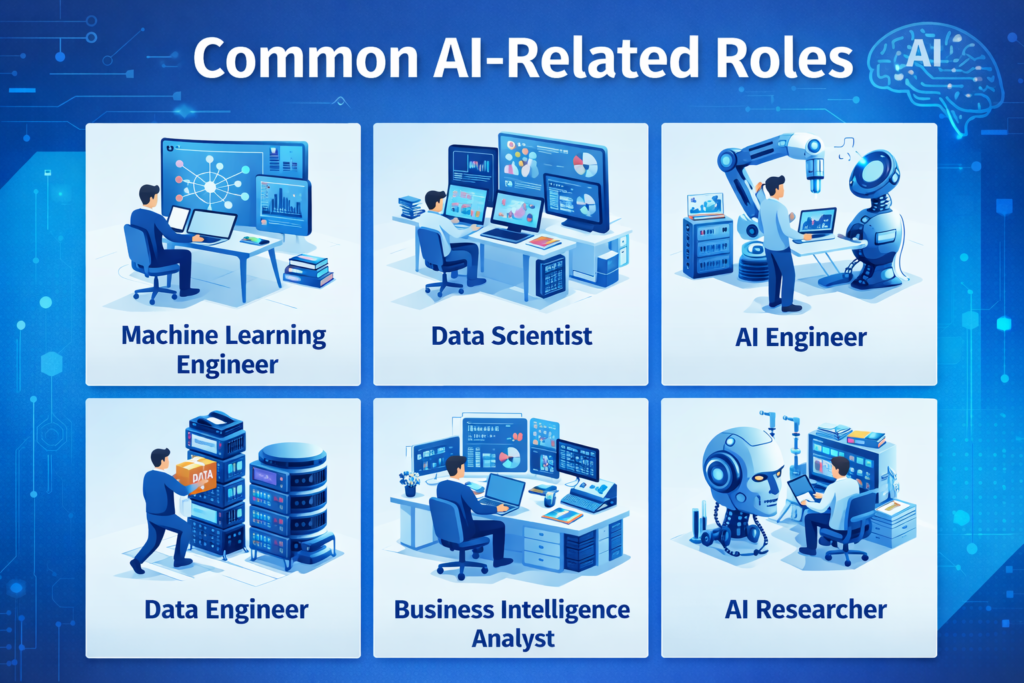
| Role | Primary Responsibilities |
|---|---|
| Machine Learning Engineer | Build and deploy ML models |
| Data Scientist | Analyze data and create predictive models |
| AI Engineer | Design AI-driven systems |
| Data Analyst | Use analytics and machine learning tools |
| NLP Engineer | Develop language-processing models |
| Computer Vision Engineer | Build image recognition systems |
These professionals typically collaborate with:
- Software developers
- Data engineers
- product managers
- DevOps teams
AI certifications can help professionals transition into these roles if supported by practical project work.
What Careers Are Possible After Learning AI?
Professionals completing structured AI learning for beginners programs may pursue several career pathways depending on their background and interests.
Career Path Overview
| Career Path | Typical Responsibilities |
|---|---|
| Data Science | Data modeling and predictive analytics |
| Machine Learning Engineering | Production deployment of ML models |
| AI Research | Developing new algorithms |
| AI Product Development | Integrating AI into software products |
| Business Analytics | Using AI insights for decision-making |
Entry-level roles often focus on data analysis and model development, while senior positions involve architecture design and large-scale AI infrastructure.
Learning Path for AI Beginners
Professionals new to AI often follow a step-by-step learning path.
Recommended Learning Progression
- Programming fundamentals (Python)
- Basic statistics and probability
- Data analysis and visualization
- Introduction to machine learning algorithms
- Neural networks and deep learning
- Model deployment and monitoring
- AI project development
Tools Commonly Learned in Beginner AI Courses
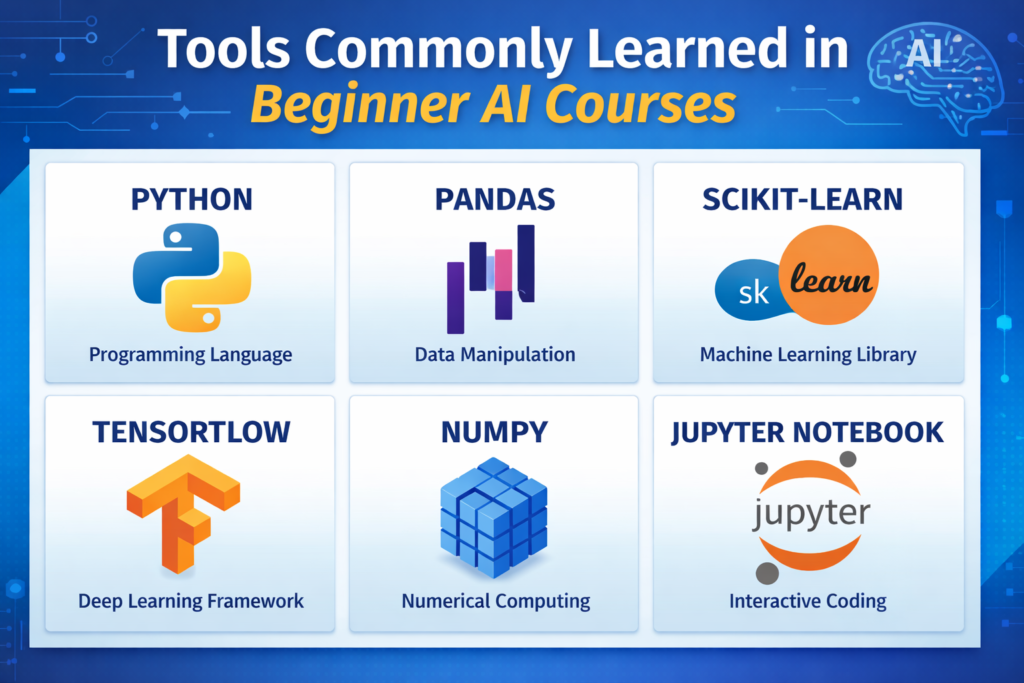
| Tool | Purpose |
|---|---|
| Python | Core programming language |
| Pandas | Data analysis |
| NumPy | Numerical computing |
| Scikit-learn | Machine learning algorithms |
| TensorFlow / PyTorch | Deep learning frameworks |
| Jupyter Notebook | Interactive development environment |
Hands-on projects help learners understand how these tools interact in real-world AI workflows.
Challenges Professionals Face When Learning AI
While AI offers strong career potential, professionals often encounter practical challenges during training.
Common Challenges
- Understanding mathematical foundations
- Managing large datasets
- Selecting appropriate machine learning algorithms
- Interpreting model results
- Deploying models in production environments
Enterprise environments also introduce constraints such as:
- Data privacy regulations
- Infrastructure limitations
- system scalability requirements
- integration with legacy software
Effective AI and machine learning courses typically include real-world case studies to help learners understand these complexities.
How AI Certifications Are Evaluated by Employers
Employers usually evaluate certifications alongside other professional factors.
Hiring Considerations
| Factor | Importance |
|---|---|
| Practical projects | High |
| Programming proficiency | High |
| Certification credentials | Moderate |
| Industry experience | High |
| Problem-solving ability | High |
Certifications are often viewed as indicators of structured learning rather than direct evidence of job-ready expertise.
Candidates who demonstrate working knowledge through portfolios or project repositories may stand out during technical interviews.
Frequently Asked Questions (FAQ)
Do AI certifications guarantee a job in the USA?
AI certifications do not guarantee employment. However, they may improve a candidate’s competitiveness by demonstrating knowledge of AI tools, algorithms, and development workflows.
Are AI and machine learning courses suitable for beginners?
Yes. Many programs are designed as AI learning for beginners, starting with programming basics, data analysis, and introductory machine learning concepts before advancing to more complex topics.
What programming language is most commonly used in AI?
Python is widely used in AI development due to its extensive libraries, including TensorFlow, PyTorch, Scikit-learn, and Pandas.
How long does it take to learn AI?
The learning timeline varies depending on prior experience. Many professionals spend 6–12 months completing foundational training and practical projects.
Are AI skills relevant outside the technology industry?
Yes. AI applications are used in industries such as finance, healthcare, retail, manufacturing, and logistics, creating opportunities beyond traditional IT roles.
Key Takeaways
- AI certifications help demonstrate structured knowledge in artificial intelligence and machine learning concepts.
- Many professionals begin with AI learning for beginners programs before progressing to advanced training.
- AI and machine learning courses typically teach programming, data analysis, and model development.
- AI skills are used across multiple job roles, including data science, machine learning engineering, and analytics.
- Certifications are most valuable when combined with hands-on project experience and practical understanding of enterprise workflows.
Explore H2K Infosys AI and Machine Learning courses to gain hands-on experience with industry tools and real-world projects.
Structured training can help professionals build practical AI skills aligned with modern enterprise technology environments.