If you’ve spent any time exploring AI Salesforce features lately, you’ve probably noticed one name coming up again and again: Einstein AI. And honestly, there’s a good reason for that. Salesforce didn’t just add artificial intelligence as a trendy feature they built it directly into the platform so that everyday business users can benefit from it without needing a data science background.
I remember talking to a Salesforce admin at a conference last year who described it perfectly: “It feels like the CRM suddenly got a brain.” That’s basically what Einstein AI does. It looks at patterns in your CRM data, predicts what might happen next, and even recommends actions.
But the real question people ask is what exactly it can do? What capabilities are companies utilizing in practice?
Let’s take a look at a few of them.
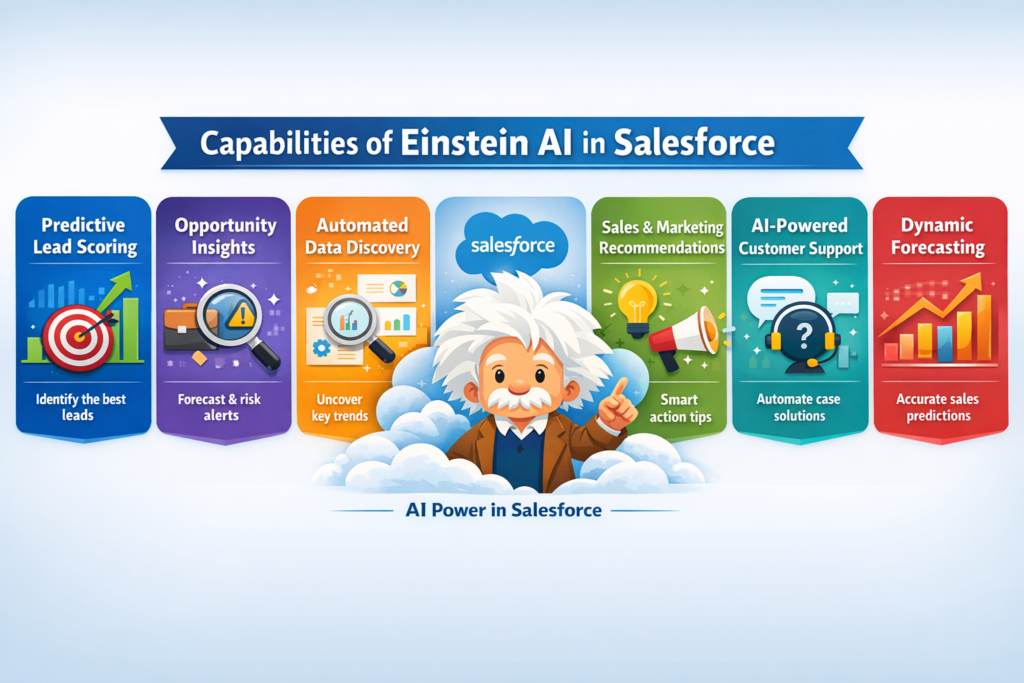
The Integration of AI into Salesforce
Prior to examining functionalities, it is useful to look at Salesforce and AI from a broader perspective.
For the past several decades, Salesforce has been amassing enormous amounts of customer data, including sales calls, emails, purchases, support tickets, marketing data, etc. The data is extremely valuable; the problem is that without some means of processing it, the data is just sitting.
This is the problem that Einstein AI aims to solve.
Instead of having to move data to other tools, Salesforce customers get analytics within Salesforce, courtesy of Einstein AI. It continuously analyzes records, user behavior, and trends in real time.
In practical terms, this means:
- Sales reps get lead recommendations.
- Marketers get smarter targeting suggestions.
- Customer support agents receive automated insights.
And interestingly, adoption has accelerated rapidly in the past two years. With the rise of generative AI tools and Salesforce’s newer AI layers, Einstein AI has evolved from a predictive analytics feature into a much broader intelligence platform.
Predictive Lead and Opportunity Scoring
One of the most widely used capabilities of Einstein AI is predictive scoring.
Sales teams constantly ask the same question:
Which leads are actually worth pursuing?
At numerous organizations, representatives continue to depend on instinct or rudimentary screening measures like job designation or the size of the company. However, Einstein AI takes into account previous sales and assesses which potential customers are the most likely to convert.
This is how it functions, implemented in practice:
- It analyzes previous deals that have been closed.
- It identifies patterns among successful leads.
- It assigns scores to new leads based on those patterns.
For example, imagine a software company that typically closes deals with mid-size healthcare organizations. Einstein AI might detect that companies in that sector with 200–500 employees tend to convert faster.
When a similar lead appears in Salesforce, the system highlights it automatically.
This kind of predictive insight is one of the reasons people interested in Salesforce classes often start exploring AI capabilities early in their learning journey.
Intelligent Opportunity Insights
Sales forecasting has always been tricky. Ask any sales manager and they’ll tell you the same story: forecasts often depend on optimistic guesses.
But Einstein AI helps reduce that guesswork.
By analyzing deal history, email communication patterns, and pipeline activity, Einstein AI can flag risks in ongoing opportunities.
Some of the insights it provides include:
- Deals that are likely to close
- Opportunities at risk of slipping
- Deals that need attention from sales leadership
- Missing key contacts in an opportunity
A rep might log in on Monday morning and see a notification like:
“This opportunity has a 30% lower chance of closing compared to similar deals.”
That’s incredibly valuable. It allows teams to intervene earlier instead of realizing problems at the end of the quarter.
Automated Data Discovery
Here’s something people outside the Salesforce ecosystem often underestimate: data discovery is hard.
Organizations often have millions of CRM records. Manually finding trends inside that data can take weeks.
Einstein AI automates that process.
Instead of waiting for analysts to run reports, the system constantly scans the database looking for patterns. When it discovers something interesting, it surfaces the insight directly inside dashboards.
For example:
- A sudden increase in customer churn from a certain region
- A product feature driving higher sales
- A marketing campaign producing unusually strong conversions
This ability to surface insights automatically is one of the reasons many companies investing in Salesforce training courses are now including AI-focused modules.
AI-Powered Sales Recommendations
One of my favorite capabilities of Einstein AI is its recommendation engine.
Think of it like a smart assistant that watches how successful deals progress and then suggests next steps.
Let’s say a rep is working on a deal in the pipeline. Einstein AI might suggest actions like:
- Schedule a follow-up meeting
- Send product documentation
- Introduce a technical specialist
- Engage an executive sponsor
These recommendations are based on patterns found in past deals.
It’s not replacing the salesperson it’s simply guiding them.
And honestly, for new reps, this kind of guidance can be a huge confidence boost.
AI for Marketing Personalization
Marketing is another area where Einstein AI has become incredibly useful.
Today’s customers expect personalized experiences. Generic email blasts just don’t perform well anymore.
Einstein AI helps marketing teams deliver more targeted campaigns by analyzing customer behavior across multiple channels.
It can identify things like:
- The best time to send marketing emails
- Which customers are likely to unsubscribe
- Which audience segments are most engaged
- Content that performs best with certain demographics
For instance, a retail company using Marketing Cloud might see Einstein AI automatically adjust campaign targeting based on engagement data.
That level of personalization used to require dedicated data science teams.
Now it’s built directly into the CRM.
AI-Driven Customer Service Automation
Customer support is another area where Einstein AI shines.
Support agents deal with high ticket volumes and repetitive questions every day. AI can dramatically reduce that workload.
Here are some examples of what Einstein AI enables:
- Automatic case classification
- Suggested replies for support agents
- Knowledge article recommendations
- Chatbot-powered customer interactions
A support agent might open a case and immediately see suggested solutions based on similar issues in the past.
The system essentially acts like a knowledge assistant.
And from what I’ve seen working with CRM teams, this feature alone can reduce resolution time significantly.
Natural Language Insights and Analytics
Data dashboards are useful, but they can also be intimidating for non-technical users.
This is where Einstein AI introduces something surprisingly powerful natural language insights.
Instead of digging through complex reports, users can ask questions in plain language.
For example:
- “Which region had the highest revenue growth this quarter?”
- “Why did conversions drop last month?”
Einstein AI analyzes the data and provides explanations.
This kind of accessibility has been a big reason why organizations investing in a Salesforce course are encouraging employees across departments not just technical teams to understand AI capabilities.
AI-Powered Forecasting
Sales forecasting is one of the most mission-critical tasks for any business.
And historically, forecasts have been. Well, inconsistent.
Sales leaders rely on spreadsheets, rep estimates, and pipeline reports that can change quickly.
Einstein AI improves forecasting by analyzing historical performance, pipeline changes, deal velocity, and market trends.
It then produces predictive forecasts that are far more data-driven.
Customers appreciate that some companies merge these forecasts with human heuristics. Sales executives modify these forecasts from an AI baseline prediction to incorporate their contextual insights.
It is the human experience that balances the real world with science.
Automation of Workflows and Intelligent Actions
The strengthened dimension of Einstein AI is its ability to merge with the automation functionalities of Salesforce.
Organizations can define intelligent processes to act automatically to shifts in data, working in conjunction with automation rules, flows, and AI data.
An example is:
- When the score of a lead is above a set target, he is assigned to a sales rep of a higher tier.
- When a customer is predicted to disengage, a retention campaign is initiated.
- When the volume of support tickets increases, management is alerted automatically.
These kinds of intelligent automations are becoming standard topics in Salesforce admin training because admins are now responsible for managing both automation and AI-driven insights.
AI for Email and Communication Analysis
Communication analysis is another fascinating capability.
Einstein AI can scan email interactions between sales teams and prospects to identify engagement signals.
It might detect things like:
- Lack of response from a prospect
- Increased email activity from decision makers
- Sentiment changes in communication
If a prospect suddenly stops responding, the system might flag the opportunity as at risk.
It’s subtle, but incredibly useful.
Sales reps often miss these signals because they’re juggling dozens of conversations at once.
AI-Powered Data Entry and Activity Capture
One of the least glamorous but most helpful features of Einstein AI is automatic activity capture.
Manual data entry is one of the biggest complaints Salesforce users have.
Time is spent logging emails, meetings and calls.
Einstein AI for Salesforce automatically captures activity from email and calendar systems, associating the data with the appropriate record.
This means:
- Less manual data entry
- More accurate CRM data
- Better visibility for managers
And the bonus is that better data makes better AI predictions.
AI-Powered Customer Insights
A further mind-blowing feature of Einstein AI is how it can recognize customer behavioral patterns.
It can analyze:
- Purchase history
- Customer engagement
- Support interactions
- Website activity
As a result, the system can forecast situations such as:
Which customers might churn
Who are the most likely customers that will upgrade
Which accounts have expansion potential
Beyond these transactional insights, companies also use this information for proactive outreach.
This can, for instance, help a manager to get involved with the client account if a high-value customer account is showing signs of bad engagement before it goes downhill.
The Reason Salesforce Professionals Must Start Learning AI
If you’re considering entering Salesforce classes online now, knowing about AI capabilities is more important than ever.
As recently as a few years ago, AI features were viewed as advanced tools.
Now they’re quickly becoming standard.
Indeed, entire modules focusing on AI-driven CRM strategies are being added to Salesforce training courses.
What I have seen be most successful for Salesforce professionals today is the combination of skill set that understands both the technical capabilities of the platform and the strategic value behind AI.
With the increasing demand for automation and predictive analytics, professionals with knowledge of AI Salesforce functionality are in more demand than ever.
Real-World Example: Retail Personalization
So, let me give you a quick example from the real world.
Salesforce with AI capabilities for Marketing Personalization in a mid-sized e-commerce company.
Before AI, they blasted the same email promos to all.
Once relying on Einstein AI, the system began to analyze:
- browsing patterns
- purchase history
- engagement with previous campaigns
Within months, the platform was automatically recommending specific categories of products for individual customers.
The result?
Conversion rates from email increased by almost 30%.
That’s the kind of quantifiable impact that gets organizations to spend significant money on Salesforce and AI integration.
Where AI is heading within Salesforce
Without a doubt, the future of CRM is powered by AI.
Salesforce’s new tools, automation features and generative capabilities continue its growth around an AI ecosystem.
And if these industry trends continue the way they seem to be, then Einstein AI will likely only become more embedded into everyday workflows.
Rather than a separate feature, it’s becoming the intelligence layer throughout the entire Salesforce platform.
Sales, marketing, service, analytics, everything is leaning more and more on AI insights.
For professionals entering the ecosystem via Salesforce admin training, the importance of knowing how these tools function will be as vital as learning reports, dashboards and automation.”
Final Thoughts
At its heart, Einstein AI emboldens Salesforce beyond being a traditional CRM database into an intelligent decision-making platform.
It anticipates outcomes, suggests actions, automates workflows and detects patterns that lie buried in Petabytes of client data;
For organizations, that translates into better sales performance and smart marketing as well as more responsive customer support.
For people building careers in the ecosystem, it’s a different story. Knowledge of AI is rapidly becoming an essential skill.
And honestly, if you’re planning to take a Salesforce course or advance through Salesforce training courses, understanding how AI works inside the platform will put you miles ahead of the average admin or consultant.