Artificial intelligence and machine learning training programs in the United States are offered by universities, technology institutes, and professional training platforms such as H2K Infosys. These programs focus on practical skills such as data modeling, neural networks, AI deployment, and machine learning workflows used in modern enterprise environments. Many professionals pursue Artificial Intelligence Engineer Courses through online institutes that combine theoretical foundations with real world project experience.
Online AI training programs are designed to support working professionals who want to transition into roles such as machine learning engineer, AI engineer, or data scientist while continuing their current employment.
What Is Artificial Intelligence Training?
Artificial intelligence training refers to structured educational programs that teach the principles, tools, and practical implementation of AI systems. These programs typically include:
- Machine learning algorithms
- Data processing techniques
- Neural networks and deep learning
- Model training and evaluation
- AI deployment in production environments
AI training is often delivered through online instructor-led courses, self-paced modules, and project-based learning environments.
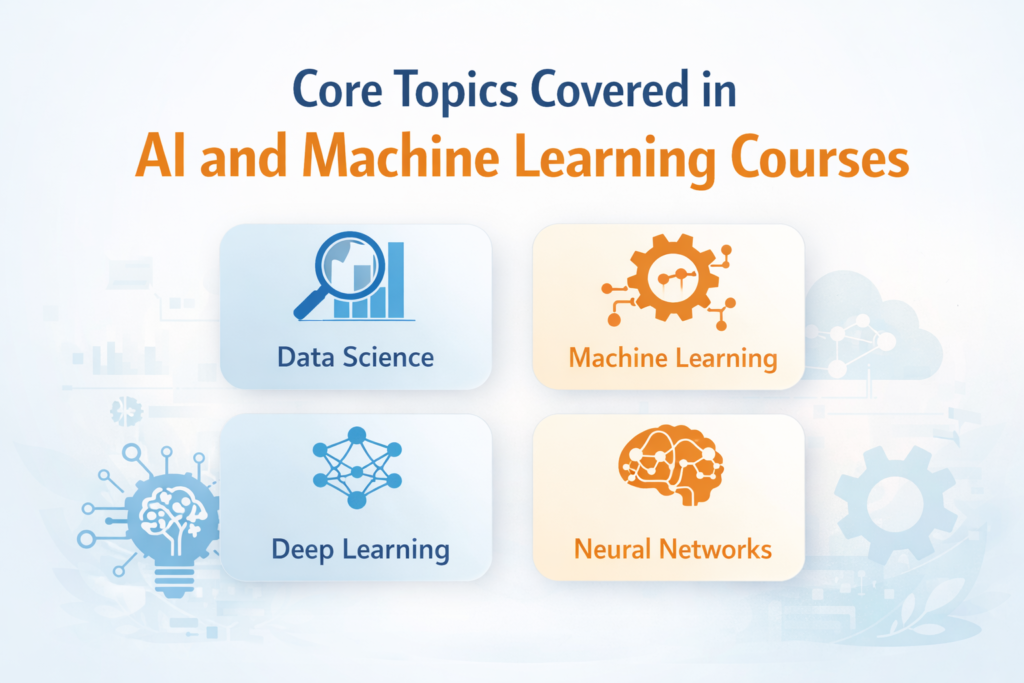
Core Topics Covered in AI and Machine Learning Courses
| Topic | Description |
|---|---|
| Machine Learning | Algorithms that allow systems to learn from data |
| Deep Learning | Neural networks for complex pattern recognition |
| Natural Language Processing | AI systems that understand human language |
| Computer Vision | Image recognition and visual analysis |
| Model Deployment | Integrating trained models into production systems |
| Data Engineering | Data preparation pipelines for AI systems |
These subjects form the technical foundation required for an artificial intelligence engineer course.
Why Is AI and Machine Learning Training Important for Working Professionals?
Artificial intelligence has become a core technology in modern enterprise systems. Organizations across industries use AI models to automate decisions, analyze data, and improve operational efficiency.
Working professionals pursue AI and machine learning courses for several reasons:
Career Transition Opportunities
Many professionals in fields such as:
- Software development
- Data analysis
- IT infrastructure
- Business intelligence
move into AI-related roles after completing structured training programs.
Enterprise Demand for AI Skills
Organizations implement AI in areas such as:
- Predictive analytics
- fraud detection
- recommendation systems
- customer behavior modeling
- intelligent automation
AI engineers help design, train, and deploy these systems.
Integration with Existing Technologies
AI solutions often work alongside technologies such as:
- cloud computing platforms
- big data frameworks
- enterprise data warehouses
- microservices architectures
Understanding these integrations is a key learning outcome in most artificial intelligence engineer courses.
How Does Artificial Intelligence Work in Real-World IT Projects?
In enterprise environments, artificial intelligence systems follow a structured workflow that transforms raw data into predictive models and automated decisions.
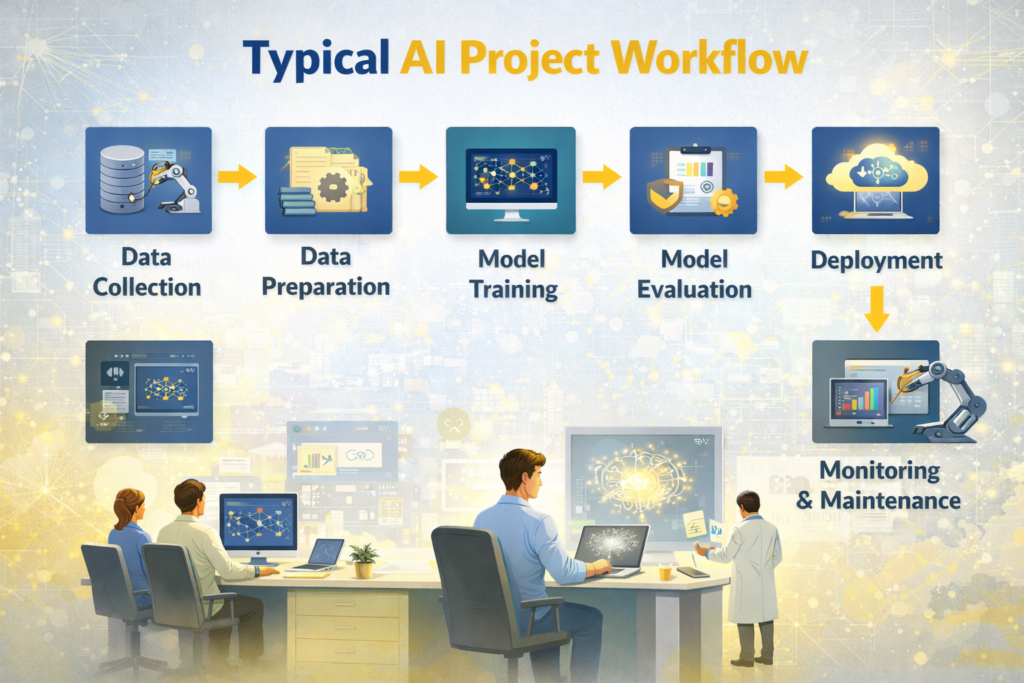
Typical AI Project Workflow
| Stage | Description |
|---|---|
| Data Collection | Gathering structured and unstructured datasets |
| Data Cleaning | Removing inconsistencies and preparing data |
| Feature Engineering | Selecting relevant input variables |
| Model Training | Applying machine learning algorithms |
| Model Evaluation | Testing model accuracy and reliability |
| Deployment | Integrating the model into applications |
| Monitoring | Tracking model performance over time |
Example Enterprise Scenario
A financial institution may implement AI to detect fraudulent transactions.
Workflow steps include:
- Collect transaction data from banking systems
- Clean and normalize data
- Train classification models using historical fraud cases
- Deploy the model in a real-time transaction monitoring system
- Trigger alerts when suspicious activity is detected
This type of project is commonly included as a hands-on assignment in AI and machine learning courses.
What Skills Are Required to Learn an Artificial Intelligence Engineer Course?
AI training programs combine mathematical concepts, programming skills, and data engineering techniques.
Technical Skills Required
| Skill Area | Examples |
|---|---|
| Programming | Python, R |
| Data Analysis | Pandas, NumPy |
| Machine Learning Libraries | Scikit-learn, TensorFlow |
| Deep Learning | PyTorch |
| Data Visualization | Matplotlib, Seaborn |
| Cloud Platforms | AWS, Azure, Google Cloud |
Supporting Knowledge Areas
Professionals studying AI typically develop knowledge in:
- statistics and probability
- linear algebra
- optimization techniques
- software engineering practices
- version control systems
Many AI and machine learning courses include beginner modules that cover these prerequisites.
How Is Artificial Intelligence Used in Enterprise Environments?
Artificial intelligence solutions are commonly integrated into enterprise software systems to support data-driven decision making.
Common Enterprise Applications
| Industry | AI Use Case |
|---|---|
| Finance | Fraud detection, credit risk modeling |
| Healthcare | Medical image analysis |
| Retail | Product recommendation systems |
| Manufacturing | Predictive maintenance |
| Telecommunications | Network optimization |
| Cybersecurity | Threat detection |
AI in Production Systems
Enterprise AI implementations typically involve:
- data pipelines
- scalable computing infrastructure
- model versioning systems
- API-based deployment
- monitoring dashboards
Training programs often simulate these environments to help learners understand how AI systems operate in real production settings.
Which Are the Online Institutes for AI and Machine Learning Training in the USA?
Several institutes and universities offer structured AI and Machine learning Courses for working professionals. These programs vary in duration, format, and technical depth.
Each program emphasizes different learning objectives. Some focus on academic theory, while others prioritize practical enterprise applications.
What Tools Are Commonly Used in AI and Machine Learning Courses?
AI training programs introduce learners to widely used tools that support data processing, model development, and deployment.
Core AI Development Tools
| Tool | Purpose |
|---|---|
| Python | Primary programming language for AI development |
| TensorFlow | Deep learning framework |
| PyTorch | Neural network development |
| Scikit-learn | Machine learning algorithms |
| Jupyter Notebook | Interactive data analysis environment |
| Apache Spark | Distributed data processing |
Cloud Platforms for AI Deployment
Many enterprise AI systems run on cloud infrastructure.
| Platform | AI Services |
|---|---|
| AWS | SageMaker |
| Microsoft Azure | Azure Machine Learning |
| Google Cloud | Vertex AI |
These platforms allow engineers to train and deploy models at scale.
What Job Roles Use Artificial Intelligence Skills Daily?
Professionals with AI training work in several technical roles across data-driven organizations.
Common AI-Related Job Roles
| Role | Responsibilities |
|---|---|
| Machine Learning Engineer | Develop and deploy ML models |
| AI Engineer | Design intelligent systems |
| Data Scientist | Analyze complex datasets |
| NLP Engineer | Build language processing models |
| Computer Vision Engineer | Develop image recognition systems |
| AI Research Engineer | Develop new algorithms |
Many professionals transition into these roles after completing an artificial intelligence engineer course.
What Careers Are Possible After Learning AI and Machine Learning?
AI skills open career opportunities in technology companies, consulting firms, and enterprise IT teams.
Career Path Progression
| Entry Level | Mid-Level | Advanced |
|---|---|---|
| Data Analyst | Machine Learning Engineer | AI Architect |
| Junior Data Scientist | AI Engineer | AI Research Scientist |
| Business Intelligence Analyst | NLP Engineer | Director of AI Engineering |
Career progression often depends on:
- project experience
- advanced algorithm knowledge
- system architecture expertise
What Should Professionals Look for in AI and Machine Learning Courses?
Choosing the right training program requires evaluating several factors related to curriculum quality and practical exposure.
Important Course Features
Professionals often look for:
- instructor-led training
- real-world AI projects
- hands-on coding assignments
- industry-relevant tools
- cloud deployment training
Learning Format Considerations
| Format | Advantages |
|---|---|
| Self-paced | Flexible schedule |
| Instructor-led | Structured guidance |
| Hybrid | Combines flexibility and mentorship |
Programs that include real-world enterprise projects often provide stronger practical experience.
Frequently Asked Questions (FAQ)
What is an artificial intelligence engineer course?
An artificial intelligence engineer course is a structured training program that teaches how to build, train, and deploy AI models using machine learning and deep learning frameworks.
Are AI and machine learning courses suitable for beginners?
Many programs offer beginner-friendly modules that cover Python programming, statistics, and machine learning fundamentals before moving into advanced topics.
How long does it take to learn AI and machine learning?
Learning timelines vary depending on the program format. Professional certificate programs typically take 3 to 9 months of structured learning.
Do AI engineers need programming skills?
Yes. Most AI development involves programming in languages such as Python and using machine learning libraries for model development.
Can working professionals learn AI through online training?
Online training programs are specifically designed for working professionals, allowing them to learn through evening classes, weekend sessions, or self-paced modules.
What industries hire AI engineers?
AI engineers work in industries such as:
- finance
- healthcare
- retail
- technology
- manufacturing
- cybersecurity
These sectors use AI systems to analyze large datasets and automate decision processes.
Key Takeaways
- Artificial intelligence training programs teach machine learning algorithms, data engineering, and model deployment.
- AI systems are widely used in industries such as finance, healthcare, and retail.
- Many professionals pursue artificial intelligence engineer courses to transition into AI-related careers.
- Online institutes offer flexible learning formats designed for working professionals.
- Hands-on projects and real-world AI workflows are essential components of effective AI and machine learning courses.
Explore AI and machine learning courses at H2K Infosys to gain hands-on experience with real-world projects and enterprise AI tools.
Structured training programs can help professionals build practical AI engineering skills for modern technology roles.