In most cases transition into an AI career starts with practical AI Online Training, followed by building real projects, completing an AI Certification Course, and if possible joining a program that offers AI Training with Job Placement. You don’t necessarily need a computer science degree anymore. What you do need is a structured way to learn and some proof that you can actually apply AI to real problems.
Let’s unpack that a bit, because the transition usually looks different from what people expect.
Why So Many Professionals Are Moving Toward AI
If you pay attention to what’s happening in workplaces lately, AI is showing up almost everywhere. Not just in tech companies either.
Marketing teams use AI tools to generate campaigns. Hospitals rely on machine learning models to help interpret scans. Finance departments are experimenting with AI-driven forecasting tools. Even small businesses are starting to automate parts of their workflow.
So naturally, professionals from completely different backgrounds are starting to wonder: Could I move into this field too?
The interesting part is that many companies actually want people who already understand an industry. Someone who has spent years in logistics, healthcare, or retail often brings insights that pure technical specialists might not have.
Think about it this way.
A supply chain manager who learns machine learning can build demand forecasting systems that actually make sense for real operations. That combination industry knowledge plus AI skills is becoming surprisingly valuable.
Step 1: Figure Out Which AI career Role Fits Your Background
One mistake people make early on is assuming AI is one single job.
It’s not.
There are dozens of roles that sit under the AI umbrella, and some are far more accessible for career switchers.
A few common ones include:
AI / Machine Learning Engineer
These professionals build models that learn from data.
AI Data Analyst
They focus on analyzing datasets using AI tools to uncover patterns and insights.
AI Product Manager
Someone who guides the development of AI-powered products and makes sure they actually solve business problems.
Prompt Engineer or AI Workflow Specialist
A newer role that involves designing workflows using generative AI tools and large language models.
For someone switching careers, the goal isn’t to master every part of AI. That would be overwhelming. The trick is finding where your current experience overlaps with AI.
For example:
- A marketer might transition into AI-powered marketing automation
- Someone in finance could work on AI-driven risk analysis
- A software developer might move toward machine learning engineering
Those overlaps make the learning curve a lot less steep.
Step 2: Start With Structured AI Online Training
A lot of people try the DIY approach first random tutorials, scattered articles, a few YouTube videos late at night. And while that can work, it often turns into a confusing maze.
One video explains neural networks. Another jumps straight into coding a complex model. Somewhere in between, you realize there are five prerequisites nobody mentioned.
That’s why structured AI Online Training can be helpful. It provides a clear path instead of scattered learning.
Most well-designed programs cover things like:
- Python programming for AI
- machine learning basics
- neural networks and deep learning
- generative AI tools
- hands-on projects using real datasets
The project part matters more than people realize. Reading about AI is one thing. Actually building something even a simple model is where the concepts start to click.
Step 3: Get an AI Certification Course (But Don’t Rely on It Alone)
Certifications can help, but they’re not magic.
An AI Certification Course is useful because it shows you’ve gone through structured training. It signals effort and foundational knowledge.
But hiring managers rarely stop there.
What they really want to see is how you applied what you learned.
So instead of just listing a certification on your resume, it’s better to pair it with projects such as:
- a chatbot built with generative AI
- a machine learning model predicting customer churn
- a recommendation system for products
- an AI-powered data dashboard
Projects tell a much stronger story than certificates alone.
Step 4: Build a Small Portfolio of Real Projects
This is where things get interesting and where many career changers either gain momentum or lose it.
Projects transform theory into proof.
You don’t need to build something huge. Simple projects work perfectly fine as long as they demonstrate your thinking process.
Some beginner-friendly ideas:
- predicting housing prices using machine learning
- sentiment analysis on customer reviews
- building a basic AI chatbot
- creating a model that categorizes resumes
Lately, there’s also been a lot of buzz around AI copilots and AI agents. Companies are exploring ways to automate repetitive tasks using these systems. Building even a small automation project in this space can stand out in a portfolio.
And honestly, projects make learning more fun. Instead of memorizing concepts, you’re solving real problems.
Step 5: Look for AI Training with Job Placement Support
Switching careers can feel a little intimidating especially when you’re not sure how to break into the industry.
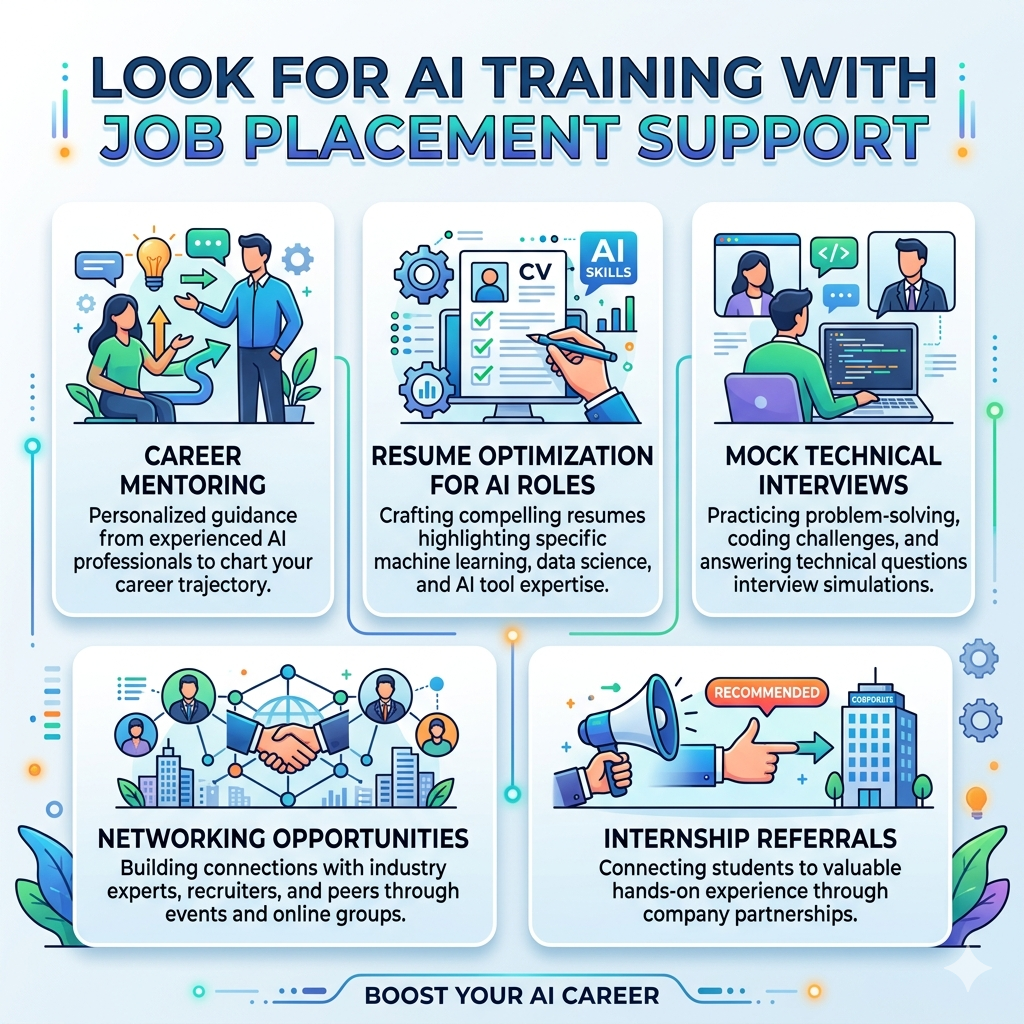
Programs that offer AI Training with Job Placement can make that transition smoother.
Many of them include things like:
- career mentoring
- resume optimization for AI roles
- mock technical interviews
- networking opportunities
- internship referrals
I’ve seen people land their first AI role this way not because they suddenly became world-class experts, but because they had guidance and structured support.
Sometimes the biggest barrier isn’t learning AI. It’s figuring out how to enter the industry.
Step 6: Use Your Previous Career as a Strength
There’s a strange myth floating around that switching to AI means abandoning everything you’ve done before.
That’s rarely true.
In fact, many companies actively look for professionals who combine domain knowledge with AI skills.
Healthcare companies want people who understand medical workflows.
Financial institutions want people who understand risk models and markets.
Retail companies want people who understand customer behavior.
Industry analysts have started calling this group “applied AI professionals.” These are people who bridge the gap between technical AI systems and real-world business problems.
Career switchers often fall right into that category.
Step 7: Start Connecting With the AI Community
One thing you’ll notice quickly: the AI community is extremely active.
New tools, open-source models, and research papers appear almost every week. It’s a fast-moving space.
Getting involved even casually can help a lot.
Places where people often start:
- LinkedIn AI communities
- Discord groups focused on AI development
- open-source AI projects on GitHub
- local tech meetups or hackathons
Some job opportunities actually come from these communities rather than traditional job applications.
And to be honest, AI developers usually enjoy sharing ideas and discussing projects. It’s a collaborative space.
So… How Long Does the Transition Take?
It varies quite a bit.
Someone with a programming background might move faster. Someone starting from a non-technical role may take a little longer.
A rough timeline often looks like this:
- 3–6 months: learning fundamentals through AI Online Training
- 6–12 months: building projects and completing an AI Certification Course
- 9–15 months: preparing for entry-level AI roles or AI-adjacent jobs
It’s not a race, though. Many professionals gradually move into AI by integrating it into their existing job responsibilities.
A Final Thought
Moving into AI from another field isn’t some impossible leap anymore. With accessible AI Online Training, a solid AI Certification Course, hands-on projects, and programs that offer AI Training with Job Placement, the path is much clearer than it used to be.
And here’s the part people often overlook: you’re not starting from scratch.
You’re bringing your previous experience with you then layering AI skills on top of it. That mix is exactly what many companies are searching for right now.