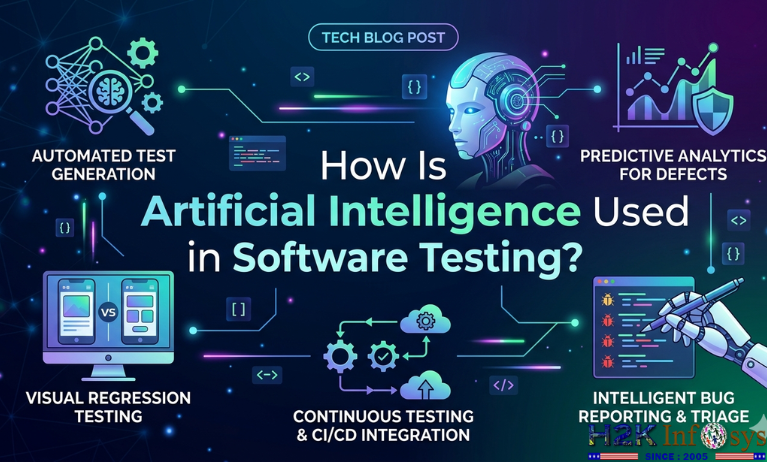
Software testing has always been a critical part of delivering reliable digital products. As applications become more complex, release cycles get shorter, and customer expectations rise, traditional testing methods alone often struggle to keep pace. This is where artificial intelligence is making a real difference.
Artificial intelligence, or AI, is transforming software testing by helping teams work faster, test smarter, and improve product quality. Rather than replacing testers, AI strengthens the testing process by automating repetitive work, identifying patterns, predicting risks, and supporting better decisions across the software development lifecycle.
In simple terms, AI in software testing means using machine learning, natural language processing, predictive analytics, and intelligent automation to improve how testing is planned, created, executed, and maintained. It allows QA teams to move beyond manual effort and static scripts toward more adaptive and efficient testing practices.
The Growing Need for AI in Software Testing
Modern software testing development moves quickly. Agile, DevOps, and continuous delivery models demand frequent updates and faster releases. At the same time, applications now run across browsers, devices, operating systems, APIs, and cloud environments. This creates a huge testing burden.
Traditional testing approaches often face a few common challenges. Test cases can become outdated. Test automation scripts break when the user interface changes. Regression suites grow too large to run efficiently. Manual testing consumes significant time and effort. Defects may still escape into production despite all of this work.
AI helps solve these problems by bringing intelligence into the testing process. Instead of relying only on predefined rules, AI systems can learn from historical data, user behavior, code changes, and test results. This makes testing more dynamic, targeted, and scalable.
How AI Is Used in Software Testing
AI is used in software testing in several practical ways. Some applications are already widely adopted, while others are still evolving. Together, they are reshaping the quality assurance landscape.
1. Intelligent Test Case Generation
One of the most valuable uses of AI is generating test cases automatically. Creating good test cases manually takes time, especially for large applications with many workflows. AI tools can analyze requirements, user stories, application behavior, and past defects to suggest or generate relevant test scenarios.
For example, if a system receives a requirement for a login feature, an AI-based testing tool can generate positive and negative test cases such as valid login, invalid password, missing username, locked account, and session timeout. It can also recommend edge cases that human testers may overlook.
This improves test coverage while reducing the time spent writing cases from scratch.
2. Self-Healing Test Automation
One of the biggest frustrations in test automation is script maintenance. Automated UI tests often fail when element locators change, labels are updated, or page layouts shift slightly. Even minor UI changes can break dozens of tests.
AI addresses this with self-healing automation. Instead of failing immediately when an element changes, AI-enabled tools identify similar elements based on attributes, position, behavior, or visual structure. The test can then adjust automatically and continue running.
This reduces maintenance overhead and makes automation more stable, especially in fast-moving development environments.
3. Smarter Regression Testing
Regression testing ensures that new changes do not break existing functionality. However, running the full regression suite for every release is often expensive and slow.
AI can prioritize regression tests by analyzing code changes, defect history, business-critical functions, and previous test execution results. It predicts which areas are most likely to be affected and recommends the most relevant tests to run first.
This risk-based approach helps teams detect important issues earlier, reduce unnecessary test execution, and shorten release cycles.
4. Defect Prediction and Risk Analysis
AI can analyze historical project data to predict where defects are most likely to appear. It looks at patterns such as code churn, module complexity, developer activity, previous bug density, and failed builds.
If the system identifies a component as high risk, testers can focus more effort on that area. This allows teams to allocate time and resources more effectively instead of treating all parts of the application equally.
Defect prediction does not guarantee that bugs will be found, but it improves the testing strategy by highlighting likely trouble spots before issues become serious.
5. Visual Testing and UI Validation
Modern applications rely heavily on user experience, layout consistency, and responsive design. Traditional automation can verify whether a button exists or a page loads, but it may miss visual defects such as overlapping text, broken alignment, missing images, or incorrect colors.
AI-powered visual testing tools compare screens intelligently rather than pixel by pixel. They can distinguish between acceptable layout variations and actual UI problems. This makes it easier to detect visual bugs across devices, browsers, and screen sizes.
For customer-facing applications, this kind of testing is especially valuable because visual errors can harm user trust even when core functionality still works.
6. Natural Language Processing for Test Design
Natural language processing, or NLP, is another area where AI adds value. Many project requirements are written in plain language rather than technical formats. AI tools can read these requirements, interpret intent, and convert them into structured test cases or automation steps.
This helps bridge the gap between business teams, developers, and testers. Instead of manually translating every requirement into a technical test plan, QA teams can use AI to speed up the process and reduce misunderstandings.
It also makes test creation more accessible for non-technical stakeholders who want to contribute to quality planning.
7. API Testing and Service Validation
Applications today depend heavily on APIs and microservices. Testing these systems requires validating data exchange, response times, error handling, and integration logic.
AI can improve API testing by identifying common usage patterns, detecting anomalies in responses, and recommending test scenarios based on historical traffic or functional dependencies. It can also help monitor production behavior and use that data to strengthen future test coverage.
This is particularly useful in distributed systems, where issues may not be obvious from the user interface alone.
8. Test Data Management
Good testing depends on good data. But preparing meaningful test data is often difficult, especially when applications handle sensitive information or complex workflows.
AI can generate realistic, diverse, and relevant test data based on usage patterns and expected scenarios. It can also classify data, anonymize sensitive information, and identify gaps in current datasets.
This helps teams perform better functional, performance, and security testing while staying compliant with privacy requirements.
9. Root Cause Analysis
When a test fails, the next challenge is understanding why. Was it a real defect, an environment issue, unstable data, or a broken script? In large test suites, sorting through logs and error reports can be time-consuming.
AI can speed up root cause analysis by clustering similar failures, examining logs, comparing patterns with past incidents, and suggesting the most likely cause. Instead of spending hours investigating repetitive failures, teams can focus faster on the real problem.
This increases efficiency and reduces delays in debugging and issue resolution.
Benefits of AI in Software Testing
The use of AI in software testing offers several important benefits.
First, it increases speed. AI can automate complex and repetitive tasks much faster than manual processes. This supports rapid development and continuous delivery.
Second, it improves accuracy. By analyzing large amounts of data, AI can identify risks, inconsistencies, and hidden patterns that may be missed by human observation alone.
Third, it reduces maintenance. Self-healing scripts and intelligent automation decrease the effort required to keep test suites current.
Fourth, it strengthens test coverage. AI can suggest edge cases, prioritize critical scenarios, and adapt testing based on changes in the application.
Fifth, it supports better decision-making. Predictive analytics and risk analysis help teams focus on what matters most instead of wasting time on low-value activity.
Limitations and Challenges
Although AI is powerful, it is not a magic solution. It also comes with challenges.
AI tools depend on good data. If the available data is incomplete, poor quality, or biased, the results may be unreliable. Setting up AI-based testing can also require investment in tools, training, and process changes.
Another limitation is that AI does not replace human judgment. Exploratory testing, usability evaluation, business context, and ethical reasoning still require skilled testers. AI can assist, but it cannot fully understand every product goal or customer expectation.
There is also the challenge of trust. Teams need transparency into how AI makes recommendations. If testers do not understand why a tool prioritized certain cases or flagged a risk, adoption can become difficult.
For these reasons, the best approach is usually a balanced one where AI supports human testers rather than replacing them.
The Future of AI in Software Testing
The future of Software testing is likely to be increasingly intelligent, automated, and data-driven. AI will continue to improve in areas such as autonomous test generation, adaptive regression testing, predictive quality monitoring, and continuous analysis of production behavior.
As tools evolve, software testing will shift from being a mostly reactive activity to a more proactive one. Instead of only detecting problems after code is written, AI will help prevent issues earlier by guiding design, identifying risks, and recommending smarter testing strategies.
This will not eliminate the role of QA professionals. In fact, it will elevate it. Testers will spend less time on repetitive execution and more time on strategy, analysis, user experience, and quality leadership.
Conclusion
Artificial intelligence is changing software testing by making it faster, more adaptive, and more efficient. From automated test case generation and self-healing scripts to visual validation, defect prediction, and root cause analysis, AI helps teams improve software quality in practical ways.
The real value of AI in testing is not just automation. It is intelligence. It enables teams to focus on high-risk areas, reduce wasted effort, and make better testing decisions based on evidence and patterns.
As software systems continue to grow in complexity, AI will become an increasingly important part of the testing process. Organizations that combine AI-driven tools with skilled human testers will be better positioned to deliver reliable, high-quality software at speed.
If you’d like, I can also turn this into an SEO-optimized version with a meta title, meta description, headings, and keywords.