Artificial Intelligence (AI) has become one of the most transformative fields in modern technology, affecting industries across the globe. It integrates complex algorithms and systems to automate tasks, enhance decision-making, and improve customer experiences. As AI continues to evolve, understanding the tools and programming languages used in AI courses is essential for professionals looking to stay competitive in the field. This article explores the most common tools and programming languages taught in Online Ai Classes, with a focus on their applications in real-world IT projects and enterprise environments, with expertise from H2K Infosys.
What Is Artificial Intelligence?
Artificial Intelligence (AI) refers to the development of computer systems capable of performing tasks that typically require human intelligence. These tasks include problem-solving, pattern recognition, language understanding, and decision-making. AI systems are built using a combination of algorithms, machine learning, neural networks, and deep learning techniques to mimic human cognitive functions. AI is widely used in areas like robotics, data analysis, speech recognition, and autonomous systems.
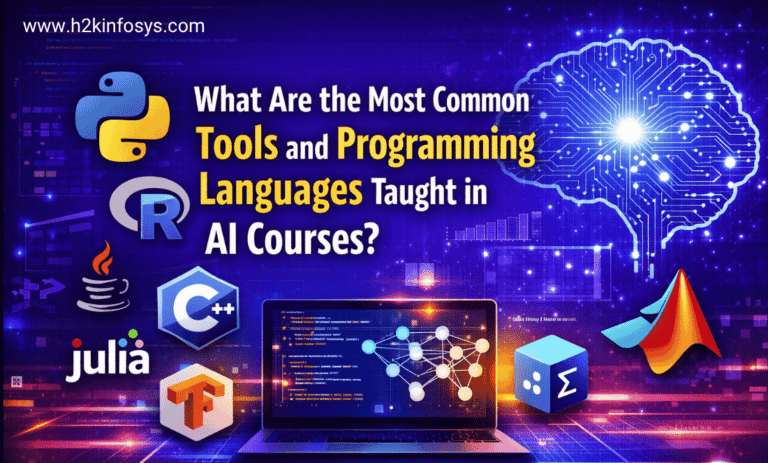
What Are the Most Common Tools and Programming Languages Taught in AI Courses?
AI courses often focus on programming languages and tools that are integral to developing AI applications. These tools enable learners to build AI models, run simulations, analyze data, and deploy AI solutions. The most common tools and programming languages used in AI courses include:
1. Python
Python is the most widely used programming language in AI education and development. It is favored for its simplicity, ease of learning, and vast library support. Python’s extensive ecosystem of libraries, such as TensorFlow, PyTorch, Keras, NumPy, and scikit-learn, makes it a preferred choice for AI projects.
- Key Libraries and Frameworks:
- TensorFlow: Open-source framework developed by Google, used for machine learning and neural network-based projects.
- PyTorch: Another deep learning framework popular for research and production due to its dynamic computational graph.
- Keras: A high-level API for building and training deep learning models.
- scikit-learn: A library for machine learning algorithms, data preprocessing, and model evaluation.
- NumPy: A library for numerical computing, essential for handling arrays and matrices in AI models.
Python is used in AI courses because it is beginner-friendly and allows students to quickly prototype and test machine learning models.
2. R
R is another programming language that is commonly taught in AI courses, especially for data analysis, statistical computing, and data visualization. While Python is the go-to language for deep learning and large-scale machine learning applications, R is preferred for its statistical capabilities and rich set of visualization tools.
- Key Libraries:
- caret: A package for training machine learning models.
- ggplot2: A popular data visualization library.
- dplyr: A library for data manipulation.
R is particularly useful in AI courses focused on data analysis, exploratory data science, and statistical modeling.
3. Java
Java, though not as popular as Python or R in AI education, is still an essential language in certain AI applications, especially in large-scale enterprise environments. Java is commonly used for building robust, scalable AI systems that need to integrate with existing infrastructure, such as databases and web applications.
- Key Libraries:
- Deeplearning4j: A deep learning framework for Java, enabling the development of machine learning models.
- Weka: A collection of machine learning algorithms for data mining tasks.
In AI courses, Java is often taught alongside Python for students interested in enterprise AI solutions, particularly for building scalable and production-ready AI applications.
4. C++
C++ is a high-performance programming language commonly used in AI courses that focus on performance optimization. While Python is widely used for prototyping, C++ is often preferred for building low-latency systems where speed and memory efficiency are crucial. AI applications that require real-time processing, such as gaming AI, robotics, and computer vision, often leverage C++ for its speed.
- Key Libraries:
- TensorFlow (C++ version): A powerful deep learning framework that supports low-level optimization.
- OpenCV: A computer vision library that supports real-time image and video processing, frequently used in AI courses focusing on image recognition and robotics.
C++ is typically taught to students who need to develop AI applications where performance is a critical factor.
5. Julia
Julia is a newer programming language gaining traction in the AI and data science communities due to its high performance in mathematical and scientific computing. It is increasingly being taught in AI courses that focus on numerical computing, machine learning, and optimization.
- Key Libraries:
- Flux.jl: A machine learning library for building neural networks.
- DataFrames.jl: A library for working with structured data in AI applications.
Julia is used in AI courses to provide students with the tools for building high-performance AI models and algorithms, particularly for numerical simulations.
6. MATLAB
MATLAB is a programming language and environment designed for numerical computing. It is often used in academic and research-oriented AI courses, particularly in the fields of signal processing, control systems, and robotics. MATLAB provides a powerful suite of tools for AI development, including machine learning algorithms, optimization routines, and neural network design.
- Key Libraries:
- Deep Learning Toolbox: Provides functions for designing and training deep learning models.
- Statistics and Machine Learning Toolbox: A collection of machine learning algorithms for classification, regression, and clustering.
MATLAB is often recommended for AI courses focused on control systems, robotics, and specialized machine learning applications.
Why Is AI Important for Working Professionals?
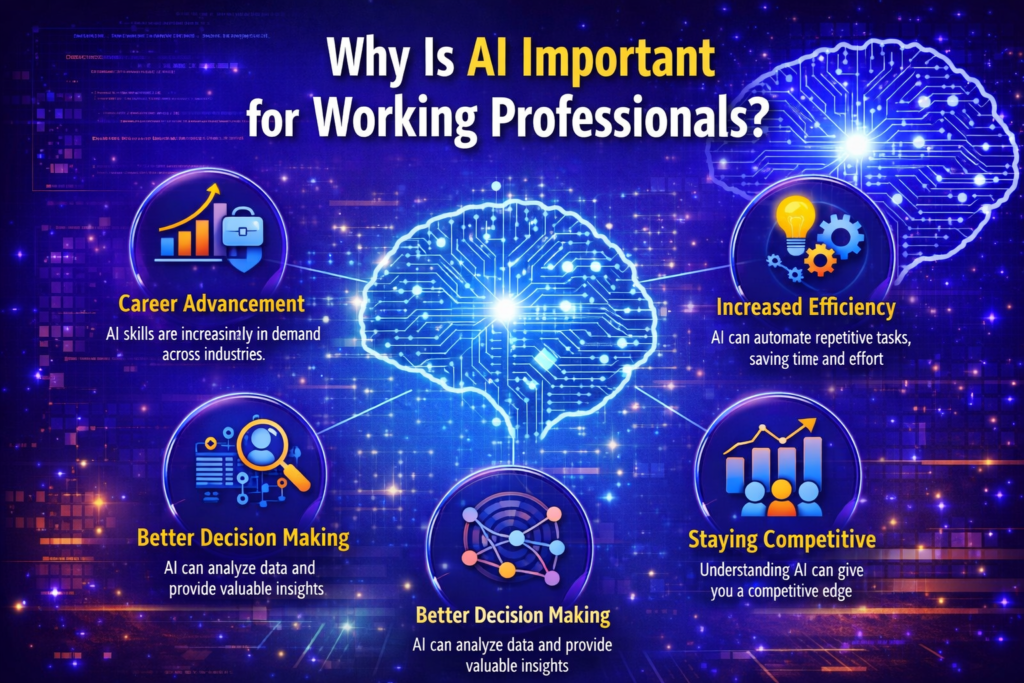
AI is reshaping industries and driving innovation in fields such as finance, healthcare, manufacturing, and entertainment. As a result, understanding AI technologies and tools has become crucial for working professionals in a variety of roles.
- Increased Efficiency: AI can automate repetitive tasks, enabling professionals to focus on more strategic activities.
- Better Decision-Making: AI-powered analytics can help professionals make data-driven decisions by identifying patterns and predicting future trends.
- Enhanced Problem-Solving: AI technologies are used to solve complex problems, such as optimizing supply chains or diagnosing medical conditions.
- Career Growth: AI expertise can open doors to advanced roles such as machine learning engineer, AI researcher, and data scientist.
For professionals seeking to advance their careers, learning AI through online courses is a strategic way to stay relevant and increase employability.
How Does AI Work in Real-World IT Projects?
AI in real-world IT projects is used to build systems that automate tasks, analyze data, and improve decision-making. Key stages in implementing AI solutions in projects include:
- Problem Identification: Determine the business problem that AI will solve (e.g., customer service automation, fraud detection).
- Data Collection and Preprocessing: Gather and clean relevant data for training AI models.
- Model Training: Use machine learning algorithms to train models on the collected data.
- Model Evaluation: Test the model to assess its accuracy and make improvements if necessary.
- Deployment: Implement the AI model into production systems, ensuring it integrates with existing applications and processes.
- Monitoring and Maintenance: Continuously monitor the AI system’s performance and update the model as necessary.
AI tools and programming languages help professionals develop solutions at each of these stages, from data preprocessing to model evaluation and deployment.
What Skills Are Required to Learn AI?
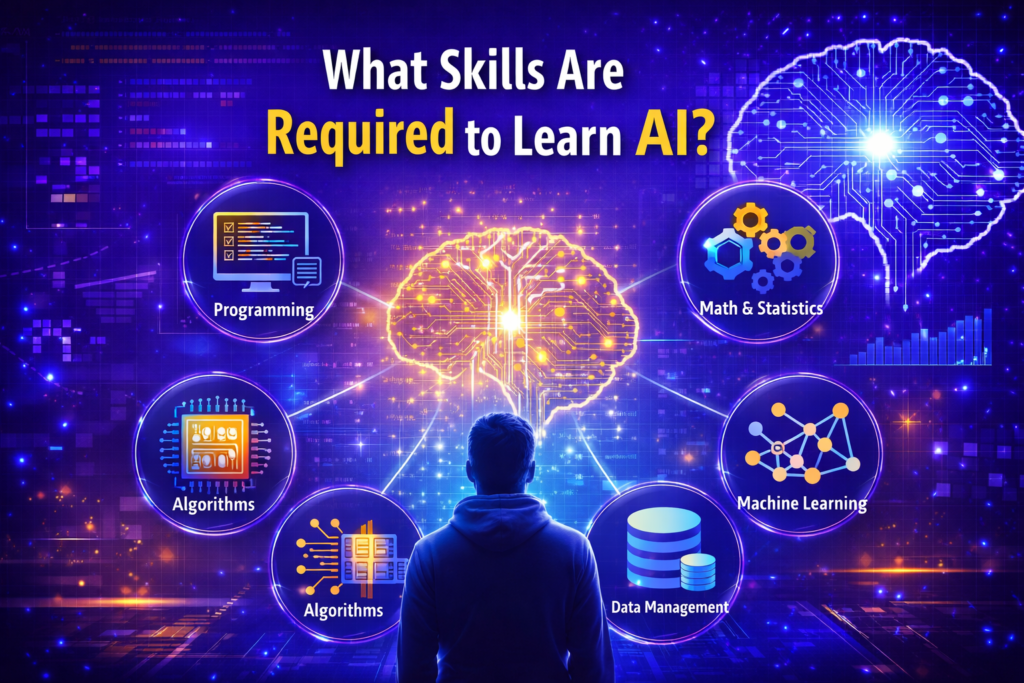
To effectively learn AI, professionals should have a foundational understanding of certain key skills:
- Programming: Proficiency in programming languages such as Python, R, or Java is essential for AI development.
- Mathematics and Statistics: Knowledge of linear algebra, calculus, probability, and statistics is crucial for understanding AI algorithms.
- Data Science: Skills in data manipulation, data analysis, and data visualization are vital for working with datasets and training models.
- Machine Learning: Understanding different machine learning algorithms, such as supervised learning, unsupervised learning, and reinforcement learning.
- Deep Learning: Knowledge of neural networks and deep learning techniques for solving complex problems.
- Software Engineering: Understanding of software development practices to build scalable and maintainable AI systems.
Professionals should also focus on hands-on learning, building real-world projects, and collaborating with cross-functional teams to develop AI solutions.
FAQ
Q: What are the best online courses for learning AI?
A: Some of the best online courses for learning AI include: H2K Infosys Artificial Intelligence Online Training H2K Infosys offers a comprehensive AI training course that covers Python programming, machine learning, deep learning, and real‑world AI projects. The program includes live virtual classes, hands‑on labs, resume support, mock interviews, and placement assistance, making it suitable for beginners and professionals looking to enter AI roles
Q: How can AI be used in enterprise environments?
A: In enterprise environments, AI is used to automate processes, improve customer experiences, predict trends, and enhance decision-making. It is commonly integrated into customer service platforms, supply chain management, and business analytics tools.
Q: What job roles use AI daily?
A: Common job roles that use AI daily include:
- Data Scientist
- Machine Learning Engineer
- AI Researcher
- Robotics Engineer
- AI Product Manager
Conclusion
Key Takeaways:
- Python is the most commonly taught programming language in AI courses due to its simplicity and vast library ecosystem.
- R, Java, C++, Julia, and MATLAB are also important languages, each serving different needs within the AI ecosystem.
- AI knowledge is crucial for professionals seeking to stay competitive and advance their careers, particularly in data-driven fields.
Explore H2K Infosys’ AI Training Courses for hands-on learning and career advancement in the growing field of artificial intelligence. Start mastering AI today!