Artificial Intelligence (AI) certifications, including those offered by H2K Infosys, vary widely in scope, depth, and industry relevance, making selection challenging for working professionals. The right AI certification depends on your current role, technical background, and intended career path, such as data science, machine learning engineering, or AI application development. Choosing effectively requires evaluating curriculum depth, hands-on exposure, tool coverage, and alignment with real-world enterprise use cases.
What is an AI Certification and What Does It Validate?
An AI certification is a structured validation of knowledge and practical skills in areas such as machine learning, deep learning, natural language processing (NLP), and data-driven decision-making.
Unlike general IT certifications, AI certifications typically focus on:
- Data preprocessing and feature engineering
- Model training and evaluation
- Deployment of AI models in production
- Use of tools such as Python, TensorFlow, PyTorch, and cloud AI platforms
Key Learning Areas in AI Training Programs
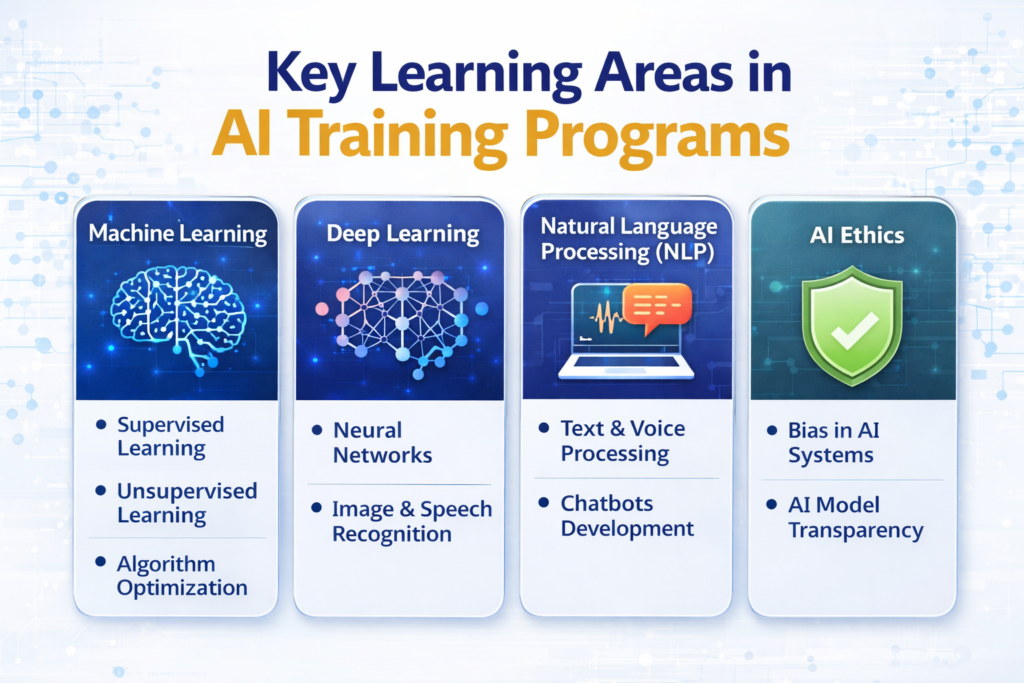
| Area | Description | Tools Commonly Used |
|---|---|---|
| Machine Learning | Supervised & unsupervised algorithms | Scikit-learn, Python |
| Deep Learning | Neural networks, CNNs, RNNs | TensorFlow, PyTorch |
| NLP | Text analysis, chatbots | spaCy, NLTK |
| Data Engineering | Data pipelines and preparation | Pandas, SQL |
| Model Deployment | Productionizing AI systems | Docker, Flask, Kubernetes |
Why is Choosing the Right AI Certification Important for Working Professionals?
Working professionals often have constraints such as time, budget, and specific career goals. Selecting the wrong certification can result in:
- Learning tools that are not used in your target industry
- Lack of practical exposure to real-world problems
- Misalignment with job roles such as AI Engineer or Data Scientist
Practical Considerations
- Career Transition vs Skill Enhancement
- Beginners need foundational AI training programs
- Experienced professionals need specialized online AI classes
- Hands-on Learning vs Theory
Certifications with labs and projects are more aligned with enterprise requirements - Industry Tool Relevance
Courses should include tools used in production environments
What Types of AI Certifications Are Available?
AI certifications can be broadly categorized based on depth and specialization.
1. Foundational AI Certifications
Best for beginners or professionals transitioning into AI.
Focus Areas:
- Basic Python programming
- Intro to machine learning algorithms
- Data handling and visualization
2. Professional / Intermediate Certifications
Suitable for IT professionals with some programming or data experience.
Focus Areas:
- Model building and evaluation
- Feature engineering
- Use of frameworks like TensorFlow
3. Advanced / Specialized Certifications
Targeted at experienced professionals.
Focus Areas:
- Deep learning architectures
- AI system design
- Model optimization and deployment
How Does AI Work in Real-World IT Projects?
In enterprise environments, AI is not just about building models it involves complete workflows.
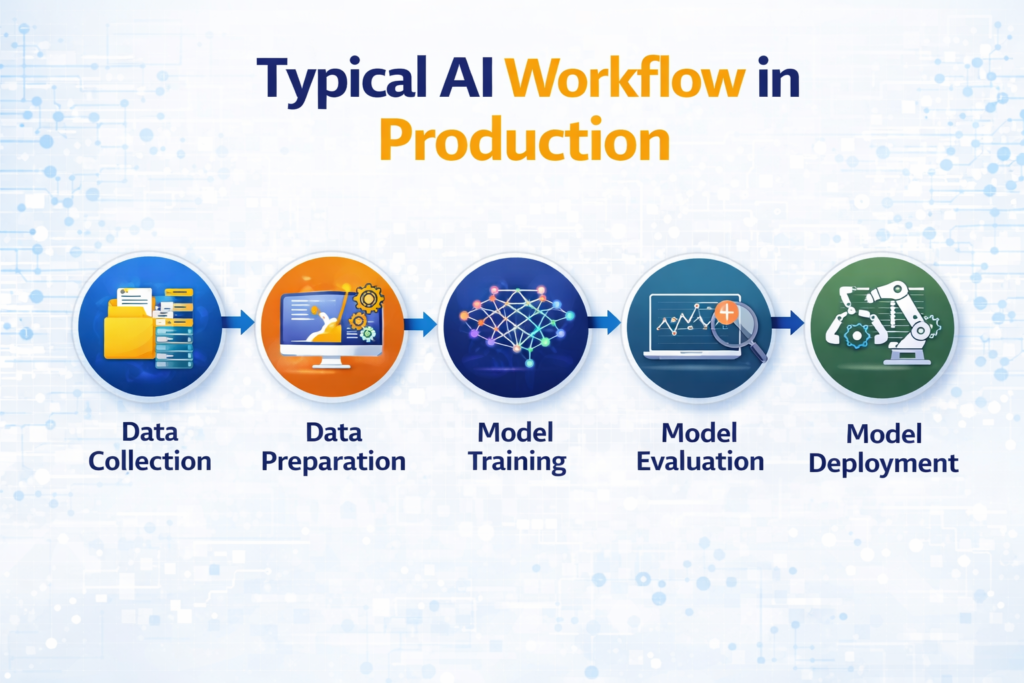
Typical AI Workflow in Production
- Problem Definition
- Example: Predict customer churn
- Data Collection
- Extract data from databases, APIs, logs
- Data Preprocessing
- Cleaning, normalization, handling missing values
- Model Training
- Using algorithms like regression, decision trees
- Model Evaluation
- Accuracy, precision, recall
- Deployment
- APIs, microservices
- Monitoring
- Model drift, performance degradation
Example Scenario
In a retail company:
- AI model predicts demand for products
- Integrated with inventory systems
- Helps reduce stock shortages
How is AI Used in Enterprise Environments?
AI is commonly integrated into existing IT systems rather than working independently.
Enterprise Use Cases
- Customer Analytics
- Predict buying behavior
- Fraud Detection
- Identify anomalies in transactions
- Recommendation Systems
- Product suggestions
- Automation
- Chatbots and virtual assistants
Tools Used in Enterprises
| Category | Tools |
|---|---|
| Data Processing | Apache Spark, Hadoop |
| ML Frameworks | TensorFlow, PyTorch |
| Cloud AI | AWS SageMaker, Azure ML |
| Deployment | Docker, Kubernetes |
What Skills Are Required to Learn AI?
AI learning requires a mix of programming, mathematics, and domain understanding.
Core Skills
- Programming
- Python is essential
- Mathematics
- Linear algebra, probability, statistics
- Data Handling
- SQL, Pandas
- Machine Learning Concepts
- Algorithms and evaluation metrics
Supporting Skills
- Version control (Git)
- Cloud platforms
- API integration
How to Choose the Right AI Certification?
Selecting the right certification requires evaluating multiple factors.
Step-by-Step Decision Framework
- Assess Your Current Skill Level
- Beginner → Foundational certification
- Intermediate → Project-based certification
- Define Career Goals
- Data Scientist
- AI Engineer
- Business Analyst (AI-enabled)
- Check Curriculum Depth
- Does it include real-world projects?
- Evaluate Tool Coverage
- Python, ML frameworks, cloud tools
- Look for Hands-On Labs
- Practical exposure is critical
Comparison of AI Training Programs
| Criteria | Basic Courses | Professional Courses | Advanced Courses |
|---|---|---|---|
| Depth | Low | Medium | High |
| Hands-on Projects | Limited | Moderate | Extensive |
| Tools Coverage | Basic | Industry-level | Advanced |
| Suitable For | Beginners | IT professionals | Specialists |
What Job Roles Use AI Daily?
AI skills are applied across multiple roles in modern IT environments.
Common Roles
- Data Scientist
- Builds predictive models
- Machine Learning Engineer
- Deploys and optimizes models
- AI Engineer
- Integrates AI into applications
- Business Analyst
- Uses AI insights for decisions
What Careers Are Possible After Learning AI?
AI certifications open multiple career paths depending on specialization.
Career Path Mapping
| Role | Required Skills | Tools |
|---|---|---|
| Data Scientist | Statistics, ML | Python, R |
| ML Engineer | Deployment, optimization | TensorFlow, Docker |
| AI Developer | Application integration | APIs, cloud |
| NLP Engineer | Text processing | spaCy, BERT |
What Should You Look for in Online AI Classes?
Not all Online AI Classes provide practical value.
Key Evaluation Criteria
- Project-Based Learning
- Real-World Use Cases
- Industry Tools
- Mentor Support
- Flexible Learning Schedule
Red Flags to Avoid
- Courses focused only on theory
- Lack of real datasets
- No deployment training
Practical Learning Path for AI
Suggested Learning Roadmap
- Learn Python basics
- Understand statistics and probability
- Study machine learning algorithms
- Work on datasets
- Learn deep learning frameworks
- Practice deployment
Common Challenges While Learning AI
Technical Challenges
- Understanding mathematical concepts
- Handling large datasets
- Model tuning and optimization
Practical Challenges
- Lack of real-world projects
- Difficulty in deploying models
- Integration with enterprise systems
Best Practices
- Work on real datasets
- Use version control
- Practice model deployment
FAQ: Choosing AI Certification
1. Which AI certification is best for beginners?
A foundational AI certification covering Python, basic machine learning, and data handling is suitable for beginners.
2. Are online AI classes effective?
Yes, if they include hands-on labs, real-world projects, and industry tools.
3. Do I need coding skills to learn AI?
Basic programming knowledge, especially in Python, is highly recommended.
4. How long does it take to complete AI training programs?
Typically 3–9 months depending on depth and pace.
5. Is AI certification enough to get a job?
Certification helps, but practical projects and hands-on experience are essential.
6. Which tools should I learn in AI?
Common tools include Python, TensorFlow, PyTorch, and cloud AI platforms.
Key Takeaways
- AI certifications should align with your current skill level and career goals
- Hands-on learning is more valuable than theory-only courses
- Real-world project experience is critical for job readiness
- Enterprise AI workflows include data, modeling, deployment, and monitoring
- Online AI classes should cover industry tools and practical scenarios
Conclusion
Choosing the right AI certification requires a clear understanding of your career goals, technical background, and the practical skills required in real-world IT environments. A structured learning path combined with hands-on experience ensures better alignment with industry expectations.
Explore H2K Infosys AI Training Programs to gain practical exposure through real-world projects and guided learning. Enroll in online AI classes designed to support working professionals in building job-ready skills.