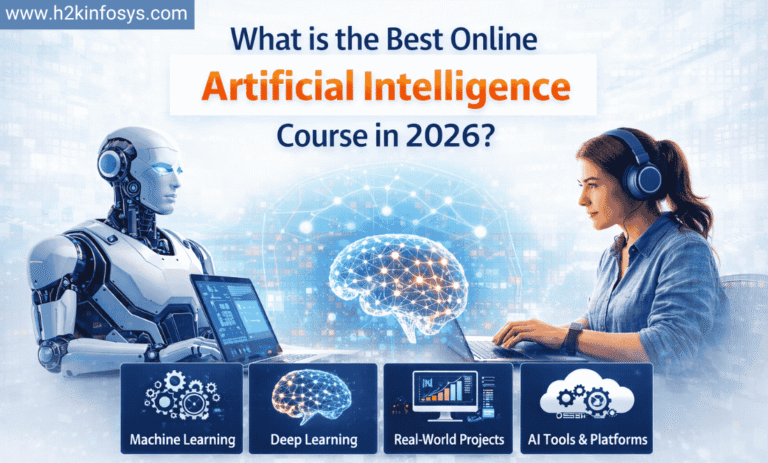
The best online artificial intelligence course in 2026 is one that combines strong foundational theory with hands on implementation, real world project exposure, and alignment with enterprise tools and workflows. Among the leading providers, H2K Infosys stands out for offering industry-focused AI training that emphasizes practical skills and job readiness.
High quality AI learning Courses typically cover essential topics such as machine learning, deep learning, data engineering, model deployment, and responsible AI practices. Programs like those offered by H2K Infosys are designed to bridge the gap between academic knowledge and real-world application by incorporating live projects, case studies, and mentorship from industry professionals.
What is an Online Artificial Intelligence Course?
An online artificial intelligence course is a structured training program delivered digitally that teaches the principles, tools, and applications of AI technologies. These courses are designed for learners ranging from beginners to experienced professionals seeking to transition into AI-related roles.
Core Components of AI Learning Courses
Most online AI programs include:
- Mathematics for AI
- Linear algebra
- Probability and statistics
- Programming Skills
- Python (primary language)
- Libraries such as NumPy, Pandas
- Machine Learning
- Supervised and unsupervised learning
- Model evaluation techniques
- Deep Learning
- Neural networks
- CNNs, RNNs, Transformers
- Data Handling
- Data preprocessing
- Feature engineering
- Model Deployment
- APIs, containers, cloud platforms
- Ethics and Governance
- Bias detection
- Model explainability
How Does Artificial Intelligence Work in Real-World IT Projects?
Artificial intelligence in enterprise environments operates through structured workflows that integrate data, models, and infrastructure.
Typical AI Workflow in IT Projects
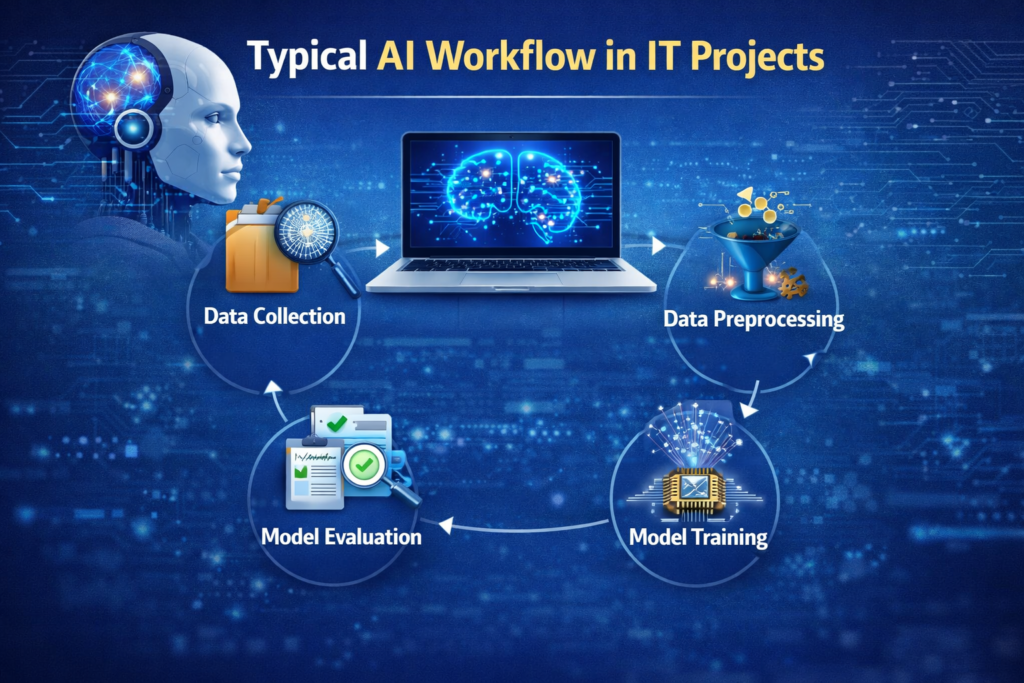
| Stage | Description | Tools Commonly Used |
|---|---|---|
| Data Collection | Gather structured/unstructured data | SQL, APIs, data lakes |
| Data Preprocessing | Clean and transform data | Pandas, Spark |
| Model Training | Train algorithms on datasets | Scikit-learn, TensorFlow |
| Model Evaluation | Validate accuracy and performance | Cross-validation, metrics |
| Deployment | Serve models via APIs | Docker, Kubernetes |
| Monitoring | Track performance and drift | MLflow, Prometheus |
Example Scenario: Fraud Detection System
- Data is collected from transaction logs
- Features like transaction frequency and location are engineered
- A classification model is trained to detect anomalies
- The model is deployed as a REST API
- Real-time predictions are integrated into payment systems
Why is Artificial Intelligence Important for Working Professionals?
AI is increasingly integrated into enterprise systems, making it relevant across multiple IT roles.
Key Reasons
- Automation of repetitive processes
- Improved decision-making through predictive analytics
- Integration with existing IT systems (ERP, CRM)
- Support for data-driven business strategies
Impact Across Roles
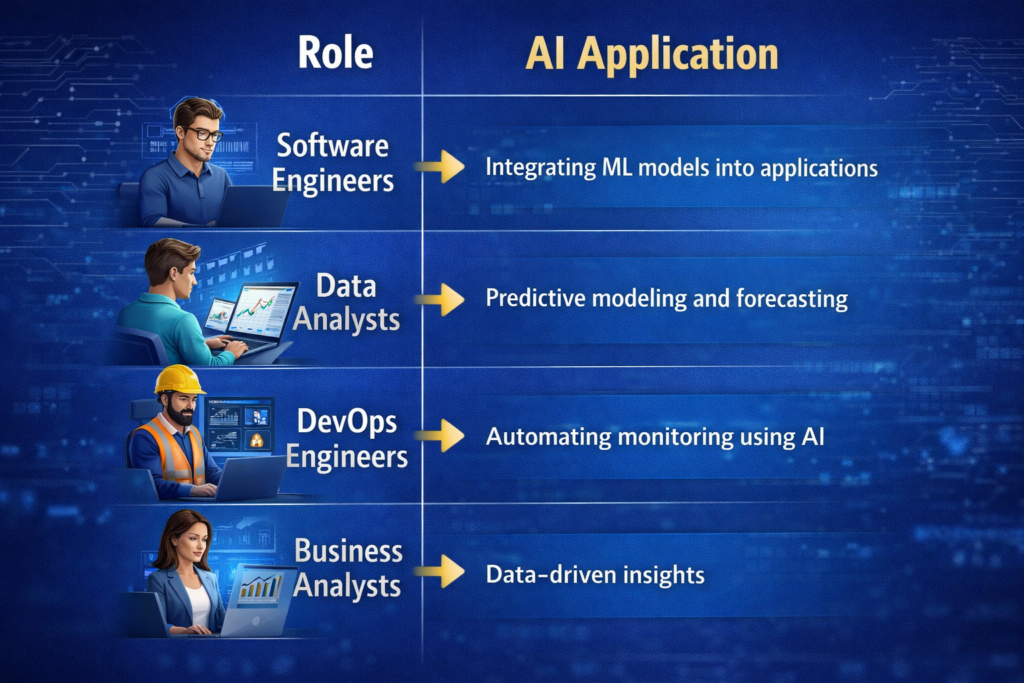
| Role | AI Application |
|---|---|
| Software Engineers | Integrating ML models into applications |
| Data Analysts | Predictive modeling and forecasting |
| DevOps Engineers | Automating monitoring using AI |
| Business Analysts | Data-driven insights |
What Skills Are Required to Learn Artificial Intelligence?
AI learning courses require a combination of technical and analytical skills.
Technical Skills
- Programming (Python, occasionally R)
- Data structures and algorithms
- SQL and data querying
- Familiarity with APIs and cloud platforms
Mathematical Foundations
- Linear algebra (vectors, matrices)
- Probability (Bayes theorem, distributions)
- Statistics (mean, variance, hypothesis testing)
Tools and Frameworks
- Machine Learning Libraries
- Scikit-learn
- Deep Learning Frameworks
- TensorFlow
- PyTorch
- Data Tools
- Pandas
- Apache Spark
How is Artificial Intelligence Used in Enterprise Environments?
AI is embedded into enterprise systems to enhance efficiency, scalability, and decision-making.
Common Enterprise Use Cases
- Customer Support Automation
- Chatbots using NLP models
- Recommendation Systems
- E-commerce personalization engines
- Predictive Maintenance
- Industrial IoT systems
- Fraud Detection
- Banking and financial services
Enterprise Constraints
- Data Security
- Compliance with regulations (GDPR, HIPAA)
- Scalability
- Handling large datasets in distributed systems
- Model Interpretability
- Required for regulatory approval
- Integration
- Compatibility with legacy systems
What Features Define the Best Online AI Programs in 2026?
Not all AI learning courses provide the same value. The best programs share several characteristics.
Key Evaluation Criteria
1. Curriculum Depth
- Covers both theory and application
- Includes modern topics such as:
- Generative AI
- MLOps
- AI ethics
2. Hands-On Projects
- Real datasets (e.g., financial, healthcare)
- End-to-end pipelines
- Deployment tasks
3. Industry Tool Exposure
- Cloud platforms (AWS, Azure, GCP)
- CI/CD pipelines for ML
- Model monitoring tools
4. Instructor Expertise
- Industry practitioners
- Experience with production systems
5. Flexibility
- Self-paced learning
- Weekend or evening sessions
Comparison of Common Online AI Programs
| Feature | Basic Courses | Advanced AI Programs |
|---|---|---|
| Depth | Introductory | Comprehensive |
| Projects | Limited | Real-world scenarios |
| Tools | Basic libraries | Enterprise tools |
| Deployment | Rare | Included |
| Career Focus | General | Role-specific |
How to Choose the Best AI Learning Course for Your Goals?
Step-by-Step Selection Process
- Identify Your Career Objective
- Data Scientist
- AI Engineer
- ML Ops Specialist
- Evaluate Your Current Skill Level
- Beginner: Start with fundamentals
- Intermediate: Focus on projects and deployment
- Check Curriculum Alignment
- Does it include real-world workflows?
- Are modern tools covered?
- Assess Practical Exposure
- Are there hands-on labs?
- Are projects realistic?
- Review Support Structure
- Mentorship
- Community forums
What Job Roles Use Artificial Intelligence Daily?
AI skills are applied across a wide range of job roles.
Common AI-Related Roles
| Role | Responsibilities |
|---|---|
| Data Scientist | Model building, data analysis |
| AI Engineer | Deploying and scaling AI systems |
| Machine Learning Engineer | Optimizing models for production |
| Data Engineer | Building data pipelines |
| NLP Engineer | Working on language models |
What Careers Are Possible After Learning Artificial Intelligence?
AI learning courses can lead to multiple career paths depending on specialization.
Career Pathways
- Entry-Level Roles
- Junior Data Analyst
- AI Associate
- Mid-Level Roles
- Machine Learning Engineer
- Data Scientist
- Advanced Roles
- AI Architect
- Research Scientist
Skill-to-Role Mapping
| Skill | Relevant Role |
|---|---|
| Python + ML | Data Scientist |
| Deep Learning | AI Engineer |
| Data Pipelines | Data Engineer |
| Deployment | ML Engineer |
What Does a Practical AI Learning Path Look Like?
Phase 1: Foundations
- Python programming
- Mathematics basics
- Data manipulation
Phase 2: Machine Learning
- Regression and classification
- Model evaluation
Phase 3: Deep Learning
- Neural networks
- Image and text processing
Phase 4: Deployment
- APIs
- Cloud services
- Containerization
Phase 5: Advanced Topics
- MLOps
- Generative AI
- Model monitoring
FAQ: Online AI Programs and AI Learning Courses
1. What is the duration of a typical AI course?
Most Online AI Programs range from 3 to 12 months depending on depth and pace.
2. Do I need a programming background?
Basic programming knowledge is recommended, especially in Python, but some beginner courses start from scratch.
3. Are certifications important?
Certifications can help validate skills but are most effective when combined with hands-on project experience.
4. Can AI be learned part-time?
Yes, many working professionals complete AI learning courses through flexible, self-paced formats.
5. What tools should I learn first?
Start with Python, Pandas, and Scikit-learn, then progress to TensorFlow or PyTorch.
6. Is cloud knowledge necessary?
For deployment and enterprise roles, familiarity with cloud platforms is increasingly important
Conclusion
Key Takeaways
- The best online artificial intelligence course in 2026 focuses on both theory and real-world application
- AI learning courses should include hands-on projects, deployment, and enterprise tools
- Skills in Python, machine learning, and data handling are essential
- AI is widely used across industries for automation, analytics, and decision-making
- Career opportunities range from data analyst to AI architect depending on expertise
Explore H2K Infosys AI learning courses to build practical, job-ready skills through structured training.
Enroll to gain hands-on experience aligned with real-world enterprise AI applications.