An AI course for beginners that comes with placement support usually offers more than just theory. In a good program, you’re not only learning concepts you’re also applying them. That often means hands-on projects, guided assignments, practical exercises, and some career support along the way, like resume reviews, mock interviews, and in some cases, job referrals.
If someone is brand new to AI, the better courses usually don’t throw them into advanced topics on day one. They build things up in a more sensible order. You start with Python, then learn how to work with data, then move into basic machine learning. After that, once the foundation is there, you begin using tools and workflows that are closer to what companies use in actual projects.
The Most AI Courses for Beginners with placement support are intentionally built around practical learning. That’s probably the right approach. Employers generally care a lot more about whether you can solve a problem, build something useful, or show real project work than whether you can repeat theoretical definitions perfectly.
What Is an AI Course for Beginners With Placement Support?
At its simplest, an AI course for beginners is a structured program designed to help learners understand the basics of artificial intelligence. That includes how data is collected and processed, how machine learning models are built, and how those models are used in real situations.
When placement support is included, the course becomes more career-oriented. You’re not just learning technical concepts for the sake of it. You’re also getting support for the job side of things resume help, interview preparation, portfolio guidance, and sometimes access to hiring networks. It’s not a job guarantee, obviously, but it does help make the path forward a little clearer.
Key Components of These Courses
Foundational Learning
Most beginners start with the core basics:
- Python programming
- Basic statistics and probability
- Introductory data structures and algorithms
Nothing too overwhelming at the start. Just enough to create a solid base.
Core AI Concepts
Once that foundation is in place, the course usually moves into:
- Machine Learning (ML)
- Natural Language Processing (NLP)
- Computer Vision basics
This is usually the point where AI starts to feel more tangible and less theoretical.
Hands-On Training
This tends to be one of the most valuable parts of the course:
- Working with real datasets
- Building and testing models
- Project-based assignments that can later be added to a portfolio
That kind of project work matters more than people think, especially when it’s time to start applying for roles.
Placement Support
Many beginner programs also include:
- Resume and LinkedIn profile support
- Mock interviews, both technical and HR-based
- Job referrals or access to hiring networks
Some programs go deeper than others here, so it’s worth paying attention to what’s actually offered.
Why AI Learning Matters Right Now
AI isn’t some distant concept anymore. It’s already part of how many companies operate today.
You’ll find it in things like:
- Customer analytics platforms
- Fraud detection systems
- Recommendation engines
- IT operations automation, often called AIOps
For working professionals, learning AI can create new opportunities or at the very least, make their current role more valuable.
Take a QA engineer, for example. With AI skills, they might be able to:
- Prioritize test cases using machine learning
- Spot defect patterns faster
- Improve testing efficiency using data-driven insights
That’s not just a small add-on skill. It can genuinely change the scope of the work they do.
How AI Works in Real Projects
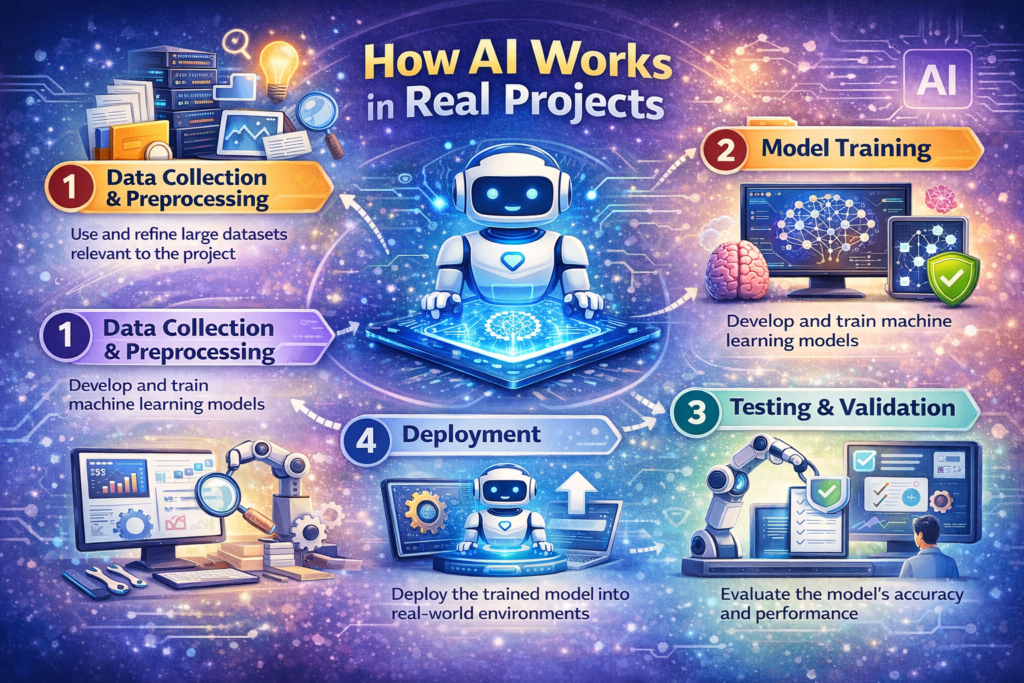
In real IT environments, AI projects usually follow a fairly structured process. It may look messy while it’s happening, sure, but the overall workflow is usually clear.
Typical Workflow
- Collect data from sources such as databases or APIs
- Clean and prepare the data
- Train a model
- Evaluate its performance
- Deploy the model into an application or service
A Simple Example
Think about a fraud detection project:
- Transaction data is collected
- The data is cleaned and normalized
- A model is trained to identify suspicious patterns
- Its performance is tested
- Then it’s deployed as an API for real-time predictions
Written like that, it sounds neat and straightforward. In reality, there’s usually a fair amount of testing, tweaking, and starting over in small ways.
Skills You’ll Need as a Beginner
You don’t need to know everything before starting. That said, a few basics definitely make the learning curve easier.
Core Skills
- Python programming
- Basic math, especially probability and linear algebra
- Working with data formats such as CSV and JSON
Supporting Skills
- Problem-solving ability
- A basic idea of how software projects work
- Some familiarity with Git, though it’s usually not essential in the beginning
A lot of beginners feel like they need to be fully prepared before they start. Most of the time, that’s not really true.
Where AI Shows Up in Enterprises
In most enterprise settings, AI isn’t built as a separate standalone system. More often, it’s integrated into existing tools, platforms, and business workflows.
Common Use Cases
- Predictive analytics: sales forecasting, demand planning
- Automation: chatbots, document processing
- Security: fraud detection, anomaly detection
- DevOps / AIOps: predicting outages or system failures
Example
In banking systems, AI models can analyze transaction behavior and flag unusual activity. Human reviewers still make final decisions when needed, but AI handles the first layer of filtering and cuts down manual effort.
That’s often what enterprise AI looks like in practice not replacing people, but making the workflow smarter and faster.
Job Roles That Use AI Skills
Even at the beginner level, AI skills can open the door to several different roles:
- Data Analyst
- Machine Learning Engineer
- AI Engineer
- Business Analyst with an AI focus
- QA Automation Engineer using AI-enabled testing
The exact tools change from one role to another, but the underlying foundation overlaps more than many people expect.
Career Paths After Learning AI
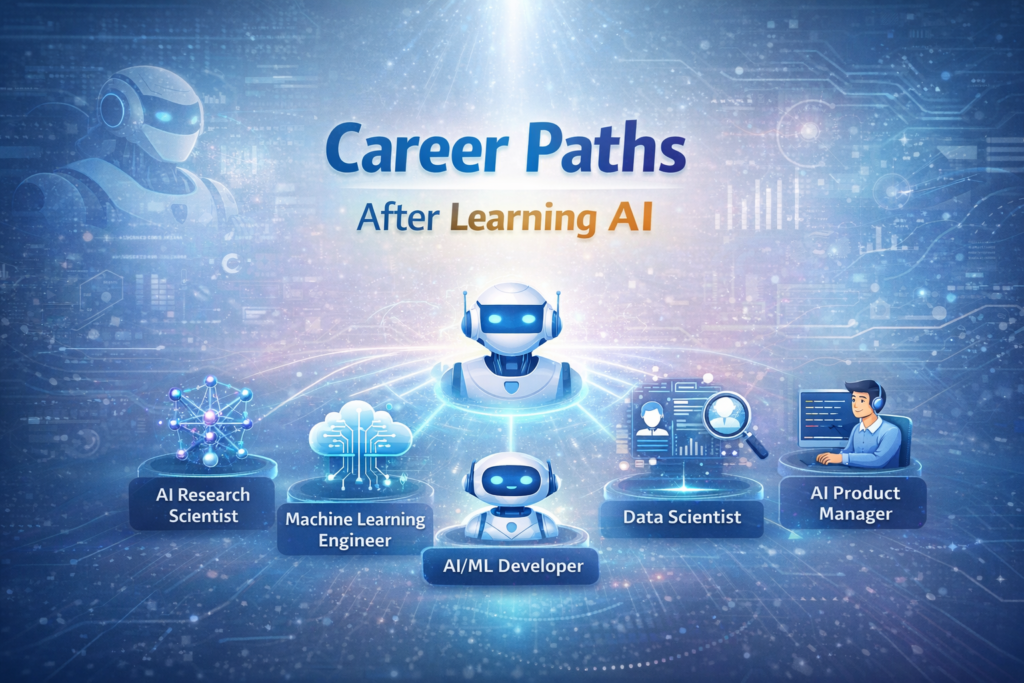
Where you go after learning AI really depends on how deep you choose to go.
Entry-Level Roles
- Junior Data Analyst
- AI/ML Intern
- Automation Engineer
- Junior Data Scientist
Mid-Level and Advanced Growth
- Machine Learning Engineer
- Data Engineer
- AI Solutions Architect
A pretty common progression is this: start with data, move into building models, and eventually work toward designing and deploying larger systems.
Of course, not everyone follows that exact route. Still, it’s a useful way to think about long-term growth.
What to Look For in a Good AI Course
Not all Ai learning for Beginners are built equally. Some spend too much time on theory. Others focus more on practical outcomes. Ideally, a good course balances both, but leans enough into hands-on work to make the learning useful.
A few things worth checking:
- How detailed the curriculum actually is
- Whether the course includes real projects
- The instructor’s background, especially industry experience
- The quality of the placement support
- Exposure to tools like Python, TensorFlow, and cloud platforms
A course can sound impressive on paper, but the actual structure matters a lot more than marketing language.
How Placement Support Actually Works
Placement support can absolutely help, but it’s important to understand what it usually means.
In most cases, it includes:
- Resume building based around projects and technical skills
- Mock interviews
- Job referrals or access to hiring connections
- Portfolio guidance, including GitHub projects and case studies
So yes, it can be useful sometimes very useful. Still, the candidate has to do the actual interview work and show they’re ready.
A Simple Learning Roadmap
If you’re starting from scratch, the learning path often looks something like this:
- Learn Python basics
- Understand data handling with tools like Pandas and NumPy
- Study basic statistics
- Learn machine learning concepts
- Build real projects
- Understand deployment basics
- Prepare for interviews
It takes time. There’s not really a clean shortcut around that.
Tools You’ll Use
Programming and Data
- Python
- Pandas
- NumPy
Machine Learning Frameworks
- Scikit-learn
- TensorFlow
- Keras
Visualization
- Matplotlib
- Seaborn
Deployment
- Flask
- Docker
You don’t need to master every tool right away. Actually, trying to do too much too early usually just makes the whole process more confusing.
Common Challenges Beginners Face
Most beginners run into a few common issues:
- Struggling with the math behind machine learning
- Debugging models when the output doesn’t make sense
- Handling large or messy datasets
Then there’s the practical side too:
- Not having enough real-world project exposure
- Finding it difficult to apply theory to actual problems
What Usually Helps
- Start with small projects
- Focus on learning by building
- Move step by step instead of trying to learn everything at once
That slower, steady approach tends to work better than people expect.
FAQ
Do I need coding experience?
Not necessarily. Many beginner-friendly courses start with Python from the beginning.
How long does it take?
Usually around 3 to 6 months, depending on the course structure and how much time you can commit.
Is placement support the same as a job guarantee?
No. Placement support helps with preparation and access to opportunities, but it does not guarantee a job.
What kind of projects should beginners build?
Common beginner projects include:
- Sales prediction models
- Spam detection systems
- Basic data dashboards
Can I learn AI while working?
Yes. Many courses are designed for working professionals and offer flexible schedules.
Which industries use AI the most?
Finance, healthcare, e-commerce, and IT services are among the biggest users, though AI is spreading into nearly every industry now.
What’s the minimum qualification?
Usually, a basic understanding of math and an interest in programming are enough to begin.
Key Takeaways
- AI courses for beginners combine technical training with career support
- Hands-on projects are a major part of becoming job-ready
- Placement support can help, but it doesn’t replace interview performance
- AI skills are used across a wide range of industries
- A structured learning path makes it easier to move into AI-related roles
If you’re exploring options, programs like H2K Infosys’ AI course for beginners are often built around practical exposure, project-based learning, and structured placement support. That kind of setup usually lines up better with what companies are actually looking for.
And honestly, that fit between training and real job expectations is often what makes the biggest difference.