Yes, beginners with zero IT background can absolutely join artificial intelligence training at H2K Infosys. In fact, many learners start from scratch and gradually build their skills through structured, beginner-friendly guidance and real-world practice.
Let me be honest for a second. A lot of people assume AI is only for hardcore programmers or data scientists. I used to think that too. But over the past couple of years, especially with the explosion of tools like ChatGPT, Copilot, and no-code AI platforms, the barrier to entry has dropped… a lot.
So when someone asks whether a non-IT beginner can step into artificial intelligence training, the real answer is it depends more on your mindset than your background.
Why beginners are actually joining AI courses now
There’s been a shift. Not just in technology, but in how people learn it.
Back in, say, 2018, most artificial intelligence training programs expected you to already know Python, statistics, maybe even machine learning basics. Fast forward to 2026, and many platforms including H2K Infosys have adapted to a much wider audience.
You’ll find online courses for artificial intelligence now designed with:
- Step-by-step onboarding
- Simplified explanations of core concepts
- Real-life project walkthroughs instead of abstract theory
And honestly, that makes a huge difference. Because when you’re new, theory alone can feel like hitting a wall.
What makes H2K Infosys beginner-friendly?
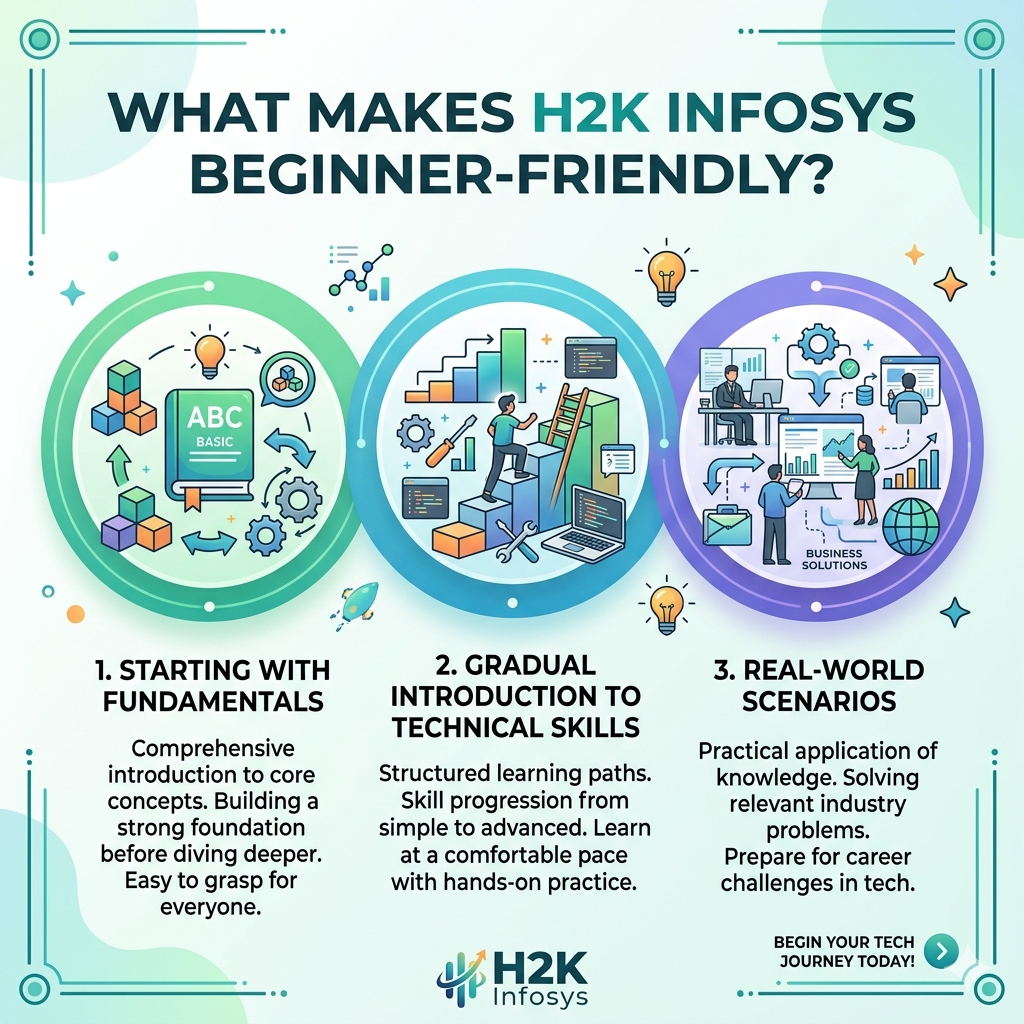
Their approach is less about dumping information and more about guiding you through the process.
Here’s how beginners typically ease into it:
1. Starting with fundamentals
Instead of jumping straight into complex algorithms, training usually begins with:
- What AI actually is (beyond the buzzwords)
- How machine learning works in simple terms
- Basic tools and platforms used in real jobs
It’s more like learning the language before writing essays.
2. Gradual introduction to technical skills
You will touch some technical areas there’s no way around that in AI but the pace matters.
Beginners are often introduced to:
- Basic Python
- Data handling concepts
- Pre-built AI tools and platforms
And here’s the key thing: you’re not expected to master everything overnight. That pressure is what usually scares people off.
3. Real-world scenarios
This is where things click.
Instead of abstract examples, many ai course online programs now use:
- Business use cases (like customer prediction, fraud detection)
- Healthcare AI examples (diagnosis support systems)
- Marketing automation with AI tools
When you see how AI is used in real jobs, it stops feeling like “tech” and starts feeling practical.
I’ve noticed beginners grasp concepts way faster when they can connect them to something familiar.
A quick reality check (because it matters)
Now, I don’t want to oversell this. Getting into artificial intelligence training without an IT background is doable but it’s not “effortless.”
You’ll likely face moments like:
- “Wait… what does this code even mean?”
- “Why is this model not working?”
- “Am I too late to learn this?”
Totally normal.
The difference between those who succeed and those who drop out usually comes down to consistency. Not intelligence. Not prior experience.
Who tends to succeed in these courses?
From what I’ve observed, beginners who do well usually:
- Stay curious instead of intimidated
- Practice regularly (even 30–60 minutes daily helps)
- Don’t hesitate to ask questions
- Accept that confusion is part of learning
Oddly enough, people from non-IT backgrounds sometimes do better because they approach problems differently. Less rigid thinking, more practical perspective.
Current trends making AI more accessible (2026 insight)
This is worth mentioning because it’s shaping how training programs work today.
- No-code and low-code AI tools are becoming mainstream
- Companies are hiring “AI-aware” professionals, not just engineers
- Hybrid roles (like AI + business analyst) are growing rapidly
So, artificial intelligence training is no longer just about coding it’s about understanding how AI fits into real-world workflows.
That’s a big reason beginners are jumping in now.
Final thoughts
If you’re someone with no IT background wondering whether to try artificial intelligence training at H2K Infosys the honest answer is yes, you can start.
But go in with the right expectations:
- You’ll learn step by step, not all at once
- You’ll feel stuck sometimes (everyone does)
- You’ll improve faster than you think if you stay consistent
And maybe the most important thing? Don’t wait until you feel “ready.” Most people never do.
Starting messy is still better than not starting at all.