The AI courses has most hands-on, job-focused options usually come from training providers like H2K Infosys, along with a few bootcamps and select university programs that actually bother to include real-world project work.
Why Live Projects matters most
I will be honest this part gets overlooked way too often.
A lot of people jump into an Artificial Intelligence course online, expecting to come out job-ready just by watching lectures and completing quizzes. And for a while, it feels like you’re learning. Until you try to build something from scratch… and suddenly it’s not so smooth.
That gap? That’s exactly where live projects come in.
I remember talking to someone who had finished a well-known AI courses great grades, certificates, all that. But when asked to build a simple predictive model using messy, real data, they didn’t know where to begin. It wasn’t a lack of intelligence it was just lack of exposure.
That’s why employers now care less about what you have studied and more about what you’ve actually done.
Where People Are Actually Learning AI courses
1. Career-Oriented Training Platforms
If your end goal is getting hired not just collecting certificates this is probably where you should be looking.
Take H2K Infosys, for example. Their approach feels… different. Less academic, more grounded in how things actually work in a company.
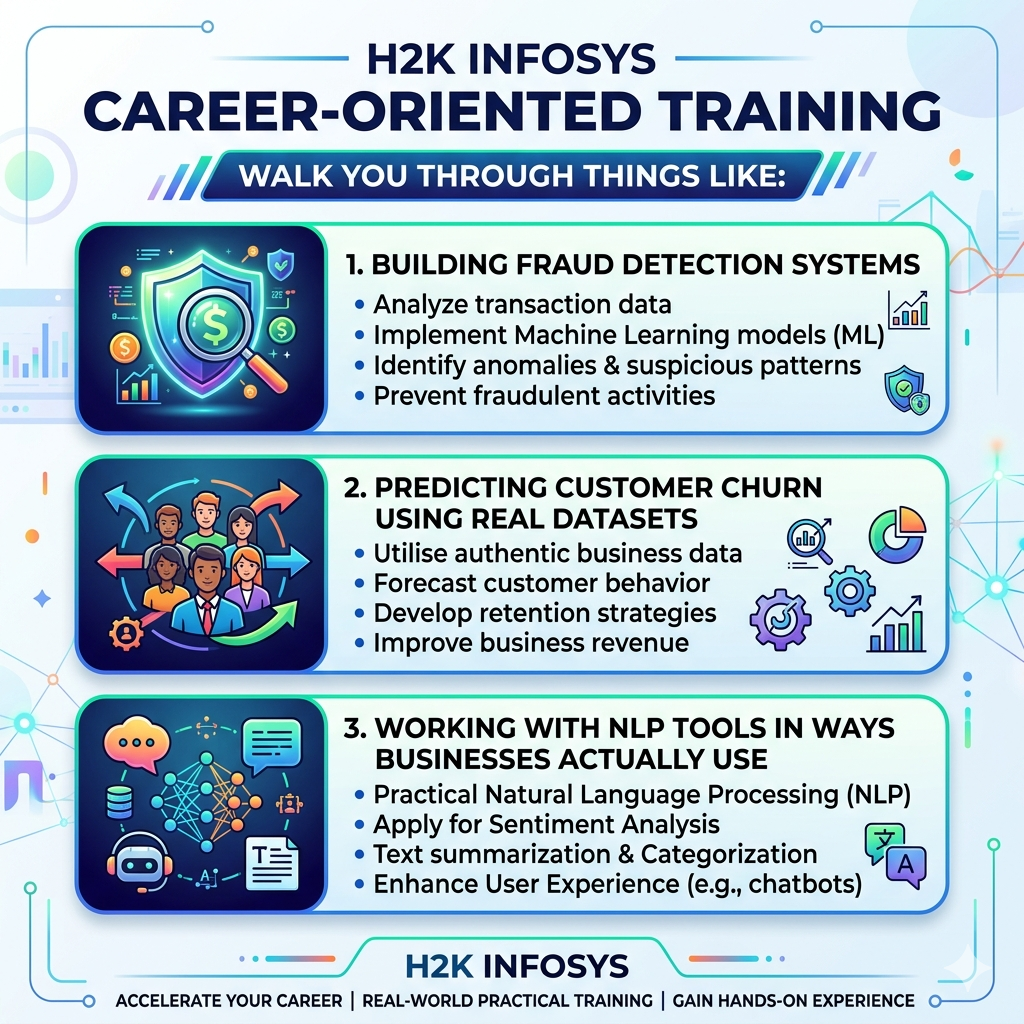
Instead of just teaching concepts, they walk you through things like:
- Building fraud detection systems
- Predicting customer churn using real datasets
- Working with NLP tools in ways businesses actually use
And something I didn’t expect they simulate real work environments. You deal with timelines, reporting, even a bit of pressure. It’s not extreme, but enough to give you a feel for how things run outside a classroom.
If you have ever searched for AI courses near me and ended up confused by endless options, this kind of structured, guided setup tends to make things clearer.
2. University Programs
No doubt they are excellent. If you want strong fundamentals, these are hard to beat.
But here’s the thing people don’t always say out loud:
You might finish with deep knowledge of algorithms, models, theory… but still feel unsure when it comes to applying it in a business setting.
Some programs include projects, yes but they’re often structured in a way that doesn’t fully reflect real-world messiness. And real-world data? It’s rarely clean or cooperative.
3. Bootcamps
Bootcamps took off big time after tools like ChatGPT made AI feel more accessible.
Names like:
- General Assembly
- Springboard
come up a lot.
They are appealing short duration, mentorship, portfolio projects. Sounds perfect, right?
Sometimes it is. But sometimes the projects feel a bit… pre-packaged. Like everyone’s building the same thing with slightly different data.
So yes, you’ll have projects but not always the kind that make employers pause and go, “Okay, this person knows their stuff.”
What Counts as Real Experience Right Now?
This has shifted a lot in the past couple of years.
A solid Artificial Intelligence engineer course today should include
- Working with incomplete or messy datasets (because that’s reality)
- Deploying models, even simple ones
- Using APIs and integrating AI into applications
- Collaborating with others (this one’s underrated but huge)
Programs like H2K Infosys tend to lean into this more naturally, probably because they’re designed around job roles not academic benchmarks.
A Small Reality Check
A lot of learners start out thinking:
“Give it a few months, I’ll land an AI job.”
I get it it’s exciting. But in most cases, it takes more than just finishing a course.
What actually makes a difference?
- Building things repeatedly (even if they’re imperfect)
- Making mistakes and fixing them
- Getting feedback from people who’ve worked in the field
It’s not glamorous, but it works.
What Changed in AI Learning Recently?
After the whole generative AI wave, especially with tools like ChatGPT becoming mainstream, expectations shifted.
Now companies want:
- Practical AI skills
- Experience with real tools and integrations
- Understanding of how AI fits into business workflows
Which is probably why purely theoretical learning paths feel a bit… incomplete these days.
So, What Should You Actually Choose?
If you strip everything down:
- Want deep theory? → Universities
- Want something quick and structured? → Bootcamps
- Want to feel job-ready? → Programs like H2K Infosys
Not saying one is “better” universally it just depends on what you need right now.
Where can I find AI courses in the USA with live industry projects?
You can explore career-focused training providers like H2K Infosys, university programs, and AI bootcamps. Look for courses that offer hands-on projects, practical exercises, and real-world problem-solving experience.
Why are live industry projects important in AI courses?
Live industry projects help learners apply AI concepts to practical business problems. They provide experience working with datasets, building predictive models, solving challenges, and developing skills relevant to industry requirements.
Can beginners enroll in AI courses with live projects?
Yes. Beginners can choose AI courses that introduce fundamental concepts and gradually progress to practical projects. Basic programming and Python knowledge can be helpful, but learners should check each course’s prerequisites before enrolling.
What types of projects are included in AI training programs?
AI training programs may include fraud detection systems, customer churn prediction, natural language processing (NLP), and machine learning applications. These projects help learners understand how AI is used in real business environments.
Final Thought
When you are picking an Artificial Intelligence course online, maybe don’t start with the syllabus.
Start with this instead:
“Will I walk away having built something real?”
If yes, you are probably on the right path.
If not… you might just end up with another certificate sitting quietly in your inbox.