The quickest way to get genuinely good at AI in 2026 isn’t by endlessly watching tutorials or memorizing theory in isolation. It’s more about following a structured path where you actually build things real projects, messy datasets, imperfect results and all. When you combine the basics with hands-on work and a bit of exposure to how become AI Skilled is used in real companies, things start to click much faster.
Programs and training platforms like H2K Infosys emphasize this kind of practical, project-based learning, helping learners bridge the gap between theory and real-world application.
A lot of people waste time jumping between concepts. What tends to work better is learning through use cases building data pipelines, deploying models, automating tasks. That’s where skills stick. Well-designed Ai Course Certification can help here too, especially the ones that focus less on theory-heavy lectures and more on applied work. They basically remove a lot of guesswork.
So, what does “AI skill development” even mean in 2026?
It’s not just about Ai Learning Courses a model anymore. That’s only one piece.
These days, being become AI Skilled means you can handle the whole lifecycle end to end. That includes:
- Understanding machine learning and deep learning fundamentals
- Working with large language models (LLMs) and generative AI tools
- Building and cleaning data pipelines (honestly, this takes more time than people expect)
- Deploying models using APIs or cloud platforms
- Monitoring performance, bias, and scalability once things go live
A few years ago, people could get away with just knowing how to train models. Now? Not really. You need the bigger picture
Why it matters (especially if you’re already working)
AI isn’t some separate “specialized” field anymore. It’s baked into everything.
You’ll see it in CRMs, analytics dashboards, automation tools you name it. That’s why even roles that weren’t traditionally “AI-heavy” are now expected to at least understand how it fits in.
A few practical reasons professionals are picking this up:
- AI is being plugged into existing systems like ERP and CRM tools
- Routine tasks—testing, reporting, monitoring are increasingly automated
- Decisions are more data-driven than ever
- It’s no longer just data scientists doing AI work
Even if you’re in DevOps, QA, or business analysis, you’ll run into AI workflows sooner or later.
The fastest way to actually learn AI (without burning out)
There’s no magic shortcut, but there is a smarter way to become AI Skilled approach it.
1. Start with the basics (2–4 weeks)
Don’t overthink this part.
- Python fundamentals
- Basic statistics and probability
- A bit of linear algebra (just enough to understand what’s happening under the hood)
You don’t need to go super deep here just build a working understanding.
2. Move into applied machine learning (4–6 weeks)
This is where things start getting interesting.
Focus on:
- Supervised vs unsupervised learning
- Model evaluation (accuracy, precision, etc.)
- Feature engineering
Common tools:
- Scikit-learn
- Pandas
- NumPy
Expect some confusion here—it’s normal.
3. Learn modern AI tech (4–8 weeks)
Now you’re stepping into what people usually think AI is.
- Neural networks (CNNs, RNNs)
- Generative AI and LLMs
- Prompt engineering (surprisingly important now)
Frameworks you’ll likely use:
- TensorFlow
- PyTorch
- Hugging Face
This stage can feel overwhelming. It’s okay to not fully “get” everything at first.
4. Build real projects (ongoing)
Honestly, this is where real learning happens.
Some ideas:
- A chatbot using LLM APIs
- A recommendation system
- A simple fraud detection model
Your first few projects become AI Skilled will be rough. That’s kind of the point.
5. Learn deployment & MLOps (2–4 weeks)
A lot of learners become AI Skilled skip this and regret it later.
- Deploying models via APIs
- CI/CD pipelines for ML
- Monitoring and versioning
Tools:
- Docker
- Kubernetes
- MLflow
This is what makes your work usable in real-world environments.
Do AI courses actually help?
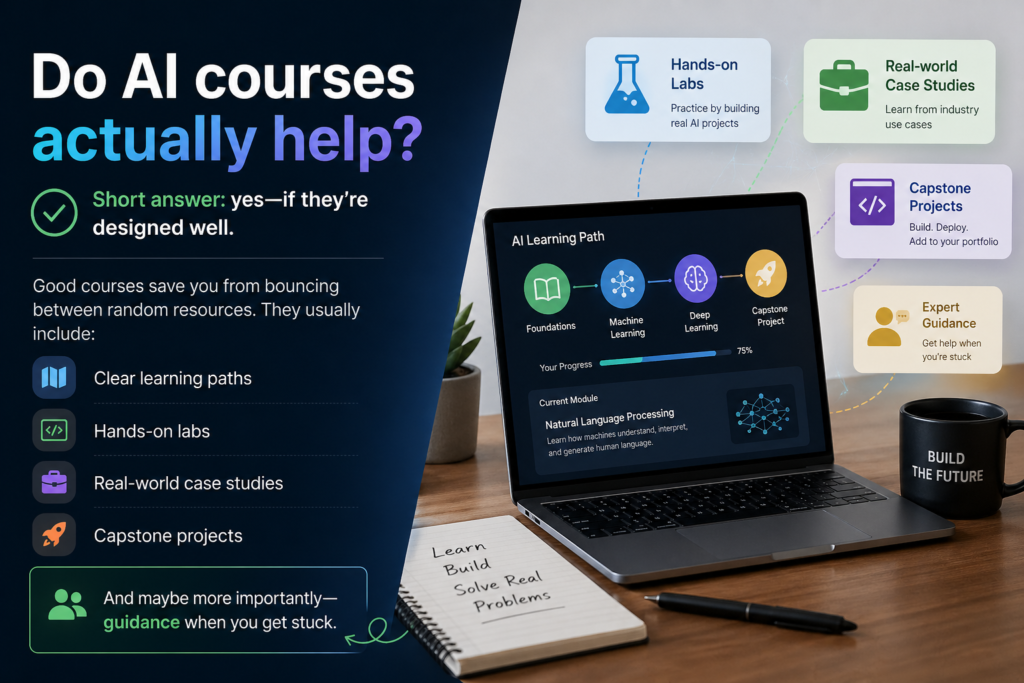
Short answer: yes if they’re designed well.
Good courses save you from bouncing become AI Skilled between random resources. They usually include:
- Clear learning paths
- Hands-on labs
- Real-world case studies
- Capstone projects
And maybe more importantly guidance when you get stuck.
What skills do you really need?
It’s a mix. Not just coding.
Core skills:
- Python programming
- Data preprocessing
- Machine learning basics
- Deep learning fundamentals
Supporting skills:
- Cloud platforms (AWS, Azure, GCP)
- APIs and integration
- Data visualization
- SQL
Nice-to-have (but valuable):
- NLP
- Computer vision
- Reinforcement learning
- Generative become AI Skilled workflows
You don’t need everything at once. Build gradually.
How AI actually works in real projects
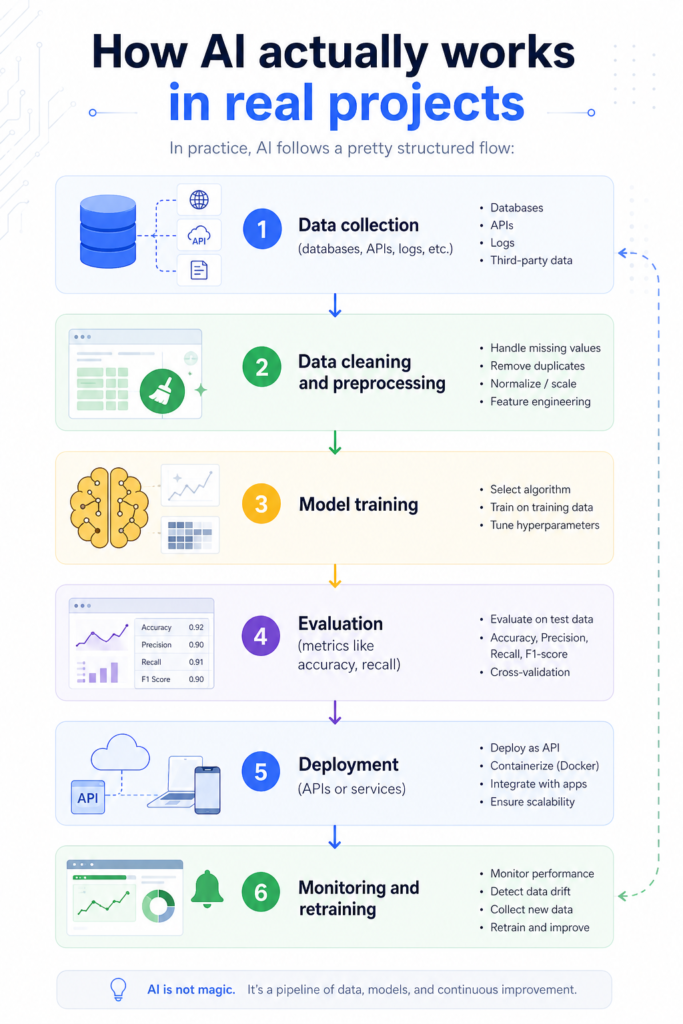
In practice, AI follows a pretty structured flow:
- Data collection (databases, APIs, logs, etc.)
- Data cleaning and preprocessing
- Model training
- Evaluation (metrics like accuracy, recall)
- Deployment (APIs or services)
- Monitoring and retraining
A simple example?
Customer support chatbot:
- User sends a query
- NLP model figures out intent
- System responds or escalates if needed
Sounds simple. It rarely is.
Where AI shows up in companies
You’ll see it across different areas:
- Sales forecasting and predictive analytics
- Automation (especially RPA + AI)
- Fraud detection
- Chatbots and recommendation engines
- IT operations (log analysis, anomaly detection)
And then there are constraints privacy laws, scalability issues, legacy systems. Real-world stuff.
Jobs that use AI regularly
It’s not limited to one role anymore.
- Data Scientists → model building
- ML Engineers → deployment and optimization
- Data Analysts → insights and reporting
- Software Engineers → integrating AI features
- DevOps Engineers → MLOps pipelines
- QA Engineers → AI-based testing
Even if your title doesn’t say “AI,” chances are you’ll still use it.
Career paths after learning AI
There’s quite a range:
- Machine Learning Engineer
- AI Engineer
- Data Scientist
- NLP Engineer
- AI Solutions Architect
- BI Analyst
Entry-level roles might start with data analysis. Advanced roles move toward architecture and strategy.
Tools you’ll likely use
A typical stack looks something like this:
- Programming: Python, R
- ML: Scikit-learn, TensorFlow, PyTorch
- Data: Pandas, Spark
- Visualization: Matplotlib, Tableau
- Deployment: Docker, Kubernetes
- MLOps: MLflow, Kubeflow
You don’t need to master all of them pick a stack and stick with it for a while.
Common challenges (and yeah, everyone faces them)
- Too many tools, not enough direction
- Struggling to apply theory
- Math feeling harder than expected
- Lack of real-world experience
- Handling large datasets
A few things that help:
- Focus on one toolset at a time
- Build small, consistent projects
- Start with clean, pre-built datasets
- Learn deployment earlier than you think you should
How long does it take?
Rough timeline:
- Fundamentals → 2–4 weeks
- Machine Learning → 4–6 weeks
- Advanced AI → 4–8 weeks
- Projects & deployment → ongoing
So overall, about 3–6 months if you stay consistent.
Quick FAQs
Do you need programming experience?
Basic Python helps—a lot.
Can non-IT folks learn become AI Skilled?
Yes, but expect a slightly longer ramp-up.
Theory vs practice?
Both matter, but practice tends to speed things up.
Best place to start?
Machine learning and data analysis are solid entry points.
Is cloud knowledge necessary?
Pretty much, yes—most AI systems run there.
Key takeaway become AI Skilled (if you skimmed everything)
If there’s one thing to remember:
You learn AI fastest by doing, not just reading.
Structured, become AI Skilled project-based learning works because it mirrors real work. Combine that with consistent practice, and you’ll build skills that actually stick not just concepts you forget in a week.
And yeah, a good course can help speed things up but only if you actually build alongside it.