If you’re trying to Learn Artificial Intelligence Online, the biggest mistake people make is hopping between random tutorials or just binge-watching videos and hoping it all clicks. It usually doesn’t. What actually works is having some kind of path even a loose one that mixes concepts, practice, and real projects.
That’s why structured learning approaches like those offered by H2K Infosys tend to be more effective. They guide you through the fundamentals while also pushing you to apply what you learn in practical scenarios, which is where real understanding starts to form.
From what I’ve seen (and honestly, learned the hard way), the people who really understand AI aren’t the ones who read the most they’re the ones who build stuff. Even small things. Especially small things.
A solid Courses of Artificial Intelligence helps, sure. But only if it forces you to do something use tools, write code, solve messy problems that feel at least somewhat real.
So… what even is AI?
At a basic level, Learn Artificial Intelligence Online is just about getting machines to do things that feel a bit like human thinking. Not perfectly just well enough to be useful.
Stuff like:
- Spotting patterns
- Making decisions
- Understanding language (kind of)
- Predicting what might happen next
It’s a huge field, though. When people say “AI,” they might mean:
- Machine Learning (ML)
- Deep Learning
- Natural Language Processing (NLP)
- Computer Vision
Most of this today runs on Python. And yeah, you’ll keep hearing about TensorFlow, PyTorch, Scikit-learn… they’re basically everywhere.
Why should you care about AI (even if it’s not your main job)?
This part surprises people.
AI isn’t just for data scientists anymore. It’s slowly creeping into almost every tech role.
- Automation is everywhere now. Things like ticket routing or anomaly detection? Often AI-driven.
- Decisions are more data-based than ever.
- It shows up in random places DevOps, cybersecurity, finance, healthcare… you name it.
- And once you get the basics, you can kind of move across domains more easily.
Even if you’re a developer or analyst or sysadmin having some Best Artificial Intelligence Course Online knowledge isn’t really “extra” anymore. It’s starting to feel like a baseline.
What’s the actual best way to Learn Artificial Intelligence Online?
1. Follow some kind of structure (seriously)
Learn Artificial Intelligence Online randomly sounds fun at first… until you realize you’re missing half the fundamentals.
A more realistic path looks like:
- Start with Python (get comfortable, don’t rush it)
- Pick up basic math (you don’t need to go crazy—just probability and linear algebra basics)
- Move into Machine Learning
- Then Deep Learning
- Then projects (this part matters more than people think)
Skipping steps feels faster. It usually isn’t.
2. Practice while you learn
You can’t just read your way into Learn Artificial Intelligence Online. It doesn’t work like that.
Try things like:
- Build a simple classification model
- Train a small neural network
- Clean messy datasets (this alone teaches a lot)
- Turn a model into a tiny API
It’ll feel rough at first. That’s normal.
3. Work on projects (this is where things click)
This is the turning point for most people.
Some beginner-friendly ideas:
- Predict customer churn
- Fraud detection
- Sentiment analysis (text stuff)
- Image classification
What’s nice is… these actually reflect real workflows:
- Get data (usually messy)
- Clean it
- Pick useful features
- Train a model
- See if it works (often it doesn’t at first)
- Improve it
It’s not glamorous, but it’s real.
4. Use real tools (not outdated stuff)
No point learning things nobody uses anymore.
Start with:
- Python
- Pandas / NumPy
- Scikit-learn
- TensorFlow or PyTorch
- Basic visualization tools
- Maybe Flask or Docker later
You don’t need all of them at once. That’s a trap people fall into.
5. Try to understand, not memorize
This one’s easy to ignore.
Don’t just copy code—figure out:
- Why something works
- When it breaks
- What trade-offs you’re making
Otherwise, the moment something changes slightly, you’re stuck.
6. Certifications… yeah, but don’t rely on them
They can help. Especially if they:
- Include hands-on labs
- Use real-world examples
- Walk through full workflows
But in most cases? A solid project portfolio beats a certificate.
What AI work actually looks like (in reality)
In real systems, it’s usually something like:
- Collect data (logs, APIs, databases)
- Clean it (this part is always bigger than expected)
- Build features
- Train models
- Evaluate them
- Deploy them
- Monitor and tweak over time
For example, fraud detection:
- Input: transaction data
- Model: looks for weird patterns
- Output: flags suspicious activity
Simple idea. Messy execution.
Skills you actually need
Technical:
- Python
- Data handling
- ML basics
- Stats & probability
Other stuff (just as important):
- Problem-solving
- Logical thinking
- Understanding what the business actually needs
Different roles need different depth:
- Analysts → data + basic ML
- Engineers → APIs, integration
- DevOps → deployment
- Business folks → use cases
Where AI shows up in companies
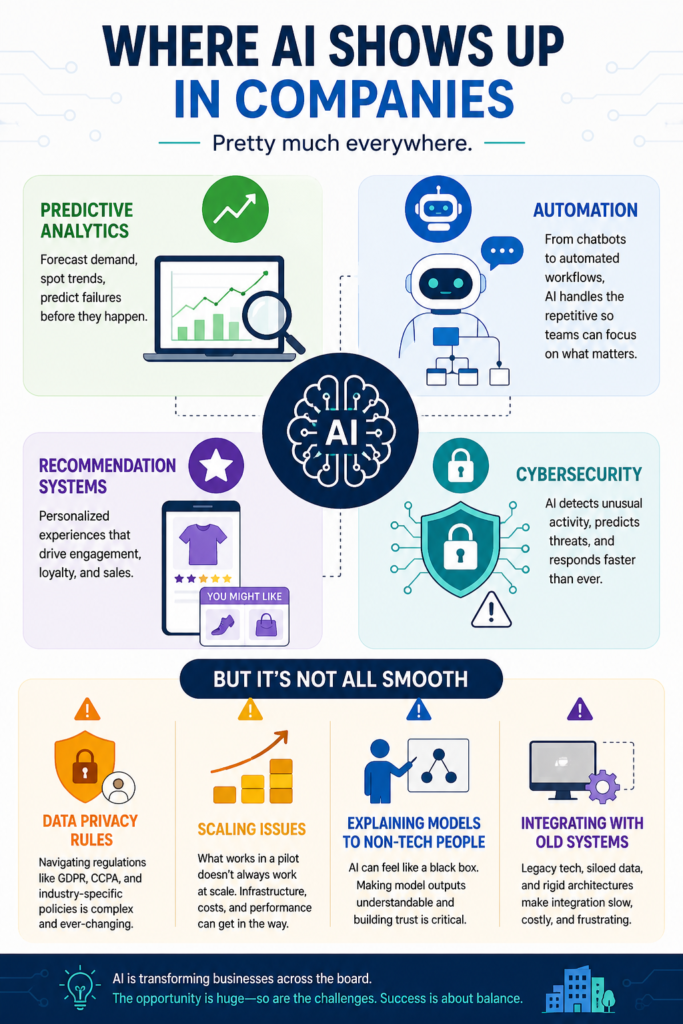
Pretty much everywhere now:
- Predictive analytics (demand, failures)
- Automation (chatbots, workflows)
- Recommendation systems
- Cybersecurity
But it’s not all smooth:
- Data privacy rules
- Scaling issues
- Explaining models to non-tech people
- Integrating with old systems
That last one… surprisingly painful.
Jobs that use AI regularly
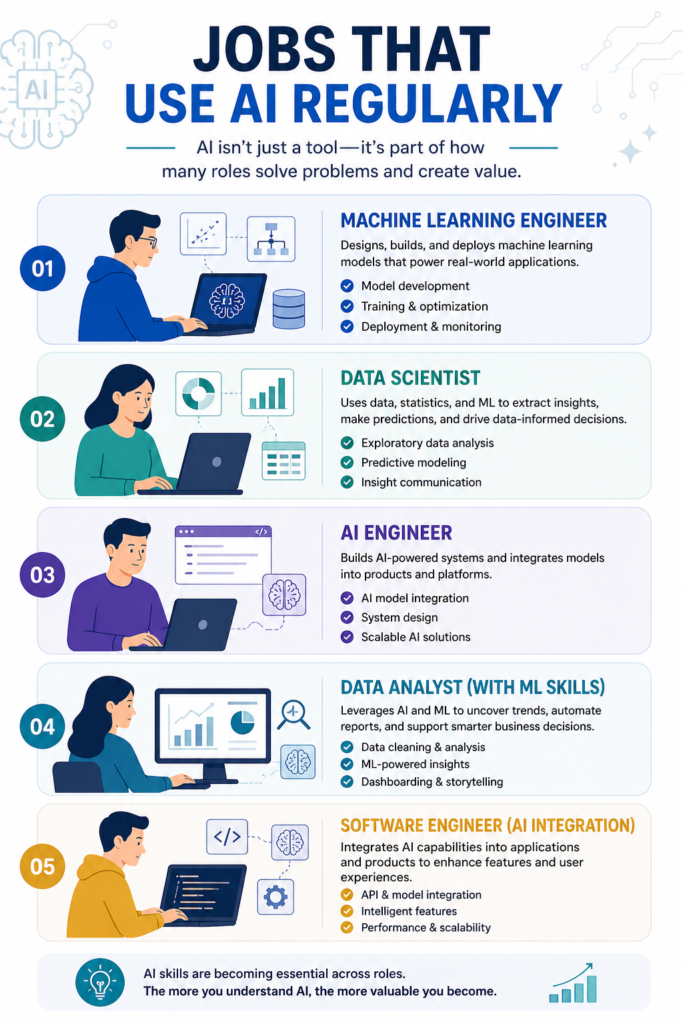
You’ll see roles like:
- Machine Learning Engineer
- Data Scientist
- AI Engineer
- Data Analyst (with ML skills)
- Software Engineer (AI integration)
Day-to-day work varies a lot:
- Building models
- Analyzing data
- Deploying systems
- Generating insights
Career paths (rough idea)
- Entry-level → junior analyst, ML intern
- Mid-level → data scientist, ML engineer
- Advanced → AI architect, lead roles
There’s flexibility you’re not locked into one track.
Picking the right course
Some are great. Some… not so much.
Look for:
- Clear structure
- Hands-on work
- Real projects
- Industry tools
If it’s all theory, you’ll struggle later.
If it skips fundamentals, same problem—just delayed.
Common struggles (everyone goes through this)
- No structure → things feel scattered
- Not enough practice → nothing sticks
- Too many tools → overwhelm
- Weak fundamentals → confusion later
Honestly, getting stuck is part of it.
A few practical tips
- Learn Artificial Intelligence Online properly before jumping ahead
- Practice regularly (even small things count)
- Build projects—even imperfect ones
- Focus on understanding, not memorizing
- Revisit basics more than once
Consistency matters more than intensity. Always.
Quick FAQs
How long does it take to Learn Artificial Intelligence Online?
Around 6–12 months if you’re consistent.
Do you need coding experience?
Basic Python helps a lot.
Is certification required?
No. Helpful sometimes, but not essential.
Can you skip math?
Not really. You can keep it light—but you’ll need some.
Best way to practice?
Projects. Real datasets if possible.
Are Learn Artificial Intelligence Online enough?
Yes—if they’re practical.
Key takeaways
- Structure helps more than you think
- Practice matters more than theory alone
- Real tools > outdated learning
- Projects > certificates (most of the time)
- Consistency beats everything else