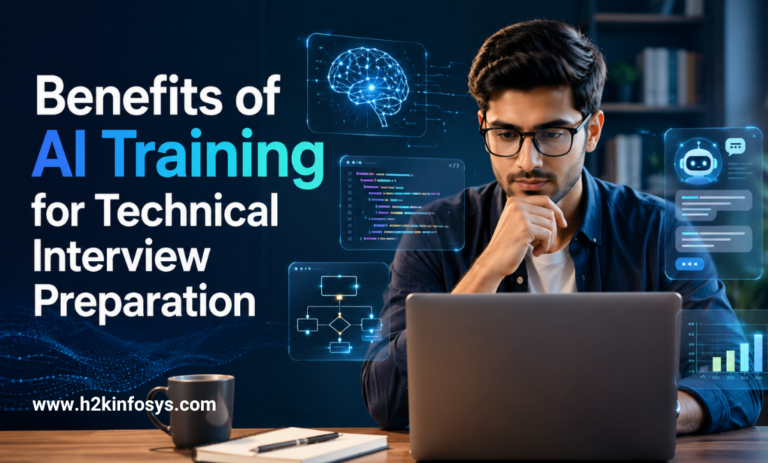
AI Training for Technical Interview Preparation can genuinely help candidates build the knowledge and confidence needed to perform well in technical interviews. Online AI training from H2K Infosys goes beyond theory by including practical projects, workflow-based learning, algorithm fundamentals, and exposure to enterprise AI tools. Strong programs do not simply explain concepts; they require learners to build solutions, troubleshoot models, and work through real implementation scenarios. This hands-on experience is often what improves problem-solving ability, technical communication, and overall interview readiness.
A structured Artificial Intelligence Certification Online program often gives candidates a stronger grasp of machine learning concepts, data processing, model evaluation, and production-style AI workflows the same areas hiring teams tend to focus on during technical interviews. And honestly, understanding the “why” behind a model matters just as much as getting the code to run.
A lot of modern AI Training for Technical Interview also include coding exercises, portfolio projects, mock interviews, and cloud-based AI labs. Those pieces matter more than people sometimes realize. Recruiters and interviewers typically want proof that candidates can apply knowledge in practical situations, not just repeat definitions from a course module.
What Is AI Training for Technical Interview?
Online AI Training for Technical Interview usually refers to structured virtual learning programs that teach artificial intelligence concepts, frameworks, tools, and implementation practices. These AI Training for Technical Interview programs are commonly designed for students, software developers, data analysts, cloud professionals, and working IT practitioners who want to transition into AI-focused roles or expand their technical skill set.
Most AI training paths cover areas like:
- Machine learning fundamentals
- Neural networks
- Deep learning
- Natural language processing (NLP)
- Computer vision
- Generative AI
- Python programming
- Data preprocessing
- Model deployment
- AI ethics and governance
Many AI Training for Technical Interview online programs combine several learning formats instead of relying only on lectures.
| Training Component | Purpose |
|---|---|
| Video lectures | Explain core concepts |
| Coding labs | Hands-on implementation |
| Assignments | Validate understanding |
| Capstone projects | Simulate real-world AI work |
| Assessments | Measure technical progress |
| Mock interviews | Prepare for hiring rounds |
These programs are usually hosted through learning platforms that support recorded sessions, live classes, cloud labs, project reviews, and collaborative exercises. Some even mimic enterprise workflows pretty closely, which helps learners feel less overwhelmed when they face production-style interview questions later.
Why AI Interview Preparation Matters for Working Professionals
AI Training for Technical Interview are often tougher than traditional software interviews because companies evaluate multiple skill areas at the same time. Candidates may need to demonstrate programming ability, analytical thinking, data handling skills, and an understanding of machine learning workflows all in one process.
Interviewers frequently assess areas such as:
- Statistical reasoning
- Feature engineering
- Model optimization
- Python programming
- Data pipelines
- Cloud AI services
- Problem-solving methodology
For working professionals moving into AI roles, the challenge is usually not technical intelligence it’s the transition itself. Someone with software engineering or infrastructure experience may already understand systems and development practices but still need structured exposure to:
- AI terminology
- Model evaluation techniques
- Data preprocessing workflows
- Enterprise AI architecture
- Applied machine learning pipelines
That gap is exactly where AI Training for Technical Interview tends to help most.
How AI Training Helps During Technical Interviews
Building Strong Fundamentals
Most AI Training for Technical Interview begin with conceptual questions before moving into coding or system design discussions.
Typical examples include:
- Difference between supervised and unsupervised learning
- Bias-variance tradeoff
- Overfitting vs. underfitting
- Classification vs. regression
- Gradient descent
- Neural network optimization
Courses of AI Training for Technical Interview usually organize these topics progressively, which makes learning feel less chaotic. Instead of jumping randomly between advanced topics, learners build understanding layer by layer.
| Concept Area | Interview Relevance |
|---|---|
| Linear regression | Core ML fundamentals |
| Decision trees | Model explainability |
| Neural networks | Deep learning interviews |
| Clustering | Data analysis scenarios |
| NLP | Text-processing applications |
| Feature engineering | Production ML workflows |
That structure often helps candidates answer interview questions more naturally and with better clarity.
Improving Practical Coding Skills
Most AI Training for Technical Interview include coding assessments at some stage. Candidates may be asked to:
- Write Python functions
- Process datasets
- Build ML pipelines
- Explain algorithm complexity
- Debug training issues
- Optimize workflows
Online AI Training for Technical Interview programs usually include hands-on labs using tools like:
- Python
- Jupyter Notebook
- NumPy
- Pandas
- Scikit-learn
- TensorFlow
- PyTorch
These aren’t just academic tools they’re heavily used in enterprise environments.
A typical workflow learners practice might look something like this:
- Import raw business data
- Clean missing values
- Transform features
- Train a machine learning model
- Tune hyperparameters
- Evaluate accuracy
- Prepare for deployment
That’s pretty close to how real AI teams work in production systems.
How AI Works in Real Enterprise Projects
AI implementation inside companies usually follows structured development lifecycles similar to standard software engineering practices.
| Phase | Description |
|---|---|
| Data collection | Gathering structured or unstructured data |
| Data preprocessing | Cleaning and transforming datasets |
| Model selection | Choosing suitable algorithms |
| Training | Building predictive models |
| Validation | Measuring model performance |
| Deployment | Integrating models into applications |
| Monitoring | Tracking drift and reliability |
Good AI Training for Technical Interview programs expose learners to these workflows through guided projects instead of isolated textbook exercises.
Take customer support automation as an example.
A real-world workflow might involve:
- Collecting support tickets
- Cleaning and preprocessing text data
- Training an NLP classification model
- Categorizing ticket priority
- Deploying a chatbot or recommendation engine
Interviewers often ask candidates to walk through workflows like this because it reveals whether they understand practical implementation not just theory.
Skills Needed to Learn AI
AI learning usually combines technical knowledge with analytical thinking. The good news is that many beginner-friendly programs are designed for professionals who don’t come from research or mathematics-heavy backgrounds.
Core Technical Skills
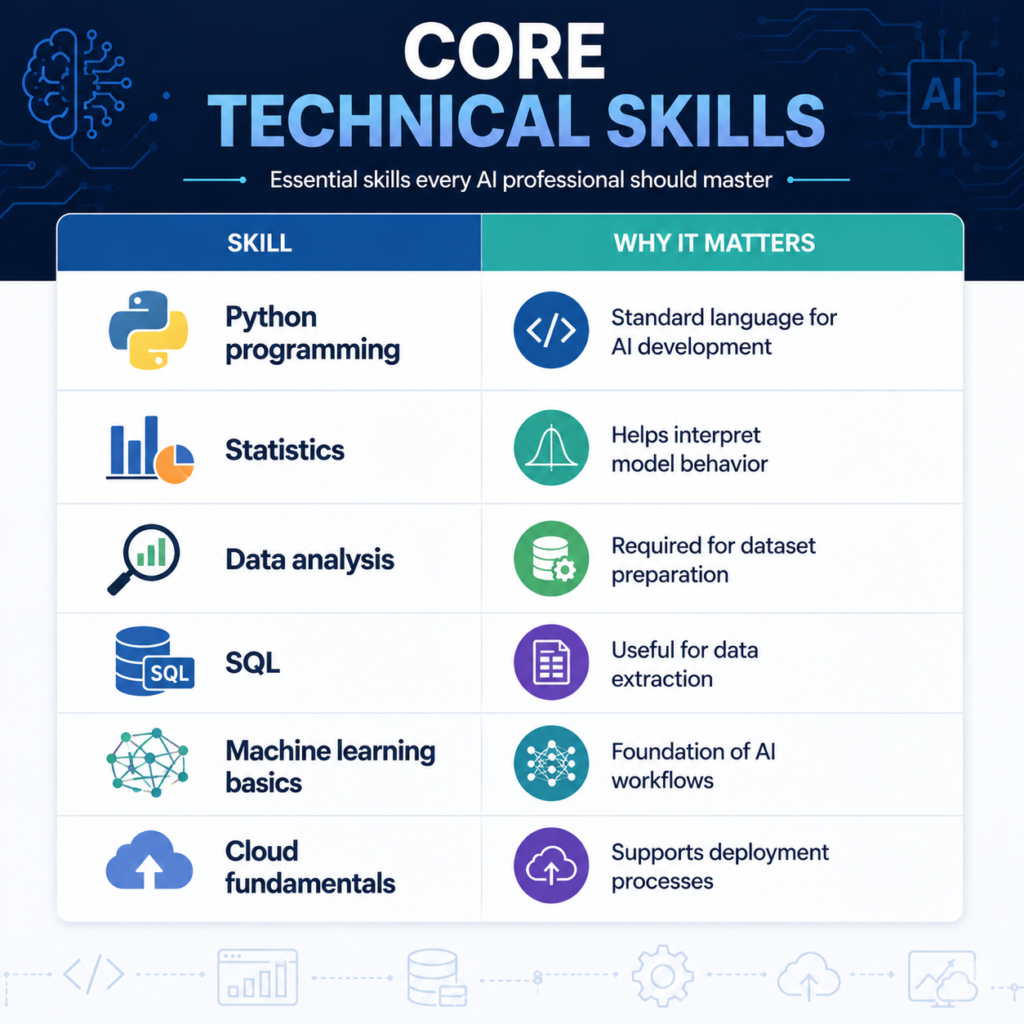
| Skill | Why It Matters |
|---|---|
| Python programming | Standard language for AI development |
| Statistics | Helps interpret model behavior |
| Data analysis | Required for dataset preparation |
| SQL | Useful for data extraction |
| Machine learning basics | Foundation of AI workflows |
| Cloud fundamentals | Supports deployment processes |
Enterprise environments also increasingly expect familiarity with:
- Git and version control
- API integration
- Docker basics
- MLOps concepts
- Cloud AI platforms
- Data governance practices
A lot of Ai Certified Courses now include these operational skills because real-world AI projects involve collaboration across engineering, infrastructure, analytics, and business teams.
How AI Is Used in Enterprise Environments
AI is now embedded into everyday business systems across multiple industries.
Healthcare
- Medical image analysis
- Predictive diagnostics
- Patient data analytics
Finance
- Fraud detection
- Risk modeling
- Trading analysis
Retail
- Recommendation engines
- Inventory forecasting
- Customer segmentation
Cybersecurity
- Threat detection
- Behavioral analytics
- Security anomaly monitoring
Manufacturing
- Predictive maintenance
- Quality inspection
- Process optimization
Technical interviews often include scenario-based discussions around these kinds of applications because companies want candidates who can think beyond isolated algorithms.
Common AI Tools Candidates Should Know
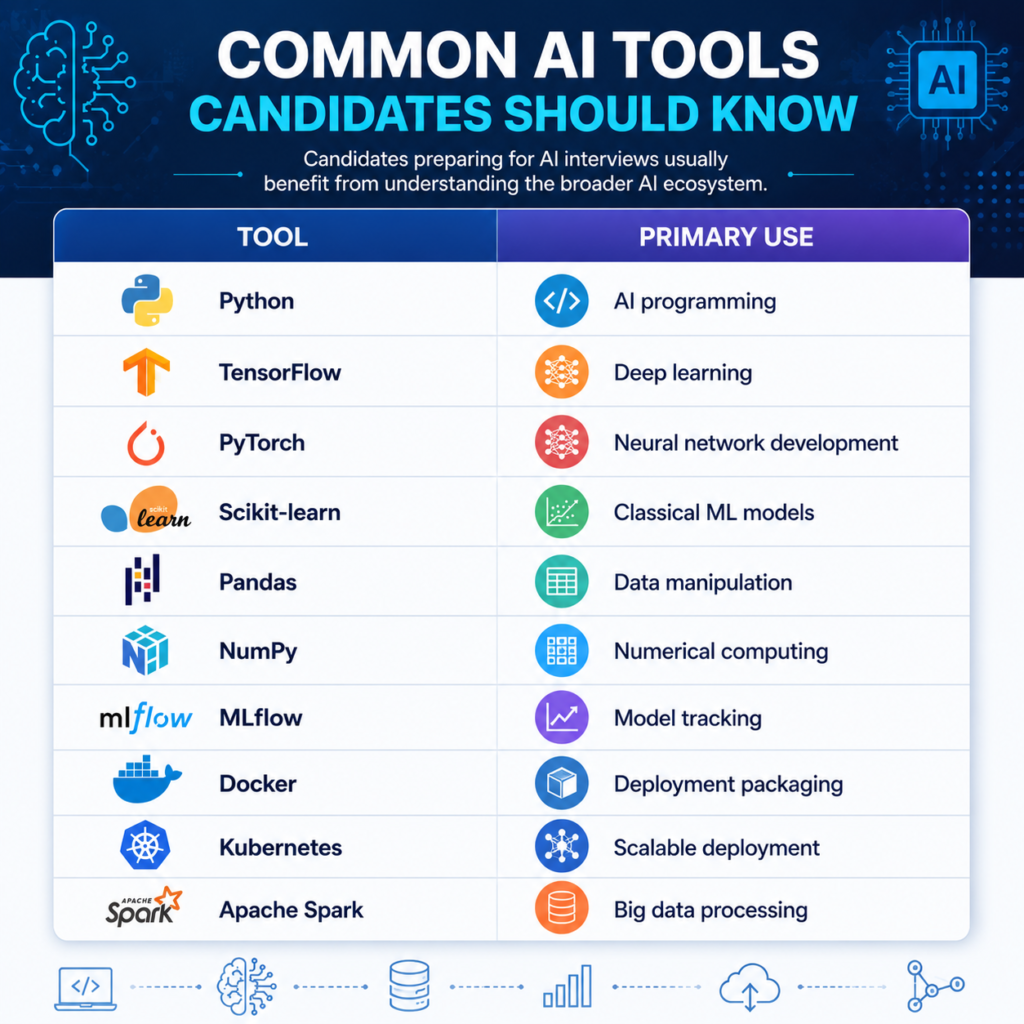
Candidates preparing for AI interviews usually benefit from understanding the broader AI ecosystem.
| Tool | Primary Use |
|---|---|
| Python | AI programming |
| TensorFlow | Deep learning |
| PyTorch | Neural network development |
| Scikit-learn | Classical ML models |
| Pandas | Data manipulation |
| NumPy | Numerical computing |
| MLflow | Model tracking |
| Docker | Deployment packaging |
| Kubernetes | Scalable deployment |
| Apache Spark | Big data processing |
Interviewers often care less about memorizing syntax and more about understanding when and why specific tools are used.
How AI Courses Improve Problem-Solving
Interview preparation is rarely about memorizing answers. Most hiring teams want to evaluate how candidates approach technical problems.
Online AI Training for Technical Interview often improves this through:
- Debugging exercises
- Dataset analysis labs
- Model optimization tasks
- Business case studies
- Performance tuning assignments
For example, an interviewer might ask:
“Your model accuracy dropped after deployment. What would you investigate first?”
Someone with project-based AI training might discuss:
- Data drift
- Feature inconsistencies
- Training-serving skew
- Incorrect preprocessing
- Imbalanced data
- Infrastructure latency
That type of troubleshooting mindset usually comes from practical exposure, not passive learning.
Can Online AI Training Help With Machine Learning Interviews?
In many cases, yes.
Machine learning interviews often combine theory, coding, and applied reasoning.
| Interview Area | Example Questions |
|---|---|
| Algorithms | Explain random forest |
| Statistics | What is standard deviation? |
| Coding | Build a classification model |
| Data preprocessing | Handle missing values |
| Evaluation metrics | Precision vs. recall |
| Optimization | Reduce overfitting |
Most solid AI Training for Technical Interview are built around these exact domains because they reflect real production challenges.
AI-Related Job Roles
AI skills are relevant across a wide range of technical and analytical roles now.
| Role | Typical Responsibility |
|---|---|
| Machine Learning Engineer | Build predictive systems |
| Data Scientist | Analyze and interpret data |
| AI Engineer | Deploy AI applications |
| NLP Engineer | Work on language-based systems |
| Computer Vision Engineer | Build image-processing models |
| Data Analyst | Support business intelligence |
| MLOps Engineer | Manage deployment pipelines |
Some roles lean more toward research, while others focus heavily on implementation and operational workflows.
Why Projects Matter So Much
Projects are often one of the strongest indicators of readiness during AI interviews.
Recruiters usually look for evidence of:
- Practical implementation ability
- Technical reasoning
- Workflow understanding
- Documentation quality
- Communication skills
Strong AI projects typically include:
| Good Practice | Why It Matters |
|---|---|
| Clean datasets | Shows preprocessing ability |
| Model comparison | Demonstrates analytical thinking |
| Evaluation metrics | Reflects practical understanding |
| Deployment workflow | Indicates production awareness |
| GitHub documentation | Improves technical presentation |
Honestly, projects tend to speak louder than certifications alone.
Challenges Beginners Commonly Face
AI learning isn’t always straightforward, especially early on.
Common challenges include:
Mathematics
Topics like:
- Linear algebra
- Probability
- Statistics
- Optimization
can feel intimidating at first.
Large Datasets
Enterprise datasets often contain:
- Missing values
- Inconsistent formatting
- Imbalanced records
- High-dimensional data
Model Tuning
Candidates eventually need to understand:
- Hyperparameters
- Feature selection
- Cross-validation
- Evaluation metrics
Structured AI Training for Technical Interview helps people build these skills gradually instead of trying to absorb everything at once.
What Makes an AI Certification Program Valuable?
Not every program provides the same depth or practical exposure.
The more useful ones usually include:
- Hands-on coding labs
- Real-world projects
- Cloud AI workflows
- Version control practices
- Deployment concepts
- Mock interviews
- Resume reviews
- Technical assessments
Cloud exposure is especially valuable now because enterprise AI environments often rely on:
- AWS AI services
- Azure Machine Learning
- Google Vertex AI
Programs that combine implementation with interview preparation generally provide better career value for working professionals.
How Long AI Interview Preparation Usually Takes
Preparation timelines vary a lot depending on background and consistency.
| Background | Approximate Timeline |
|---|---|
| Software developer | 4–8 months |
| Data analyst | 3–6 months |
| Beginner IT professional | 6–12 months |
| Non-technical learner | 12+ months |
Project-based learning usually works better than endless video watching. Most people start improving faster once they begin building and troubleshooting actual models.
FAQ: AI Training and Interview Preparation
Does online AI training help beginners?
Yes. Many AI Training for Technical Interview programs introduce programming, statistics, and machine learning gradually through guided projects and exercises.
Are certifications enough to get AI jobs?
Usually not by themselves. Employers often evaluate projects, coding skills, and interview performance alongside certifications.
Which programming language matters most for AI interviews?
Python remains the most widely used language for AI and machine learning interviews.
Do AI interviews require mathematics?
Yes. Basic probability, statistics, and linear algebra concepts are commonly assessed.
Are projects important?
Definitely. Projects help candidates demonstrate applied skills and workflow understanding.
Which industries hire AI professionals?
Healthcare, finance, cybersecurity, retail, manufacturing, logistics, and cloud technology sectors all actively use AI systems.
Can working professionals learn AI online?
Yes. Many AI Training for Technical Interview are specifically structured for working professionals with flexible schedules and project-focused learning.
Key Takeaways
AI Training for Technical Interview can significantly improve technical interview readiness when it combines theory with practical implementation. The strongest artificial intelligence certification online programs usually focus on coding, machine learning workflows, enterprise tools, cloud environments, and hands-on projects rather than only academic content.
Projects matter. Real workflow exposure matters even more.
Enterprise AI environments also require awareness of scalability, monitoring, deployment, security, and operational collaboration areas that many modern AI programs now include as part of training.
For working professionals, structured learning combined with consistent project practice often creates a smoother path into AI and machine learning careers.
Explore H2K Infosys AI Training for Technical Interview programs to gain hands-on exposure to enterprise AI tools, real-world workflows, and technical interview preparation strategies designed for professionals building careers in AI and machine learning.