Artificial Intelligence (AI) is basically about building computer systems that can handle tasks we normally associate with the human thinking things like recognizing patterns, making decisions, understanding language, or even predicting outcomes based on data. These days, an Artificial Intelligence Engineer Course at H2K Infosys usually goes far beyond theory. Best Artificial Intelligence Online Training in the USA programs focus on practical skills: machine learning, deep learning, data pipelines, model deployment, and how AI actually fits into real business environments.
What makes modern AI interesting is how deeply it’s woven into everyday enterprise operations. You’ll find AI running behind the scenes in healthcare systems, financial platforms, retail analytics, cybersecurity tools, manufacturing automation, and cloud applications. So learning AI today isn’t just about algorithms anymore. Professionals are expected to know how to build and deploy solutions using tools like Python, TensorFlow, PyTorch, Scikit-learn, OpenAI APIs, cloud AI services, and MLOps workflows. That’s become pretty standard in the industry.
What Is Artificial Intelligence?
At its core, Artificial Intelligence is a branch of computer science focused on creating systems that imitate certain aspects of human intelligence. AI systems are built to analyze information, spot patterns, automate repetitive work, generate predictions, and improve efficiency especially in large-scale environments where manual processes become difficult to manage.
AI itself covers several specialized areas:
| AI Domain | Primary Purpose | Common Use Cases |
|---|---|---|
| Machine Learning | Learning patterns from data | Fraud detection, recommendations |
| Deep Learning | Neural network-driven learning | Image recognition, NLP |
| Natural Language Processing (NLP) | Understanding human language | Chatbots, virtual assistants |
| Computer Vision | Interpreting images and video | Facial recognition, inspections |
| Generative AI | Creating new content | AI copilots, text/image generation |
| Reinforcement Learning | Learning through feedback | Robotics, autonomous systems |
In enterprise IT environments, AI usually doesn’t operate in isolation. It’s tied into cloud platforms, APIs, automation systems, databases, and large-scale data infrastructure.
Why AI Matters for Working Professionals
A few years ago, AI knowledge was mostly limited to researchers or specialized data science teams. That’s changed fast. Companies across industries are integrating predictive systems and automation directly into their workflows, and now even software engineers, cloud professionals, analysts, and DevOps teams are expected to understand the basics of AI implementation.
Some common reasons professionals start learning AI include
- Automating repetitive operational work
- Building predictive analytics systems
- Improving customer support with AI chat systems
- Detecting cybersecurity threats more efficiently
- Supporting cloud-native AI applications
- Working with enterprise-scale data pipelines
- Developing recommendation engines and intelligent search systems
AI skills now overlap with several technical roles, including:
- Software engineering
- Data engineering
- Cloud architecture
- DevOps and MLOps
- Business intelligence
- Data science
- Product engineering
A lot of professionals don’t completely switch careers when they learn AI. Instead, they layer AI capabilities onto their existing expertise cloud, software development, analytics, security, things like that.
What an Best Artificial Intelligence Online Training in the USA Course Usually Covers
Most Artificial Intelligence Online Training in the USA combine programming, machine learning concepts, enterprise deployment practices, and real-world workflows. The stronger programs tend to emphasize implementation over pure academic theory.
Programming for AI
Python remains the dominant language in AI development because the ecosystem around it is massive and mature. Students generally work with tools like:
- Python
- NumPy
- Pandas
- Jupyter Notebook
- Scikit-learn
Machine Learning Fundamentals
This is where learners typically start building predictive models and understanding how systems learn from data.
Common topics include:
- Supervised learning
- Unsupervised learning
- Regression models
- Classification algorithms
- Clustering techniques
- Model evaluation methods
Deep Learning
Deep learning modules usually move into neural networks and advanced architectures. This part can feel intimidating at first, honestly, but it becomes manageable once you start building projects.
Typical concepts include:
- Neural networks
- CNNs (Convolutional Neural Networks)
- RNNs and LSTMs
- Transformer architectures
- GPU-based model training
Natural Language Processing (NLP)
NLP focuses on how systems process and understand human language.
Training often includes:
- Text preprocessing
- Tokenization
- Sentiment analysis
- Language models
- Chatbot workflows
Generative AI
Most modern Artificial Intelligence Online Training in the USA now include Generative AI because enterprises are actively adopting it.
Topics often cover:
- Large Language Models (LLMs)
- Prompt engineering
- Retrieval-Augmented Generation (RAG)
- AI copilots
- OpenAI and Hugging Face integrations
MLOps and Deployment
This part is increasingly important because companies care about operational AI not just training models in notebooks.
Common deployment topics include:
- Docker
- Kubernetes
- ML pipelines
- CI/CD for AI systems
- Monitoring and logging
- Model versioning
How AI Works in Real IT Projects
In production environments, AI systems usually follow a structured lifecycle from raw data collection to deployment and monitoring.
| Stage | Description | Common Tools |
|---|---|---|
| Data Collection | Gather business data | SQL, APIs, Kafka |
| Data Preparation | Clean and transform data | Pandas, Spark |
| Feature Engineering | Prepare model inputs | Scikit-learn |
| Model Training | Train AI models | TensorFlow, PyTorch |
| Validation | Evaluate model accuracy | MLflow |
| Deployment | Push models to production | Docker, Kubernetes |
| Monitoring | Track model performance | Prometheus, Grafana |
Take customer support AI as an example. A company might collect historical support tickets, clean and categorize the text, train an NLP model, expose APIs for ticket classification, then monitor prediction accuracy over time.
And that’s where enterprise AI gets complicated. Real production systems have to deal with latency, scalability, security compliance, throughput limits, privacy concerns, and bias mitigation. Those operational realities matter just as much as the model itself.
Skills Helpful for Learning AI
You don’t necessarily need an advanced math background to start learning AI, despite what people sometimes assume online. Still, having a few technical fundamentals definitely helps.
| Skill Area | Importance |
|---|---|
| Basic Programming | Essential |
| Python Fundamentals | Highly Recommended |
| Mathematics | Moderately Important |
| Statistics | Important |
| SQL and Databases | Useful |
| Cloud Computing | Increasingly Relevant |
Some mathematical concepts used in AI include:
- Linear algebra
- Probability
- Statistics
- Gradient descent
- Optimization methods
That said, many enterprise-focused Artificial Intelligence Online Training in the USA emphasize practical implementation rather than heavy academic theory.
How Enterprises Use AI
Most enterprise AI adoption revolves around automation, operational efficiency, analytics, and scalability.
Financial Services
AI is commonly used for:
- Fraud detection
- Credit scoring
- Risk modeling
- Transaction monitoring
Healthcare
Healthcare systems use AI for:
- Medical image analysis
- Predictive patient analytics
- Workflow automation
Retail and E-Commerce
Retail platforms rely on AI for:
- Recommendation engines
- Inventory forecasting
- Customer behavior analysis
Cybersecurity
AI-powered security systems help identify:
- Threat patterns
- Suspicious activity
- Malware indicators
Manufacturing
Manufacturing organizations apply AI to:
- Predictive maintenance
- Defect detection
- Supply chain optimization
Most enterprise AI systems integrate closely with cloud infrastructure, databases, APIs, and monitoring tools rather than functioning as standalone applications.
Common AI Tools Used in Industry
AI professionals usually work across multiple tools and platforms at the same time.
| Category | Tools |
|---|---|
| Programming | Python, R |
| ML Libraries | Scikit-learn, XGBoost |
| Deep Learning | TensorFlow, PyTorch |
| Data Processing | Spark, Pandas |
| Visualization | Matplotlib, Tableau |
| MLOps | MLflow, Kubeflow |
| Containerization | Docker |
| Orchestration | Kubernetes |
| Cloud AI Platforms | AWS SageMaker, Azure ML, Google Vertex AI |
| Version Control | Git, GitHub |
Realistically, enterprise AI work is rarely about mastering one tool. It’s more about understanding how different systems fit together.
Why Hands-On Learning Matters in AI
Reading theory helps, but AI becomes much clearer once you start building and debugging projects yourself. Most professionals really improve through implementation work.
Common hands-on exercises include:
Data Cleaning Tasks
Learners often work with:
- Missing data
- Duplicate records
- Normalization
- Feature scaling
Model Training Labs
Projects commonly involve:
- Regression models
- Classification systems
- Hyperparameter tuning
- Cross-validation
Deep Learning Projects
Examples might include:
- Image classification
- Object detection
- Text summarization
- Sentiment analysis
Deployment Projects
More advanced labs may involve:
- Building REST APIs
- Deploying models to cloud platforms
- Creating Docker containers
- Monitoring inference performance
That deployment side is something a lot of beginners underestimate until they hit real-world environments.
Common Challenges AI Teams Face
AI implementation sounds straightforward on paper, but production systems introduce a lot of complexity.
Data Quality Problems
Poor-quality data can seriously reduce model accuracy. In practice, teams often spend more time preparing data than training models.
Model Drift
Over time, production data changes. Models that performed well initially may become less accurate unless they’re retrained and monitored regularly.
Scalability Issues
Large AI systems require:
- GPU resources
- High-throughput infrastructure
- Efficient storage systems
Security and Compliance
Organizations also have to manage:
- Sensitive customer data
- Regulatory compliance
- Access control
- Encryption requirements
Explainability
Certain industries — especially finance and healthcare — require AI systems to be interpretable and auditable.
Because of this, responsible AI and governance discussions are becoming common parts of professional AI training programs.
Job Roles That Use AI
AI skills now show up across a wide range of technical and business-oriented roles.
| Job Role | Primary Responsibilities |
|---|---|
| AI Engineer | Build and deploy AI systems |
| Machine Learning Engineer | Train and optimize models |
| Data Scientist | Analyze business data |
| NLP Engineer | Develop language systems |
| MLOps Engineer | Manage deployment pipelines |
| Data Engineer | Build scalable infrastructure |
| AI Solutions Architect | Design enterprise AI systems |
| Business Intelligence Analyst | Use predictive analytics |
Some professionals focus heavily on research, while others concentrate on operational deployment and enterprise integration.
Career Paths After AI Training
Artificial Intelligence Online Training in the USA can support both career transitions and skill expansion for existing IT professionals.
Entry-Level Roles
- Junior AI Engineer
- Data Analyst
- ML Associate
- AI Support Engineer
Mid-Level Roles
- Machine Learning Engineer
- AI Developer
- NLP Specialist
- AI Platform Engineer
Advanced Roles
- AI Architect
- Lead Data Scientist
- MLOps Specialist
- AI Product Engineer
Career growth usually depends on a combination of project experience, cloud knowledge, deployment expertise, and domain specialization.
How Long It Usually Takes to Learn AI
Learning timelines vary depending on prior technical experience.
| Experience Level | Estimated Timeline |
|---|---|
| Beginner | 6–12 months |
| Software Developer | 4–8 months |
| Data Professional | 3–6 months |
| Cloud Engineer | 4–7 months |
Most professionals learn AI gradually through:
- Programming fundamentals
- Machine learning basics
- Deep learning concepts
- Real-world projects
- Deployment practices
It’s rarely a one-shot learning process. Even experienced engineers keep adapting because the AI ecosystem changes constantly.
What to Look for in an AI Training Program
Choosing the right AI Training Program matters more than people sometimes realize. A course can look impressive on paper but still feel disconnected from real enterprise work.
A few things worth evaluating:
Industry-Relevant Curriculum
Good programs should cover:
- Modern AI frameworks
- Cloud deployment
- Generative AI concepts
- Enterprise workflows
Hands-On Projects
Project-based learning helps reinforce:
- Model development
- Deployment practices
- Troubleshooting
- Performance optimization
Experienced Instructors
Instructors with production experience often provide valuable insights around architecture decisions, operational trade-offs, and implementation best practices.
Cloud and Deployment Exposure
Modern AI systems are heavily cloud-driven, so familiarity with AWS, Azure, or Google Cloud has become increasingly important.
How Generative AI Is Changing Enterprise Training
Generative AI is influencing how organizations build automation tools, internal assistants, and enterprise search systems.
Common enterprise use cases include:
- Internal knowledge assistants
- Customer service copilots
- Code generation tools
- Automated summarization
- Intelligent enterprise search
Skills now commonly included in AI programs:
| Skill | Practical Application |
|---|---|
| Prompt Engineering | Improving AI output quality |
| Vector Databases | Semantic search |
| RAG Pipelines | Enterprise knowledge retrieval |
| LLM APIs | AI integration |
| AI Governance | Compliance and risk management |
Generative AI is increasingly treated as part of broader enterprise AI engineering rather than a completely separate discipline.
AI vs Machine Learning vs Deep Learning
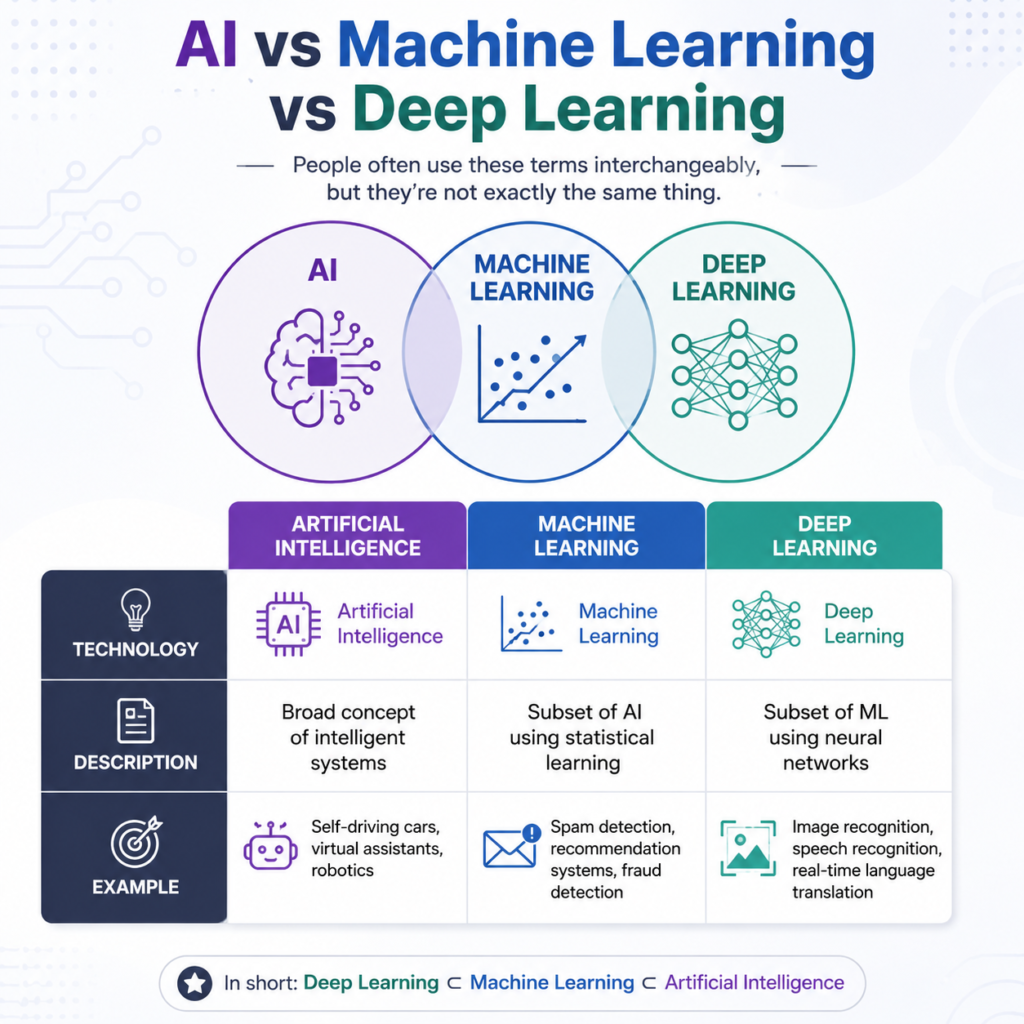
People often use these terms interchangeably, but they’re not exactly the same thing.
| Technology | Description |
|---|---|
| Artificial Intelligence | Broad concept of intelligent systems |
| Machine Learning | Subset of AI using statistical learning |
| Deep Learning | Subset of ML using neural networks |
Artificial Intelligence Online Training in the USA, Machine learning and deep learning are essentially techniques used to build AI systems.
Frequently Asked Questions
Is coding required to learn AI?
Yes, in most cases. Python is especially important because it’s widely used across AI and machine learning development.
Which programming language is most common in AI?
Python remains the industry standard due to its large ecosystem of AI libraries and frameworks.
Is cloud knowledge important for AI engineers?
Definitely. Many AI systems are deployed using AWS, Azure, or Google Cloud infrastructure, so cloud skills are becoming increasingly valuable.
Can working professionals learn AI part-time?
Yes. Many Artificial Intelligence Online Training in the USA programs are designed for part-time learners and include flexible online schedules with project-based learning.
What industries hire AI professionals?
Healthcare, finance, retail, manufacturing, cybersecurity, logistics, and software development are among the biggest adopters of AI talent right now.
Does Artificial Intelligence Online Training in the USA include deployment skills?
Many enterprise-focused programs now include Docker, Kubernetes, MLOps, and cloud deployment practices alongside model development.
What is MLOps?
MLOps refers to the operational processes used to deploy, monitor, maintain, and scale machine learning models in production environments.
Are AI certifications important?
Certifications can help validate structured learning, though employers usually place significant value on hands-on projects and practical experience too.
Key Takeaways
Artificial Intelligence combines machine learning, deep learning, NLP, automation, and predictive technologies into systems that solve real business problems.
A modern Artificial Intelligence Online Training in the USA typically covers programming, model development, deployment workflows, cloud integration, MLOps, and increasingly, generative AI.
Enterprise AI projects also involve operational realities like scalability, monitoring, security, compliance, and infrastructure management not just algorithms.
Professionals with AI expertise commonly work across software engineering, analytics, cloud computing, enterprise automation, and data-driven product development.
Hands-on projects, deployment exposure, and real-world implementation experience are often what separate practical AI training from purely theoretical learning.
Explore H2K Infosys Artificial Intelligence Online Training in the USA to gain practical exposure to enterprise AI tools, workflows, and real-world project environments. Their AI training programs focus on hands-on implementation and long-term skill development aligned with modern IT industry needs.