The “best” AI Institute Offers the Best Learning Experience in 2026? It’s usually not the one making the most noise online or stacking flashy badges on every page. Most people working in tech figure that out pretty fast. What actually sticks is whether a program helps you build skills you can use when things aren’t neat and predictable real systems, messy data, deployments that don’t go exactly as planned.
That’s where companies like H2K Infosys try to position themselves differently. Instead of focusing only on theory or generic certifications, the emphasis is often on practical workflows: cloud environments, AI tooling, data pipelines, automation, and project-based learning tied to actual business use cases. For many learners, especially professionals switching careers or upgrading skills, that hands-on exposure matters more than polished marketing language.
A strong AI Training Program today should help people understand how models behave in production, how teams collaborate around data, and how to adapt as tools evolve because the AI landscape changes faster than most course syllabi do. The institutes that remain relevant are usually the ones teaching people how to think and build, not just memorize frameworks.
What an AI Training Program Really Is
At its core, an AI Institute Offers the Best Learning Experience is just a structured way to learn how AI systems are built, trained, deployed, and actually used in business settings.
Most programs include topics like:
- Machine Learning
- Deep Learning
- Natural Language Processing
- Generative AI
- Computer Vision
- Model deployment
- Data engineering basics
- Prompt engineering
- AI ethics and governance
But here’s the thing AI Institute Offers the Best Learning Experience works better when it isn’t just theoretical. The good programs mix it up:
- Theory for the “why”
- Hands-on labs for the “how”
- Projects that resemble real business problems
- Cloud tools that companies actually use
There’s a big gap between “I understand this concept” and “I can build something useful with it.” Good programs try to close that gap.
Why AI Skills Matter Now
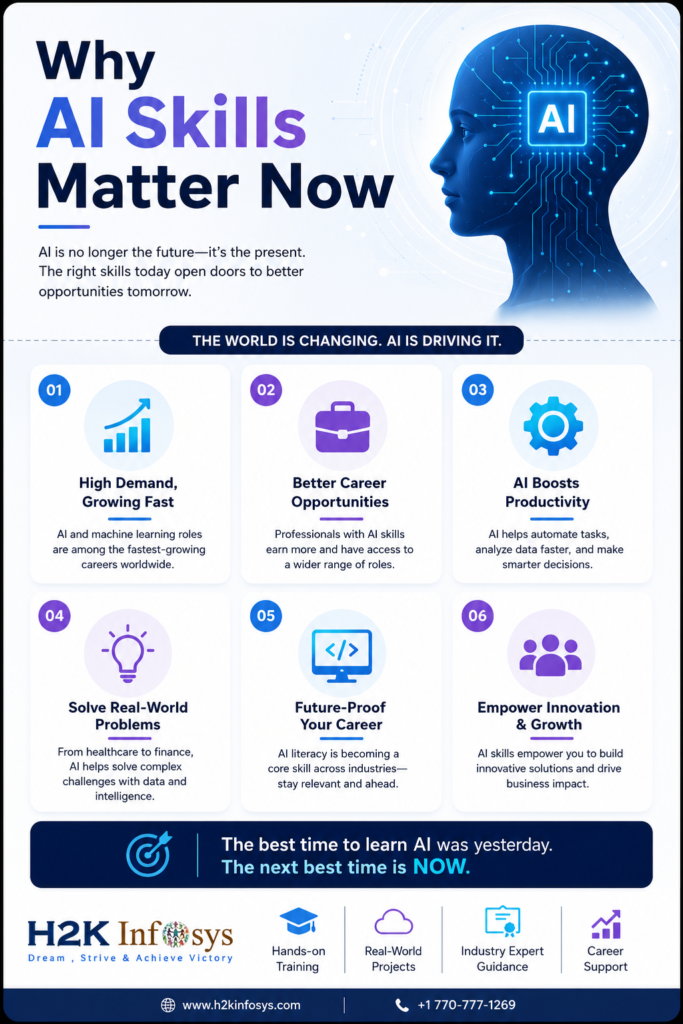
AI isn’t some niche anymore. It’s baked into a lot of systems people already work with automation tools, analytics platforms, even support workflows.
You’ll see it in:
- Predictive analytics
- Recommendation systems
- Fraud detection
- Chatbots
- Document processing
- DevOps automation
And it’s not just for data scientists now. That idea feels a bit outdated.
AI knowledge is becoming useful for:
- Developers
- Business analysts
- Cloud engineers
- QA testers
- Cybersecurity teams
- Even project managers
Companies are starting to look for people who understand how AI fits into the bigger picture architecture, workflows, compliance not just model training.
What Actually Makes an AI Institute Offers the Best Learning Experience Good in 2026
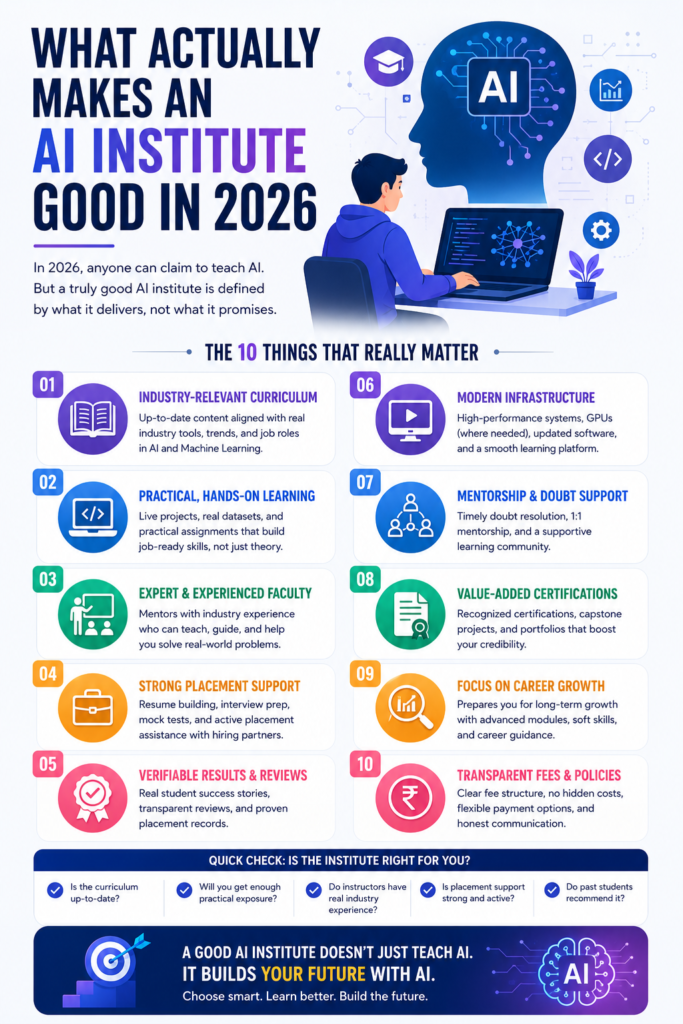
People don’t judge programs the same way anymore. Brand name alone doesn’t carry as much weight. Practical value does.
Curriculum matters but only if it’s current.
Programs should cover things like generative AI, LLMs, RAG systems, vector databases, APIs, and MLOps. If it’s mostly older academic theory, that gap shows up quickly when you try to apply it.
Projects matter more than lectures.
Watching demos isn’t enough. You need to build things, break things, fix them. That’s where learning sticks.
Typical useful projects might include:
- A chatbot or resume parser
- Image classification
- Customer churn prediction
- A generative AI assistant
- Recommendation engines
And through those, you run into real issues latency, scaling, deployment hiccups. That’s actually valuable.
Tools matter too.
Exposure to tools like Python, TensorFlow, PyTorch, cloud platforms, Docker, Kubernetes, and MLOps frameworks makes a big difference later. Otherwise, there’s usually a rough adjustment period.
How AI Works in Real Projects (Not Just Tutorials)
In real environments, AI isn’t standalone. It’s just one piece in a larger system.
A typical workflow looks something like:
- Data collection
- Cleaning and transformation
- Feature engineering
- Model training
- Testing
- Deployment
- Monitoring
Take something simple like a support chatbot. Behind the scenes, it’s pulling data, processing language, retrieving knowledge, generating responses, and sometimes handing things off to humans.
And then there are all the extra layers:
- Security
- API reliability
- Cost control
- Compliance
- Monitoring
Deployment isn’t just clicking a button. Anyone who’s tried it knows that.
Skills You Actually Need to Start
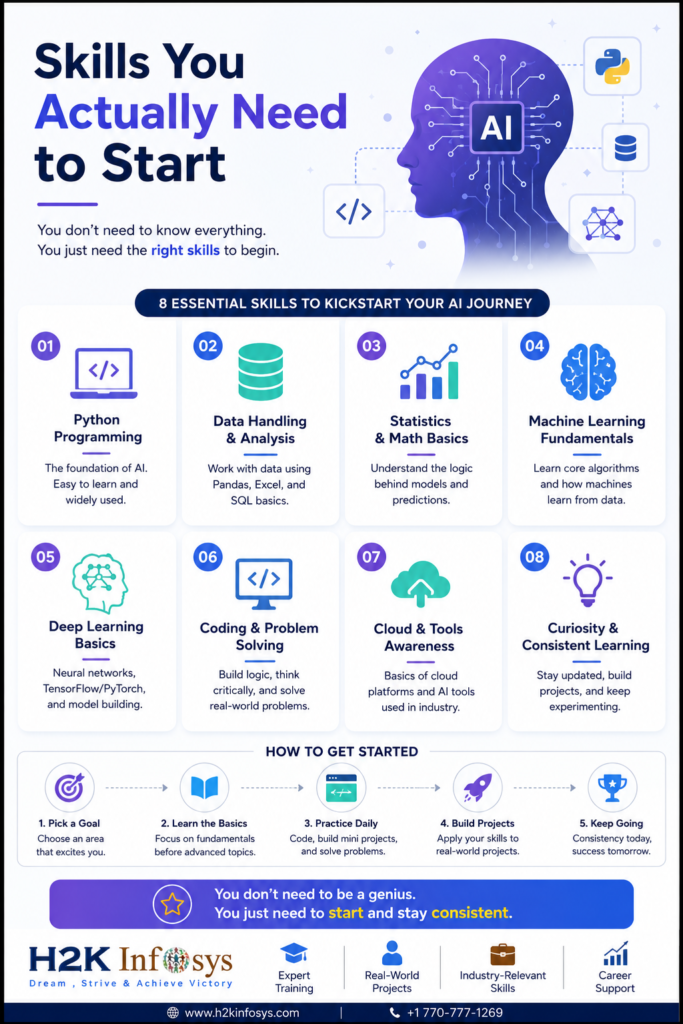
You don’t need to be a math expert to begin, despite what people think. But a few basics help:
- Python (pretty much essential)
- SQL
- Basic statistics
- Data analysis
- Some cloud familiarity
Math concepts like probability or linear algebra come in handy, but many modern courses explain them through practical examples instead of heavy theory which, honestly, works better for most people.
Where AI Shows Up in Enterprises
Companies are using AI in ways that are pretty practical:
- Processing documents (invoices, claims, forms)
- Predicting maintenance issues
- Detecting fraud
- Automating internal workflows
- Building AI assistants
Generative AI, especially, has grown fast internal tools, reporting, coding help, knowledge systems. But it also comes with challenges like hallucinations, data privacy, and cost control.
The Less Glamorous Side of AI
Building a model is often the easiest part.
The harder parts?
- Messy or incomplete data
- Models losing accuracy over time
- Scaling systems
- Security and compliance requirements
Good AI Institute Offers the Best Learning Experience programs don’t ignore these they introduce them early.
Career Paths After Learning AI
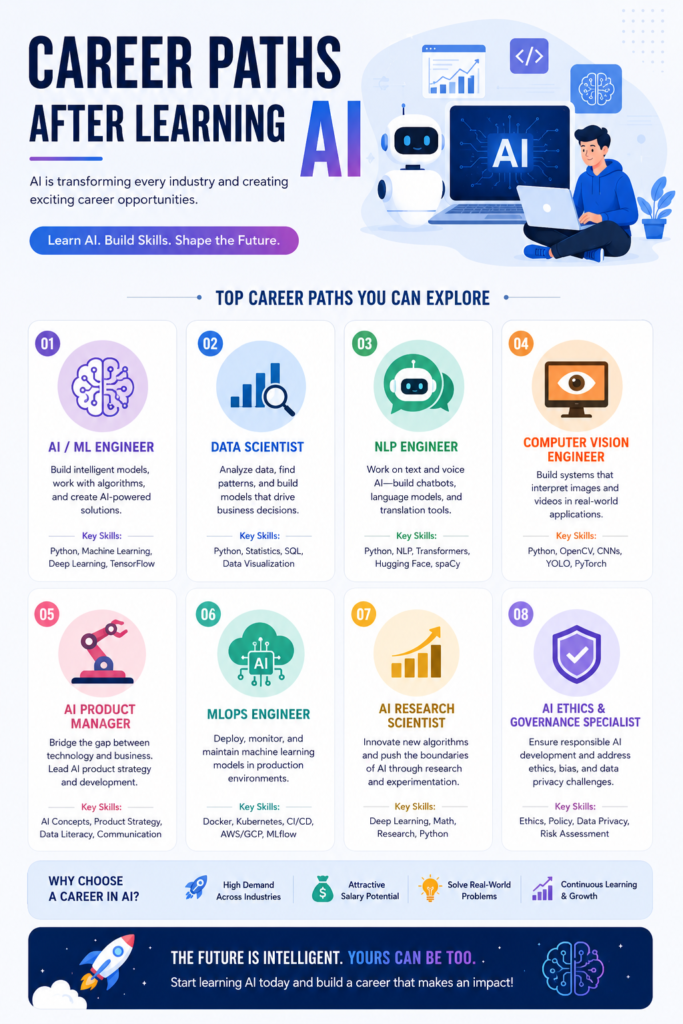
AI skills open up a range of roles:
- Data Analyst
- Machine Learning Engineer
- AI Engineer
- NLP Specialist
- Cloud AI Architect
- MLOps Engineer
Career growth usually depends on:
- Real project experience
- A solid portfolio
- Understanding deployment
- Some cloud knowledge
That last one deployment matters more than people expect.
How to Evaluate an AI Course (Without Getting Distracted)
Instead of focusing on branding, it helps to ask simple questions:
- Are there real projects?
- Does it cover deployment?
- Is generative AI included?
- Are cloud platforms part of it?
- Is there instructor support?
These things matter more than polished marketing pages.
A Practical Learning Path
Most people do better with a step-by-step approach:
- Learn Python
- Understand data basics
- Study machine learning
- Build small projects
- Learn deployment
- Explore cloud tools
- Move into generative AI
- Practice real workflows
Skipping ahead too quickly usually creates gaps. A lot of people realize that later.
A Quick Note on Generative AI
It’s a big deal right now, no question. Companies are using it for productivity, automation, and internal tools.
But it’s not magic.
There are real concerns:
- Accuracy
- Data privacy
- Governance
- Cost
Any good Online Ai Programs should talk about both sides not just the exciting part.
Final Thoughts
Choosing the AI Institute Offers the Best Learning Experience in 2026 really comes down to one thing: usefulness.
The best programs don’t just teach concepts. They help you build, deploy, and understand how AI fits into real systems. They show the messy parts, not just the clean demos.
A few things worth remembering:
- Theory helps, but application matters more
- Cloud and MLOps are becoming essential
- Generative AI is important—but not the whole story
- Certifications mean more when backed by real work
- Enterprise AI involves more than just models
And maybe the biggest one learning AI isn’t about rushing through topics. It’s about building something that actually works, even when things aren’t perfect.