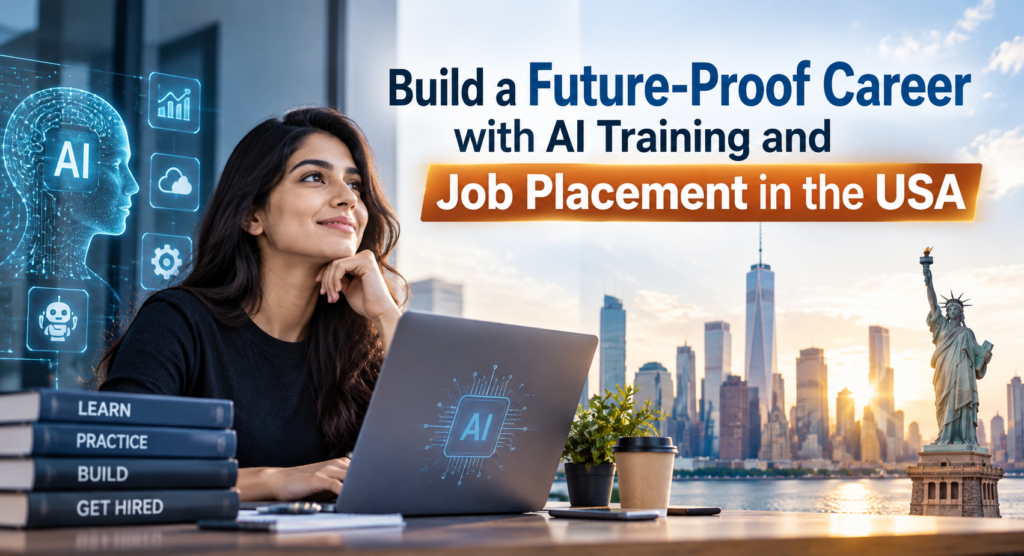
AI Online Training Support helps professionals build practical technical skills that are becoming part of everyday IT work. A solid Artificial Intelligence Certified Course usually blends machine learning concepts, automation workflows, cloud-based AI tools, and hands-on projects that feel much closer to what happens inside real companies not just textbook exercises. H2K Infosys offers industry-oriented AI online training programs designed to give learners real-world experience through live projects, practical assignments, and expert-led instruction that prepares professionals for modern AI and machine learning roles.
These days, AI isn’t something only research labs or giant tech firms care about anymore. Healthcare providers, banks, retail companies, cybersecurity teams, logistics organizations, even cloud operations groups are weaving AI into normal day-to-day processes. Because of that shift, more working professionals are signing up for AI certified courses to sharpen their technical skills, stay project-ready, and keep up with how enterprise technology is evolving.
What Is AI Online Training?
AI Online Training Support is basically a structured way for professionals to learn how artificial intelligence systems are actually built, trained, deployed, and maintained in real environments. Most programs are delivered through virtual classes, recorded sessions, cloud labs, and project assignments that simulate workplace scenarios pretty closely.
And honestly, that practical side matters.
A lot of short online tutorials explain theory well enough, but they rarely show what happens when systems break, datasets get messy, or deployment suddenly becomes complicated. Professional AI programs usually try to close that gap by exposing learners to the same tools, workflows, and day-to-day challenges development teams run into while building AI-powered applications.
Most artificial intelligence certified course programs cover topics like:
- Machine learning fundamentals
- Python programming
- Data preprocessing
- Neural networks
- Deep learning
- Natural language processing (NLP)
- Computer vision
- Model deployment
- AI ethics and governance
- Cloud AI services
Many of these online programs are built with working professionals in mind, so flexible schedules and self-paced access are pretty common.
Why AI Matters for Working Professionals
Artificial intelligence has long outgrown its status as a niche, specialized professional field, and become a core component of infrastructure for mainstream enterprises. Currently, enterprises can leverage AI to complete five core tasks, including automation
of repetitive tasks and analysis of operational data. When carrying out system upgrades, practitioners with foundational AI knowledge can participate in digital transformation projects to avoid being disconnected from core
Common Areas Where AI Is Used
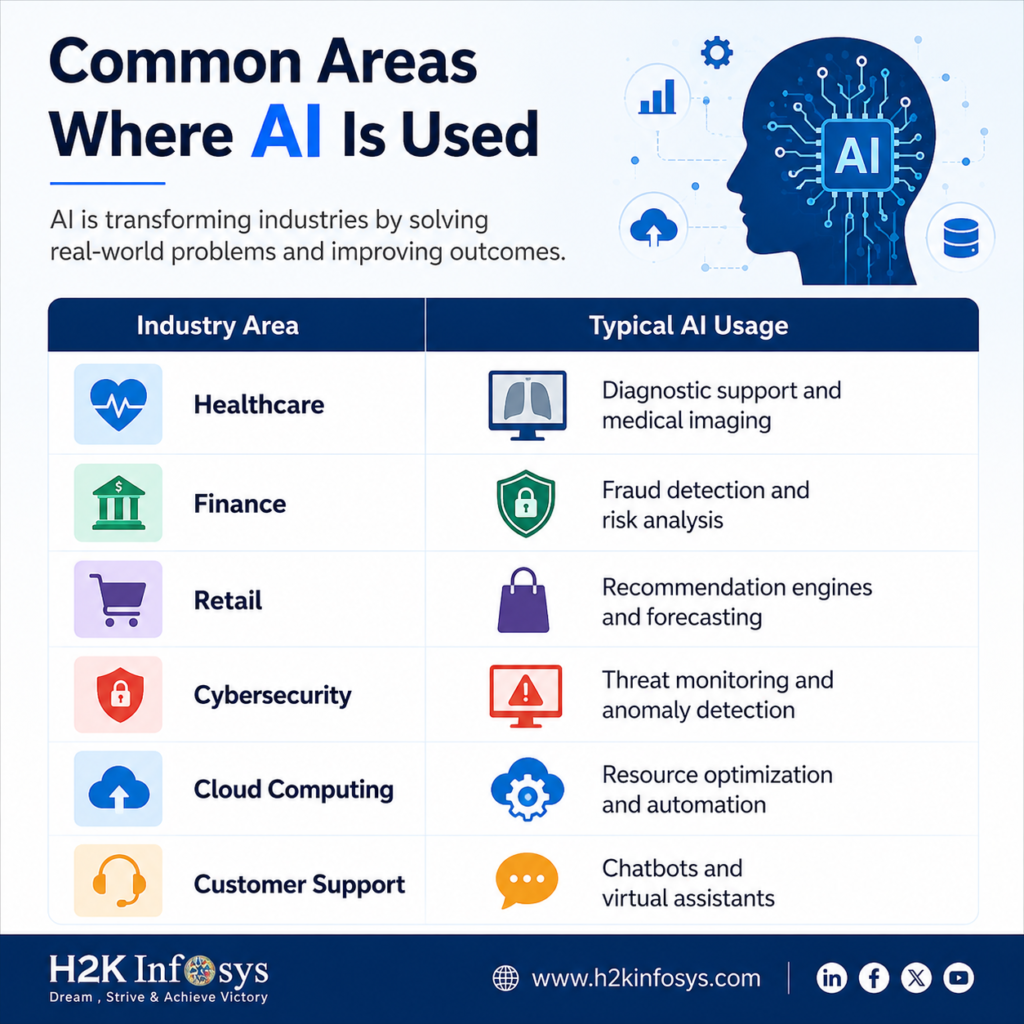
| Industry Area | Typical AI Usage |
|---|---|
| Healthcare | Diagnostic support and medical imaging |
| Finance | Fraud detection and risk analysis |
| Retail | Recommendation engines and forecasting |
| Cybersecurity | Threat monitoring and anomaly detection |
| Cloud Computing | Resource optimization and automation |
| Customer Support | Chatbots and virtual assistants |
At present, the core career trend in the IT field is that AI is no longer an independent career track, but a supplementary skill for IT practitioners: professionals working in roles such as cloud computing and software engineering can leverage this skill to strengthen their competitiveness in their existing positions.
How AI Online Training Supports Career Growth
The AI Online Training Support service launched by this platform caters to working professionals. It helps users build technical confidence, familiarize themselves with corporate processes, accumulate hands-on experience operating production tools, and achieve career growth.
Building Practical Technical Skills
Many ordinary learners who start learning AI Online Training Support by relying on online videos and popular science articles soon discover that understanding AI concepts is far from equivalent to being able to implement the technology in practical real-world settings.
Structured training helps bridge that gap.
Professionals typically learn how to:
- Clean and prepare datasets
- Train machine learning models
- Evaluate model performance
- Deploy AI applications
- Monitor models in production
- Work with cloud AI platforms
And in real enterprise projects, there’s usually much more happening than just writing algorithms. Data quality issues, deployment constraints, monitoring, infrastructure scaling those things become part of the job too.
Transitioning Into New Roles
Many professionals use AI training to gradually move into more specialized technical positions.
| Current Background | Potential AI Role |
|---|---|
| Software Developer | Machine Learning Engineer |
| Data Analyst | Data Scientist |
| System Administrator | AIOps Specialist |
| QA Engineer | AI Test Automation Engineer |
| Cloud Engineer | AI Infrastructure Architect |
What’s interesting is that most people don’t completely restart their careers. They usually combine existing domain expertise with AI capabilities. A cloud engineer who understands machine learning infrastructure, for example, can become incredibly valuable without becoming a pure data scientist.
Improving Project Readiness
Enterprises’ artificial intelligence (AI) projects typically require cross-team collaboration bringing together developers, infrastructure engineers, security teams, analysts, and business stakeholders.
Hands-on AI Online Training Support often exposes learners to workflows such as:
- Collecting and validating datasets
- Training machine learning models
- Testing model accuracy
- Deploying applications to cloud environments
- Monitoring production systems
- Managing scalability and performance
That exposure makes it easier to contribute during real projects because the workflows already feel somewhat familiar.
How AI Works in Real Enterprise Projects
In most organizations, AI systems don’t operate independently. They’re usually integrated into larger business platforms and require constant maintenance, tuning, and monitoring.
That’s one of the biggest misconceptions people have about AI Online Training Support that once a model is deployed, it somehow runs forever on autopilot. In reality, enterprise AI systems need ongoing attention.
Typical AI Workflow in Enterprise Environments
| Stage | Purpose |
|---|---|
| Data Collection | Gather operational or customer data |
| Data Cleaning | Remove inconsistencies and errors |
| Model Training | Build machine learning models |
| Validation | Test model accuracy |
| Deployment | Integrate into enterprise systems |
| Monitoring | Track performance over time |
| Optimization | Retrain and improve models |
Example: AI in Customer Support
A support organization might use AI to automate ticket categorization.
The workflow could look something like this:
- Historical support tickets are collected
- Text data is cleaned and labeled
- An NLP model is trained using ticket descriptions
- The system predicts issue categories automatically
- Tickets are routed to the right support teams
- Performance is monitored and adjusted over time
This kind of automation reduces repetitive manual work while still allowing human teams to review edge cases or more complicated issues.
What Skills Help When Learning AI?
AI Online Training Support usually combines programming, analytical thinking, and data interpretation. That sounds intimidating at first, but beginner-focused AI certified courses often start with foundational concepts before moving into advanced topics.
Programming Basics
Python is the most commonly used language in AI because of its massive ecosystem of machine learning libraries.
Learners are usually introduced to:
- Variables and functions
- Loops and conditions
- APIs and libraries
- File handling
- Data structures
Data Analysis Skills
AI professionals spend a lot of time working with structured and unstructured datasets.
Important areas include:
- Data visualization
- Statistical analysis
- Pattern recognition
- Feature engineering
Cloud and Infrastructure Awareness
Modern AI applications are heavily tied to cloud infrastructure.
Professionals benefit from understanding:
- Cloud storage
- APIs
- Containers
- Virtual machines
- Kubernetes basics
Even a basic understanding of deployment environments can make a huge difference later on.
Tools Commonly Used in AI Certified Courses
Practical AI Online Training Support usually includes exposure to industry-standard frameworks and tools.
Common AI Tools
| Tool | Usage |
|---|---|
| TensorFlow | Deep learning development |
| PyTorch | Neural network modeling |
| Scikit-learn | Machine learning workflows |
| Pandas | Data manipulation |
| NumPy | Numerical operations |
| Jupyter Notebook | Experimentation and testing |
| Docker | Containerized deployment |
| MLflow | Model tracking |
Cloud Platforms Used in AI Projects
Many enterprise organizations rely on managed AI services from cloud providers, including:
- AWS SageMaker
- Microsoft Azure AI
- Google Vertex AI
These services simplify deployment, scaling, monitoring, and infrastructure management especially for teams that don’t want to maintain everything manually.
AI Across Enterprise Environments
AI implementations vary depending on business goals, available data, and operational needs. Most projects focus on:
- Automation
- Prediction
- Optimization
- Decision support
- Operational monitoring
AI in Healthcare
Healthcare organizations often use AI for:
- Medical image analysis
- Patient risk assessment
- Workflow optimization
- Virtual health assistants
AI in Finance
Financial institutions commonly apply AI to:
- Fraud detection
- Credit scoring
- Risk analysis
- Transaction monitoring
AI in Cybersecurity
Security teams may use AI for:
- Threat detection
- Malware analysis
- Behavioral monitoring
- Incident prioritization
Of course, these systems usually require strong governance and compliance oversight because privacy and security risks become major concerns at enterprise scale.
Common Challenges AI Teams Face
AI deployment sounds exciting until teams start dealing with production realities.
Data Quality Problems
AI systems rely heavily on clean, accurate datasets. Unfortunately, enterprise data is rarely perfect.
Common issues include:
- Missing records
- Duplicate entries
- Inconsistent formatting
- Biased training data
Poor data quality can seriously reduce model reliability.
Model Drift
Over time, real-world conditions change. Customer behavior shifts, market trends evolve, and model accuracy gradually declines.
Teams usually address this by:
- Monitoring performance metrics
- Retraining models regularly
- Updating datasets
- Reviewing prediction outcomes
Scalability Constraints
Enterprise AI Online Training Support applications may process massive volumes of requests or transactions.
That introduces infrastructure concerns like:
- Compute resource allocation
- Storage optimization
- Network latency
- High availability
This is why AI increasingly overlaps with cloud engineering and DevOps practices.
Job Roles That Use AI Regularly
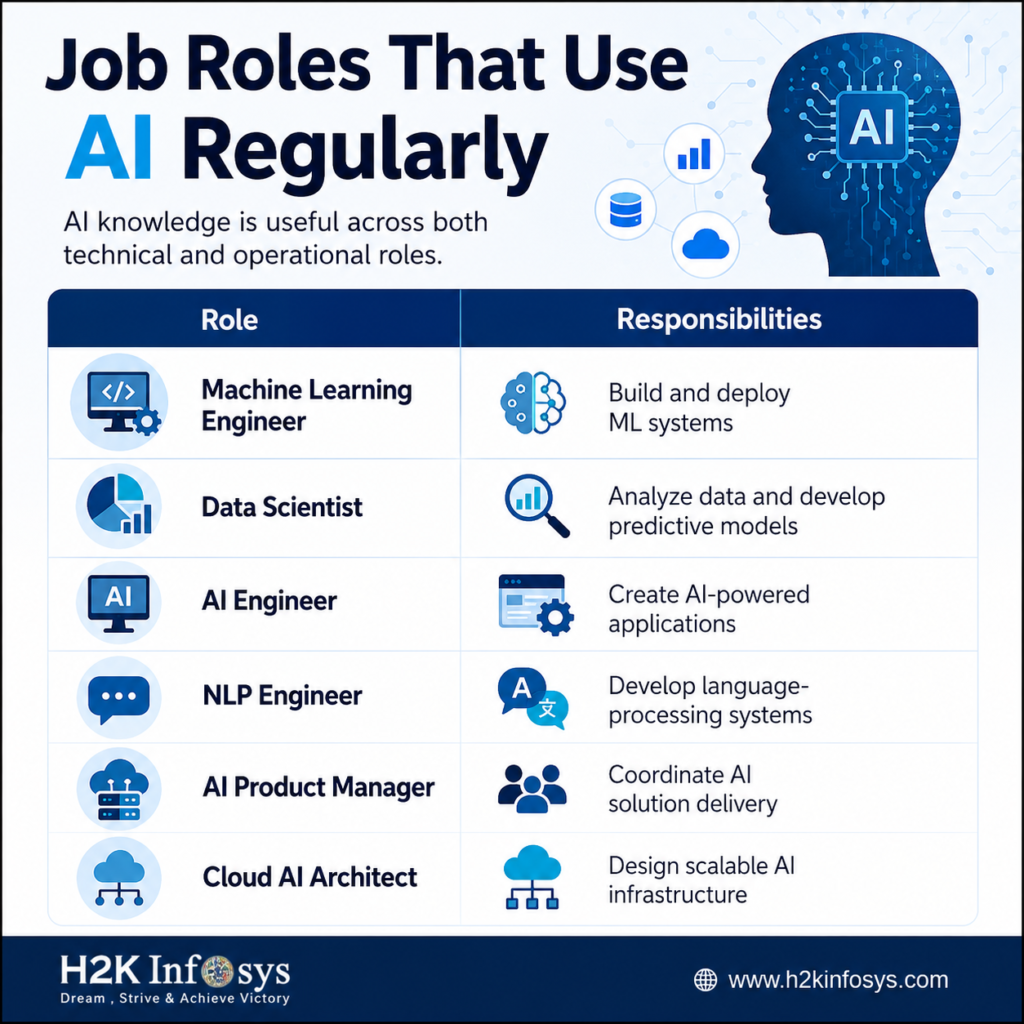
AI knowledge is useful across both technical and operational roles.
| Role | Responsibilities |
|---|---|
| Machine Learning Engineer | Build and deploy ML systems |
| Data Scientist | Analyze data and develop predictive models |
| AI Engineer | Create AI-powered applications |
| NLP Engineer | Develop language-processing systems |
| AI Product Manager | Coordinate AI solution delivery |
| Cloud AI Architect | Design scalable AI infrastructure |
Some professionals focus heavily on model development, while others work more on infrastructure, deployment, governance, or automation workflows.
Career Paths After Learning AI
AI Online Training Support can support career advancement, specialization, or simply broaden someone’s technical range.
Professionals may apply AI knowledge in areas such as:
- Software engineering
- Cloud architecture
- Cybersecurity operations
- Business intelligence
- Intelligent automation
- Data engineering
And honestly, that flexibility is part of what makes AI appealing. Most professionals don’t need to abandon their current field they just add AI capabilities to what they already know.
A Typical AI Learning Path
AI learning usually happens gradually and becomes more project-focused over time.
Phase 1: Foundations
Most learners begin with:
- Python programming
- SQL basics
- Statistics fundamentals
- Data analysis concepts
Phase 2: Machine Learning
Core topics often include:
- Regression
- Classification
- Clustering
- Model evaluation
Phase 3: Advanced AI Topics
This stage may include:
- Deep learning
- NLP
- Computer vision
- Generative AI
Phase 4: Deployment and MLOps
Enterprise-focused training often covers:
- CI/CD pipelines
- Containerization
- Model monitoring
- Infrastructure automation
This deployment phase is where many professionals realize AI is as much about operations and systems engineering as it is about algorithms.
How Employers Evaluate AI Skills
Most employers care less about memorizing definitions and more about whether candidates can solve practical problems.
Common Evaluation Areas
| Skill Area | Typical Evaluation |
|---|---|
| Programming | Coding assessments |
| Machine Learning | Model-building exercises |
| Data Analysis | Case studies |
| Cloud Deployment | Project reviews |
| Problem Solving | Scenario-based interviews |
Candidates who can explain why they made certain implementation decisions and back that up with hands-on projects usually stand out more during interviews.
What to Look for in an AI Online Training Support Program
Choosing the right AI Online Training Support involves more than just checking a syllabus.
Industry-Relevant Curriculum
A strong program should include:
- Current frameworks
- Cloud integration
- Deployment workflows
- Real-world project scenarios
Hands-On Labs
Labs and projects matter because they help learners understand how AI behaves in production environments, where things are rarely perfect.
Experienced Instructors
Experienced instructors can often provide insights around:
- Architecture trade-offs
- Enterprise constraints
- Debugging strategies
- Industry best practices
Sometimes those practical discussions end up being more valuable than the theory itself.
Flexible Scheduling
Working professionals usually prefer options like:
- Weekend sessions
- Recorded classes
- Self-paced modules
- Mentorship support
Flexibility becomes important when balancing training alongside full-time work.
FAQ: AI Online Training and Career Growth
Is an artificial intelligence certified course suitable for beginners?
Yes. Many programs start with foundational topics like Python programming, statistics, and data analysis before moving into advanced machine learning concepts.
Do AI certified courses require coding experience?
Basic programming knowledge helps, but many beginner-friendly programs include introductory coding support.
Which programming language is most commonly used in AI?
Python is widely used because of its extensive machine learning ecosystem and strong community support.
Can working professionals learn AI Online Training Support?
Absolutely. Most online AI training programs are designed specifically for professionals who need flexible schedules and remote access to labs and projects.
What industries hire AI professionals?
Healthcare, finance, retail, cybersecurity, logistics, manufacturing, and cloud computing organizations all use AI technologies in some capacity now.
Are cloud platforms important for AI learning?
Yes. Modern enterprise AI systems are frequently deployed using cloud infrastructure and managed AI services.
Final Thoughts
AI Online Training Support helps professionals build practical technical skills that align with modern enterprise environments. The best AI certified courses usually combine foundational learning with hands-on projects, cloud deployment practices, automation workflows, and exposure to real-world implementation challenges.
Professionals who understand how AI systems are built, deployed, monitored, and maintained are often better prepared to contribute to modern data-driven projects and enterprise transformation initiatives.
Key Takeaways
- AI Online Training Support skills are becoming increasingly relevant across enterprise IT roles
- AI certified courses combine theory with practical implementation
- Enterprise AI projects require deployment, monitoring, and governance knowledge
- Cloud platforms play a major role in AI workflows
- Hands-on projects improve real-world problem-solving skills
- AI knowledge can support both career growth and technical specialization
Explore H2K Infosys AI Online Training to gain practical exposure to enterprise AI tools, cloud platforms, and real-world implementation workflows. Build hands-on AI Online Training Support skills that support long-term professional growth in today’s evolving IT landscape.