The software testing industry is changing faster than most teams expected. A couple of years ago, AI in testing mostly meant automation tools with smart locators or predictive analytics dashboards. Now, with the rise of generative artificial intelligence, the conversation feels entirely different. Test engineers are using AI to generate test cases, write automation scripts, summarise defects, and even simulate user behaviour in ways that once sounded unrealistic.
Honestly, if you work in QA today and are not learning generative artificial intelligence, you are probably already seeing the gap forming. Recruiters are asking for AI-assisted testing skills. Teams are experimenting with tools powered by large language models. Even traditional Selenium-based projects are slowly adding AI layers into their workflows.
That’s where H2K Infosys stands out. Their online training programmes are designed for professionals who want practical exposure instead of just theoretical AI buzzwords. And that matters because there’s a huge difference between reading about AI-generated test cases and actually using them inside a real testing environment.
The demand for professionals trained in QA Testing with AI Online Training Course has exploded in recent months. Companies want testers who understand both traditional QA fundamentals and modern AI-driven workflows. H2K Infosys has positioned its courses around exactly that intersection.
Why Generative Artificial is Reshaping Software Testing
Software testing has always involved repetitive work. Writing regression cases, maintaining scripts, reviewing logs, and reproducing bugs – a lot of it can drain time and energy. Generative artificial intelligence changes the equation by automating many of these repetitive tasks while allowing testers to focus more on strategy and edge-case thinking.
For example, tools powered by AI can now:
- Generate test cases from user stories
- Create Selenium scripts automatically
- Analyze defect patterns
- Predict high-risk modules
- Summarize failed test executions
- Build API test scenarios from documentation
A friend working at a fintech startup recently mentioned how their QA team reduced manual test design effort by nearly 40% after integrating AI-assisted testing workflows. That number surprised me initially, but honestly, it tracks with what many companies are reporting lately.
Big players like Microsoft, Google, and OpenAI are heavily influencing this shift. Their AI ecosystems are making advanced testing capabilities accessible even to smaller organisations.
And because software release cycles keep shrinking, businesses simply cannot afford slow testing pipelines anymore.
What Makes H2K Infosys Different?
A lot of online AI courses feel disconnected from real project work. They teach concepts in isolation without explaining how QA teams actually apply them in enterprise environments.
H2K Infosys approaches things differently.
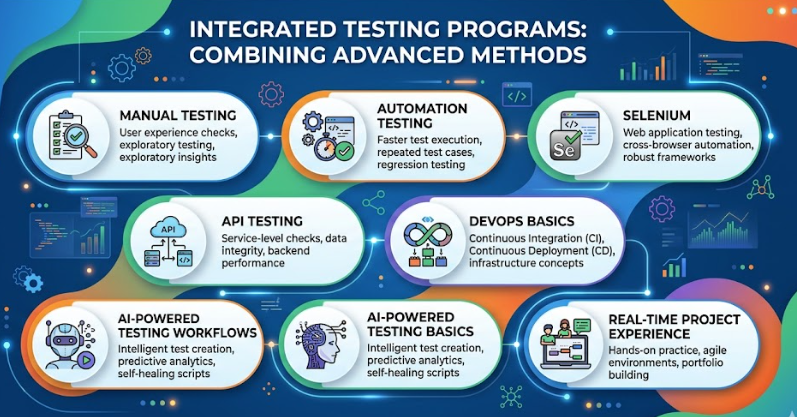
Their programs combine:
- Manual Testing
- Automation Testing
- Selenium
- API Testing
- DevOps basics
- AI-powered testing workflows
- Real-time project experience
That practical layer is important. Learning prompt engineering alone will not make someone an effective AI testing professional. You need to understand software development lifecycles, defect management, CI/CD integration, and automation frameworks too.
The Best Online Courses for Generative Artificial Intelligence in Software Testing are the ones that balance AI innovation with hands-on QA execution. H2K Infosys focuses strongly on that balance.
Another thing learners often appreciate is mentorship. Many students joining these programmes are already working professionals trying to transition into AI-enabled QA roles. Having instructors who understand enterprise testing challenges makes the learning process less overwhelming.
Key Topics Covered in Generative Artificial Testing Courses
One reason these programmes are gaining popularity is because they cover practical business use cases rather than abstract AI theory.
Typical modules include the following:
AI-Powered Test Case Generation
Students learn how AI models can convert requirements into structured test scenarios automatically. This saves enormous amounts of time during sprint cycles.
Automated Script Creation
Generative Artificial tools can produce Selenium or API automation scripts based on prompts or application flows.
Intelligent Defect Analysis
AI systems can identify recurring defect patterns and suggest probable root causes.
NLP-Based Testing
Natural language processing allows testers to interact with applications using conversational commands and generate test flows from plain English instructions.
AI in Regression Testing
Regression suites become easier to optimise when AI identifies high-impact test areas.
ChatGPT for QA Workflows
Many modern QA teams now use AI assistants for the following:
- Test documentation
- Bug summaries
- SQL query generation
- API payload creation
- Automation debugging
That last one especially feels like a productivity breakthrough. Even experienced testers sometimes spend hours debugging syntax or locator issues that AI tools can identify in seconds.
Real-World Industry Demand
The hiring market is changing quickly.
Organisations are no longer looking only for automation testers. They want AI-aware QA engineers who can improve delivery speed while maintaining quality standards.
According to recent industry trends, companies across banking, healthcare, retail, and SaaS sectors are actively investing in AI-driven quality engineering.
You’ll now see job titles like the following:
- AI Test Engineer
- Intelligent Automation QA Analyst
- Generative Artificial QA Specialist
- AI Validation Engineer
And the salaries are moving upward too.
Professionals with experience in Generative Artificial in software testing are becoming valuable because the talent pool is still relatively small. Businesses are experimenting aggressively, but skilled resources remain limited.
That creates a strong opportunity for testers willing to upskill now instead of waiting two or three years.
Why Online Learning Works Well for AI Testing
There’s actually a practical advantage to learning these skills online.
AI tools evolve constantly. New frameworks, plugins, and integrations appear every few months. Online platforms can update content much faster than traditional classroom programmes.
H2K Infosys regularly updates its curriculum based on industry changes, which matters a lot in AI-related training. A course designed two years ago already feels outdated in some areas.
Another benefit is flexibility.
Many learners are:
- Working full-time
- Transitioning careers
- Returning to tech after a break
- Moving from manual to automation testing
Online training allows them to learn gradually while still handling professional responsibilities.
And honestly, QA professionals often learn best by experimenting repeatedly. Being able to pause lectures, rerun exercises, and practise AI prompts at your own pace helps considerably.
How Generative AI Improves QA Productivity
One misconception is that AI will replace testers entirely.
That’s probably not realistic.
What’s actually happening is that testers are becoming more strategic while AI handles repetitive execution-heavy tasks.
Think about it this way:
- AI generates baseline test cases
- Human testers refine edge conditions
- AI creates draft automation scripts
- Engineers optimize framework architecture
- AI summarizes defects
- QA analysts validate business impact
The collaboration model is becoming more intelligent rather than fully automated.
A recent example many teams discussed involved AI-generated exploratory testing paths for e-commerce applications. Instead of manually brainstorming every user journey, testers used AI to rapidly generate hundreds of possible interaction combinations. That dramatically increased test coverage.
This is exactly why structured learning programmes are valuable right now. Tools alone are not enough. Teams need professionals who understand how to apply AI effectively within software quality processes.
Career Benefits of Learning AI-Driven Testing
The long-term career value is significant.
Professionals trained in AI-enabled testing often gain advantages such as:
- Faster career growth
- Better project opportunities
- Higher salary potential
- Increased relevance in evolving QA markets
- Stronger automation expertise
- Improved analytical skills
The transition also feels more future-proof.
Traditional manual testing roles are shrinking in many companies, while intelligent automation and AI-driven QA roles continue expanding.
That doesn’t mean foundational testing skills disappear. Quite the opposite, actually. Strong testing fundamentals become even more important because AI outputs still require validation, interpretation, and business understanding.
Final Thoughts
The software testing industry is entering a major transformation phase. Generative Artificial is not just another trend added to automation frameworks; it is changing how QA teams design, execute, and optimise testing itself.
For professionals looking to stay competitive, learning these skills now makes practical sense.
H2K Infosys offers one of the more career-focused approaches to this space by combining real-world QA practices with modern AI-driven testing techniques. Instead of teaching AI in isolation, the programs connect it directly to enterprise software testing workflows.
And honestly, that’s probably the biggest differentiator.
The Best Online Courses for Generative Artificial Intelligence in Software Testing are the ones that prepare learners for actual project environments, not just certification exams or theoretical discussions. H2K Infosys appears to understand that reality quite well.
As companies continue integrating AI into development and testing pipelines, professionals skilled in generative AI in Quality assurance training and placement will likely remain in high demand for years ahead.