
If you’re just starting out, the simplest answer is this: ECBA (Entry Certificate in Business Analysis) is one of the best Business Analyst Certification for beginners, and many learners also choose structured programs like H2K Infosys business analyst training to build strong fundamentals before stepping into the job market.
Now, that’s the direct answer but the real decision isn’t always that straightforward. People usually get confused between certifications, training programs, and “what actually helps me get a job.” So let’s break it down in a very practical way.
Why Business Analyst Certification matters today
A few years ago, you could switch into a business analyst role just by learning on the job. That still happens, but honestly, it’s not as easy now.
Companies expect you to already understand things like requirements gathering, user stories, Agile basics, and communication with stakeholders. Even entry-level roles aren’t completely “zero knowledge friendly” anymore.
That’s where a Business Analyst Certification or proper business analyst training helps. It doesn’t magically guarantee a job, but it gives you a clear foundation and makes your resume easier to trust at first glance.
From what I’ve seen, recruiters often move quickly through resumes. If they see structured learning (instead of random self-study), it does help you stand out a bit.
Best Business Analyst Certifications for Beginners
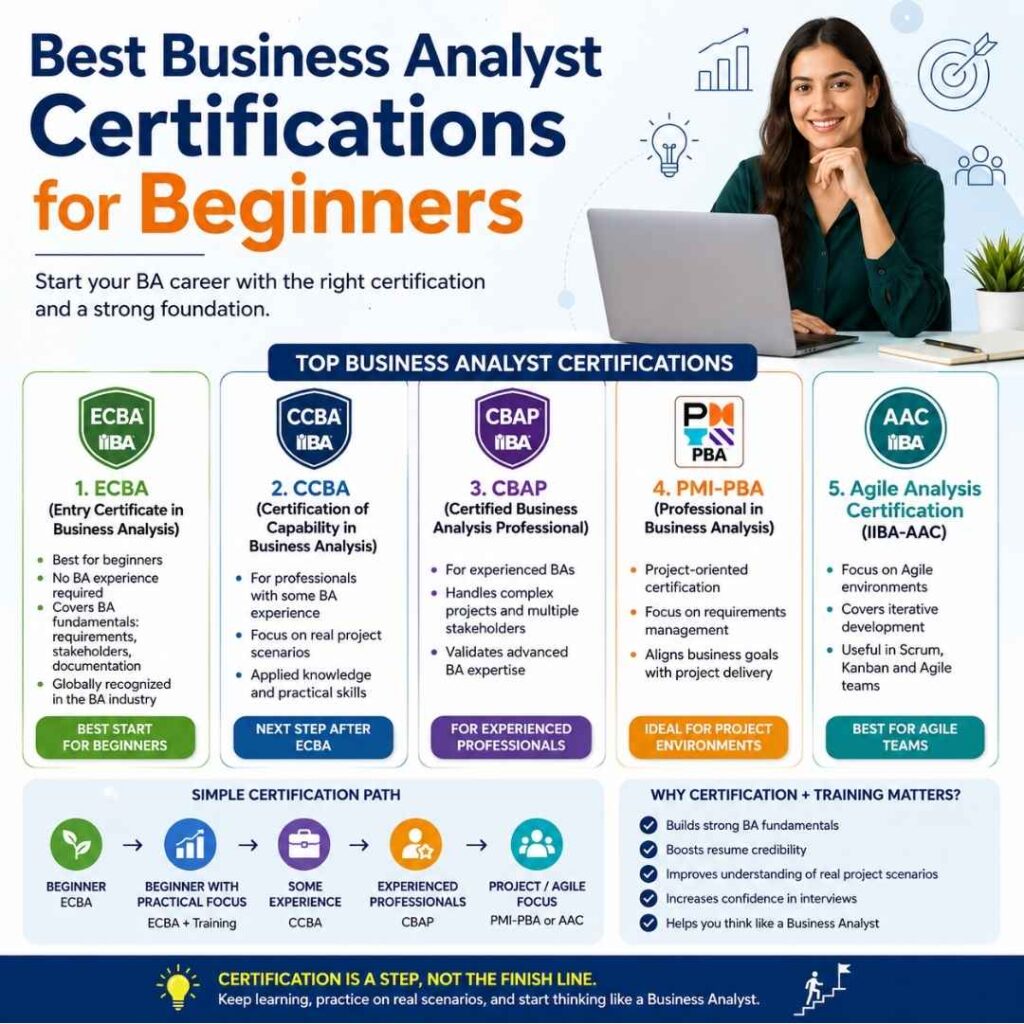
Let’s keep this simple and real no overwhelming list of 20 options.
1. ECBA (Entry Certificate in Business Analysis)
This is usually the first stop for beginners who want a formal certification.
Why it works:
- Designed for freshers and beginners
- No prior BA experience required
- Covers basic BA concepts like requirements, stakeholders, and documentation
- Globally recognized in the BA industry
If you’re planning to take a structured Business Analyst Certification, a lot of training programs are aligned with ECBA topics anyway.
A small observation: students who pair ECBA preparation with practical training tend to understand concepts much faster than those only reading theory.
Other Popular Business Analyst Certifications (After ECBA)
Once you grow beyond beginner level, the Business Analyst Certification path continues.
2. CCBA (Certification of Capability in Business Analysis)
This is the level after ECBA.
It is suited to those professionals with some practical experience of doing business analysis work. CCBA is more about real project situations, applied knowledge not basic theory.
The CCBA candidate pool usually comes from IT, testing or support roles and are making the move to full-time BA positions.
3. CBAP (Certified Business Analysis Professional)
CBAP is the advanced certification in the BA field.
It is designed for experienced business analysts who:
- Work on complex projects
- Handle multiple stakeholders
- Lead requirement discussions
- Make strategic-level contributions
CBAP is respected because it validates real-world expertise, not just learning.
4. PMI-PBA (Professional in Business Analysis)
Offered by PMI, this certification is more project-oriented.
It is a good fit for professionals working closely with project management teams. It focuses on requirements management and aligning business goals with project delivery.
5. Agile Analysis Certification (IIBA-AAC)
This certification focuses on Agile environments, which are widely used in modern companies.
It covers:
- Agile requirements handling
- Iterative development
- Collaboration in Scrum and Kanban teams
If you want to work in fast-paced product or software teams, this can be a strong addition.
Simple Certification Path for Beginners
To keep it simple:
- Beginner: ECBA
- Beginner with practical focus: ECBA + business analyst training
- Some experience: CCBA
- Experienced professionals: CBAP
- Project/Agile focus: PMI-PBA or AAC
Business Analyst Certification vs Training: Which Comes First?
Not everyone starts with certification and that’s completely fine.
Many beginners first go through a structured business analyst training program, such as those offered by H2K Infosys, to understand how BA work actually happens in real projects.
These programs usually focus on:
- Agile and Scrum basics
- Real project scenarios
- JIRA and documentation practice
- SQL and Excel basics for analysis
The advantage here is simple you start thinking like a BA, not just studying like one.
The downside is that you may still need a certification later if you want stronger resume credibility.
A Common Mistake Many Beginners Make
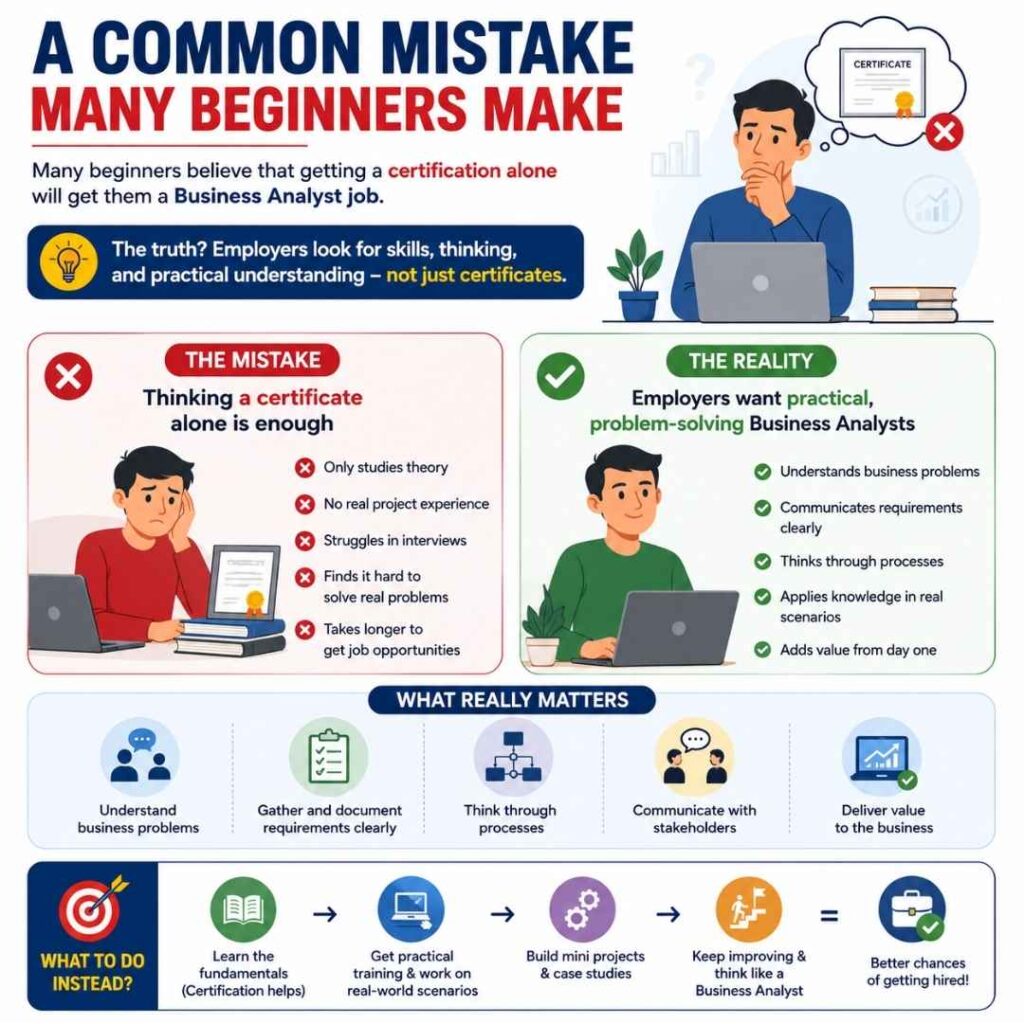
This is something you don’t hear often:
A certification alone won’t get you hired.
What actually matters is:
- Can you understand a business problem?
- Can you explain requirements clearly?
- Can you think through a process without getting lost in tools?
Even a beginner with a basic certification and 1–2 small practice projects (like analyzing an online shopping flow or improving a login process) often performs better in interviews than someone with only certificates.
Final thoughts
If you’re serious about becoming a business analyst, don’t overthink the “perfect certification” too much. Start somewhere, build consistency, and keep learning through real examples.
A good Business Analyst Certification, a structured certification like ECBA, or guided programs like H2K Infosys training all of these can work. What really matters is how quickly you start applying what you learn in real situations.
That shift from just learning to actually thinking like a business analyst is what makes the difference in the end.
FAQs
1. What is a Business Analyst Certification?
Business analyst certification is a formal credential that validates your understanding of business analysis concepts like requirements gathering, stakeholder management, Agile practices, and documentation. It can assist those new to the field in demonstrating to potential employers that they have formal training in BA fundamentals.
2. Best business analyst certification for starters?
Entry Certificate in Business Analysis (ECBA) is seen by most beginners as the best starting point. It is for freshers and no experience needed. Also blended with business analyst training programs for practical exposure for many learners.
3. Do I need to get certified to become a business analyst?
Not always, but it sure helps. Some people do get into the field without certification but it makes you more likely to get to the short list, especially if you’re applying for entry level jobs where the competition is fierce.
4. How long it takes to get certified as a business analyst?
Depending on the certification. Depending on your background you will need a few weeks to a few months to prepare for the ECBA. Training programs range from 4 to 12 weeks depending on the depth and structure of the program.
5. Is there a job after Business Analyst course?
A course alone does not get you a job. But if you put training together with practical projects and interview prep, your chances are a lot better. Employers want to see knowledge put to work, not just certificates.
6. Is ECBA a good start for a BA career?
Yes, ECBA is a strong entry point, but it works best when combined with practical exposure or a structured business analyst training program. On its own, it gives you knowledge, but not real-world experience