If you’re a fresher trying to enter tech in 2026, one of the smartest paths right now is joining a cyber security training with placement program that focuses on practical skills, live projects, and interview preparation not just theory. The programs getting the best results are the ones that simulate real SOC environments and help students transition directly into entry-level security roles. Providers like H2K Infosys have been getting attention because they combine live instructor-led sessions with hands-on SOC labs and placement-focused mentoring, which is exactly what many beginners need when entering the field for the first time.
The interesting thing is… cyber security has changed a lot over the last couple of years. Recruiters are no longer impressed by people who only completed recorded courses and collected certificates. Most hiring managers now want proof that candidates can actually investigate alerts, understand phishing attacks, work with SIEM tools, and think through real incidents. I’ve noticed this shift especially in companies hiring junior SOC analysts and cloud security trainees. That’s one reason many learners now prefer practical training platforms like H2K Infosys, where students work on real-time projects and security tools instead of only studying theoretical concepts.
That’s exactly why freshers are actively searching for cyber security training with placement instead of standalone certification courses.
Why Freshers Are Choosing Cyber Security in 2026
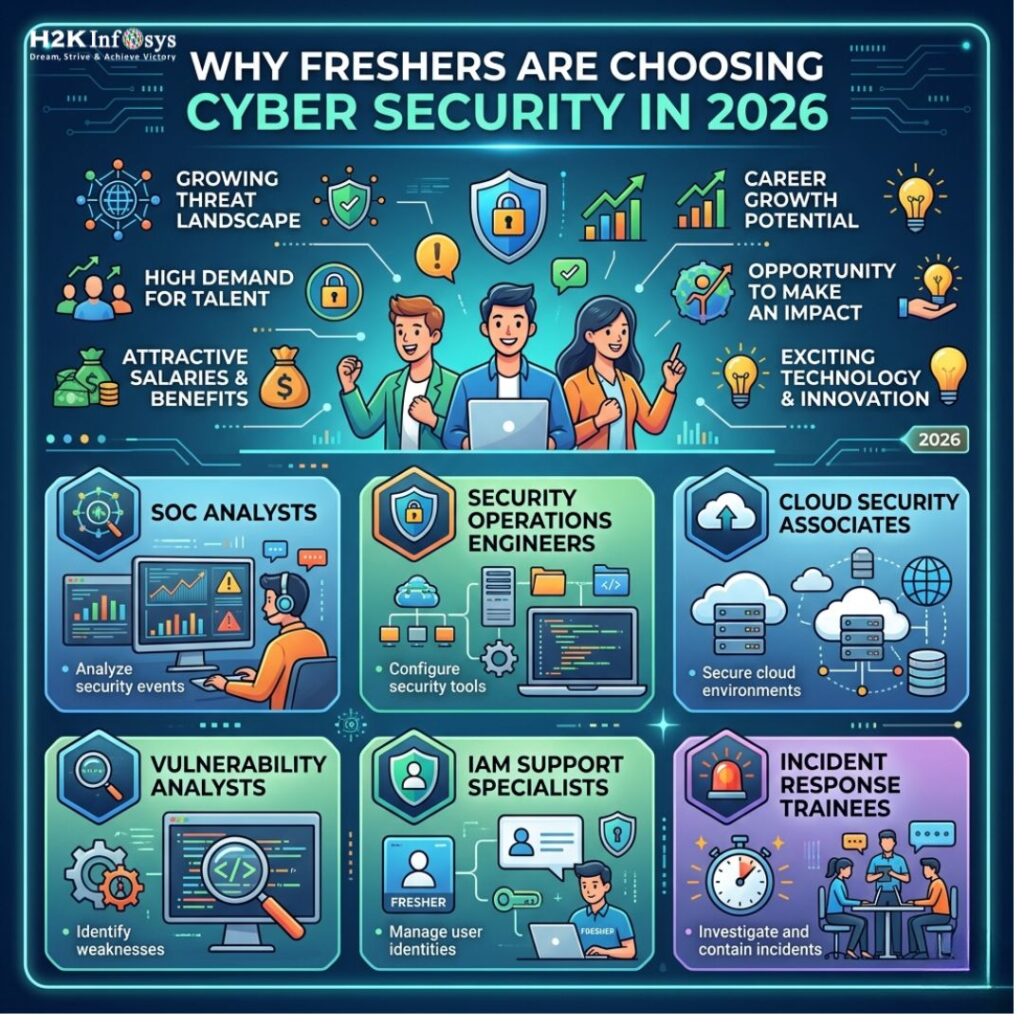
A few years ago, many fresh graduates rushed toward software development or data science. Now the conversation looks different. With ransomware attacks increasing, cloud adoption exploding, and AI-driven threats becoming more sophisticated, businesses are investing heavily in security teams.
Even mid-sized companies now need:
- SOC Analysts
- Security Operations Engineers
- Cloud Security Associates
- Vulnerability Analysts
- IAM Support Specialists
- Incident Response Trainees
What surprised me recently was seeing non-IT graduates entering the field successfully after proper training. Some came from customer support backgrounds, others from networking, and a few even from completely unrelated careers.
The common factor?
Hands-on learning.
Not endless PowerPoint slides.
What Makes a Cyber Security Training with placement Program Actually Worth Joining?
Honestly, this is where many freshers make mistakes.
A lot of courses advertise “100% placement,” but the training itself is outdated or purely theoretical. You finish the course knowing definitions… but not how to investigate an alert in Splunk or identify suspicious traffic in Wireshark.
A strong cyber security training with job placement program should include:
1. Live Instructor-Led Classes
Recorded videos are fine for basics, but security is easier to understand when instructors explain real attack scenarios live. Students learn faster when they can ask questions during labs.
2. Real Security Tools
The best programs expose students to tools companies actually use, such as:
- Splunk
- Wireshark
- Nessus
- Nmap
- Burp Suite
- Kali Linux
- Microsoft Sentinel
- AWS Security services
This matters because interviewers often ask practical questions tied to these tools.
Why H2K Infosys Stands Out for Freshers
One training provider that keeps coming up in discussions around practical learning is H2K Infosys. Their approach leans heavily toward hands-on implementation instead of passive learning, which honestly makes a big difference for beginners.
What I personally find useful about their structure is that they combine:
- Live online training
- Real-time project exposure
- Resume preparation
- Mock interviews
- Placement assistance
- Internship-style practical sessions
A fresher usually struggles with one major problem: “I have no experience.”
H2K Infosys tries to bridge that gap by giving learners project-based exposure that feels closer to workplace experience. That’s important because many recruiters now ask scenario-based questions instead of textbook definitions.
For example:
- “How would you investigate suspicious login activity?”
- “What steps would you take after detecting a phishing email?”
- “How do you prioritize SIEM alerts?”
Students who practiced labs tend to answer these questions with much more confidence.
The Big Shift Happening in Cyber Security Hiring
Something I’ve been noticing lately especially across U.S. tech hiring is that companies increasingly value practical exposure over academic credentials alone.
A candidate with:
- Splunk dashboards,
- vulnerability scanning experience,
- cloud security basics,
- and SOC lab practice
often performs better in interviews than someone who only memorized certification material.
This is one reason programs focused on cyber security jobs with training are gaining popularity among freshers and career switchers.
There’s also growing demand around:
- AI security
- Cloud threat monitoring
- Zero Trust environments
- Identity & Access Management (IAM)
- Security automation
Training providers that update their curriculum around these trends naturally give students a stronger advantage.
Real-World Learning Matters More Than Ever
I remember speaking with a junior analyst who struggled for months after finishing a basic online course. He knew cyber security training with placement terminology but froze during technical interviews.
Later, after joining a more practical program with live SOC simulations, things changed quickly. He started understanding:
- how alerts move through SIEM systems,
- how analysts escalate incidents,
- how phishing investigations are documented,
- and how vulnerability reports are interpreted.
That practical exposure helped him land an entry-level SOC role within a few months.
This is why freshers should avoid courses built entirely around theory.
Cyber security is one of those fields where “doing” teaches faster than “watching.”
Skills Freshers Should Focus On in 2026
The market has become more skill-driven than certification-driven. Recruiters still value certifications, but practical capability matters more during interviews.
Some of the most useful beginner-friendly skills include:
Networking Fundamentals
Understanding IP addresses, DNS, TCP/IP, ports, and protocols.
SIEM Monitoring
Learning how platforms like Splunk collect and analyze logs.
Vulnerability Assessment
Using tools like Nessus and Nmap to identify weaknesses.
Linux Basics
Many security tools and servers rely heavily on Linux environments.
Cloud Security Basics
AWS and Azure security knowledge is becoming almost unavoidable now.
Incident Response
Understanding how analysts investigate and respond to attacks.
Good cyber security training with placement programs integrate these topics into practical exercises instead of isolated theory chapters.
Placement Assistance Is More Important Than People Think
A lot of freshers underestimate this part.
Technical skills alone don’t always guarantee interviews. Many students struggle with:
- resume formatting,
- LinkedIn optimization,
- mock interviews,
- confidence during HR rounds,
- and explaining projects clearly.
This is where placement-oriented institutes help.
Programs like those offered by H2K Infosys often include:
- interview preparation,
- real-world project explanations,
- career mentoring,
- and job support sessions.
That extra guidance can shorten the learning-to-employment journey significantly.
Is Cyber Security Still a Good Career for Freshers?
Short answer? Yes probably more than ever.
The cybersecurity talent shortage is still very real globally. Organizations continue struggling to hire trained analysts who can handle modern threats.
The catch is this:
Companies want job-ready candidates.
That’s why structured cyber security training and job placement programs are becoming more valuable than random self-paced courses scattered across the internet.
Freshers who combine:
- hands-on labs,
- tool-based learning,
- live mentorship,
- and placement support
usually transition into the industry faster and with better confidence.
Final Thoughts
For beginners entering tech in 2026, cyber security training with placement remains one of the more practical and stable career choices especially for people willing to learn through real-world practice instead of memorization alone.
The strongest training programs today are the ones that teach students how security work actually happens inside companies. That includes SOC workflows, vulnerability analysis, cloud security basics, SIEM monitoring, and incident handling.
Platforms likeH2K Infosys have gained attention because they focus on that practical side of learning while also supporting students cyber security training with placement preparation. For freshers with little or no experience, that combination can make the transition into cybersecurity much smoother.
And honestly, in this field, confidence usually comes from hands-on exposure not from simply finishing another video course.