The best Generative AI courses for beginners is one that combines foundational AI concepts with hands-on practice, real-world projects, and exposure to today’s leading AI tools like ChatGPT, Google Gemini, Claude, and Microsoft Copilot. Beginners should prioritize courses that teach prompt engineering, AI ethics, workflow automation, and practical business applications rather than focusing only on theory. While coding isn’t required to get started, learning basic Python can help learners build AI-powered applications later. Instructor-led programs with mentorship, live projects, and career guidance can further accelerate learning and improve job readiness. By choosing a course that emphasizes practical skills and industry relevance, beginners can confidently build a strong foundation in Generative AI and prepare for evolving career opportunities in 2026.
Artificial Intelligence has moved from being a specialized technology to an everyday productivity tool. Whether you’re writing content, analyzing data, building applications, or automating repetitive tasks, Generative AI is transforming how work gets done.
For beginners, however, one challenge appears almost immediately:
Which Best Generative AI courses for Beginners is actually worth taking?
A quick online search returns hundreds of options. Some promise mastery in a few hours. Others require programming experience. Many focus on theory without showing how AI is used in real business environments.
The best Generative AI courses for beginners isn’t necessarily the one with the biggest marketing budget or the highest number of enrolled students. It’s the course that helps you build practical skills you can confidently apply in your career.
This guide explains what beginners should look for in a Generative AI course, which skills matter most in 2026, and how to choose a program that prepares you for real-world AI applications.
Why Learn Generative AI in 2026?
Generative AI is no longer limited to technology companies.
Businesses across industries now use AI to improve productivity, automate workflows, generate insights, and support decision-making.
Professionals in roles such as:
- Software Development
- Quality Assurance
- Business Analysis
- Data Analytics
- Digital Marketing
- Healthcare
- Finance
- Project Management
- Customer Support
are increasingly expected to understand AI-assisted workflows.
Learning Generative AI is becoming less about replacing jobs and more about improving how work gets done.
What Is a Generative AI Course?
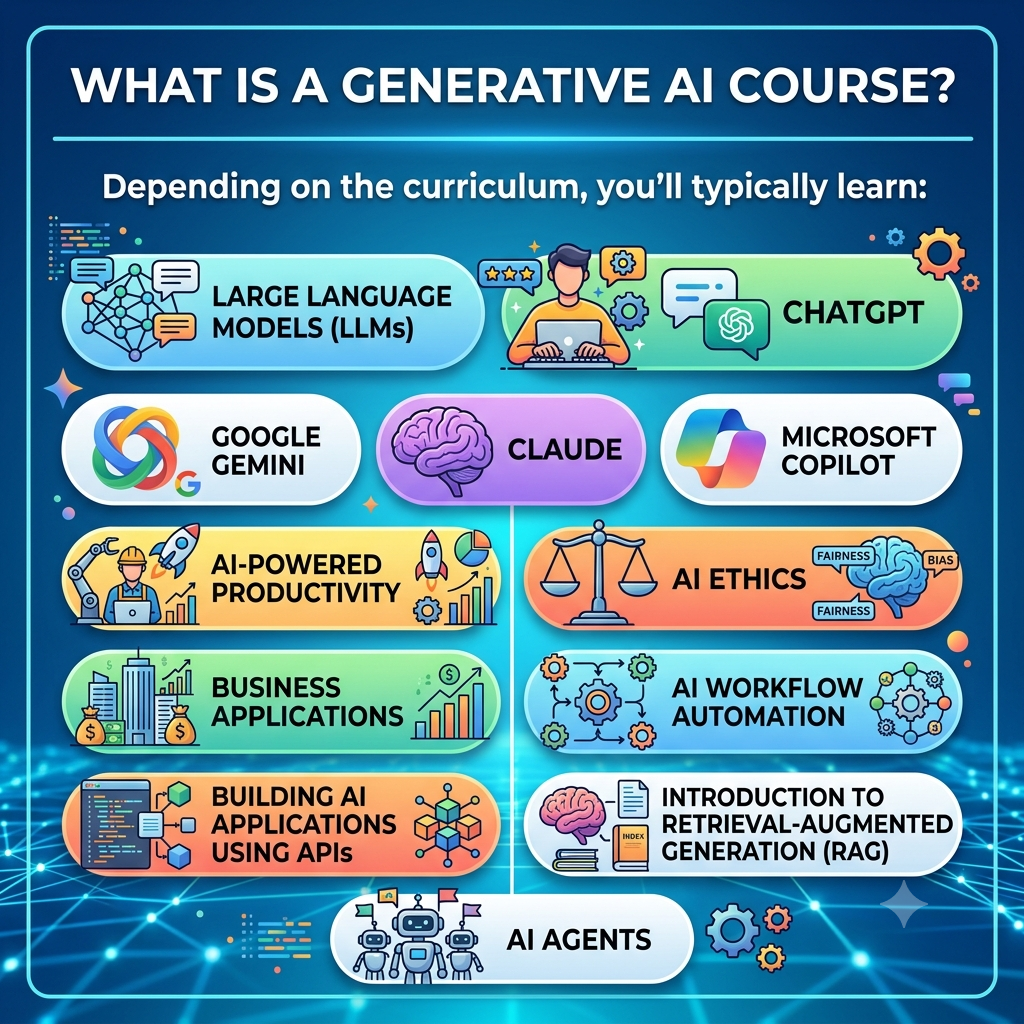
The best Generative AI courses for beginners teaches you how modern AI models create new content based on user input.
Depending on the curriculum, you’ll typically learn:
- Large Language Models (LLMs)
- Prompt Engineering
- ChatGPT
- Google Gemini
- Claude
- Microsoft Copilot
- AI-powered productivity
- AI ethics
- Business applications
- AI workflow automation
- Building AI applications using APIs
- Introduction to Retrieval-Augmented Generation (RAG)
- AI agents
Good beginner courses focus on understanding how to use these technologies effectively rather than explaining only the underlying mathematics.
Who Should Take a Beginner Generative AI Courses?
One common misconception is that AI is only for software engineers.
In reality, beginners from many backgrounds can benefit, including:
- College students
- Career changers
- Business professionals
- QA testers
- Project managers
- Marketing professionals
- Data analysts
- IT professionals
- Entrepreneurs
- Non-technical learners interested in AI
Many high-quality beginner courses require no prior AI experience.
What Makes a Best Generative AI Courses for Beginners?
Not every course delivers practical value.
Here are the most important factors to evaluate.
1. Beginner-Friendly Curriculum
The course should explain concepts clearly without assuming advanced programming knowledge.
Look for:
- Simple explanations
- Step-by-step lessons
- Hands-on demonstrations
- Real examples
Avoid courses that immediately dive into complex neural network theory unless your goal is AI research.
2. Hands-On Learning
Watching videos alone won’t build confidence.
The best courses include practical exercises using popular AI tools.
Examples include:
- Writing effective prompts
- Building AI assistants
- Creating business workflows
- Automating repetitive tasks
- Using APIs
- Experimenting with AI platforms
Learning by doing helps reinforce concepts much faster than passive instruction.
3. Real-World Projects
Employers value practical experience.
Projects might include:
- AI-powered chatbots
- Document summarization
- Resume optimization
- Content generation
- Customer support assistants
- AI research assistants
- Data analysis automation
Working on realistic projects helps you understand how Generative AI is used in production environments.
4. Current AI Tools
The AI landscape evolves rapidly.
Choose a course that covers current technologies such as:
- ChatGPT
- GPT models
- Google Gemini
- Claude
- Microsoft Copilot
- Open-source LLMs
Regularly updated content is a strong indicator of course quality.
5. Prompt Engineering
Prompt engineering course has become one of the most valuable AI skills.
A quality course should teach:
- Prompt design
- Context building
- Role prompting
- Chain-of-thought techniques (where appropriate)
- Structured outputs
- Prompt optimization
- Common prompt mistakes
Effective prompting often makes the difference between mediocre and excellent AI results.
6. AI Ethics and Responsible Use
Understanding AI limitations is just as important as learning its capabilities.
A comprehensive course should discuss:
- Hallucinations
- Bias
- Privacy
- Copyright considerations
- Responsible AI practices
- Human oversight
These topics prepare learners to use AI professionally and responsibly.
Programming vs. No Programming: Which Course Should You Choose?
Many beginners wonder whether they need coding experience.
The answer depends on your goals.
| Goal | Coding Required? |
|---|---|
| Improve productivity | No |
| Content creation | No |
| Prompt engineering | No |
| AI-assisted business workflows | No |
| Build AI applications | Basic Python recommended |
| AI development | Yes |
| LLM integration | Yes |
If you’re completely new to technology, starting with a no-code or low-code best Generative AI courses for beginners can help build confidence before moving into programming.
Skills You Should Gain by the End of the Course
By completing a well-designed beginner course, you should be able to:
- Understand Generative AI fundamentals
- Write effective prompts
- Use multiple AI tools confidently
- Automate common business tasks
- Evaluate AI-generated responses
- Build simple AI workflows
- Recognize AI limitations
- Apply AI ethically
- Explore APIs and integrations
- Continue learning advanced AI topics independently
Common Mistakes Beginners Make
Many learners slow their progress by making avoidable mistakes.
Choosing the Cheapest Course
Low-cost courses aren’t always updated or practical.
Focusing Only on Theory
Knowing how transformers work is useful, but practical experience matters more for most beginners.
Ignoring Projects
Real-world projects strengthen both understanding and your portfolio.
Expecting Instant Expertise
Generative AI is a rapidly evolving field. Continuous practice is essential.
Learning Only One AI Tool
Different tools have different strengths. Exposure to multiple platforms builds adaptability.
Instructor-Led Training vs. Self-Paced Learning
Both learning formats have advantages.
Self-Paced Courses
Best for learners who:
- Prefer flexibility
- Learn independently
- Already have technical experience
Instructor-Led Courses
Ideal for those who benefit from:
- Live guidance
- Structured learning paths
- Hands-on labs
- Real-time feedback
- Interactive Q&A sessions
- Career mentoring
- Accountability
Many beginners find instructor-led learning helps them progress more confidently, especially when exploring unfamiliar technologies.
How H2K Infosys Supports Beginners Learning Generative AI
For learners who prefer structured guidance, H2K Infosys offers instructor-led training designed to bridge the gap between theory and practical application. Following the organization’s educational philosophy, the emphasis is on hands-on projects, industry-relevant skills, and real-world scenarios rather than memorizing concepts alone. Learners also benefit from mentorship, interview preparation, and exposure to practical AI use cases that can strengthen career readiness.
Can beginners learn Generative AI without coding?
Yes. Many foundational topics, including prompt engineering, AI productivity tools, and business applications, can be learned without programming experience. Coding becomes more important if you plan to build AI applications or integrate models into software.
How long does it take to learn Generative AI?
Most beginners can understand the fundamentals within a few weeks of consistent study. Developing practical proficiency takes longer and depends on the amount of hands-on practice.
Which programming language is useful for Generative AI?
Python is the most widely used language for AI development due to its rich ecosystem of libraries and frameworks.
Is ChatGPT enough to learn Generative AI?
ChatGPT is an excellent starting point, but a comprehensive understanding also includes concepts such as prompt engineering, AI ethics, model limitations, APIs, workflow automation, and other leading AI platforms.
Are Generative AI certifications valuable?
A certification can demonstrate structured learning, but employers often place equal or greater emphasis on practical projects, problem-solving ability, and the effective use of AI tools.
Final Thoughts
The best Generative AI courses for beginners isn’t defined by popularity alone. It should provide a clear learning path, practical exercises, real-world projects, and guidance on applying AI responsibly.
As Generative AI becomes a core capability across industries, investing time in learning the fundamentals today can help you stay competitive and adapt to evolving workplace expectations. Whether you choose self-paced learning or instructor-led training, prioritize courses that emphasize hands-on experience and continuous skill development over theoretical knowledge alone.