
Business Analyst scenario based interview questions and answers evaluate how a candidate applies business analysis knowledge to real-world situations. They focus on practical decision-making, stakeholder interaction, requirement handling, and tool usage rather than theoretical definitions. These questions assess readiness for day-to-day responsibilities commonly encountered in enterprise IT projects.
Why are scenario-based interviews used for Business Analyst roles?
Scenario-based interviews are used because Business Analysts operate in complex, changing environments. Employers want to understand how candidates:
- Analyze ambiguous requirements
- Communicate with diverse stakeholders
- Balance business needs with technical constraints
- Apply business analysis training concepts in production settings
Unlike direct knowledge questions, scenarios reveal analytical thinking, prioritization, and professional judgment.
How does the Business Analyst role work in real-world IT projects?
In enterprise environments, a Business Analyst acts as a bridge between business stakeholders and technical teams. Daily work typically includes:
- Eliciting and documenting requirements
- Validating requirements through reviews and walkthroughs
- Supporting solution design with context and constraints
- Managing requirement changes during delivery
Business analysis online training often emphasizes these workflows because they mirror how BA responsibilities function across Agile, Waterfall, and hybrid models.
Core skills evaluated through scenario-based BA interview questions
Scenario questions are designed to test applied competence in:
- Requirement elicitation and analysis
- Stakeholder communication and conflict resolution
- Process modeling and documentation
- Change management and impact analysis
- Tool usage in business analyst courses
These skills are foundational to business analyst certification online programs and enterprise BA roles.
Scenario-Based Interview Questions and Answers for Business Analysts
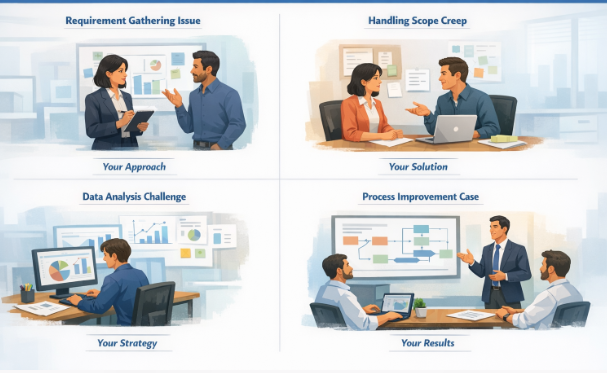
1. How would you handle unclear or incomplete requirements from a stakeholder?
Answer: When requirements are unclear, I first confirm my understanding by paraphrasing what has been shared and documenting assumptions explicitly. I then use structured elicitation techniques such as stakeholder interviews, workshops, or observation. In enterprise projects, I validate findings using requirement walkthroughs and obtain formal sign-off once clarity is achieved.
This approach aligns with standard practices taught in business analysis training and reduces downstream rework.
2. What would you do if business stakeholders keep changing requirements mid-project?
Answer: I document each change request and assess its impact on scope, timeline, cost, and dependencies. Using a formal change control process, I present the impact analysis to stakeholders and the project manager. Changes are implemented only after approval, ensuring transparency and traceability.
Such scenarios are common in environments covered under business analyst classes and enterprise Agile implementations.
3. How do you manage conflicting requirements from different stakeholders?
Answer: I identify the root objectives behind each requirement and map them to business goals. I then facilitate discussions to prioritize based on value, risk, and feasibility. When conflicts persist, I escalate with documented analysis to decision-makers for resolution.
This reflects real-world BA responsibilities emphasized in BA training programs.
4. How would you prioritize requirements when everything seems critical?
Answer: I apply prioritization frameworks such as MoSCoW or value-versus-effort analysis. I collaborate with stakeholders to define success criteria and align priorities with business objectives. Prioritization decisions are documented and revisited as conditions evolve.
5. How do you validate requirements before development begins?
Answer: I conduct requirement reviews, walkthroughs, and prototyping sessions with stakeholders. Validation ensures requirements are clear, testable, and aligned with business needs. In many business analyst certification online programs, validation is treated as a quality checkpoint before development.
6. What steps would you take if developers misinterpret documented requirements?
Answer: I review the documentation to identify gaps or ambiguity. I then clarify requirements through collaborative sessions and update artifacts accordingly. Continuous communication and visual models often prevent misinterpretation in enterprise projects.
7. How do you handle resistance from stakeholders during requirement elicitation?
Answer: I focus on building trust by explaining the purpose and benefits of the analysis. I adapt my communication style to the stakeholder’s perspective and address concerns with evidence-based explanations. This approach is widely practiced in business analysis online training scenarios.
8. Describe how you would handle scope creep in a live project.
Answer: Scope creep is addressed by clearly defining scope boundaries upfront and enforcing change management processes. I document new requests, assess impacts, and seek approval before inclusion. This discipline is essential in business analyst training and placement-oriented projects.
9. How do you ensure alignment between business requirements and technical solutions?
Answer: I maintain continuous collaboration with technical teams, provide contextual explanations, and participate in design discussions. Traceability matrices help ensure each requirement maps to a solution component.
10. What would you do if a delivered solution does not meet business expectations?
Answer: I conduct a gap analysis to identify mismatches between requirements and outcomes. Findings are shared with stakeholders, and corrective actions are proposed. Post-implementation reviews are standard practices in enterprise business analysis training environments.
Tools commonly referenced in BA scenario interviews
| Category | Common Tools | Usage Context |
|---|---|---|
| Requirement Management | JIRA, Azure DevOps | Tracking and traceability |
| Documentation | Confluence, MS Word | BRDs, FRDs |
| Modeling | Visio, Lucidchart | Process and data models |
| Communication | Teams, Zoom | Stakeholder collaboration |
These tools are frequently included in business analyst courses and hands-on labs.
How scenario-based questions differ across project methodologies
Agile environments
- Focus on user stories and acceptance criteria
- Emphasis on iterative feedback
- Frequent requirement refinement
Waterfall environments
- Detailed upfront documentation
- Formal sign-offs
- Structured change control
Understanding these differences is essential for professionals pursuing business analysis online training.
Job roles that use Business Analyst skills daily
- Business Analyst
- Product Owner
- Systems Analyst
- Functional Consultant
- Process Analyst
Each role applies business analysis training concepts differently depending on organizational context.
Career paths after Business Analyst training
| Experience Level | Typical Roles |
| Entry-level | Junior Business Analyst |
| Mid-level | Business Analyst, Product Analyst |
| Senior-level | Lead BA, Product Owner, BA Manager |
These paths are commonly discussed in business analyst training and placement programs.
Frequently Asked Questions (FAQ)
Are scenario-based BA interview questions difficult?
They are practical rather than difficult. They test applied understanding gained through business analyst courses and real project exposure.
How should beginners prepare for scenario-based interviews?
By practicing real-world scenarios, understanding workflows, and applying concepts learned in BA training programs.
Do certifications help with scenario-based interviews?
Certifications provide structured knowledge, but interview success depends on applying that knowledge effectively.
Are tools knowledge mandatory for BA interviews?
Tool familiarity is often expected, especially in enterprise environments, but conceptual clarity remains critical.
Key takeaways
- Scenario-based interviews assess real-world BA competence
- Strong focus on requirement handling and stakeholder communication
- Preparation requires applied practice, not memorization
- Business analysis training bridges theory and execution
Explore H2K Infosys Business Analyst courses to gain hands-on exposure to real project scenarios. Learn through structured BA training and practical application to support long-term career growth.