Yes, beginners absolutely can build strong Data Analytics skills through online learning especially when the training is practical and not just endless theory slides. Honestly, that’s one of the biggest differences people notice today. Companies care far more about whether someone can actually work with data than where they learned it.
A few years back, online learning still made some employers skeptical. People wondered if remote training was “serious enough.” That hesitation has faded quite a bit now. Hiring teams want people who can clean messy datasets, build dashboards, explain trends clearly, and make business decisions easier. If a candidate can show projects and confidence during interviews, the learning format becomes less important.
That shift alone explains why demand for a good Data Analytics course has grown so quickly lately.
Why Beginners Are Suddenly Interested in Analytics
Data is pretty much everywhere now. Retail brands track buying habits. Hospitals analyze patient trends. Logistics companies monitor delivery patterns. Even smaller businesses rely on dashboards to figure out what’s working and what’s quietly draining money.
That’s what makes analytics feel approachable for many beginners. You do not always need a hardcore technical background to get started.
A lot of people entering this field actually come from completely different roles:
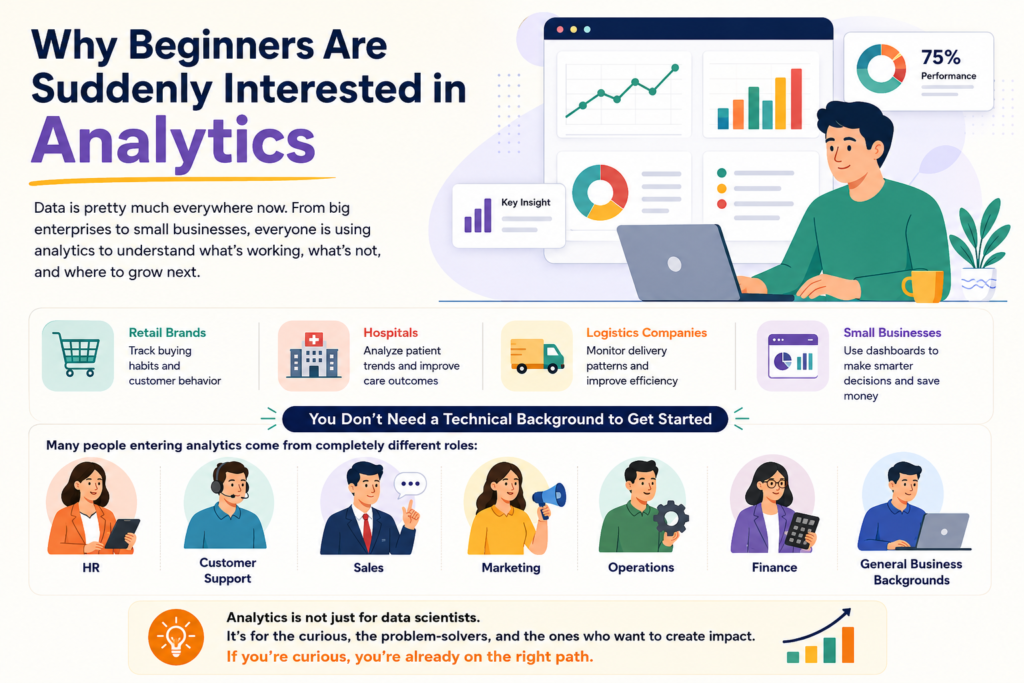
- HR
- Customer support
- Sales
- Marketing
- Operations
- Finance
- General business backgrounds
And when you think about it, many of them already deal with reports, spreadsheets, and performance numbers daily. They just never labeled those activities as Data Analytics skills before.
I remember talking with someone who worked in recruitment operations for years. She spent most of her day buried in Excel sheets but believed analytics was “too technical” for her. After joining structured Data analyst online classes, she realized tools like SQL and Power BI were learnable once somebody explained them properly instead of throwing jargon everywhere. Stories like that are becoming really common now.
The Real Problem Most Beginners Face
Usually, beginners do not struggle because analytics is impossible.
They struggle because they try learning everything randomly.
One YouTube tutorial teaches SQL joins. Another jumps into Python automation. Then suddenly somebody is watching Power BI dashboard videos without understanding data cleaning basics first. It becomes chaotic fast.
A proper Data Analytics course helps because it gives learners a path instead of scattered information.
Typically, the learning flow looks something like this:
- Excel and data cleaning
- SQL fundamentals
- Visualization tools
- Real datasets
- Business case studies
- Project practice
- Interview preparation
That structure honestly matters more than people realize. Without it, many learners burn out halfway.
How H2K Infosys Helps Beginners Build Practical Data Analytics Skills
One reason some learners mention H2K Infosys while discussing analytics training is the practical approach behind their programs. Beginners usually need more than recorded videos. They need guided exposure to how analytics actually works inside companies.
That’s where structured learning becomes valuable.
Instead of focusing only on definitions or theory-heavy lectures, programs associated with H2K Infosys often emphasize hands-on work like:
- SQL reporting
- Dashboard development
- Excel-based analysis
- Business interpretation
- Data visualization
- Mock interview sessions
And honestly, that practical element makes a huge difference.
A lot of learners lose confidence midway because nobody connects the tools to real business situations. They learn commands but never understand how analysts solve actual workplace problems. Training environments that include projects and scenario-based exercises help bridge that gap naturally.
In 2026 especially, employers care less about memorized theory and more about whether someone can apply Data Analytics skills in realistic situations.
Why Online Learning Actually Works for Many People
Traditional classroom learning does not fit everyone anymore. That’s just reality.
Working professionals, career changers, even parents returning to the workforce often need flexibility more than anything else. Online learning gives them room to study after work hours, revisit recorded sessions, and practice gradually instead of rushing through concepts.
Good Data analyst online classes usually include:
- Live mentoring
- Resume guidance
- Hands-on assignments
- Peer discussions
- Practice datasets
- Mock interview preparation
That combination feels far more interactive than people assume.
And honestly? I’ve noticed learners who consistently study for one or two hours daily often perform better than those trying to “master analytics” over a single intense weekend. Consistency quietly wins here.
The Most Important Data Analytics Skills Beginners Should Learn First
One mistake beginners make is trying to learn every trending tool immediately. Machine learning, cloud analytics, AI automation, Python libraries it becomes overwhelming very quickly.
A smarter approach is building core Data Analytics skills first.
Excel and Data Cleaning
Still incredibly important in business environments. Analysts constantly clean messy reports, organize datasets, and create summaries.
SQL
Probably the most important technical skill for analysts right now. Companies expect analysts to retrieve and filter data independently.
Power BI or Tableau
Visualization tools help transform raw information into something decision-makers can actually understand.
Business Thinking
This gets overlooked constantly. Strong analysts do not just create charts — they explain what the numbers mean and why businesses should care.
Communication Skills
Surprisingly underrated. Analysts spend a huge amount of time presenting insights to managers and stakeholders.
Many learners entering a Data Analytics course focus only on software tools at first. But companies increasingly want people who can explain insights clearly, not just generate reports.
Why Analytics Has Become More Beginner-Friendly Recently
The industry itself has changed a lot over the past few years.
AI tools now automate repetitive reporting tasks, but interestingly, that has increased demand for people who understand context and business reasoning. Companies still need humans who can interpret patterns, ask the right questions, and connect data to decisions.
That’s why foundational Data Analytics skills continue to stay valuable despite automation trends.
Another noticeable shift is the rise of hybrid analytics roles:
- HR analytics
- Healthcare analytics
- Marketing analytics
- Financial analytics
This opens doors for people coming from non-technical backgrounds because domain knowledge suddenly becomes useful alongside analytics training.
H2K Infosys and Career Transition Support
Career changers usually need confidence just as much as technical training.
Learning SQL syntax is one thing. Explaining a project confidently during an interview is something completely different.
This is where mentorship-focused programs help. H2K Infosys training programs are often mentioned by learners looking for practical transition support because they combine technical lessons with interview preparation and project-based learning.
That combination matters more than people expect.
Recruiters can often tell when somebody has genuinely practiced Data Analytics skills versus someone who only watched theory videos. Real project discussions, business case studies, and mock scenarios make candidates sound far more confident and natural during interviews.
Common Mistakes Beginners Should Avoid

Trying To Learn Everything Together
A lot of people jump straight into advanced topics too early. It usually creates confusion instead of progress.
Start with the basics first.
Ignoring Projects
Without projects, interviews become difficult because learners cannot explain practical experience.
Watching Tutorials Without Practicing
Analytics is not passive learning. Watching videos alone rarely builds confidence.
Focusing Only on Certifications
Certificates help, sure. But employers care far more about applied Data Analytics skills and problem-solving ability.
Most interviewers eventually ask questions like:
- What project did you work on?
- What business issue were you solving?
- What insights did you discover?
That’s where real preparation shows.
How Long Does It Take to Learn Data Analytics Skills?
For most beginners, developing job-ready Data Analytics skills usually takes around four to eight months with steady practice.
Of course, nobody becomes an expert overnight. Analytics is one of those fields where learning keeps evolving.
Still, beginners can absolutely become employable through structured Data analyst online classes if they stay consistent, practice projects regularly, and spend time understanding business scenarios instead of memorizing theory.
That steady progress matters much more than trying to learn everything perfectly.
Final Thoughts
Beginners can definitely learn Data Analytics skills through online learning when the training focuses on practical experience, mentorship, and real-world projects rather than only theoretical concepts.
The field feels far more accessible now than it did a few years ago. With the right Data Analytics course, consistent practice, and guided support, even people from non-technical backgrounds can build successful analytics careers.
Programs connected with H2K Infosys are part of that growing conversation because many learners now want project-focused training that reflects actual workplace expectations instead of outdated classroom-only teaching.
And honestly, that practical exposure is often what helps someone move from “I’m curious about analytics” to genuinely feeling ready for a professional role.