Introduction
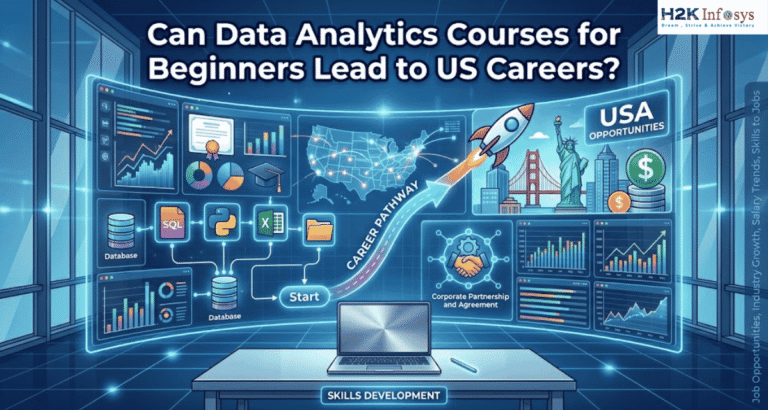
So, without further ado, the answer is yes, data analytics courses for beginners from H2K Infosys definitely lead to careers in the US, even if you are starting from ground zero. I have seen it happen often enough to know it from my own experience. The landscape in 2026 is more welcoming than ever to newcomers willing to do the work, and data analytics courses for beginners have become a direct pipeline to some pretty exciting job opportunities.
Why Are Data Analytics Beginners in Demand in the US Right Now?
It’s honestly kind of wild how fast the demand for data analytics courses for beginners has grown. Every time I scroll through LinkedIn or Indeed, I see new posts for “junior data analyst”, “business intelligence assistant”, or “entry-level analytics associate”. It’s not just tech companies hiring, either. You’ll find these roles in healthcare (think hospital systems wanting to optimise care), finance (banks tracking customer trends), retail, logistics, sports, and even education.
Why is this happening?
- Explosion of data: Companies are swimming in information, but they desperately need people who know how to make sense of it.
- Remote work: Post-pandemic, US employers are much more open to hiring talent from all over, as long as you’ve got the skills.
- Focus on skills, not degrees: Especially for entry-level roles, employers want proof you can do the job not just a fancy diploma.
I’ve seen friends who worked in totally different fields thinking marketing, teaching, and even hospitality take a solid data analytics courses for beginners and land their first analytics jobs within a year. It’s not some overnight magic, but it’s real, and it’s happening right now.
What data analytics courses for beginners Actually Cover?
Let’s break down what you’ll actually learn. A good online course for data analytics isn’t just a bunch of dry lectures. The best ones are hands-on, practical, and focused on building skills you can show off to employers.
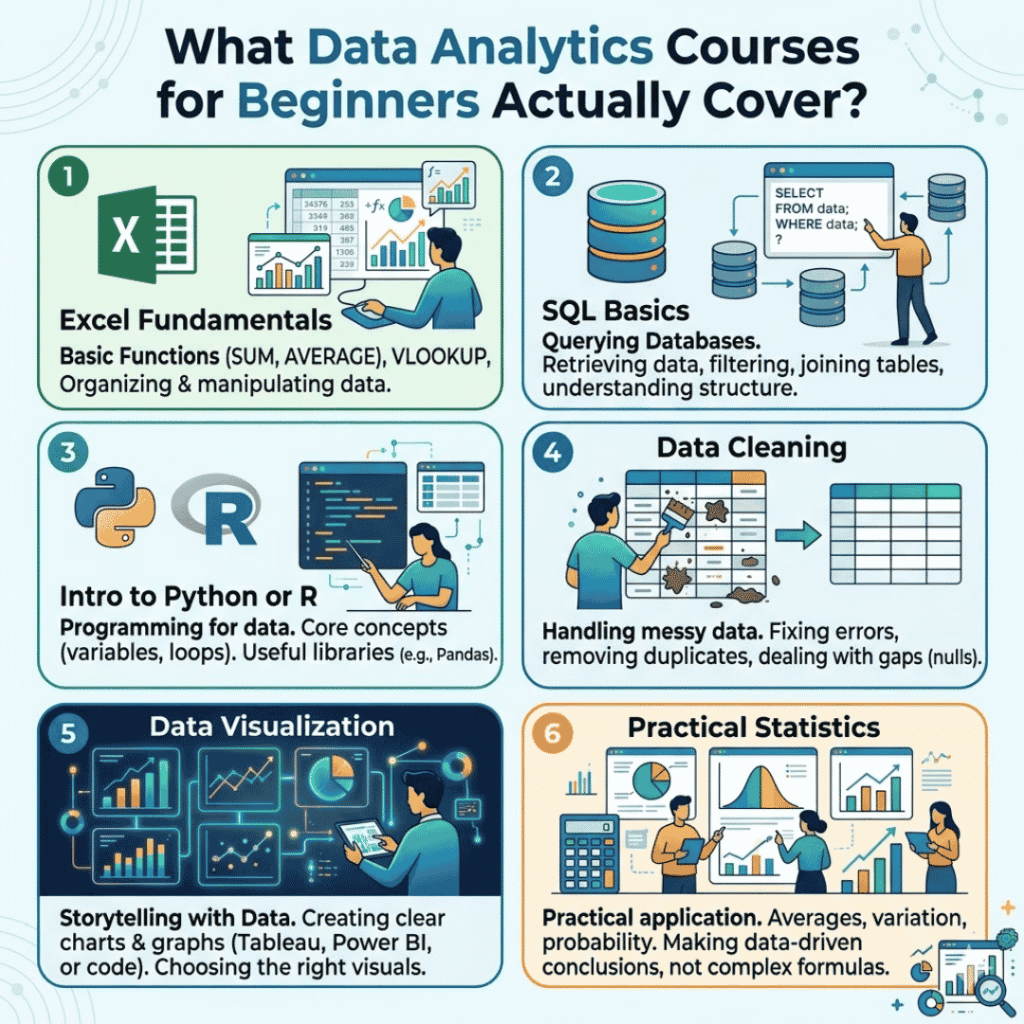
Here’s what you’ll usually see:
- Excel fundamentals: You’ll start simple, but trust me, you’ll end up doing things with spreadsheets you didn’t even know were possible.
- SQL basics: Learning how to pull data from databases is a must. SQL is everywhere in the analytics world.
- Intro to Python or R: Don’t let this scare you! These are the languages of data, and most data analytics courses for beginners make them very approachable.
- Data cleaning: Real data is messy. You’ll learn to tidy things up so you can actually work with it.
- Data visualization: Making charts and dashboards that tell a story Tableau and Power BI are big here.
- Statistics, but practical: No one’s expecting you to be a math genius, but you’ll get comfortable with averages, trends, and basic probability.
Personal tip: The first time I made a dashboard that actually helped my manager make a decision, it was a lightbulb moment. You realize it’s not just about numbers; it’s about real business impact.
Real-World Scenarios: From Online Course to US Job Offer
Let me give you a concrete example. Last year, a friend of mine was working as a customer service rep. She was burnt out, wanted more pay, and craved a job she could do remotely. She enrolled in a data analytics course for beginners (the one at H2K Infosys, actually), started building mini-projects using real datasets, and shared them on LinkedIn. Within six months, she landed an interview for a junior analyst role at a health tech company in Chicago no degree required, just the skills and a project portfolio.
What made her stand out?
- She didn’t just “watch” the lessons; she did every project, often adding her own spin.
- She networked with classmates and mentors, asking questions and even offering to help on group projects.
- Her LinkedIn profile was loaded with tangible examples of her work, not just a certificate.
That’s one story, but there are thousands like it. I’ve seen folks transition from teaching, sales, even barista gigs. If you’re willing to learn and show your work, companies notice.
Trends in Data Analytics Hiring (2026 Update)
Let’s talk about what’s happening right now. US companies are hungry for data analytics courses for beginners talent, but they’re also smartening up about how they hire. Here’s what I’m seeing, both in the news and from industry insiders:
- Portfolio-first hiring Recruiters care about what you can do, not just what you studied. That is the value of courses with real projects.
- Work on soft skills: Communication, problem solving, and business sense are just as important as technical chops. Can you explain your analysis to someone who doesn’t know anything about data? That’s gold.
- Credential stacking: Micro-credentials and certifications from respected data analytics courses for beginners providers (like H2K Infosys, Coursera, or Google) are valued by employers.
- Remote and hybrid work: Many US analytics jobs are fully remote. That means global opportunities for anyone with the right skill set.
This isn’t just my opinion the Bureau of Labor Statistics projects analytics jobs to grow much faster than average through 2030 and beyond.
What Skills Will You Really Walk Away With?
After a solid data analytics courses for beginners , here’s what ends up on your “real skills” list:
- Excel wizardry (formulas, pivot tables, dashboards)
- SQL querying (how to extract and manipulate data from large databases)
- Python basics (data manipulation with pandas, simple visualizations)
- Data storytelling (presenting insights in a way that makes sense to decision-makers)
- Statistical thinking (spotting trends, understanding what the numbers actually mean)
- Professional portfolio (GitHub projects, Tableau dashboards, case studies)
Side thought: When I started, I was terrified of SQL. But after a couple of projects, it clicked. If you practice, you’ll get there promise.
Mistakes Beginners Make (and How to Avoid Them)
We’ve all been there here are some classic pitfalls I’ve seen (and made myself):
- Only watching, never doing. Passive learning won’t cut it. Do every exercise, tweak things, break stuff, and fix it.
- Skipping the boring bits. Data cleaning isn’t glamorous, but it’s half the job. Embrace the mess!
- Not building a portfolio. Even if it’s just small projects, share them online. Recruiters love seeing proof.
- Ignoring soft skills. Can you explain your findings to a non-technical manager? Practice this it’s a game-changer.
- Going it alone. Join course forums, LinkedIn groups networking is key for job leads and referrals.
How do you actually land a job in the US after completing an online course?
Here’s what’s working for folks right now:
- Build a killer LinkedIn profile. Add every project, certificate, and relevant skill. Write about your learning journey people love it.
- Join data communities. Slack groups, Discord servers, and online forums are goldmines for advice, feedback, and sometimes even job postings.
- Apply strategically. Target entry-level roles and don’t be afraid to go for internships or contract gigs at first.
- Show your work. Employers want to see your process. Document your projects what problem you solved, how you approached it, what tools you used.
- Keep learning. The field changes fast. Stay curious; pick up new tools and trends as you go.
Career Outcomes: What’s Realistic? (Salary, Jobs, Demand)
Here’s the good news: entry-level data analytics salaries in the US are strong, even for newcomers. Based on what I’m seeing in 2026:
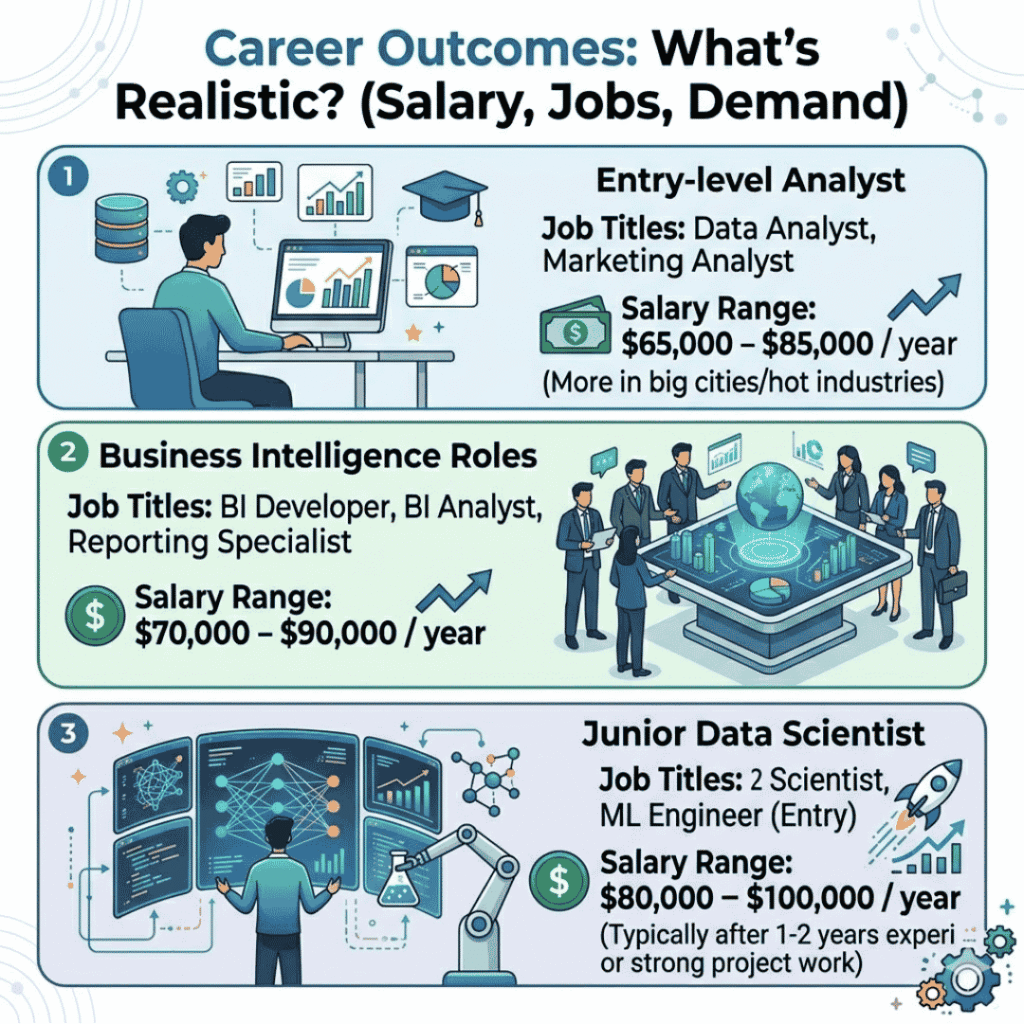
- Entry-level analyst: 65,000–85,000/year (sometimes more in big cities or hot industries)
- Business intelligence roles: 70,000–90,000/year
- Junior data scientist: 80,000–100,000/year (after some experience)
The demand isn’t slowing down if anything, it’s picking up as more companies realize how much they need data people.
What Makes H2K Infosys Stand Out for Beginners?
I have to say, H2K Infosys gets a lot of love in the data analytics courses for beginners community for a reason:
- Hands-on focus: You’re not just watching videos you’re getting messy with real datasets.
- Mentor support: Instructors actually answer questions, and you get feedback on your projects.
- Job placement help: They offer resume workshops, interview prep, and sometimes even direct introductions to employers.
- Community : You’re not a faceless student, you’re in a network.
If you are serious about making a career out of data analytics courses for beginners , structured training from a provider like H2K Infosys can make a huge difference. The support, the projects and the networking all make you stand out.
FAQs: Real Questions from Real Beginners
Q1: Do I need a college degree to get into data analytics in the US?
No, not for most entry-level roles. Skills, projects, and certifications are often more important today.
Q2: How long does it take to complete a data analytics courses for beginners ?
Most people finish in 2–6 months, depending on your pace and how deep you go.
Q3: What if I get stuck on a concept or tool during the course?
Look for courses with active support forums, live help, or mentorship. H2K Infosys is known for being responsive.
Q4: Can I get a remote analytics job in the US after finishing a course?
Absolutely. Many companies hire remote analysts, and this trend is only increasing.
Q5: Is Python a must-have skill, or can I just use Excel?
Excel and SQL are a great start. Python is super useful as you progress, but you can land entry roles with just Excel and SQL.
Next Steps & Related Topics for Further Learning
- How to Create a Data Analytics Portfolio: Demonstrate your projects to attract employers.
- Top Data Analytics Tools for Beginners: Learn Tableau, Power BI, and More
- Data Analyst Networking: Practical tips on how to break into the field.
You can research these topics to create a strong content cluster and grow your expertise.
A Real-World Takeaway
So, can data analytics courses for beginners lead to US careers? Yes, if you choose the right course, work hard, and demonstrate your skills, you’re already halfway there. The field is open, the demand is real, and your background matters less than your willingness to learn and adapt.
And if you’re ready to get started, check out H2K Infosys. Their programs are designed for real-world success whether you want to break into your first analytics role or level up your current career. Take the leap, get your hands dirty, and let your new skills open doors.