Introduction
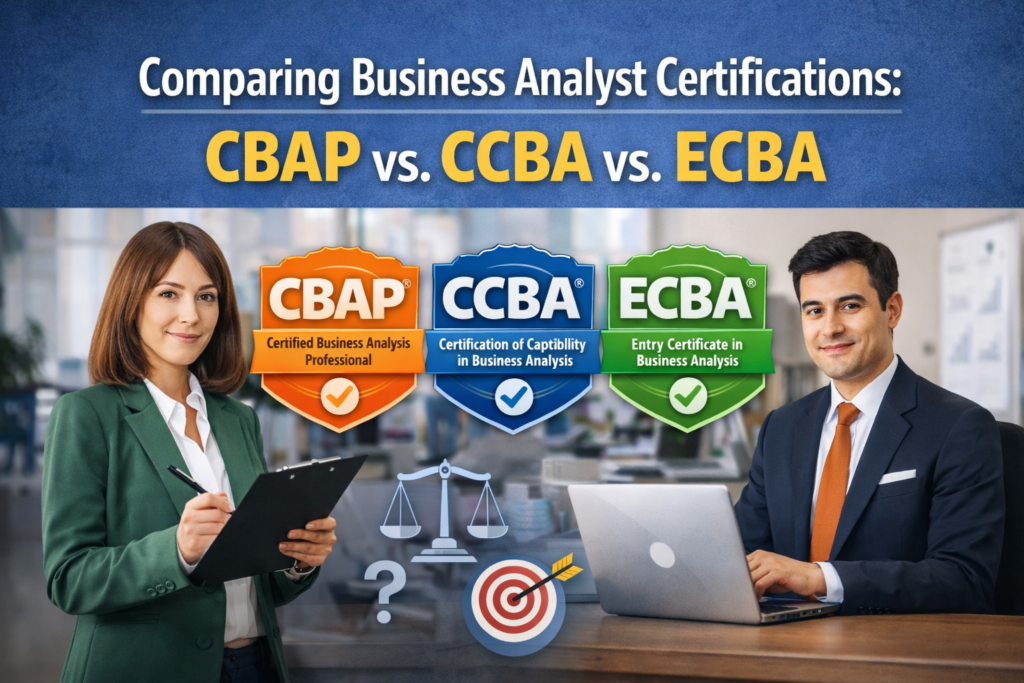
A business analyst plays a key role in modern organizations. Companies depend on analysts to improve processes, reduce costs, and deliver better products. Many professionals now explore certifications to stand out in this competitive field. This is where Comparing Business Analyst Certifications becomes important.
Certifications like CBAP, CCBA, and ECBA help professionals prove their skills. Each certification serves a different career stage. Choosing the right one can shape your career path. Many learners also combine certifications with business analyst courses or business analyst training with placement to gain practical experience.
In this guide, you will learn how these certifications differ. You will also understand which one fits your goals. This blog will help you make an informed decision through detailed explanations, real examples, and step by step guidance.
Why Business Analyst Certifications Matter
Before Comparing Business Analyst Certifications, you need to understand their value.
Organizations look for certified professionals because they trust standardized knowledge. According to industry surveys, certified business analysts often earn higher salaries than non certified peers. Employers also prefer candidates who follow structured frameworks like BABOK.
Key Benefits of Certification

- Improves job credibility
- Enhances domain knowledge
- Increases salary potential
- Opens global job opportunities
- Supports career growth
Many professionals start with business analyst courses and then pursue certifications. This path helps them gain both theory and practice.
Overview of the Business Analyst Certifications List
When you explore a business analyst certifications list, you will see three major certifications from IIBA:
- ECBA
- CCBA
- CBAP
Each certification targets a different experience level. Understanding this structure is key when Comparing Business Analyst Certifications.
Certification Levels Explained
- Entry Level: ECBA
- Mid Level: CCBA
- Advanced Level: CBAP
This tiered approach helps professionals grow step by step. Many learners combine certification with business analyst training with placement programs to improve job readiness.
ECBA: Entry Certificate in Business Analysis
ECBA is the starting point in the certification journey. It suits beginners who have little or no experience.
Who Should Choose ECBA
- Fresh graduates
- Career changers
- Professionals new to business analysis
When Comparing Business Analyst Certifications, ECBA stands out as the most accessible option.
Key Features
- No prior work experience required
- Focus on basic concepts
- Based on BABOK guide
Skills You Learn
- Requirement gathering
- Stakeholder identification
- Basic process modeling
Real World Example
A graduate joins a company as a junior analyst. They complete ECBA certification. They learn how to document requirements and support senior analysts. This helps them build confidence.
Many beginners also take business analyst courses before attempting ECBA. This improves their chances of passing the exam.
CCBA: Certification of Capability in Business Analysis
CCBA targets professionals with some experience. It focuses on practical skills and real project exposure.
When Comparing Business Analyst Certifications, CCBA fits professionals in the middle stage of their career.
Eligibility Requirements
- Minimum work experience in business analysis
- Knowledge of BABOK concepts
- Professional references
Key Features
- Focus on application of knowledge
- Emphasis on real world scenarios
- Strong validation of skills
Skills You Learn
- Requirement management
- Solution evaluation
- Stakeholder communication
Real World Example
A business analyst with three years of experience works on a banking project. They use CCBA concepts to manage changing requirements. This improves project delivery speed.
Professionals often combine CCBA preparation with business analyst training with placement to gain practical exposure.
CBAP: Certified Business Analysis Professional
CBAP is the highest level certification. It targets experienced professionals who lead projects.
When Comparing Business Analyst Certifications, CBAP represents expertise and leadership.
Eligibility Requirements
- Extensive work experience
- Deep knowledge of BABOK
- Leadership involvement
Key Features
- Advanced level certification
- Focus on strategic decision making
- High industry recognition
Skills You Learn
- Business strategy alignment
- Advanced requirement analysis
- Leadership in projects
Real World Example
A senior analyst leads a digital transformation project. They use CBAP frameworks to align business goals with technology solutions. This leads to improved customer experience.
Many professionals pursue CBAP after gaining experience through business analyst courses and real projects.
Key Differences Between CBAP, CCBA, and ECBA
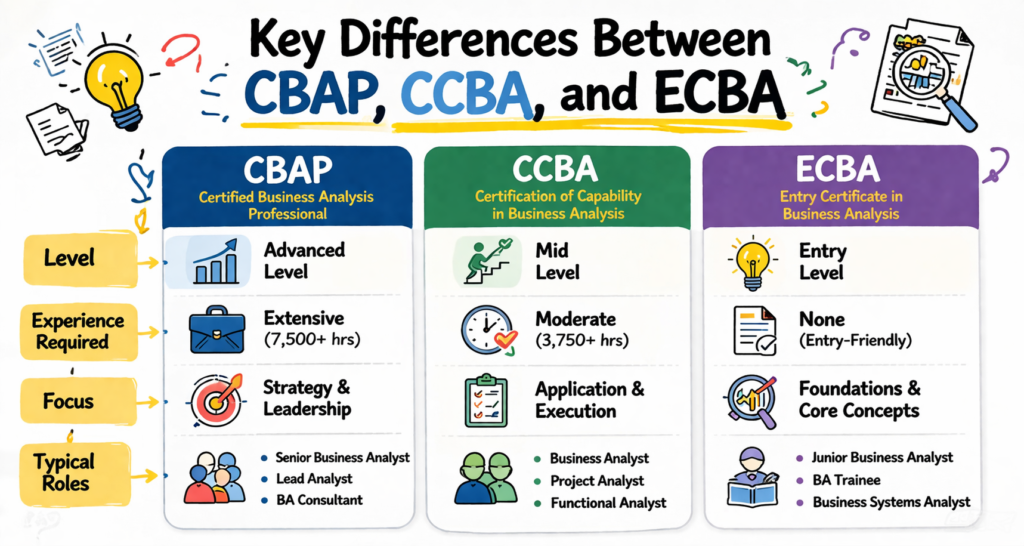
When Comparing Business Analyst Certifications, the differences become clear in experience level, skills, and career impact.
Experience Level
- ECBA: No experience
- CCBA: Moderate experience
- CBAP: Extensive experience
Career Impact
- ECBA: Entry level roles
- CCBA: Mid level roles
- CBAP: Senior roles
Learning Focus
- ECBA: Basics
- CCBA: Application
- CBAP: Strategy
Understanding these differences helps you choose the right certification.
How to Choose the Right Certification
Choosing the right certification depends on your current position.
When Comparing Business Analyst Certifications, always consider your experience level first.
Step by Step Guide
Step 1: Evaluate Your Experience
Check your work history. Beginners should start with ECBA.
Step 2: Identify Career Goals
If you want leadership roles, aim for CBAP.
Step 3: Build Knowledge
Enroll in business analyst courses to strengthen fundamentals.
Step 4: Gain Practical Skills
Join business analyst training with placement programs to work on real projects.
Step 5: Apply for Certification
Choose the certification that matches your experience.
Role of Training in Certification Success
Training plays a key role when preparing for certifications.
When Comparing Business Analyst Certifications, preparation methods can impact success.
Benefits of Training
- Structured learning
- Real world scenarios
- Expert guidance
- Hands on practice
Many learners prefer business analyst training with placement because it combines theory and practice.
Practical Skills You Need as a Business Analyst
Certifications alone are not enough. You need practical skills to succeed.
When Comparing Business Analyst Certifications, focus on skills that apply in real projects.
Essential Skills
- Requirement analysis
- Communication
- Problem solving
- Data interpretation
- Process modeling
Sample Requirement Template
Here is a simple structure used in projects:
- Project Name
- Stakeholder Details
- Business Requirements
- Functional Requirements
- Acceptance Criteria
This structure helps analysts maintain clarity.
Industry Demand for Certified Business Analysts
The demand for certified analysts continues to grow.
Reports show that companies prefer certified professionals because they follow standard practices.
When Comparing Business Analyst Certifications, industry demand supports all three levels.
Key Industries Hiring Analysts
- Banking
- Healthcare
- IT services
- Retail
- E commerce
Professionals with certifications and business analyst courses experience often secure better roles.
Common Mistakes to Avoid
Many learners make mistakes during certification preparation.
When Comparing Business Analyst Certifications, avoid these common errors.
Mistakes
- Skipping fundamentals
- Ignoring practical experience
- Choosing the wrong certification level
- Not practicing real scenarios
You can avoid these mistakes by combining learning with business analyst training with placement.
Career Path After Certification
Certification opens new opportunities.
When Comparing Business Analyst Certifications, each level leads to different roles.
Career Progression
- ECBA: Junior Analyst
- CCBA: Business Analyst
- CBAP: Senior Analyst or Consultant
This structured path helps professionals grow steadily.
How Certifications Improve Salary
Certified professionals often earn higher salaries.
Studies show that CBAP certified analysts earn significantly more than non certified peers.
When Comparing Business Analyst Certifications, salary growth increases with experience.
Salary Impact
- ECBA: Entry level salary
- CCBA: Mid level salary increase
- CBAP: High salary growth
Combining certification with business analyst training with placement improves job offers.
Real World Case Study
A professional from a non technical background enters business analysis. They start with business analyst courses. They earn ECBA certification. They gain experience through projects.
After two years, they pursued CCBA. They handle complex projects. Later, they achieve CBAP. They move into leadership roles.
This journey highlights the importance of Comparing Business Analyst Certifications at each stage.
Key Takeaways
- Certifications validate your skills
- ECBA suits beginners
- CCBA suits mid level professionals
- CBAP suits experienced analysts
- Training improves success rate
- Practical skills are essential
When Comparing Business Analyst Certifications, always align your choice with your experience and career goals.
Conclusion
Choosing the right certification can shape your future in business analysis. Take the first step today and align your learning with your career goals.
Start building your skills now and move closer to becoming a certified business analyst.