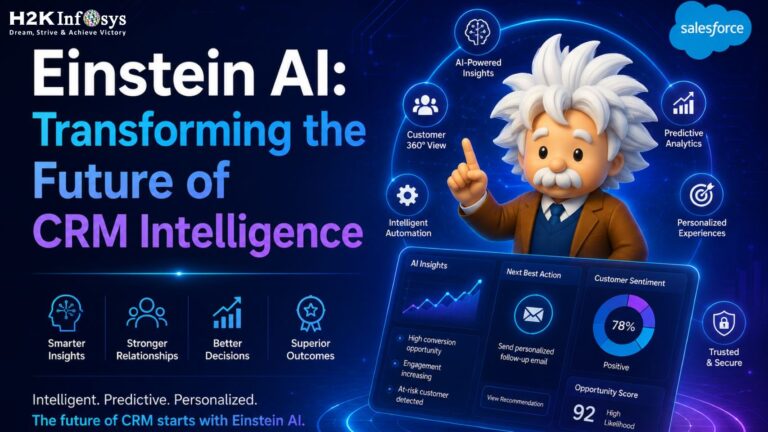
H2K Infosys is enabling professionals to stay ahead in the fast-paced CRM environment with hands-on Salesforce certification courses focusing on the growing significance of Einstein AI in today’s business processes. Customer relationship management is more than just storing contacts or tracking sales activities anymore. That phase is already behind us. Today, companies want systems that think, predict, automate, and even guide decision-making in real time. That shift is exactly why Einstein AI has become one of the biggest conversations in the Salesforce ecosystem lately.
And honestly, if you’ve worked in CRM even a little over the past few years, you can feel the difference already.
Sales teams are spending less time digging through dashboards. Service agents are getting AI-generated responses before they even finish reading a customer ticket. Marketing teams are predicting customer behaviour instead of simply reacting to it. It’s not futuristic anymore. It’s happening now.
The interesting part? Most businesses are still figuring out how to actually use these AI capabilities effectively. That’s where proper Salesforce Admin Training and hands-on learning really matter.
Why Einstein AI Is Changing CRM Faster Than Expected
A few years ago, AI inside CRM platforms sounded more like a fancy add-on feature. Something companies would experiment with if they had extra budget. But once generative AI exploded into the mainstream in 2024 and 2025, businesses suddenly started expecting intelligent automation everywhere.
Salesforce moved quickly.
They embedded Einstein AI everywhere from Sales Cloud to Service Cloud, Marketing Cloud, Slack integrations, and analytics tools. AI isn’t locked in one feature, it’s embedded in the daily workflow.
For example:
- Sales reps can now receive AI-generated follow-up email suggestions.
- Managers get predictive forecasting based on live CRM data.
- Customer support teams receive automated case summaries.
- Marketing teams can generate campaign content directly within Salesforce.
What makes Einstein AI particularly valuable is that it works within existing CRM workflows. Employees don’t need to jump between five disconnected tools anymore. Everything stays centralized.
I spoke with a Salesforce consultant recently who said something that stuck with me: Companies don’t want more software. They want smarter software.
That pretty much sums up the current direction of CRM technology.
Businesses Are Prioritizing AI-Skilled Salesforce Professionals
This is another major shift happening quietly in the background.
Companies are no longer hiring Salesforce administrators just to manage permissions and workflows. Employers increasingly want professionals who understand automation, predictive analytics, AI-driven customer engagement, and data interpretation.
That’s why enrollment in Salesforce training courses has increased significantly over the past year. Organizations know they need teams who can configure and manage AI-enabled CRM environments.
And to be fair, it makes sense.
Imagine a company investing heavily in Einstein AI features but lacking internal expertise to implement them properly. The tools become underused very quickly. AI is only valuable when people know how to apply it to real business problems.
That’s one reason H2K Infosys has been getting attention among learners transitioning into Salesforce careers. Their programs focus heavily on practical exposure rather than just theory-heavy certification preparation.
A lot of online courses still teach Salesforce like it’s 2018. Static videos. Generic explanations. Minimal real-world scenarios.
But modern Salesforce environments look completely different now because of AI integration.
How Einstein AI Improves Real Customer Experiences
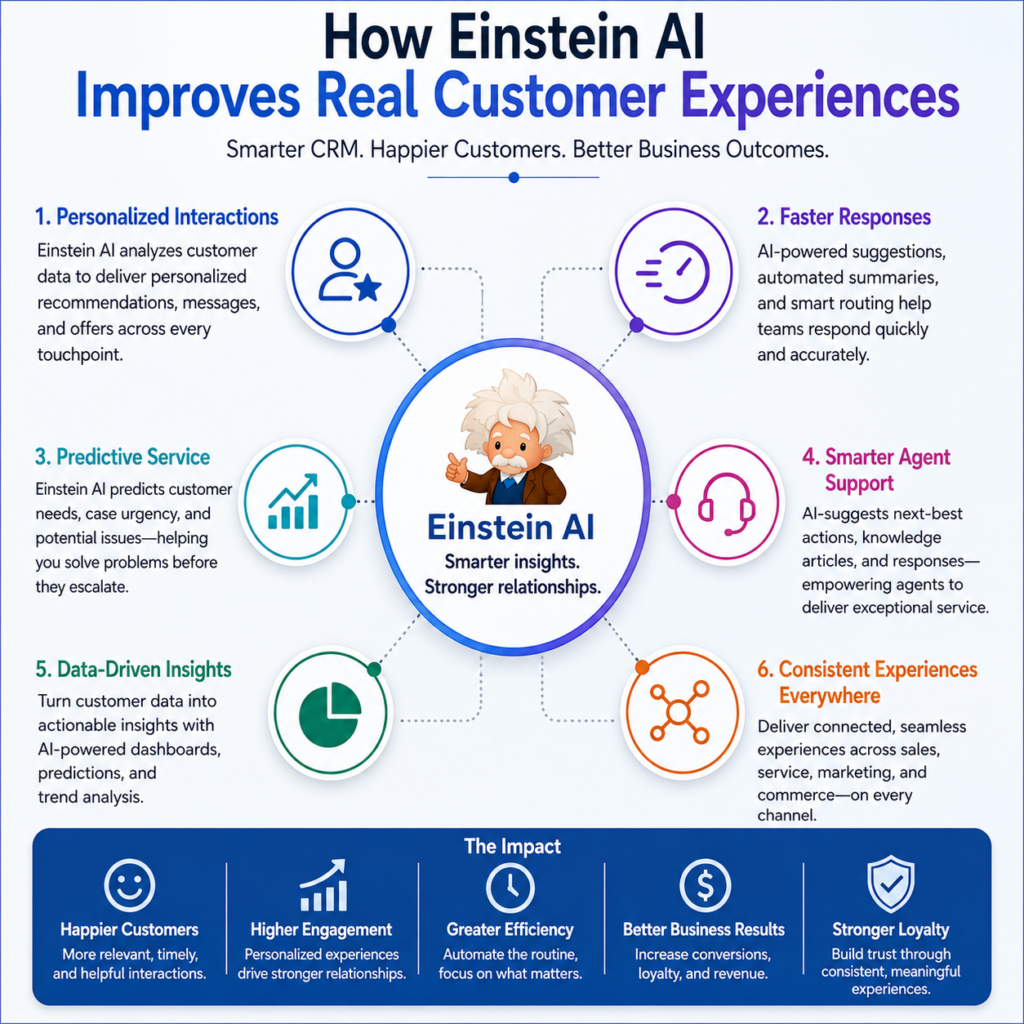
One thing people often misunderstand about AI in CRM is this: customers don’t actually care about the AI itself.
They care about faster responses.
Better recommendations.
Less frustration.
More personalized interactions.
That’s where Einstein AI quietly changes the experience behind the scenes.
For example, take customer service.
A telecom company using Einstein AI can automatically analyse incoming support cases, identify urgency, suggest likely resolutions, and route tickets to the right agents in real time. Customers just get faster support without even knowing how much automation is going on underneath.
Retailers are seeing much the same.
Einstein AI helps businesses recommend products based on browsing behaviour, purchase history and engagement patterns. The recommendation engines are becoming surprisingly accurate now.
And yes, sometimes almost too accurate.
I recently searched for a pair of running shoes online and within hours received highly personalized follow-up offers through multiple channels. Slightly creepy? Maybe. Effective? Definitely.
CRM intelligence is becoming deeply predictive rather than reactive.
Generative AI: The Next Big Thing for Salesforce
One of the biggest developments in recent months has been Salesforce’s embedding of generative capabilities directly into Einstein AI.
This is where things get really interesting for professionals looking to get Salesforce administrator training.
Now, users can generate content automatically within the platform, instead of manually writing reports, drafting customer emails or summarising service interactions.
A sales rep might say:
“Provide a summary of all client interactions within the last 30 days.”
In seconds, you get a quick summary with Einstein AI.
Resolved tickets can be turned into knowledge articles instantly by customer service managers. Marketing teams can build campaign drafts faster. Recruiters can automate communication workflows.
These capabilities save massive amounts of operational time.
But they also create new responsibilities.
Admins must understand:
- AI governance
- Data quality management
- Prompt optimization
- Security configurations
- Ethical AI practices
This is why basic CRM knowledge alone is no longer enough.
Why Hands-On Learning Matters More Than Ever
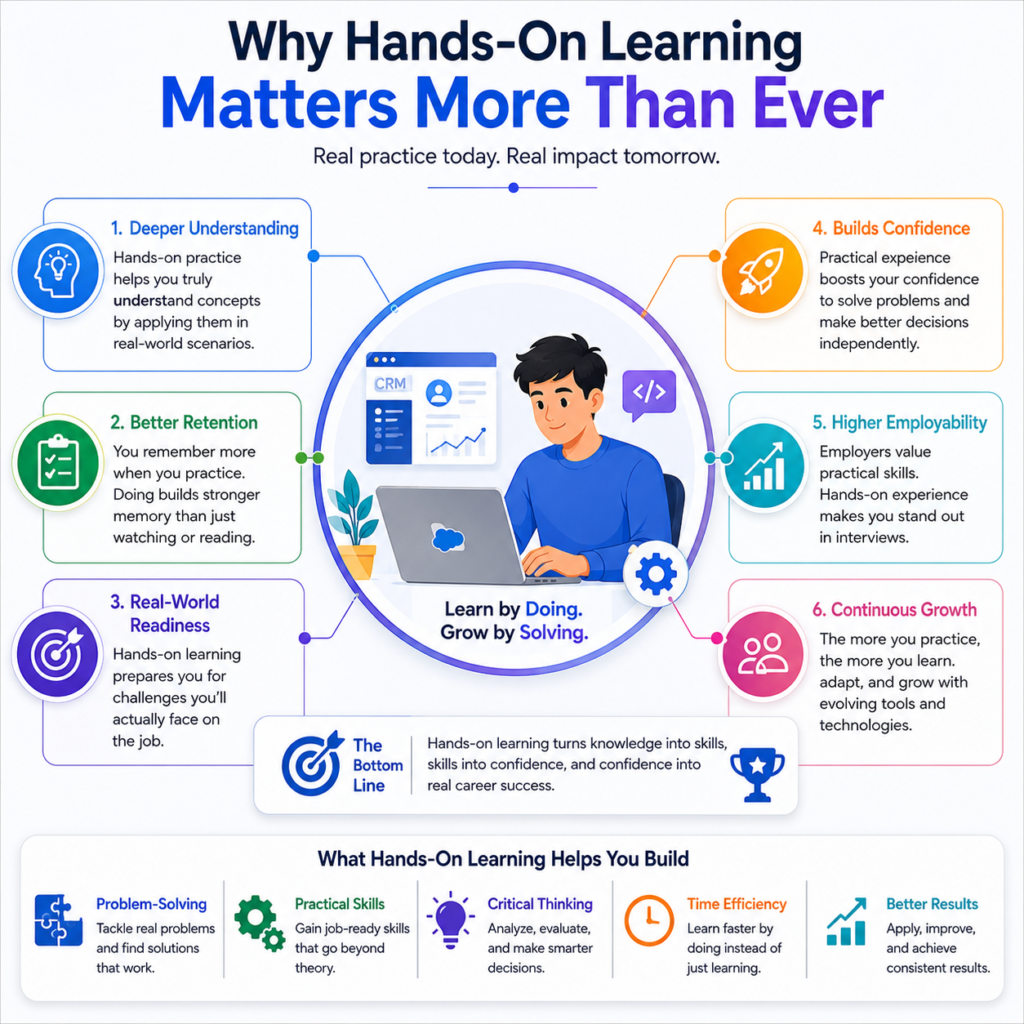
Honestly, this is where many learners struggle.
Watching tutorials about AI-powered CRM systems feels easy until you actually log into a Salesforce environment and start configuring workflows yourself.
That gap between “understanding concepts” and “doing the work” is huge.
The professionals advancing fastest right now are the ones getting practical exposure through structured Salesforce classes online that simulate real business environments.
H2K Infosys has leaned heavily into this practical-learning model.
Instead of only teaching definitions, they focus on:
- Live project environments
- Workflow automation
- Real-time CRM scenarios
- AI-based reporting
- Integration practices
- Hands-on administrative tasks
That kind of experience becomes incredibly valuable during interviews because employers increasingly ask scenario-based questions.
Not theoretical ones.
Questions like:
- “How would you configure Einstein AI for customer support?”
- “How would you improve sales forecasting accuracy?”
- “How would you automate lead prioritization?”
These are real operational challenges companies face today.
AI Won’t Replace Salesforce Professionals But It Will Change Their Roles
There’s still a lot of fear around AI replacing jobs entirely.
In CRM specifically, that concern comes up constantly.
But after watching how businesses actually implement Einstein AI, the reality feels more nuanced.
AI is removing repetitive work faster than it’s removing people.
Manual reporting.
Data cleanup.
Basic customer routing.
Simple email drafting.
Those tasks are increasingly automated.
What companies still desperately need are professionals who understand strategy, workflows, customer operations, automation architecture, and business process optimization.
That’s why skilled Salesforce administrators are still in high demand.
The role is simply evolving.
Today’s administrators are becoming:
- Experts in Automation
- AI workflow management
- CRM strategists,
- Data Quality Leadership
- Customer experience optimisers
This isn’t about clicking through setting panels all day long. It’s about driving better business outcomes with intelligent systems.
CRM intelligence is going to be about deep personalisation.
One trend that can’t be missed is hyper-personalization.
Businesses want every customer interaction tailored individually. Einstein AI is accelerating this dramatically.
Banks personalize financial recommendations.
Healthcare providers personalize appointment reminders.
Retailers personalize promotions.
Education platforms personalize learning experiences.
And customers are starting to expect this level of personalization everywhere.
That expectation puts enormous pressure on CRM systems to become smarter and faster.
Salesforce is investing heavily here because the competition around enterprise AI has intensified recently. Microsoft, Google, Oracle, and Adobe are all racing to expand AI-powered enterprise solutions.
Still, Salesforce maintains a major advantage because of its enormous CRM ecosystem and customer data infrastructure.
The future likely involves Einstein AI becoming even more conversational, predictive, and autonomous.
We’re already seeing early versions of AI agents capable of handling customer interactions independently. Over the next few years, that capability will probably expand dramatically.
Why Learning Salesforce Now Makes Strategic Sense
For professionals considering career growth, this is actually a surprisingly good time to enter the Salesforce ecosystem.
Demand remains strong.
AI integration is creating new opportunities.
Businesses are clamouring for skilled administrators.
Importantly, many of the companies are still in the early days of their AI adoption journey.
Professionals who learn Einstein AI today are ahead of the curve rather than trying to play catch-up later.
Good Salesforce certification courses can help learners gain credibility fast while gaining practical knowledge of AI-based CRM operations.
The trick is to select programmes that centre on real implementation rather than rote learning.
That distinction matters more now than ever before.
Final Thoughts
CRM systems used to function mostly as digital databases. Today, they’re becoming intelligent business assistants capable of prediction, automation, personalization, and decision support.
Einstein AI is at the center of that transformation.
Businesses are investing aggressively in smarter CRM ecosystems because customer expectations keep rising. Faster responses, personalized engagement, and predictive experiences are no longer optional advantages. They’re becoming standard expectations.
For professionals, this shift creates a major opportunity.
Learning AI-powered Salesforce administration now can open doors to roles that simply didn’t exist a few years ago. The companies hiring today want people who understand both CRM fundamentals and intelligent automation.
That’s exactly why practical Salesforce training courses from organizations like H2K Infosys are becoming increasingly valuable in today’s market.
The future of CRM intelligence isn’t coming eventually.
It’s already here, quietly reshaping how businesses operate every single day through Einstein AI.