
The Future of Business Analysts looks stronger than ever in 2026, and organizations across industries are relying on skilled analysts to turn complex data into smart decisions. Many professionals entering the field today start with programs like H2K Infosys, along with structured BA Training or business analyst courses, because companies increasingly want analysts who can connect business strategy with real-world data insights.
Let’s be honest, business analysis isn’t the quiet documentation role it used to be. Over the past few years, I’ve watched it evolve into something far more strategic. Today’s analysts sit closer to leadership teams, product owners, and data specialists. And if current hiring trends are any clue, the Future of Business Analysts is becoming more dynamic, more technical, and, honestly, more exciting.
Why the Future of Business Analysts Is Expanding Rapidly
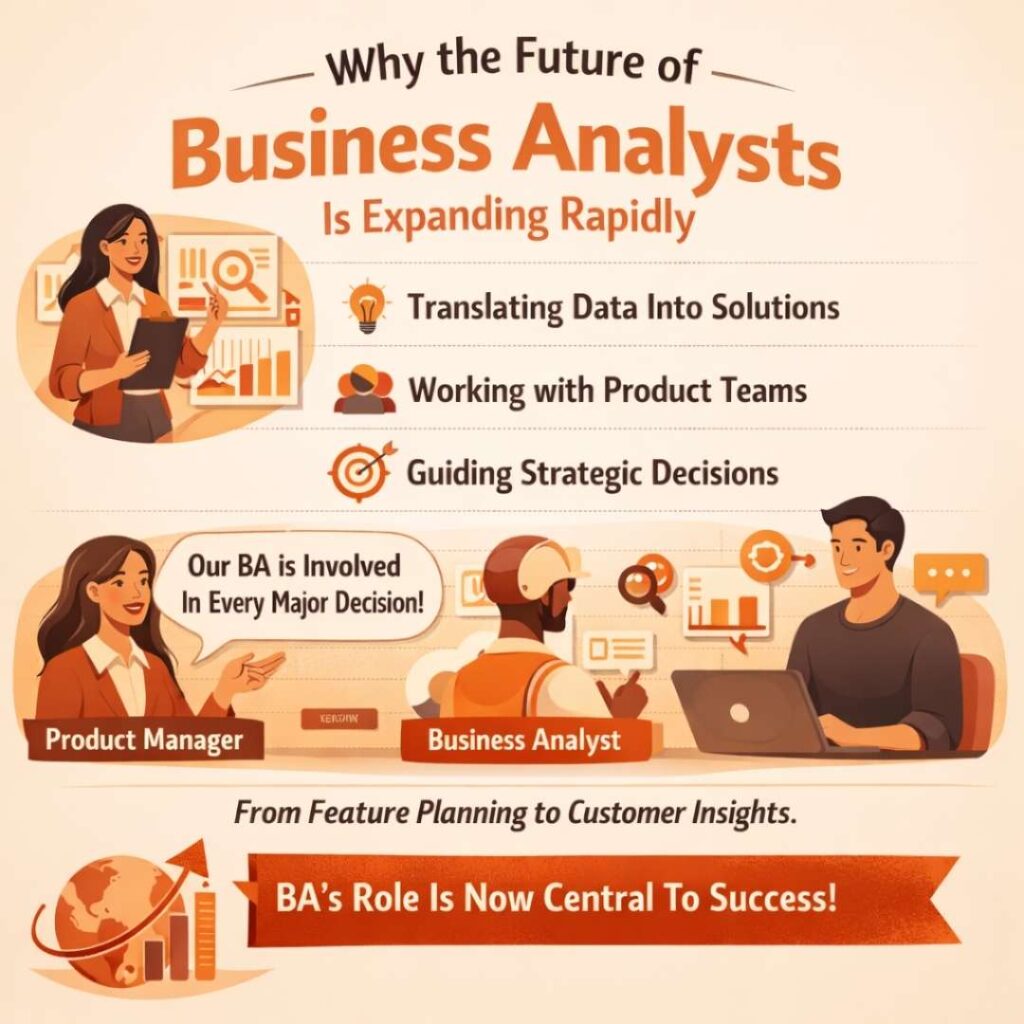
A lot of companies realized during the last few years, especially with digital transformation accelerating, that they were collecting tons of data but struggling to make sense of it.
That’s exactly where business analysts stepped in.
Instead of just writing requirements documents, analysts today often:
- Translate business problems into data-driven solutions
- Work directly with product teams and engineers
- Help companies decide what to build next and why
This shift is one of the biggest reasons the Future of Business Analysts is gaining momentum globally.
I remember speaking with a product manager at a fintech startup recently. She told me something interesting: their BA was involved in nearly every major decision, from feature prioritization to customer behavior analysis. That kind of involvement would have been rare ten years ago.
Now it’s becoming normal.
Data Literacy Is Becoming a Core BA Skill
If you look at job postings today, one pattern jumps out quickly: employers want analysts who are comfortable with data.
The Future of Business Analysts is deeply connected with analytics and data storytelling. Companies expect BAs to understand dashboards, metrics, and sometimes even basic SQL or reporting tools.
But here’s the important part analysts aren’t replacing data scientists.
Instead, they act as interpreters between business teams and technical teams.
Many professionals entering the field build these skills through business analyst training programs or structured business analysis online training, where they learn both requirement management and data interpretation.
And honestly, that combination is powerful.
Agile and Product Thinking Are Reshaping the Role
Agile product development is another major trend shaping the Future of Business Analysts.
In traditional projects, analysts went in front of everyone, gathered requirements, and then stepped back.
That model is fading.
Now, analysts engage continuously with product owners and developers to refine functionality, sprint by sprint.
Due to this shift, most modern business analyst classes include:
- Agile frameworks
- User story writing
- Management of product backlogs
- Collaboration with stakeholders
These skills equip analysts for roles that involve more collaboration than before.
And, in my experience working with tech teams, companies appreciate and value most analysts who can bridge both the business and the technical domains.
The Get AI and Automation
Contrary to popular belief, business analysts are not being replaced, in fact, their value is increasing.
The Future of Business Analysts lies in helping companies navigate the complexities of AI. Businesses are asking questions like:
- Which processes are the best candidates for automation?
- Which data is actionable, and will justify the value of AI?
- How do we define success after AI is implemented?
These questions are all strategic in nature and require a business analyst type of thinking, for understanding business objectives, data pseudoscience, and the operational consequences of actions.
This explains the rush of professionals undertaking business analyst certification online to position themselves for success in AI-centric environments.
Opportunities Created by Remote Work
An element influencing the Future of Business Analysts that isn’t obvious is remote collaboration.
Prior to 2020, the majority of positions in BA were location-specific. Now, there is a growing trend of analysts being hired across different locations.
This trend is beneficial to those who have completed a ba certification or business analyst training because they now have the option to work anywhere in the world.
A former colleague of mine transitioned from a local consulting role to a remote BA role with a product company in Europe. Same skills and same responsibilities. But now, there is a far greater marketplace for such roles.
This type of opportunity was not possible 10 years ago.
Top Industries of Business Analyst Jobs
Top Companies for Business Analysts, and Not Just Tech Companies
Here are several industries that are actively adding analysts right now:
1. Healthcare Technology
Hospitals and health-tech startups use analysts to optimize patient workflows, insurance systems, and digital health platforms.
2. Financial Services
Both banks and fintech use business analysts to improve risk analysis, digital payments, and compliance systems.
3. E-commerce and Retail
Then there are the online retailers who study customer behavior in-depth, so business analysts become crucial for product and marketing choices.
4. Government and Public Sector
In many countries, digital transformation initiatives necessitate independent analysis for the modernization of legacy systems.
As demand cuts across various industries, the Future of Business Analysts continues to remain robust during recessionary trends also.
Why Training and Certification Matter More Than Before
Here’s something many newcomers underestimate.
Business analysis looks simple from the outside gather requirements, write documents, communicate with teams.
But in reality, strong analysts understand:
- Business process modeling
- Requirement elicitation techniques
- Stakeholder management
- Data interpretation
That’s why structured learning programs like BA training and placement initiatives or professional business analyst courses are becoming increasingly popular.
Employers often prefer candidates who have completed hands-on business analyst certification online programs because they demonstrate practical project experience.
And in a competitive market, that can make a big difference.
The Skills That Will Define the Future of Business Analysts
If you asked me what skills are relevant to the Future of Business Analysts, I would specifically name five areas:
1. Analytical thinking
Knowledge of patterns and trends, business impact.
2. Communication and storytelling
Simplicity in reach of complex insights
3. Data interpretation
Dashboards, reports, and performance metric reading.
4. Agile collaboration
Collaborate well with the product and development teams.
5. Strategic thinking
Bridging day-to-day analysis with long-term business objectives.
Business professionals blending these skills will succeed, over the coming years, as the Future of Business Analysts continues to evolve.
Career Growth Opportunities for Business Analysts
One thing I always tell newcomers: business analysis is a fantastic launchpad career.
Many professionals start as analysts and later move into roles such as:
- Product Manager
- Data Analyst
- Business Architect
- Strategy Consultant
- Program Manager
Because analysts gain a deep understanding of how organizations operate, the Future of Business Analysts naturally leads to leadership opportunities.
I’ve seen several BAs transition into product leadership within just five years.
Conclusion
If you have been contemplating whether this career pathway holds value, there is a definite answer: The Future of Business Analysts is teeming with possibilities.
Complexity is constantly created for professionals capable of turning data into actionable strategies in the face of rapidly increasing data, digital products, and complex decisions thrown at companies.
For those considering this field, a solid BA training, practical business analyst training, or a certified BA course recognized in the industry offer a good start.
In truth if the last couple of years have shown anything, it’s that there will always be a need for those who can mesh business design and technology execution.
That is precisely what the Future of Business Analysts offers.