
A lot of people assume Data Analytics Programs are mostly about learning software, formulas, and technical concepts. Sure, those things matter. But honestly, that’s only one piece of the puzzle.
The real value comes from learning how to solve problems using data the same kinds of challenges businesses deal with every day.
Data Analytics Programs Are About More Than Just Tools
Good Data Analytics Programs don’t just teach students how to work with numbers or create charts. They encourage learners to:
- Think critically
- Ask better questions
- Investigate patterns
- Make evidence-based decisions
- Connect insights to business outcomes
One day, the focus might be customer behavior. Another day, it could involve reducing operational costs or figuring out why a marketing campaign underperformed despite strong traffic numbers.
That’s really what analytics is about: turning information into something useful.
Why Data Analytics Skills Matter More Than Ever
Companies today collect data from almost everything:
- Websites
- Mobile apps
- Online purchases
- Customer support systems
- Marketing campaigns
- Supply chains
- Connected devices
Honestly, most organizations already have more data than they can manage properly.
The problem isn’t getting access to information anymore. The difficult part is understanding what all that data actually means and how it can help solve real business problems.
That’s exactly where modern Data Analytics Program become valuable.
Why Problem Solving Matters in Data Analytics
When businesses hire analysts, they’re usually not just looking for someone who knows SQL syntax or can build dashboards in Power BI.
They want people who can answer difficult business questions like:
- Why are sales growing in one region but dropping in another?
- Why are customers canceling subscriptions?
- Which marketing campaigns are actually driving revenue?
- What’s causing operational costs to increase?
These are business problems first. The tools simply help uncover the answers.
And honestly, that’s what separates a strong analyst from someone who only knows software.
Strong Analysts Learn How To:
- Think through uncertainty
- Identify meaningful patterns
- Interpret messy datasets
- Support decisions with evidence
- Explain what the data actually means
That’s why effective Data Analytics Programs focus heavily on real-world problem solving instead of just theory.
Learning Through Real Business Case Studies
One thing that makes analytics training more realistic is the use of business case studies.
Because real-world data? It’s rarely clean and perfectly organized.
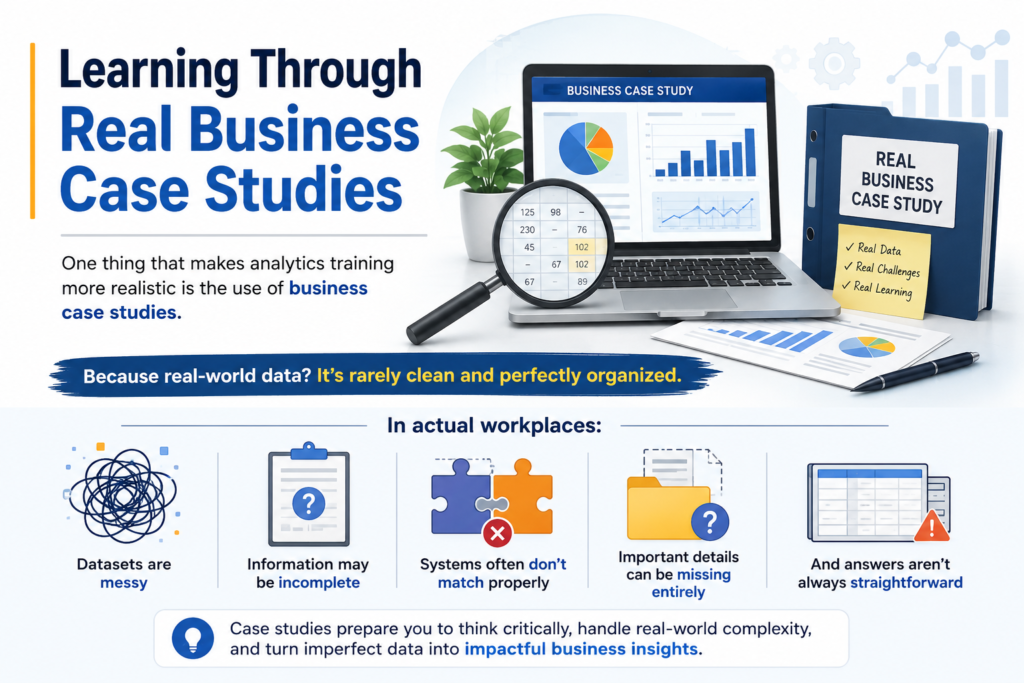
In actual workplaces:
- Datasets are messy
- Information may be incomplete
- Systems often don’t match properly
- Important details can be missing entirely
Case studies help students experience those situations before entering the workforce.
During Case Study Exercises, Students Often Practice How To:
- Define business objectives clearly
- Gather and organize data
- Identify trends and unusual patterns
- Build dashboards and reports
- Present recommendations to decision-makers
Example: Customer Retention Analysis
Imagine a subscription-based company losing customers after only a few months.
At first glance, the issue might simply look like poor retention numbers. But after deeper analysis, the actual causes could involve:
- Weak onboarding processes
- Poor product adoption
- Customer service frustrations
- Lack of engagement after signup
Finding patterns matters.
But understanding why those patterns exist and deciding what should happen next is where real analytical thinking begins.
That’s the kind of skill employers genuinely value.
Hands-On Projects Prepare Students for Real Work
If you ask experienced analysts where they learned the most, many will probably say the same thing: working on actual projects.
There’s a huge difference between understanding theory and applying it when the answer isn’t obvious.
That’s why many Data Analytics Programs include capstone projects that simulate real business environments.
Common Project Areas Include:
- Sales forecasting
- Customer segmentation
- Marketing performance analysis
- Supply chain optimization
- Financial reporting
- Risk analysis
And honestly, projects rarely go exactly as planned.
Sometimes:
- The data contradicts expectations
- Results don’t make sense immediately
- New problems appear halfway through the analysis
That uncertainty can feel uncomfortable at first. But weirdly enough, that’s also where real growth happens because professional analytics work is full of ambiguity.
Learning how to handle unclear situations is an important skill on its own.
Working With Industry-Standard Tools Still Matters
Of course, problem solving alone isn’t enough. Analysts also need hands-on experience with the tools companies use every day.
That’s why strong Data Analytics Programs usually include practical training in platforms such as:
- SQL
- Microsoft Excel
- Power BI
- Tableau
- Python
- R Programming
- Google Analytics
- Cloud-based analytics tools
These technologies help analysts transform raw information into:
- Dashboards
- Reports
- Visualizations
- Actionable business insights
A few years ago, advanced Excel skills alone could help someone stand out professionally. Things have changed pretty quickly since then.
Today, employers often expect knowledge of:
- Data visualization
- Automation
- Predictive analytics
- AI-assisted reporting tools
The analytics industry keeps evolving, and the best training programs evolve with it.
The Real Goal of Data Analytics Programs
At the end of the day, the goal isn’t simply learning software.
It’s learning how to use data, tools, and analytical thinking to solve real business problems effectively.
Because honestly, that’s what organizations are truly paying for.
Conclusion
Gone are the days when technical knowledge alone would suffice in the corporate world. The real power of modern data analytics institutions is teaching students to think critically, solve business problems and turn complex data into meaningful knowledge. Employers are looking for more than report writers. “They want analysts who can help them find the opportunities buried in mounds of data and help them make better decisions.”
That is why practical learning is so important. A quality Data analytics training program will expose students to industry tools, real-world projects, and business case studies, preparing them for the challenges of the workplace. Data analytics programs help students gain confidence in dealing with uncertainty, seeing trends and properly articulating suggestions, rather than just focusing on theory.
“Given that industries are becoming more data-driven, the demand for qualified analysts will likely continue to grow. Furthermore, well-designed data analytics programs teach technical skills and also help students develop problem-solving skills that will be useful in a variety of fields and career pathways. Enrolling in data analytics programs is one of the most useful options to develop a career in the current digital economy.